Korea and Japan · Volume 54, The Kingdom, the Battle and the Base
Umi Budo
Okinawa
Illustration
- Time
- 5 minutes
- Researched
- Researched from 85 sources in the brief
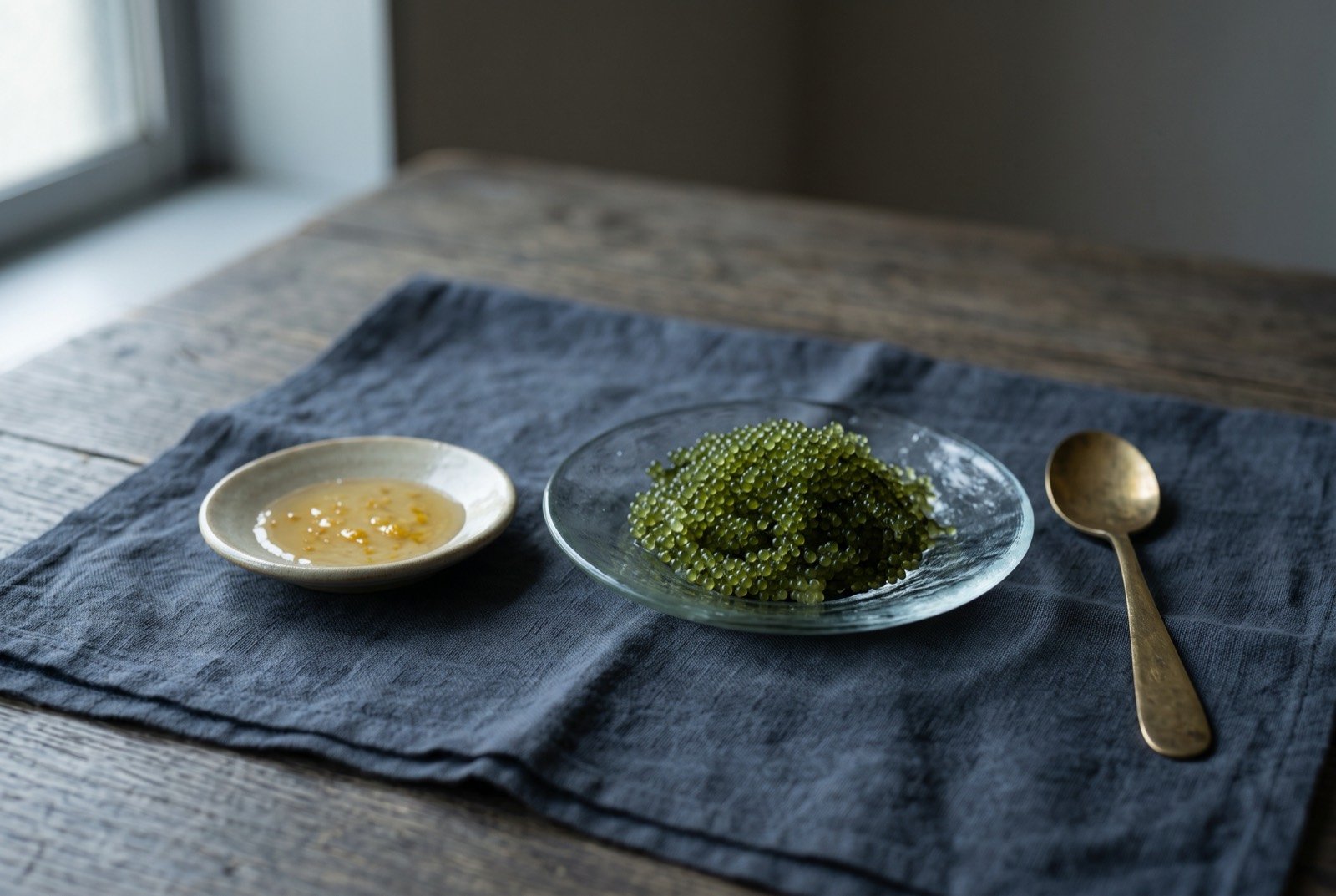
Umi budo, ンキャフ in the older dialect of its home region, was traditionally eaten only in Miyako before a 1989 cultivation breakthrough at Onna Village made it a prefecture-wide dish. This chapter treats it honestly as exactly that: a real older ingredient that only became everyday Okinawan food within living memory, not an ancient, continuously abundant one.
As tradition built it
Serves 4, as a small dish. 5 minutes.
Ingredients
- 200 g umi budo (sea grapes), fresh or from brine
- to taste shikuwasa juice, a squeeze
- to taste light soy sauce, a few drops
- to taste rice vinegar, a small splash
Method
- If the umi budo has been stored in brine, rinse briefly and very gently in cold or iced water, no more than a minute or two; oversoaking or handling it roughly deflates the small grape-like beads that give the ingredient its texture and name.
- Drain well.
- Mix the shikuwasa juice, soy sauce and rice vinegar in a small dish.
- Serve the umi budo simply, with the dressing alongside for dipping rather than poured over, since the salt and acid will soften the beads' texture if left standing in contact with them.
What a modern chef changes
A blended dressing given body from pork stock, served over a lightly set dashi gelée
Four named variables
Method
- The dressing is emulsified in the high-power blender with a small amount of the pork stock reserved from the soba recipe above, giving it a rounder body than a simple citrus and vinegar mix, while keeping the citrus and acid genuinely dominant.
- Shikuwasa is used at a two-to-one ratio of lime juice to a little yuzu zest, following the honest UK substitution this chapter's sourcing section recommends, rather than treating any single citrus as a perfect stand-in.
- The umi budo is served over a very lightly set dashi gelée, made with a minimal quantity of gelatine so the texture stays closer to a chilled sauce than a solid jelly, giving the dish a cool, savoury base rather than serving the seaweed on a bare plate.
- A final grating of dehydrated, powdered kombu is dusted over at the very end, adding a concentrated savoury note in place of any liquid seasoning, so the umi budo's own delicate pop is not weighed down.