The Horn · Volume 10, The Highland Ferment
Hilbet
Eritrea and Tigray, particularly Akkele Guzay and Agame
Illustration
- Time
- Hands on 2 hours 30 · Waiting 8 hours
- Researched
- Researched from 149 sources in the brief
- Reviewed
- Awaiting a reader from inside the tradition
- Cooked
- Awaiting a cook report
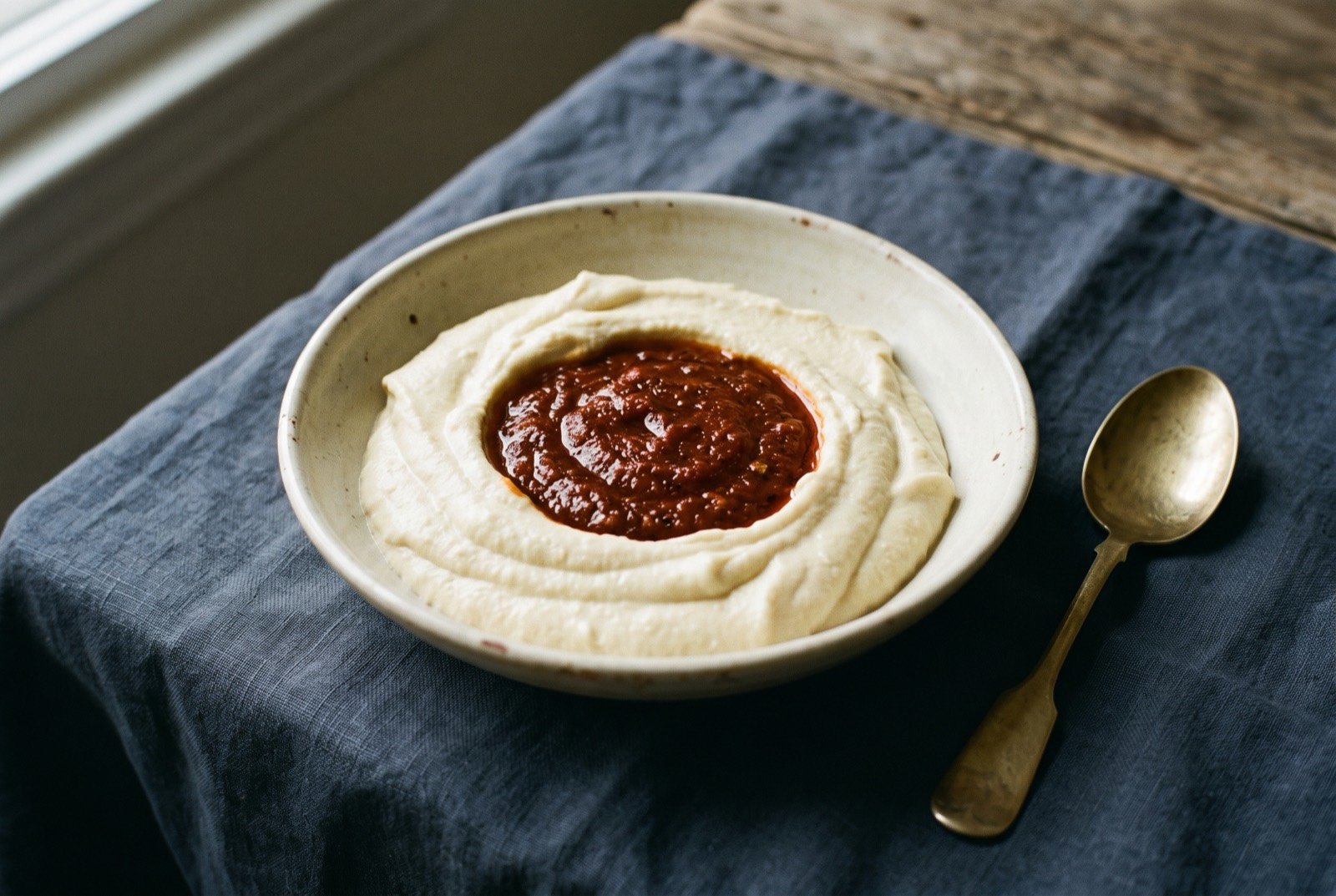
Fava beans, lentils and fenugreek, cooked and then whipped to a pale, aerated cream, served with a well of sils, the spiced tomato sauce, in the centre. The long soak plus the long cook plus the fat-free whipping is a bitterness management protocol, not an arbitrary sequence, because fenugreek's bitter principles are water-soluble. The whipping does a second job: it aerates a legume purée containing no gluten and no dairy, which is why a dish made almost entirely of fava beans eats light. There is no fat in the aeration at all, which makes it structurally unlike any European mousse.
As tradition built it
Serves 4. 2 hours 30, plus an overnight soak.
Ingredients
- 200 g dried fava beans, skinned
- 50 g brown lentils
- 1 tbsp fenugreek seeds
- 1.4 L water
- 240 ml sils, spiced tomato sauce
- to taste salt
Method
- Soak the dried fava beans, brown lentils and fenugreek seeds together for at least 8 hours, or overnight. Drain and rinse well. This soak is the first bitterness step and it is not optional.
- Cover with fresh water, bring to the boil, then simmer low about 2 hours until everything is completely soft.
- Drain, reserving the liquid, and blend or mash to a thick cream, adding cooking liquid back until it is just pourable.
- Salt, and serve warm with the sils poured into a well in the centre and a stuffed jalapeño alongside.
Notes
After Balè Moya, with a second Eritrean home practice noted.
The second, more technical route, from Eritrean home practice: chill the cooked paste overnight and whip it the following day until light and airy. That is what gives hilbet its signature texture. It is a community source rather than a published one, so it is offered as documented practice rather than as a standard.
What a modern chef changes
The bitterness measured rather than endured, and the aeration done properly
Rungs 3, 4 and 5
Method
- Toast the fenugreek before the soak, for under a minute, until it smells of maple rather than celery. Toasting converts some of the bitter principle and adds a caramel note; over-toasting makes it savagely bitter, so smell rather than watch.
- Chill overnight and whip cold, for 6 to 8 minutes. The mechanism is clear: cold legume paste has enough viscosity to hold air and warm paste does not. Look for a visible lightening and a doubling in volume.
- Build the sils as a reduction, not a sauce. Onion cooked dry, berbere bloomed one minute, tomato reduced hard, nothing else. Rungs 3 and 4 in miniature: the well is the plate's only concentrated flavour.
- Season the hilbet only after the sils is made. It is deliberately bland and cool, doing the job ayib does against berbere. Rung 5: seasoned on its own, it fights the sils instead of framing it.