Oceania and the Pacific · Volume 13
Tahiti, the Society Islands & the Cook Islands
One Reef, Two Flags
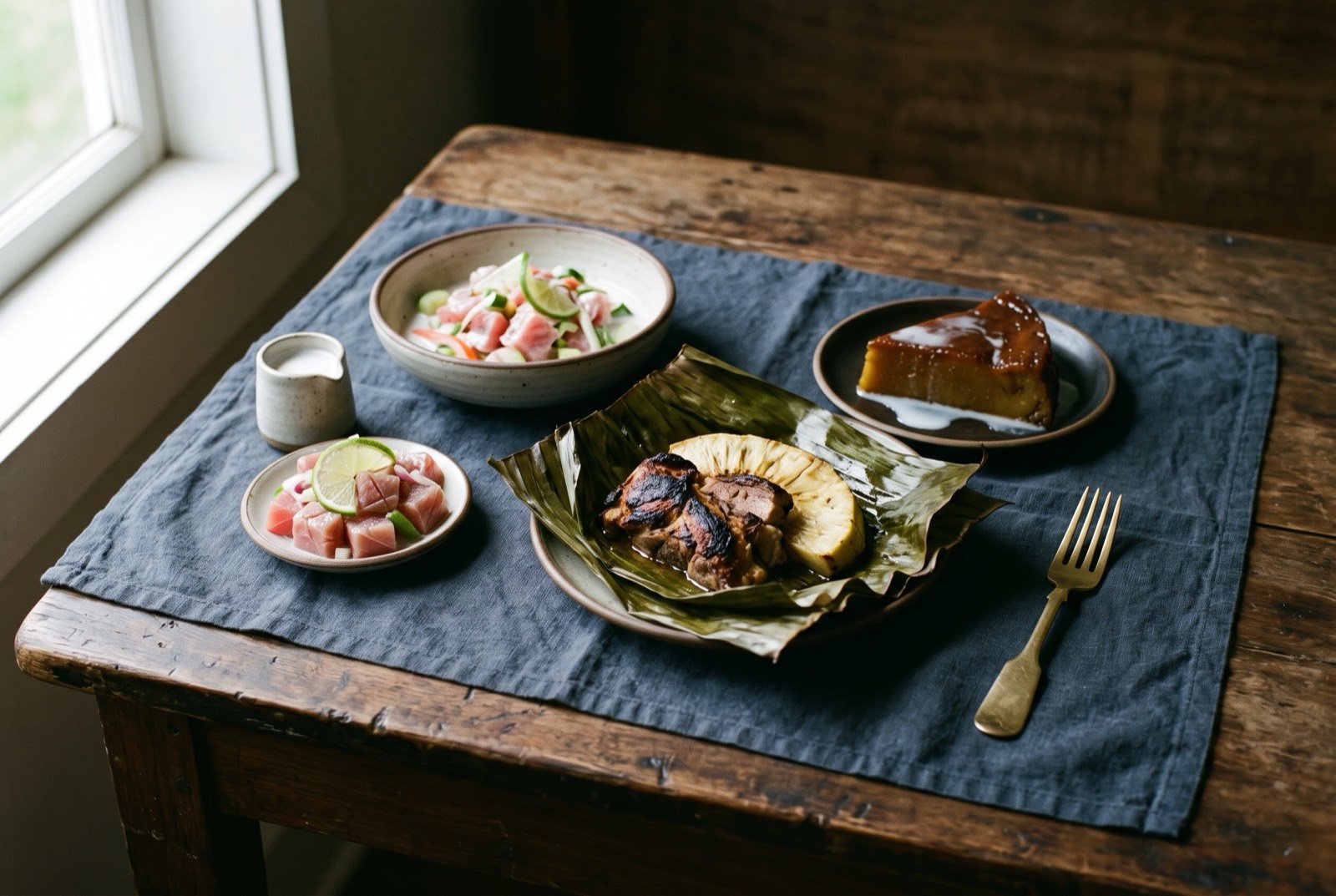
Two archipelagos paired for near-identical high-island ecology and a shared Eastern Polynesian ancestry, their single centrepiece dish, raw reef fish cured in citrus and coconut, carried under two different names by two peoples who inherited it from one voyaging culture and finished it two ways. What splits the volume is not ecology but flag: French administration in Tahiti, a British mission then New Zealand free association in the Cook Islands.
Sources and review · What this chapter does not assert · How we research · Spotted something wrong?
A Sense of Place
Say the pairing logic plainly, because it decides how the rest of this chapter is organised. The Society Islands (Tahiti, Moʻorea, and the Leeward group of Bora Bora, Raiatea, Taha'a and Huahine) and the southern Cook Islands (Rarotonga, Aitutaki, Mangaia, Atiu, Mauke, Mitiaro) are ecologically close to identical: high volcanic islands ringed by lagoon and barrier reef, a mountain interior growing taro and breadfruit, a reef and lagoon fishery supplying the protein, coconut supplying the fat. Wikipédia, Cuisine de Tahiti; FAO, One Country One Priority Product: Cook Islands The Marquesas break that pattern on the French Polynesian side: high volcanic islands without any fringing coral reef at all, semi-arid, with cultivation confined to the valleys, a geography that drove real historic emigration to Tahiti and produced its own distinct food technology, breadfruit fermentation in storage pits, discussed below. IRD/ORSTOM, Atlas de la Polynésie française The northern Cook Islands break the same pattern on the other side: true coral atolls, Manihiki, Penrhyn, Pukapuka, Rakahanga, Palmerston, Nassau, Suwarrow, with no permanent streams, where taro cannot grow without standing fresh water and the crop that fills its role instead is puraka, giant swamp taro, grown in pits dug down to the freshwater lens. Bishop Museum, Cook Islands Biodiversity
The peoples are Maʻohi Tahitian under French state administration, French Polynesia being a French overseas collectivity, and Cook Islands Māori, whose islands have been self-governing in free association with New Zealand since 4 August 1965 under the Cook Islands Constitution Act 1964, a specific constitutional status worth stating precisely rather than folding into a generic "former colony" label: the Cook Islands remains part of the Realm of New Zealand and shares its head of state, and Cook Islanders hold New Zealand citizenship and freedom of movement, but New Zealand has no authority to make or amend Cook Islands law. New Zealand Legislation, Cook Islands Constitution Act 1964; Congress.gov/CRS, "The Cook Islands and Niue: States in Free Association" Both islands groups also carry a diaspora layer that this chapter treats as fully in-tradition rather than a dilution. Tahiti's is Chinese: indentured Cantonese and Hakka labour arriving from 28 February 1865 to work the Tahiti Cotton and Coffee Plantation Company at Papara, with later waves through 1914, Chinese-Tahitians only granted French nationality in 1973, and Hakka descendants now around 12 per cent of Tahiti's population. Wikipédia, Hakkas; Outremers360 The Cook Islands' diaspora is a matter of raw scale: by the 2023 census there were 94,176 people identifying as Cook Islands Māori in New Zealand and roughly 28,000 in Australia, against 17,459 people counted in the Cook Islands itself in the 2016 census, meaning only 15 to 17 per cent of Cook Islands Māori people now live in the islands. South Auckland kitchens, church halls and island nights are, on that arithmetic, where most Cook Islands cooking actually happens today, and this chapter treats that cooking as a live branch of the tradition rather than a diminished copy of it.
| Tahiti and the Society Islands | The Cook Islands | |
|---|---|---|
| Starch | Taro, breadfruit (uru), feʻi (mountain plantain, endemic and cooked only), sweet potato | Taro (rukau leaf; taruā dryland; puraka atoll swamp taro), breadfruit (kuru), cassava (now the second most important national starch crop), kumara |
| Fat | Coconut, in every form | Coconut, in every form |
| Protein | Reef and pelagic fish (tuna, bonite, mahi mahi), pork | Reef fish, tuna, flying fish (maroro, netted at night), octopus (eke), pork and chicken for feast |
| Souring and dressing | Tahitian lime; coconut milk folded in at the last stage | Lime or lemon; coconut cream served as a rich accompaniment alongside, not folded in |
| Sauce or condiment layer | Miti, coconut milk or, traditionally, seawater | Mitiore and tai monomono, salted fermented coconut and shellfish liquor, seasoned before European contact with only turmeric (renga) and sea salt |
| Diaspora layer | Chinese-Tahitian: soy sauce, oyster sauce, cornstarch, Chinese greens, red beans | Cook Islands Māori diaspora in Auckland, the demographic majority of the culture |
A word on language and searching, stated honestly. The Tahiti and Society Islands research for this chapter was conducted in French, with Tahitian terms sought directly (ahimaʻa, fāfaru, poʻe, feʻi), and turned up a genuine French-language institutional record, IRD, the Direction des Ressources Marines, Fare Vānaʻa, alongside a scatter of French-language home-cook recipe sites of uncertain authorial standing. No Tahitian-language-only source, as opposed to French-language sources carrying Tahitian vocabulary, was reached. The Cook Islands research was conducted using genuine Cook Islands Māori terms (ika mata, umukai, rukau, poke, mitiore) rather than English queries with one local word inserted, and this is what surfaced this chapter's single strongest source, a named Rarotonga home cook. Two of the right sources for this half of the volume, Cook Islands News and the Cook Islands Ministry of Cultural Development's own site, could not be reached in this research pass, one blocked, one broken by a certificate error, and that gap is real rather than a search failure to be papered over.
The History in Layers
Shared Eastern Polynesian voyaging, and a real ancestral line to Aotearoa
Convergent archaeological, genetic and linguistic evidence places Polynesian voyagers settling the Cook Islands from the direction of the Society Islands in roughly the mid-first millennium CE, with the Cook Islands and the Society Islands together serving as the launch point for the settlement of Aotearoa around 1250 to 1350 CE. This is the direct ancestral thread connecting this volume to the atlas's own OC-03 (Aotearoa), not yet written but already flagged in this atlas's Oceania map as sharing the same voyaging root, the same staple crop tradition and the same earth-oven technology. Cook Islands Library and Museum Society, "Unveiling the Culinary Legacies of the Cooking Islands through Archaeology," 11 December 2024 The same Society describes the umu's introduction "by the ancestors as a sacred cooking method" as likely mythological framing rather than an archaeologically dated claim, a distinction worth keeping rather than smoothing into settled fact.
European contact in Tahiti, and what is not known about it
Wallis reached Matavai Bay in 1767, Bougainville landed at Hitiaa in April 1768, his account helping seed the European "earthly paradise" image of Tahiti, and Cook arrived at Matavai Bay in April 1769 to observe the transit of Venus. No primary voyage-journal detail on what any of the three recorded eating, or observed being eaten, was reached in researching this chapter, and this chapter does not infer specifics from the general historical framing available. Britannica, Pomare II
The London Missionary Society, and the thread that runs from Tahiti to the Cook Islands
Christianity's arrival is the one piece of history genuinely shared by both halves of this volume, and it travelled from one to the other. The LMS landed in Tahiti in 1797; chief Pomare II converted around 1812 to 1815, defeated rival chiefs in November 1815 and destroyed the war god ʻOro's idol, after which most of the Society Islands adopted Christianity within about five years. Pomare also sought to monopolise the pork trade with New South Wales, evidence that pork was already a commodified, exportable good under early colonial contact rather than a purely ritual food. [Britannica, Pomare II] LMS missionaries then carried that conversion onward, accompanied by Tahitian converts: the Tahitian evangelist Papeiha, trained under John Williams, was central to the conversion of Aitutaki in 1821 and Rarotonga in 1823. Missionaries, working with the ariki, imposed strict "Blue Laws" restricting night gatherings and belief, and suppressed tattooing; kava drinking was virtually eliminated. Sunday worship became the organising axis of communal celebration, the direct root of the umukai-as-Sunday-feast pattern that persists in the Cook Islands today, and of the ahimaʻa-as-Sunday-feast pattern that persists in Tahiti. SOAS Library Special Collections blog, "Cook Islander missionaries," 2 October 2020
Two colonial paths, genuinely diverging from the same missionary starting point
France's administration of Tahiti deepened through the nineteenth century into full colonial rule and, later, an overseas collectivity of the French Republic. The Cook Islands took a different route entirely: a British protectorate from 1888, annexed by New Zealand in 1901, administered from Wellington through the twentieth century until the 1965 self-government settlement described above. These dates rest on general historical record rather than a primary New Zealand government source independently reached in this research pass, Te Ara and NZ History both returning access errors on the day; a follow-up check against those two sources would strengthen a future edition of this chapter.
Chinese indenture, a Tahitian thread with no Cook Islands equivalent
Covered above under A Sense of Place: indentured Cantonese and Hakka labour from 1865, a community that only received French nationality in 1973, and whose food, soy sauce, oyster sauce, red beans, glass and egg noodles, has become as thoroughly naturalised into Tahitian cooking as the Vietnamese and Javanese threads this atlas's OC-06 documents for New Caledonia. No comparable nineteenth or twentieth century indentured-labour migration into the Cook Islands was found in researching this chapter.
The CEP nuclear-testing economy, and the clearest documented cause of dietary change in this volume
The single strongest documentary find in this chapter, from an ORSTOM/IRD institutional source. France's Centre d'Expérimentation du Pacifique arrived in French Polynesia in 1963, its main test sites the atolls of Moruroa and Fangataufa, and by 1965 an estimated 85 per cent of agricultural workers had left rural districts for CEP-related work. Public spending reached 98 per cent of GDP in 1966. Imports grew at more than 20 per cent a year, and a 1970 INSEE report notes that even in years without nuclear tests, when equipment spending fell by half, spending on food products barely declined, evidence that imported food had become structurally embedded rather than discretionary. Copra sales fell from 25,000 to 16,000 tonnes within three years of the CEP's arrival; vanilla production fell by three quarters and prices did not recover to 1959 levels until 1970. The primary sector's share of GDP fell from 39 per cent to 7 per cent between 1960 and 1970 while the tertiary sector rose from 46 per cent to 80 per cent, the document itself naming this the shift from an "économie de comptoir," a trading-post economy built on a handful of export staples, to an "économie de consommation et de services" funded by metropolitan French public money. IRD/ORSTOM, CEP economic document This economic shift is linked at a general level, though without primary epidemiological figures reached in this pass, to rising obesity and diabetes in French Polynesia today. Reporterre
The modern diaspora economy, the Cook Islands' own version of the same present-tense tension
As above: a transnational food culture in which most Cook Islands Māori people live outside the Cook Islands, an economy substantially run on remittances and New Zealand aid alongside tourism. The structural parallel to Tahiti's CEP-era shift is real, both economies now depend heavily on money and food arriving from outside the islands rather than from the islands' own gardens and reefs, even though the specific historical mechanism, nuclear testing spending against diaspora remittance, is entirely different, and this chapter treats them as parallel rather than equivalent.
The Flavour Arsenal
Starches
Taro. The shared staple across both halves of the volume, though the two traditions prefer it differently prepared. In Tahiti it is grown in flooded beds or upland, contains oxalic acid requiring proper cooking, and is central to what the French Wikipedia's own sourced article calls ancestral culture. Tahiti Heritage In the Cook Islands, more than 20 varieties are grown across all 12 inhabited islands, roughly 99 acres under cultivation as of 2021 producing about 131,400kg, and wetland-grown taro is explicitly preferred by Cook Islanders over dryland taro for its sticky texture and darker flesh. [FAO OCOP: Cook Islands] Rukau, the leaf, is described by a named Rarotonga cook as the highest in iron of the greens in regular use. [www.ck/food/0510.htm]
Breadfruit. Uru in Tahitian, kuru in Cook Islands Māori, mei in Marquesan, the long-standing carbohydrate backbone of the whole volume, eaten fresh cooked or fermented for preservation, discussed at length below.
Feʻi, the mountain plantain, Musa troglodytarum, an endemic Polynesian and Melanesian banana whose bunch points upward rather than down, grown at 400 to 1,200m and, unlike a common banana, almost always eaten cooked. Historically a marker of prestige and used to demarcate land. This is a genuinely Tahitian and Society Islands ingredient with no equivalent found in the Cook Islands research for this chapter. Tahiti Heritage, Feʻi
Cassava (maniota), an introduced crop now the second most important starch crop nationally in the Cook Islands per the FAO, used interchangeably with taro and breadfruit as a starchy accompaniment.
Fat
Coconut, in every form, cream, milk, water and grated flesh, the binding fat and sauce base of nearly every savoury dish across both halves of the volume.
The distinctive Tahitian trio: mapé, noni and vanilla
Mapé, the Tahitian chestnut, Inocarpus fagifer, boiled and eaten hot as a snack, tasting of hot chestnuts, also made into a coconut-milk pudding, poʻe māpē, or a chestnut bread, faraoa māpē; excess consumption is locally reputed to cause flatulence. Wikipédia, Châtaignier tahitien
Noni, Morinda citrifolia, an original Polynesian canoe plant, its fruit traditionally fermented for juice and used in curries, rice dishes and sauces, its leaves used in traditional medicine.
Tahitian vanilla, Vanilla × tahitensis, introduced to Tahiti in 1848 by Admiral Hamelin from the Philippines, then crossed under cultivation into a natural polyploid hybrid of V. planifolia and V. odorata, with a rounder, caramel-and-aniseed profile against Bourbon vanilla's sharper one. Taha'a, "l'île vanille," produces roughly 80 per cent of French Polynesia's vanilla today. Production peaked at over 200 tonnes a year before the 1960s but had fallen to 30 to 40 tonnes a year more recently, the same CEP-era collapse documented above, making it now a genuine luxury crop at roughly 0.3 per cent of world production. Planet-Vie, ENS
Fish, and one ingredient shared with a different volume under a third name
Reef and pelagic fish carry the protein load on both sides: tuna, bonite, mahi mahi, carangue and swordfish on the Tahitian side, reef fish, tuna and, distinctively, flying fish, maroro, netted at night and traditionally used whole, skin and central bone left intact, on the Cook Islands side. [www.ck/food/0110.htm] Rori, sea cucumber, is eaten on both sides, most heavily by the Australs islanders on the French Polynesian side, and as matu rori in the Cook Islands. Rori is one home to this volume; kokoda, this atlas's OC-07 (Fiji), documents the same wider Pacific family of citrus-cured raw reef fish under a third name again, worth naming here rather than treating as coincidence: poisson cru, ika mata and kokoda are three names for one continuous Pacific technique, not three separate inventions.
Cook Islands' pre-contact seasoning tradition
Mitiore and its family. A distinct, well-documented Cook Islands fermented condiment tradition: moina tai, hand-pressed salted coconut cream; a thinner light coconut sauce made with coconut water; tai monomono, salted fermented young-coconut chips left days to weeks; tai oporo, a chilli-infused fermented sauce topped up daily; and mitiore itself, a fermented coconut and pounded-crab liquor. All are attributed to one named Rarotonga cook, whose own note states plainly that before European contact introduced onions and most spices, only turmeric (renga) and sea salt were used to season food, a strong, specific claim worth carrying forward with that attribution rather than as a vague generalisation. [www.ck/food/0108.htm and 0112.htm]
The Chinese-Tahitian pantry
Soy sauce, oyster sauce, cornstarch, Chinese cabbage (pota), dried red kidney beans, rice vermicelli and macaroni, all documented via the māʻa tinitō and mie sautée dishes below, customarily sourced from Papeete's central municipal market, founded 1847.
The Technique Ladder
Rung 1. The earth oven as engineered thermal mass, timed to the dish it serves
Ahimaʻa in Tahiti and umukai in the Cook Islands are the same underlying technology this atlas has already documented in OC-05 and OC-06: a pit lined with wood and volcanic stone, the fire burned down until the stones glow, food laid over them wrapped in banana leaf, sealed under more leaf and earth or sand to trap steam heat. Reported timings vary and are not resolved here rather than forced to agree: 4 to 6 hours for a full Tahitian ahimaʻa, around 3 hours for a Cook Islands umukai, both consistently tied to the Sunday feast rather than an everyday meal. [EDT ENGIE blog; www.ck food pages, indirectly sourced]
Rung 2. Citrus curing as a timed acid reaction, not a fixed recipe
The volume's flagship technique, and the one this chapter is most careful not to overstate. Working from what each tradition's own recipes actually specify: Tahitian poisson cru appears to use a short cure, reported as anywhere from one to twenty minutes depending on desired doneness, with thin coconut milk folded directly into the fish just before serving, closer in structure to a single composed salad. Cook Islands ika mata appears to use a longer cure, "a couple of hours minimum," with rich coconut cream served as a separate accompaniment alongside cooked root vegetables rather than folded into the fish itself, closer in structure to a feast plate. [Cross-referencing recettestahitiennes.com and lacerisesurlemaillot.fr against www.ck/food/0110.htm] This is offered as a working hypothesis built from the two traditions' own recipe sources, not as settled ethnography verified against a systematic comparison, and a reader should treat the distinction as real but not rigid: individual households on both sides vary.
Rung 3. Fermentation as both preservation and deliberate flavour, three distinct traditions in one volume
Three genuinely separate fermentation technologies sit inside this one chapter, worth telling apart rather than collapsing into one generic "Pacific ferment." Tahitian fāfaru steeps fish in a two-day fermented shrimp brine for hours, building pungency deliberately. Marquesan popoi packs breadfruit into leaf-lined pits for lactic fermentation lasting years, a famine-insurance technology rather than a flavour one. Cook Islands mitiore ferments coconut and shellfish liquor over six to eight hours into a savoury seasoning base. All three are detailed in the Ferment Bench below.
Rung 4. Pounding and grating to a controlled starch texture
Kaʻaku, poʻe and Cook Islands poke all depend on working a cooked starch, breadfruit or banana, to a specific smooth or wobbly consistency by hand, traditionally with a wooden pestle in a wooden bowl. This is mechanical starch work with a real, learnable technique behind it, not a rustic approximation of a blender's job.
Rung 5. Coconut cream as a sauce system with two distinct temperature stages
Cold-folded, as in poisson cru's final coconut milk addition, and hot-poured, as in poʻe's traditional second pour of stone-heated coconut milk over the finished pudding, a technique this atlas has already documented for Vanuatu's nalot in OC-06. Knowing which stage a dish calls for, and why, is the difference between a flat sauce and a dish that reads as properly finished.
The Ferment and Preserve Bench
Fāfaru (Tahiti). A brine, miti fāfaru, is made by soaking a handful of shrimp in a jar of seawater for two days, then filtering. Fish fillets, traditionally reef fish such as parrotfish, mara or marara, or a pelagic fish like tuna, are steeped in this fermented brine for 3 hours, sometimes up to 8 or more, depending on the pungency desired. The result carries a famously strong smell to the uninitiated but a sweetish, slightly sharp flavour, traditionally served with mitihue, a fermented coconut milk sauce, taro and sweet potato. [750g.com; Wikipédia, Fāfaru]
Popoi and the ua ma pits (Marquesas). Ripe breadfruit, mei, is peeled, piled for a few days, then cut and packed into a pit lined with cordyline leaf and covered with stone; lactic fermentation, pupuhi, preserves the resulting paste, sometimes for several years, in what are called ua ma silos, a genuine famine-insurance technology given the Marquesas' aridity and lack of reef. No precise fermentation-duration figure in days was found for this stage specifically, and this chapter does not invent one. [oceanien.over-blog.fr; destinationmarquises.com]
Mitiore (Cook Islands). Coconut and pounded crab liquor ferment together for six to eight hours on a warm day before shellfish are added, with a further standing period after that; the finished dish keeps three weeks or longer in storage. [www.ck/food/0108.htm]
Sourcing in Britain
The honest headline, stated once rather than repeated ingredient by ingredient: no dedicated Tahitian, Society Islands or Cook Islands grocer exists anywhere in the UK, so far as this chapter's research could find. This atlas's OC-06 recorded the entire 2021 England and Wales census "Pacific Islander" grouping, Melanesia, Micronesia and Polynesia combined, at 12,395 people, under 0.1 per cent of the population, with no breakdown by nation; French Polynesia and the Cook Islands sit somewhere inside that single, tiny, undifferentiated figure. Sourcing for this volume is necessarily improvised from Caribbean, South and Southeast Asian, and specialist fishmonger retail, not from any shop run by or for this specific diaspora.
Fresh sashimi-grade tuna, correctly frozen, is the single highest-leverage purchase in this whole volume. The Fish Society (thefishsociety.co.uk) sells yellowfin tuna loin specifically graded sashimi, and bluefin tuna, with a stated freezing protocol and next-day UK delivery. Any fish intended for raw service, whether poisson cru or ika mata, must be frozen to the UK's own legal standard, minus 20°C for at least 24 hours or minus 35°C for at least 15, under retained EU Regulation (EC) No 853/2004; this is a food safety floor, not a suggestion. Genuine Pacific reef species are not sold in the UK at all; the realistic substitute is a UK-landed firm white fish, red mullet in season being the closest match, sourced from The Cornish Fishmonger or The Devon Fishmonger, stated here plainly as a substitution rather than an equivalence.
Tahitian vanilla is the one genuine bright spot in this volume's sourcing. LittlePod, the Natural Vanilla Store UK, Spice Mountain and MSK Ingredients all stock real Vanilla × tahitensis pods by name, not generic vanilla, and Nielsen-Massey sells a Tahitian extract. It is noticeably more floral and anisic than the Madagascar bourbon vanilla in every supermarket, and commands a real premium, worth checking at time of buying rather than quoting a fixed figure here.
Taro leaf is sold fresh, distinct from the amaranth greens UK retailers often also call "callaloo," by AfroBox and by Alli Bhavan under its Colocasia (taro) patra name; most UK sellers stock it tinned rather than fresh, worth checking on order. It must be cooked thoroughly, not lightly blanched: raw taro leaf carries calcium oxalate crystals causing real oral and airway irritation, and there is a documented case report of poisoning from under-cooked taro leaf reaching a specialty supermarket chain. Breadfruit is the best-stocked ingredient in the whole volume, fresh through AfroBox, Exotic Fruits UK and Fresh & Exotic, tinned Jamaican through Niyis, a real echo of the Bounty and Bligh, Kew-sponsored transplantation voyages of the 1790s that moved breadfruit into the Caribbean in the first place; the fresh and tinned forms are genuinely different products for a dish like kaʻaku, and this chapter says so rather than treating them as interchangeable. Coconut cream and milk are fully mainstream UK stock, though Aroy-D, the Thai brand stocked by Thai Food Online, World Food Shop and others, an aseptic carton with no gums or stabilisers, is a real, tastable step up from diluted supermarket own-label in dishes this dependent on coconut as a primary flavour rather than a background note. Banana leaves for wrapping are well stocked, fresh and frozen, through Alli Bhavan, Long Dan and Oriental Mart, no caveat needed.
Feʻi, the mountain plantain, is almost certainly unobtainable fresh in the UK, fitting its history as a crop that never developed as an export good; a ripe but firm ordinary plantain is the closest realistic substitute in texture and cooking behaviour, though it will lack Feʻi's characteristic orange colour and beta-carotene sweetness, and any dish leaning on that specific character is being approximated, not reproduced. The nearest thing to a Pacific Islander shop found anywhere in the UK is Fiji Store UK, based in Goole; its linked online shop could not be loaded to confirm current stock in this research pass, and no shop of any kind specific to French Polynesia or the Cook Islands was found. Building an ahimaʻa or umukai at home on a Big Green Egg, or in a genuine dug pit with heated stones, is this chapter's own adaptation of the documented technique rather than a method drawn from any published UK source, and is presented as such rather than dressed up as verified guidance.
Voices and Sources
From inside the tradition
- Mereana Hutchinson, Rarotonga, the single strongest source in this whole chapter: a named Cook Islands home cook whose recipes and cultural notes, ika mata, rukau, poke, tiopu kuru, mitiore, the traditional sauces, are hosted at www.ck, copyrighted in her own name since 2001.
- Teheiura Teahui, Tahiti-born, raised on Taha'a in the Society Islands, professionally trained in Sète, France; author of Aventure culinaire (Éditions Au Vent des Îles, 2014), 40 recipes and a reo Māʻohi glossary, and proprietor of Le Manatoa, a Polynesian food truck touring mainland France.
- Lisa Mairai-Bellais, host of the "Cuisine de Tahiti" programme on Polynésie Première, the local public broadcaster, and author of two further cookbooks with the same Tahiti-based publisher.
- Taiora Matenga-Smith, author of the Cook Islands cook book (Institute of Pacific Studies, University of the South Pacific, with the Cook Islands Ministries of Agriculture and Health), recipes printed in both English and Cook Islands Māori. Confirmed only via bookseller listings in this research pass, not read directly, and worth sourcing physically before a future edition of this chapter leans on it further.
- Robert Oliver, with academic co-author Tracy Berno, Meʻa Kai: The Food and Flavours of the South Pacific (2010), winner of Best Cookbook in the World at that year's Gourmand World Cookbook Awards, drawing on fieldwork across the South Pacific including named Cook Islands and Tahitian cooks. Oliver is a New Zealand chef raised in Fiji and Samoa, not himself Tahitian or Cook Islands Māori, so this counts as a serious, fieldwork-grounded regional source rather than a fully in-tradition one, and is named as such.
- Chef Kemen Reddy and Chef Arana Edwards, Rarotonga, and the Cook Islands Chefs Association, evidence of a real, organised, internationally engaged professional chef culture on Rarotonga, even where this chapter could not find a named chef reworking ahimaʻa or umukai technique itself, as distinct from plating the resulting dish, anywhere in either half of this volume.
The researchers and institutions
- IRD/ORSTOM, whose institutional documents on the CEP-era economy and the Atlas de la Polynésie française are the strongest single sources in the Tahiti half of this chapter.
- Direction des Ressources Marines, the French Polynesian government fisheries authority, the strongest primary source on rori.
- Fare Vānaʻa (Académie tahitienne), the official authority on Tahitian orthography, the source for this chapter's glottal-stop diacritics.
- FAO's One Country One Priority Product programme and the Bishop Museum's Cook Islands Biodiversity database, the strongest institutional sources on Cook Islands agriculture.
- The SOAS Library Special Collections, the source for the LMS missionary thread connecting Tahiti to the Cook Islands.
The gap, named plainly
No Marquesan-based, as opposed to Tahiti or Society Islands-based, food writer publishing in French was found anywhere in this research. No restaurant in the UK, of any kind, dedicated to French Polynesian or Cook Islands cuisine specifically was found; the only UK venues surfaced by search were generic "Polynesian" or "Hawaiian" tiki-branded bars with no documented link to either tradition. No named chef anywhere, in Tahiti, the Cook Islands, or either diaspora, was found reworking ahimaʻa, umukai, popoʻi or poʻe technique itself at restaurant scale, as distinct from serving the finished traditional dish; every source describing modernist or fine-dining treatment of this volume's food describes French haute-cuisine technique applied by French chefs to a Tahitian dish, plated poisson cru rather than reinvented ahimaʻa. This is stated as a genuine, confirmed finding rather than a search failure, and it should be read alongside this atlas's OC-06, where the same gap was found and named for the Solomon Islands and Vanuatu: this remains one of the least professionally documented food regions in the whole atlas.
Things this chapter has deliberately not asserted
- A single, precise ratio for poisson cru's lime-to-coconut-milk balance or marinating time. Sources genuinely disagree, from one to twenty minutes and across two different quantity ratios, and this chapter reports the spread rather than inventing a canonical figure.
- A single standard duration for ahimaʻa cooking. Sources give 4 to 6 hours for the full pit oven and around 2h30 for a simplified stovetop version, not reconciled here.
- The ika mata versus poisson cru cure-length and coconut-application comparison as settled ethnography. It is offered as a working hypothesis built from each tradition's own recipe sources, not a systematic comparative study.
- That rukau and fafa share a documented ethnographic kinship. No source found makes this comparison explicitly; it is this chapter's own observation, stated as such.
- That coconut bread is a genuine Cook Islands dish. The most-repeated Pacific coconut bread recipe, fa'apapa, is consistently identified in the sources found as specifically Samoan, and no credible Cook Islands-specific coconut bread tradition was located.
- Any pork taboo specifically tied to Pomare II's conversion to Christianity. The only verified pork-related fact from that era is his commercial pork trade with New South Wales, a different claim.
- Any first-hand account of what Cook, Wallis or Bougainville specifically recorded eating, or observed being eaten, in Tahiti between 1767 and 1769. Primary voyage-journal text was not reached in this research.
- The "chow mein sandwich," casse-croûte chowmen, as an established, named Tahitian street-food tradition with real depth. Every source describing it by that specific name is English-language travel writing rather than French Polynesian press; the underlying components, baguette culture and Chinese-Tahitian cooking, are solidly documented separately.
- Any documented historical, colonial-era French pâtisserie tradition specifically in Papeete's cafés. Only modern commercial bakery evidence was found.
- That any restaurant in Tahiti or French Polynesia holds a Michelin star, or is confirmed to be "aiming for" one. The Michelin Guide does not currently cover French Polynesia.
- That Kai Pasifika, Auckland, is Cook Islands-run. Its documented head chef is Fijian.
- A single, precisely sourced staging of the Takurua feast in Auckland. Two accounts name different chef pairings for what may be the same, an earlier, or a related event, and this is not resolved here.
- The 20,000-to-2,000 Marquesan population collapse figure, attributed to Victor Segalen's documentation, carried at moderate confidence only, via secondary summary rather than a primary demographic record independently reached.
- The precise 1888 and 1901 dates for Cook Islands British protectorate status and New Zealand annexation, carried at general-recall confidence pending a direct check against Te Ara or NZ History, both inaccessible in this research pass.
- That any UK supplier stocks a banana variety meaningfully matching Feʻi in colour or flavour, or that any UK Pacific-branded shop beyond Fiji Store UK exists at all.
The earth oven as engineered thermal mass, timed to the dish it serves
Ahimaʻa in Tahiti and umukai in the Cook Islands are the same underlying technology this atlas has already documented in OC-05 and OC-06: a pit lined with wood...
Citrus curing as a timed acid reaction, not a fixed recipe
The volume's flagship technique, and the one this chapter is most careful not to overstate.
Fermentation as both preservation and deliberate flavour, three distinct traditions in one volume
Three genuinely separate fermentation technologies sit inside this one chapter, worth telling apart rather than collapsing into one generic "Pacific ferment."...
Pounding and grating to a controlled starch texture
Kaʻaku, poʻe and Cook Islands poke all depend on working a cooked starch, breadfruit or banana, to a specific smooth or wobbly consistency by hand...
Coconut cream as a sauce system with two distinct temperature stages
Cold-folded, as in poisson cru's final coconut milk addition, and hot-poured, as in poʻe's traditional second pour of stone-heated coconut milk over the...
The dishes
- Poisson cru Tahiti and the Society Islands
- Ika mata The Cook Islands
- Fafa / Poulet fafa Tahiti
- Rukau The Cook Islands
- Poʻe Tahiti
- Poke The Cook Islands
- The ahimaʻa Sunday roast Tahiti
- Umukai The Cook Islands
- Kaʻaku The Marquesas
- Māʻa tinitō Tahiti
- Eke The Cook Islands
Sources and review
- Researched
- 17 sources cited
- Reviewed
- Not yet reviewed from inside the tradition
- Cooked
- Not yet cooked and reported
Where this volume comes from
3 research briefs on file for this volume, researched to the rules on How we research. Published 28 August 2026. Last changed 8 September 2026.
The brief's own account of its sources
Modernist/diaspora thread. Of roughly 30 distinct sources reached and used, a small number are genuinely local or in-tradition: the Éditions Au Vent des Îles catalogue, chefsdetahiti.pf, Cook Islands News (used twice), the Cook Islands Chefs Association's activity as reported in Cook Islands News, and Pacific Resort Hotel Group's own chef profiles. Against this, a much larger share is Western secondary or tourism-industry material: hotel marketing pages, general travel sites, New Zealand lifestyle and culture press (The Spinoff, Coconet.
1 dish here carries a time estimated from comparable dishes in this atlas, because no source states one.