Oceania and the Pacific · Volume 09
Palau and the Federated States of Micronesia
The Taro Patch, the Pounding Stone and the Sakau Cup
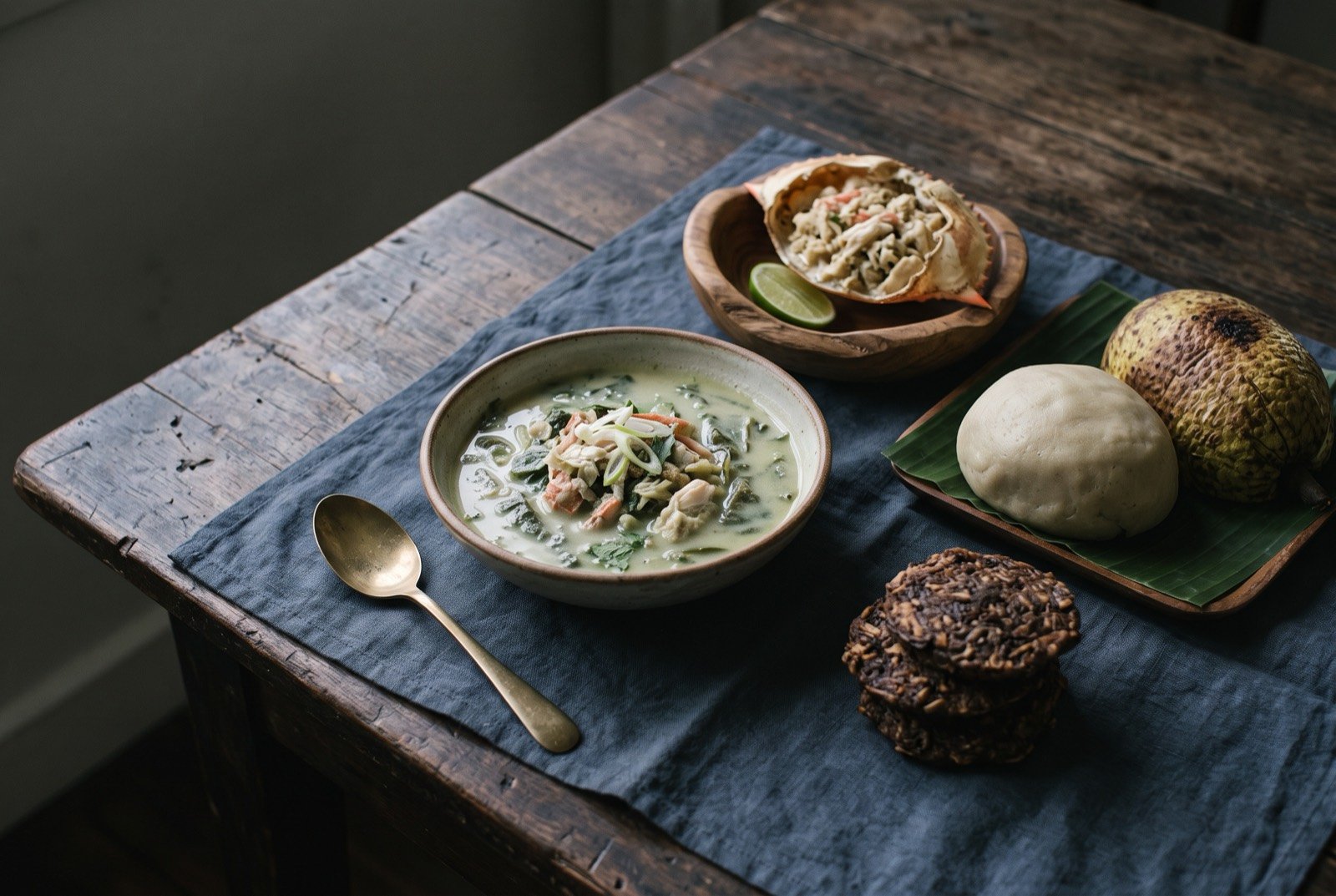
Palau, Yap, Chuuk, Pohnpei and Kosrae, taken seriously as one ecology rather than two nations and five states with almost nothing else in common. High volcanic islands that hold rain and soil in a way the region's coral atolls cannot, which is the whole reason a taro patch, a yam culture running to 177 named cultivars, and a ceremonial kava drink that outranks its own chiefs are all possible here, and every dish as tradition built it, then what a modern chef would change.
Sources and review · What this chapter does not assert · How we research · Spotted something wrong?
A Sense of Place
Five states, one ecology
Draw a line west from Chuuk Lagoon through Pohnpei, Kosrae, Yap and on to Palau and you have crossed most of what a map calls Micronesia without once touching a continent. This volume covers five states across two nations: the Republic of Palau in the far west, and the four states of the Federated States of Micronesia, Yap, Chuuk, Pohnpei and Kosrae, strung eastward across roughly 2,700 kilometres of open Pacific. They share almost nothing you would call a border and almost everything you would call an ecology. All five are high volcanic islands rather than the low coral atolls that make up Micronesia's other nations further east, Kiribati, the Marshall Islands, Nauru, and this matters more than any political boundary drawn since. High islands hold rain, build soil and cut fresh water into streams and wetlands. That is the whole difference. It is why a taro patch is possible here and is not on an atoll, why a mountain wet enough to be one of the rainiest places on earth can carry a yam culture of astonishing depth, and why this volume's food, for all its real internal variety, reads as one world rather than five unrelated ones: wetland or dryland taro and giant swamp taro, breadfruit, yam, coconut in every register, reef fish and mangrove crab, and, running under nearly all of it, the earth oven, called um in Kosrae, uhm in Pohnpei, spelled with real variation from state to state but the same hole in the ground, the same heated stones, the same leaf-wrapped parcel steaming for hours.
Palau: matrilineal, and the taro patch as status
Palau sits apart geographically and, in real ways, culturally. Its 340-odd islands split into Babeldaob, high, volcanic, genuinely soiled, and the limestone Rock Islands further south, jungled domes with no fresh water and no soil worth farming. Palauan society is matrilineal in a way that shapes the kitchen directly: land, clan wealth and titles descend through women, and the taro patch, the mesei, is a woman's own property, not her household's. The Palauan proverb a mesei a delal a telid, the taro patch is the mother of our breath, is not a decorative phrase. It is the plainest possible statement of where status actually sits. A woman's standing in Palau is built substantially on her skill as a taro farmer, and children learn to plant, to read the mud, to understand what the source material for this chapter calls "the sacred nature of food," in the family mesei before they learn much else.
The Federated States: four food worlds, not one
The Federated States of Micronesia is not one cuisine wearing four names. It is four food worlds that happened to federate in 1979, each with its own language and its own staple hierarchy, and this chapter treats them that way throughout rather than flattening Yap's fermented outer-island breadfruit into Chuuk's pounded lagoon version because both happen to start with breadfruit. Yap proper is high island; its Outer Islands, a thousand kilometres of scattered atolls to the west, are ecologically and linguistically distinct again, Carolinian-speaking rather than Yapese-speaking, and their fermented breadfruit, mwaa, is an outer-island practice, not a Yap-proper one. Chuuk is a lagoon before it is anything else, a single vast barrier reef enclosing ten eroded volcanic peaks and dozens of coral islets, and its food reads accordingly: reef, shellfish, breadfruit pounded into kon, breadfruit fermented for the long dry season under a rock-covered pit. Pohnpei is the wettest and the richest of the five, a single mountain that can record over ten metres of rain a year, and it carries this volume's most elaborate food culture by a real margin: a matrilineal chiefly system built around nine paramount chiefs, the nahnmwarki, a yam culture running to 177 named cultivars, and sakau, the ceremonial kava drink whose social rank at a gathering is described, without irony, as outranking the human chiefs present. Kosrae is smallest and plainest, a single steep island with no lagoon at all, its own now largely lost kava tradition, and one dish, fahfah, pounded taro and banana finished in a caramelised coconut sauce, documented well enough to carry real weight.
The shared grammar
What holds the whole volume together, across five states and two nations, is not a shared cuisine so much as a shared grammar: a starch pounded or roasted, coconut in every form, a reef worked hard and carefully, and status expressed through food in ways that are specific, named and still live, a woman's taro harvest in Palau, a man's yam display at the Pohnpeian nahs, rather than generalised feast custom. That grammar is the spine of this chapter.
The History in Layers
The deepest layer: the sea before the garden
The deepest layer here is the sea, not the garden. Isotopic analysis of human remains at Chelechol ra Orrak in Palau, dated to roughly 3,000 to 1,500 years before the present, shows a population overwhelmingly dependent on marine protein, its carbohydrate intake possibly leaning on sugarcane or seaweed rather than the taro that would later define the diet. The same site carries the region's earliest secure evidence for betel nut chewing, at around 3,000 years old, making western Micronesia one of the oldest attested betel-chewing zones anywhere in the world. Lapita and post-Lapita voyagers carried taro, breadfruit, yam, banana and the areca palm east and south across this whole region over the following centuries, seeding the staple set every state in this volume still cooks from.
Spain and Germany, late and light
Colonial contact arrived late and, for a long stretch, lightly. Spain claimed the Carolines formally only in 1885, and its presence was thin, chiefly nine Capuchin missionaries sent to Yap and Palau in 1886, more concerned with the alphabet and inter-village peace than with the kitchen. Germany bought the islands after the Spanish-American War in 1899 and did what German administrations did across the Pacific: it organised the coconut palm into a plantation crop, formalising copra as cash rather than leaving it to grow wild, the first move in a pattern of extraction every later administration would deepen.
Japan: the layer that actually reorganised the table
Japan is the layer that actually reorganised the table, and it did so with unusual intensity because Palau was not a minor outpost of the Japanese Mandate, it was its capital. From 1922 Koror was the seat of the Nanyo-cho, the South Seas Government administering the whole of Japanese Micronesia, with branch offices radiating out to Yap, Chuuk, Pohnpei and the Marshalls. Over 850 Japanese loanwords entered Palauan during the occupation, a striking number for a colonial period of only three decades, and a great many are food words still spoken today: udong for udon, domburi for the rice bowl, abrabang, oil bread, for deep-fried bread, bento for the lunch box. Rice itself entered the ordinary Palauan diet under Japanese rule, earlier than the American-period shift usually credited elsewhere in the Pacific. Commercial sugar, pineapple and, from 1928, industrial tuna fishing, begun in Chuuk by an Okinawan settler and spreading to Palau, Pohnpei and Saipan, turned dried, smoked bonito, katsuobushi, into the territory's second-largest export. Ramen, sushi, tempura and sashimi entered the food culture generally across the mandate and have never really left it: Tori Tori in Koror today runs a Japanese-Palauan menu under a chef formally named a Japanese Cuisine Goodwill Ambassador by Japan's own embassy, a direct living thread from a century-old administration to a restaurant table.
War, unevenly
The war did not touch every island equally, and where it fell hardest is not where the history books usually look. Peleliu, in southern Palau, was the site of one of the war's bloodiest battles, but its Palauan civilians had already been evacuated in 1943, so there were no Palauan civilian deaths in that fighting. The real Palauan catastrophe happened on Babeldaob, which American strategy bypassed rather than invaded, leaving roughly 50,000 Japanese military personnel and Micronesian and Asian civilians under prolonged siege and bombardment into 1945. An estimated 10,000 died there, at least 80 percent of them from famine and disease rather than combat, a documented instance of colonial war starving Palauan civilians on Palauan soil that deserves to be named plainly rather than folded into the more famous Peleliu story.
American shelf-stable food, and the Compact-era diet crisis
The American period brought shelf-stable food before it brought affordability. Spam, corned beef, soda and chocolate arrived with military rations from 1944, but for most of the Trust Territory period that followed, ordinary Palauans and Micronesians could not afford them as everyday food; they turned up chiefly at feasts or as post-storm relief. "We got infected by tobacco, corned beef and candy after the War," the Palauan pharmaceutical botanist Kris Kitalong has said. "Then, by the '80s, we could finally afford them." That affordability, arriving alongside independence rather than before it, is the hinge on which this whole region's present nutrition crisis turns. Palau became fully independent in 1994, the Federated States of Micronesia in 1986, both under a Compact of Free Association with the United States that traded continued American strategic access for defence guarantees, financial support and, for FSM and Palauan citizens, the right to live and work in the United States without a visa. Roughly 90 percent of the average Palauan household diet is now imported food. Palau's own diabetes prevalence, by one measure the fourth-highest national rate in the world, sits alongside obesity above 55 percent in men and 62 percent in women; the national hospital's hyperbaric chamber, built to treat divers' decompression sickness, is now used chiefly for diabetic limb amputation. Across the FSM the same pattern holds, doughnuts and instant ramen for a child's breakfast, tinned meat with rice for lunch, and it is a live enough concern that the FSM's own Nutrition Action Plan explicitly targets weaning the population off white rice and processed food, while the Island Food Community of Pohnpei has built a real, applied response around a single local ingredient: the Karat banana, a native cultivar traditionally used to wean infants, shown to carry more than 25 times the beta-carotene of an imported Cavendish. This chapter's project, giving these dishes proper technique and proper respect, sits deliberately on the side of that local revival rather than against it.
The Flavour Arsenal
Starches
Taro is the anchor across every state in this volume, but it is not one crop. Colocasia esculenta, soft taro, is Palau's dait and Yap's mal, grown in wetland patches; Cyrtosperma merkusii, giant swamp taro, is Palau's brak and, by its own agricultural literature, Yap's single most important local staple, a genuinely different plant grown in deeper, wetter conditions and reaching far larger size. Breadfruit is the dominant starch across the FSM's four states specifically, roasted whole over fire until the skin blackens, boiled and pounded into kon in Chuuk, pounded with coconut into fahfah in Kosrae, fermented for months against the lean season in every state that has a pit to spare. Yam, in Pohnpei, is not simply a starch among others; it is the single most prestige-laden crop on the island, called selin mwahnakapw, young man's vines, its cultivation a demonstrated proof of a man's labour and skill rather than merely food, with 177 named cultivars recorded across five species in a single 1988 ethnobotanical survey, more named variety than any other crop on Pohnpei carries, breadfruit included. Cassava and rice are the two genuinely modern staples, cassava introduced to the wider Pacific around 1800, rice arriving under Japanese administration and now standard everywhere.
Fat and sweetener
Coconut supplies almost everything else in this kitchen: cream and milk for simmering, oil for frying, and, tapped as sap from the flower spathe and reduced, syrup, ilaot in Palau, used to sweeten French toast, ice cream or coffee. There is no equivalent to butter or a rendered animal fat anywhere in this arsenal; coconut does that whole job.
Aromatics and heat
Ginger, garlic and onion are the standing base for coconut-milk cooking across all five states. Palau grows its own hot pepper, donne sali, Capsicum annuum, the standing chilli heat in dipping sauces. Sea hibiscus bark, kohlo in Pohnpeian, is not eaten but is essential kitchen technology: its polysaccharide-rich inner bark is torn into shreds and used to strain sakau, the mucilage helping to emulsify the drink.
Protein
Reef and lagoon fish, roughly 80 species across 13 families are commonly taken in Palau alone, rabbitfish and grouper the two workhorse families by volume across the whole region, with tuna, trevally, wahoo and marlin further offshore. Mangrove crab and coconut crab are the two shared festive delicacies, carrying real local names in every state, ked in Palau, aci in Kosrae, emp in Pohnpei, amwatang in Chuuk, yaffi in Yap, and real, live conservation pressure behind nearly all of them. Fruit bat, olik in Palau, peute in Chuuk, pwehk in Pohnpei, fak in Kosrae, is this volume's single most loaded ingredient: a real, named, technique-documented traditional food, and a species under enough pressure that it is IUCN Vulnerable and CITES Appendix I, discussed below with the weight that demands.
Ritual, not food, but load-bearing
Betel nut, buuch in Palauan, chewed unripe with slaked coral lime and wrapped in a pepper leaf, kebui, is a daily, near-universal social practice across Palau and Yap especially, with real archaeological depth and real, documented cancer risk that this chapter states as plainly as its centrality. Sakau, Pohnpei's own name for kava, Piper methysticum, in two named local cultivars, Rahmwahnger and the milder, special-occasion Rahmedel, is this volume's single most important ceremonial substance and cannot be sourced or cooked in Britain at all, for reasons given under Sourcing below.
The Technique Ladder
Rung 1. The earth oven
Called um in Kosrae, uhm or uhmw in Pohnpei, umw more generally across the FSM, spelling genuinely varies state to state rather than settling on one canonical form. Stones are heated in an open fire, food, usually leaf-wrapped, is laid over them, more hot stones and leaves go on top, and the whole parcel steams under earth or ash for hours. It is the same underlying technology this atlas has already documented as motu in the Solomon Islands, mumu in Vanuatu, and lovo in Fiji, one continuous Pacific technique wearing a different name on every island it touches, not an invention specific to any one of them. Why it works is straightforward: buried, covered heat holds a low, even, moist temperature far longer than any open fire could sustain unattended, exactly the environment slow starches and whole animals need.
On Palau, notably, this brief's research found no comparable documented earth-oven tradition; Palauan cooking, as far as the sourcing for this chapter goes, centres instead on boiling and coconut-milk simmering, a genuine and stated point of difference from its Micronesian neighbours rather than an oversight.
Rung 2. Pounding
Breadfruit and taro are cooked first, by boiling or in the earth oven, then pounded, traditionally with a stone or coral pestle against a wooden or stone board, into a smooth, elastic paste bound with coconut cream.
Chuuk names both tools directly, the nif, a wooden pounding board, and the po, a pounder carved from harvested coral rather than wood; in the lagoon islands men do the pounding, on Chuuk's outer islands women traditionally do. Kosrae's fahfah names the same technique with a stricter rule attached: the pounder is customarily required to be a first-born son of respectable standing, technique here doubling as a social credential.
Rung 3. Coconut-milk extraction and reduction
Grated coconut flesh is squeezed, by hand or through cloth, into cream and milk, the base liquid for demok, chicken fafa and the great majority of this volume's simmered dishes; tapped separately as sap and reduced by heat, it becomes ilaot syrup, and in Kosrae's fahfah fiti it is caramelised further into el, a distinct, more worked sauce rather than a simple pouring cream.
Rung 4. Pit fermentation
Ripe breadfruit, peeled and pitted, sometimes soaked in seawater for a day first, is packed into a leaf-lined pit under stones and soil and left to ferment anaerobically for months, in some accounts years or decades.
Chuuk alone carries at least three coexisting names for versions of this technique, oppot, apwet and, on the remote outer atoll of Pollap specifically, maar becoming maar-mwaal once finished; Yap's outer islands run the same underlying process under a fourth name, mwaa, using ti leaf rather than banana leaf to wrap it. This is a genuine preservation technology built for a real problem, breadfruit's short, heavy fruiting season against a long lean stretch, not a curiosity, and it is treated at length under the ferment and preserve bench below.
Rung 5. Sakau preparation, understood, not staged
Fresh sakau root is pounded on a large flat stone, the peitehl, chosen partly for the sound it makes when struck, using fist-sized basalt pounders, the moahl, the mass periodically gathered, scuffed against the stone and flipped, a motion with its own name, keidihd. It is then packed into shredded, soaked sea hibiscus bark and squeezed, wengiweng, in a forward press and a reverse twist, to extract the drink.
This is real, precise, documented technique, and it is included here for understanding rather than as something a British kitchen can stage: the plant itself cannot legally be bought or sold in the UK, a point covered fully under Sourcing below, and no blender-and-muslin substitute is worth recommending for an ingredient a reader cannot obtain.
The Ferment and Preserve Bench
Pit-fermented breadfruit, under four names
This volume's ferment bench is built around one problem: breadfruit fruits heavily but seasonally, and every state here has developed its own answer to keeping it edible through the lean months. Chuuk alone carries at least three coexisting names for the same underlying process, ripe breadfruit peeled, pitted, sometimes soaked in seawater for 12 to 24 hours, then packed into a banana-leaf-lined pit under stones and soil to ferment anaerobically for months, in some accounts years or decades: oppot, described as a soft, moist, falls-apart loaf with a light, tangy flavour; apwet or apwot, "critically important to Chuukese culture," slightly firmer and milder; and, specifically on the remote outer atoll of Pollap, maar, called maar-mwaal once finished. Yap's Outer Islands, a thousand kilometres further west, run the same process under a fourth name, mwaa, wrapped in ti leaf rather than banana leaf, documented as a traditional Ulithi staple; rinsing the finished paste after fermentation gives a milder result. None of this can be reproduced at true scale in a British kitchen, since true pit fermentation depends on months of stable, anaerobic underground conditions no dehydrator or fermentation vessel can honestly replicate, and this chapter does not pretend otherwise. What a home cook can stage, in miniature and for understanding rather than as a claimed equivalent, is a controlled small-batch version: peeled, pitted breadfruit packed tightly into a sealed fermentation vessel under weight, at room temperature, checked from a week onward for the same lactic souring the pit achieves over months, a genuinely different timescale and a genuinely different, thinner result, worth trying once and worth being honest about with a guest.
Ilaot, tapped coconut sap syrup
Ilaot, Palau's tapped and reduced coconut sap syrup, belongs on this bench too, though it preserves sweetness rather than starch: the flower spathe is tapped and the sap collected and reduced by slow heat to a syrup used on French toast, over ice cream, or stirred into coffee. No source for this chapter gave a specific tapping yield or timing for Palau, a real, stated gap; a workable substitute reduction, simmering fresh young coconut water with a little sugar until syrupy, approximates the flavour without claiming to reproduce the tapping technique itself.
Sourcing in Britain
This is, on the evidence gathered for this chapter, one of the thinnest sourcing pictures in the whole atlas so far, on a level with Volume OC-06's Melanesia. Nothing specific to Palau or the FSM exists in UK retail. Everything sourceable comes from adjacent, larger diaspora networks carrying the same or a related species under a different cultural name, and this chapter would rather say that plainly than dress up a thin picture as a fuller one.
- Taro. Common taro, Colocasia esculenta, Palau's dait, Yap's mal, is genuinely well stocked via West African and Caribbean grocers, sold as cocoyam or dasheen, the same species eaten across three continents. Giant swamp taro, Cyrtosperma merkusii, Palau's brak and Yap's most important local staple, is a different plant entirely and effectively unobtainable as food in Britain; common taro is the honest, available stand-in, not an equivalent, and this chapter says so rather than blurring the two.
- Breadfruit. Fresh breadfruit does have a real UK route, via exotic-fruit specialists, at a real price, roughly £20 a kilo and a half, and real unreliability of stock; it is worth ordering well ahead and expecting the order to fail. Tinned, pre-cooked Jamaican breadfruit, via Caribbean grocers, is the dependable fallback, but it is a genuinely different food from a whole fruit roasted or pounded fresh, and a reader building kon or dokoamai needs the fresh fruit, not the tin.
- Betel nut. Plain areca nut is legal to buy in Britain and not a controlled drug, sold through South Asian grocers and dedicated paan shops, notably in Southall, Wembley and Brick Lane. The plant is right but the preparation is not: Indian paan retail is built for wrapped, cured, often tobacco-added nut meant to be discarded after chewing, where Palauan and Yapese practice favours the plain, unripe nut chewed and spat out. Ask for it plain. Where tobacco is added, that shifts the product into UK smokeless-tobacco regulation rather than drug law, a genuine, worth-stating legal nuance. The World Health Organization's cancer research arm classifies areca nut, with or without tobacco, as a Group 1 carcinogen, a fact this chapter states without softening it, alongside betel's real, three-thousand-year-old centrality to daily life in Palau and Yap.
- Kava and sakau. Cannot legally be bought, sold or served in Britain in any form. The ban on kava-kava as an unlicensed medicine and as food has been in force continuously since January 2003, was reviewed and upheld in 2006, and, checked directly against the Food Standards Agency's own live Novel Food register for this chapter, carries no authorisation of any kind as of 2026. Commercial claims of a recent UK legalisation, repeated widely online, are false and should not be believed. This matters more here than it would in a volume where kava is a peripheral curiosity, because sakau is Pohnpei's central ceremonial institution, not a footnote, and the honest response is to explain the ceremony properly and tell the reader plainly that they cannot stage it, rather than either omitting it or quietly implying a substitute will do.
- Reef fish, mangrove crab, coconut crab. No UK retailer stocks the true reef species this volume's dishes use; a wholesale importer exists but sells trade-only. Sea bass or bream are the honest substitute for reef fish. Standard UK brown or spider crab substitutes for both mangrove crab and coconut crab, the latter additionally CITES-protected and entirely absent from any legitimate food trade anywhere.
- Fruit bat. Has no UK sourcing route of any kind, and none should be implied. The Palau flying fox is IUCN Vulnerable and CITES Appendix I, the highest tier of international protection. This chapter names fruit bat soup, explains its real cultural weight and its real, well-documented preparation, and stops there: it is a dish to understand and to respect as restricted, not one this chapter will present as cookable.
- Spam, corned beef, tinned fish. Entirely mainstream in Britain, and worth naming with real weight rather than as a joke ingredient. Spam and corned beef genuinely dominate the everyday diet across the FSM and Palau today, a direct, documented legacy of wartime rations and Compact-era import dependency, not a punchline.
There is no dedicated Micronesian or Palauan grocer, community organisation or supplier anywhere in Britain. The entire "Pacific Islander" category in the 2021 England and Wales census, all of Melanesia, Micronesia and Polynesia combined, sits under 12,400 people, with no breakdown fine enough to isolate Palau or the FSM at all. The real diaspora, and a genuinely useful comparison for a reader who happens to travel, is American: roughly 25,000 Compact migrants live in Hawaii alone, enough to support real Micronesian grocers in Honolulu's Kalihi neighbourhood. Nothing equivalent exists in Britain, and this chapter would rather state that once, clearly, than let a reader discover it ingredient by ingredient.
Voices and Sources
Institutions and researchers
- The College of Micronesia-FSM's own ethnobotany teaching material, the strongest single source behind the sakau, kon and oppot sections above.
- Stone, Fitzpatrick and Krigbaum, whose peer-reviewed archaeology of the Chelechol ra Orrak remains underpins this chapter's account of early Palauan diet.
- Stephen C. Murray, whose peer-reviewed history of the siege of Babeldaob is the source for this chapter's account of that famine.
- Chad T. Morris and colleagues, on generational change in Palauan foodways.
- Bill Raynor's 1992 ethnobotanical survey of Pohnpeian yam cultivation, the source for this chapter's 177-cultivar figure.
- The University of Hawaii at Manoa's CTAHR Pacific Food Guide.
- Palau's own English-language press, Island Times, and the Pacific-regional outlets RNZ Pacific and Pacific Island Times.
Named voices from inside
- Noah Idechong, the Palauan conservationist, cited for his own account of the bul fishing closure.
- Kris Kitalong, the Palauan pharmaceutical botanist and cook, cited directly on the postwar shift to imported, shelf-stable food.
- A Palauan-English dictionary maintained in partnership with Palau's own Language Commission, which did the real work of correcting several claims this chapter would otherwise have got wrong.
Full citations sit in briefs/OC-09-tradition.md and briefs/OC-09-modernist-sourcing.md.
Things this chapter has deliberately not asserted
- That demok is Palau's official national dish. It is widely called that, by three independent sources, but no government or Belau National Museum statement confirms it, so this chapter calls it "widely called," not settled fact.
- That "kemedukl" names a fruit bat dish, or that "demok" has any necessary connection to fruit bat at all. Both claims appeared in this chapter's original planning notes and neither survived checking: demok is taro-leaf soup, unrelated to fruit bat; kemedukl is the Palauan name for a protected reef fish, the bumphead parrotfish, not a dish name of any kind.
- That Palau has a chiefly food-title system called "ocharaot." No such term was found. The real, differently meaning term is ocheraol, a communal house-building custom.
- That "buk" is the Palauan word for betel nut. Checked directly against a Palauan dictionary: it is not. The correct term is buuch.
- That Pohnpei has a dedicated "yam house" building separate from the nahs, the community assembly house. Display and ranking of the harvest happens at the nahs itself; no source found a separate structure.
- Precise, named traditional quantities for demok, ukaeb, chicken fafa, kon, fahfah, dokoamai or delul diokang. This chapter's tradition research found real, detailed technique for all seven, order of operations, tools, timings for the parts of the process that are timed, but not a named contributor's exact measured recipe of the kind Volume OC-06 found in a published Solomon Islands community cookbook. The Tradition recipes above render that real technique into cookable quantities as an honest act of recipe-writing, not as a claim to have found a traditional measured source; where a timing is genuinely sourced, it is stated as such.
- That any chef of Palauan, Yapese, Chuukese, Pohnpeian or Kosraean heritage runs a fine-dining restaurant anywhere in the world. None was found, in Micronesia, Hawaii, the US mainland, Guam or Saipan. The strongest, warmest find in the whole research pass is Brennan Temol, a Palauan-born cook working in a community college cafeteria in rural California, a real story, but not a restaurant story, and this chapter has resisted the temptation to inflate it into one.
- That Guam or Saipan's genuinely excellent CHamoru chef scene, real, documented, chef-led, belongs to this volume. CHamoru is a distinct Austronesian people and cuisine from Palau and the FSM, and this chapter has kept them separate rather than borrowing their material to pad out a thinner volume.
- A specific, quantified domestic hunting quota or season for fruit bat in Palau. Export and commercial trade are banned and CITES-restricted; no source found a domestic quota comparable to New Caledonia's roussette regulations documented in Volume OC-06.
- That a Palau-specific earth-oven tradition exists. This chapter's research found none, and states the absence as an open question rather than either inventing one or silently assuming Palauan technique matches its FSM neighbours.
- That kava became legal in the UK at any point since 2003. It did not. This claim circulates widely online and is false, checked directly against the Food Standards Agency's current Novel Food register for this chapter.
The earth oven
Called um in Kosrae, uhm or uhmw in Pohnpei, umw more generally across the FSM, spelling genuinely varies state to state rather than settling on one canonical...
Pounding
Breadfruit and taro are cooked first, by boiling or in the earth oven, then pounded, traditionally with a stone or coral pestle against a wooden or stone...
Coconut-milk extraction and reduction
Grated coconut flesh is squeezed, by hand or through cloth, into cream and milk, the base liquid for demok, chicken fafa and the great majority of this...
Pit fermentation
Ripe breadfruit, peeled and pitted, sometimes soaked in seawater for a day first, is packed into a leaf-lined pit under stones and soil and left to ferment...
Sakau preparation, understood, not staged
Fresh sakau root is pounded on a large flat stone, the peitehl, chosen partly for the sound it makes when struck, using fist-sized basalt pounders, the moahl...
The dishes
- Demok Palau
- Ukaeb Palau
- Chicken fafa Palau
- Kon Chuuk
- Fahfah Kosrae
- Dokoamai Pohnpei
- Delul diokang Palau
Sources and review
- Reviewed
- Not yet reviewed from inside the tradition
- Cooked
- Not yet cooked and reported
Where this volume comes from
3 research briefs on file for this volume, researched to the rules on How we research. Published 3 September 2026. Last changed 8 September 2026.
The brief's own account of its sources
This brief was researched in two threads, run concurrently: Palau, and the Federated States of Micronesia's four states as a bloc, both in English throughout, given the practical impossibility of running independent searches in Palauan, Yapese, Chuukese, Pohnpeian or Kosraean, all overwhelmingly spoken rather than web-published languages.