Oceania and the Pacific · Volume 14
Rapa Nui
The Stone Garden, the Earth Oven and the Company Fence
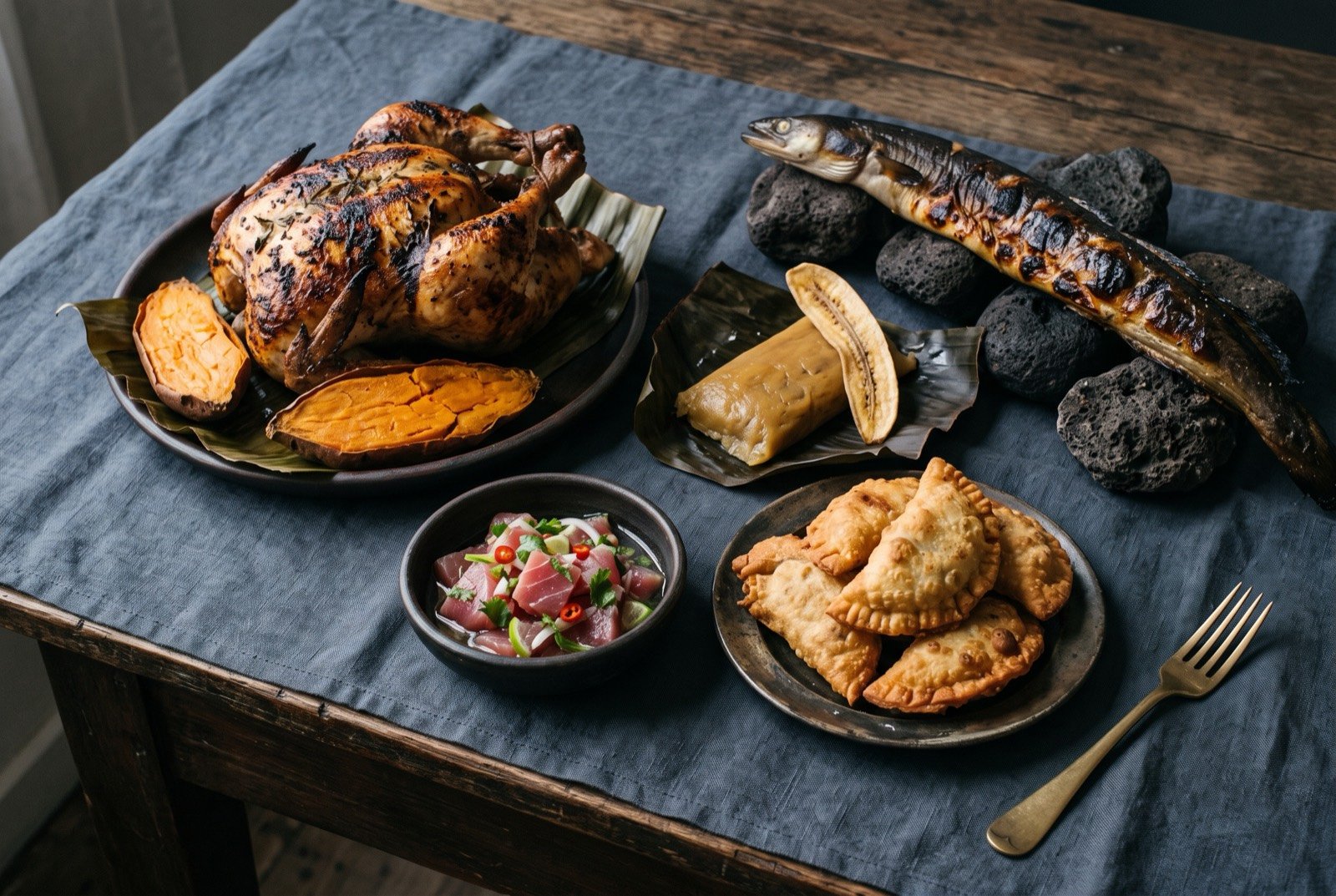
Rapa Nui does not belong with the rest of Polynesia in this atlas: cooler, drier, coconut-free and historically pig-free, its anchoring starch grown in fields engineered from broken stone. It also carries a colonial layer no other volume here does: not British, French or American, but Chilean, arriving in 1888 and run for seventy eight years as a fenced company sheep estancia that confined most Rapa Nui people off their own land.
Sources and review · What this chapter does not assert · How we research · Spotted something wrong?
A Sense of Place
Rapa Nui sits at 27°S, 109°W, roughly 3,700 kilometres from the nearest inhabited landmass in eastern Polynesia and about 2,075 kilometres from Pitcairn, its nearest Polynesian neighbour: the most isolated inhabited island on earth. That isolation is the whole chapter's starting condition, not a footnote to it. The island is volcanic, small (about 164 square kilometres), windswept, and subtropical rather than tropical, cooler and drier than Tahiti or Fiji, with no permanent freshwater river or stream. Ahu, the ceremonial stone platforms the island is best known for, and the villages around them, cluster near the coast and near what freshwater does exist, crater lakes and brackish coastal seeps, because there was nowhere else viable to live.
The fat of this cuisine is, honestly, thin on the ground. There is no coconut cream to carry it the way it carries Fijian or Tahitian cooking, and the island never supported a rich land-fat tradition either. What fat there is comes from chicken and fish themselves, rendered in the umu, plus whatever the Chilean layer has since supplied: lard for pastry, oil for frying. The starch is kumara, sweet potato, grown across the island in fields engineered from broken and piled stone rather than the tropical Pacific's flooded taro paddies, because there was no water to flood them with. Taro and yam grow too, but as dryland crops in the same stone gardens, a materially lower-yielding practice than the pondfield taro of wetter islands, and this, not a simple varietal headcount, is the real, sourced form of "more limited" that this chapter uses. The protein backbone, before Chilean contact, was chicken, unusually so for a Polynesian island, precisely because the pig that carries that role almost everywhere else in the Pacific never took hold here, alongside eel, reef and open-ocean fish, and, at scarce and ceremonially loaded moments, seabird eggs. The aromatic is close to bare: salt, a native seaweed called aúke used as a seasoning, and, after Chilean settlement, citrus and imported spice.
None of this describes a poor cuisine so much as a resourceful one. Isotope evidence from prehistoric skeletal remains shows a diet roughly half marine and half terrestrial, a more balanced picture than the "starving islanders" version of this island's story usually implies, and the island's stone-built agriculture, discussed in full below, is one of the more genuinely ingenious pieces of engineering in this whole atlas.
The structural logic, at a glance
| Indigenous Rapa Nui | The Chilean layer | |
|---|---|---|
| Fat | Chicken and fish fat, rendered in the umu | Lard and oil, from the mainland supply chain |
| Starch | Kumara (dryland stone-garden), yam, dryland taro, banana | Wheat flour (empanada pastry), rice |
| Protein backbone | Chicken (moa), eel (koreha), tuna and reef fish | Tuna (shared with the indigenous catch), imported lamb historically, beef |
| Aromatic | Salt, aúke seaweed | Citrus, merken and other mainland spice, garlic |
| The land and food claim | Manavai and lithic mulch stone gardens, worked by lineage | The Compañía Explotadora's fenced sheep estancia; today, air and sea freight from the mainland |
| The defining technique | Umu pae, the layered stone earth oven; tunu ahi, hot-stone grilling | The fried pastry turnover; the citrus cure |
The History in Layers
Voyagers, and a settlement date that genuinely depends on who you ask
Rapa Nui was settled by Polynesian voyagers navigating without instruments, by star path, swell pattern and bird flight line, in the last and longest-distance phase of the Polynesian expansion into the remote Pacific. Exactly when is a real, live disagreement rather than a rounding error, and this chapter gives all three figures rather than picking the tidiest one. UNESCO's own listing for Rapa Nui National Park states settlement "c. AD 300." Chilean popular and oral tradition, built around the founding ariki Hotu Matu'a's arrival from Hiva, usually glossed as the Marquesas, gives around AD 600, and credits him with bringing kumara, taro, yam, banana, sugarcane, the Polynesian rat and chickens in the same voyage. Modern radiocarbon-based archaeology, now the dominant position in peer-reviewed work, places initial settlement considerably later, with consensus clustering around AD 1200, allowing for a possibly earlier and intermittent presence from around AD 800. This chapter treats the radiocarbon figure as the most reliable and the earlier dates as living tradition worth recording rather than correcting away.
The collapse debate: contested, and this chapter is not the place to settle it
No history of this island is honest without naming the argument that has run through Rapa Nui scholarship for two decades, and no chapter in this atlas should pretend to settle it. The popular version, associated above all with Jared Diamond's 2005 book Collapse, holds that the island felled its own palm forest faster than it could regrow, partly for canoe timber and partly to move and raise the moai, triggering soil erosion, resource failure, and a population crash from a peak of perhaps 15,000 to as few as 2,000 to 3,000 people by first European contact in 1722.
Archaeologists Terry Hunt and Carl Lipo, and others working in the same direction, have mounted a serious and still live challenge to that account. They point to the Pacific rat, brought by the settlers themselves, as a plausible major driver of palm loss in its own right, since rats eat palm seeds and can prevent forest regeneration without any human logging at all. They argue the archaeological evidence for a large pre-contact population crash is thin, and that the population may have stabilised at a smaller, sustainable level rather than booming and then collapsing. A 2024 paper using satellite-mapped agricultural coverage estimated the island's whole stone-garden farming footprint at only 4.9 to 21.1 square kilometres, which implies a population considerably smaller than the 15,000 the "boom then bust" story depends on. What both camps agree on, and what this chapter asserts without taking a side, is that the palm forest did disappear over time, that its loss ended large canoe-building on the island, and that this measurably narrowed Rapa Nui's fishing to inshore and reef waters rather than the open-ocean pelagic fishing a big voyaging canoe would once have allowed. What caused the deforestation, and whether a demographic boom-and-bust ever happened before Europeans arrived, remain open questions, and this chapter leaves them open.
The catastrophe nobody disputes: 1862, and a near-total break
Whatever happened or did not happen before European contact, the demographic catastrophe that unquestionably did happen came afterwards, and it came from Peru, not from the island's own ecology. Between June 1862 and August 1863, at least twenty Peruvian ships called at Rapa Nui to forcibly recruit labour for the guano fields off the Peruvian coast, seizing islanders by trickery or outright force. Roughly 1,400 Rapanui, around 35 per cent of the island's entire population, were taken. International pressure, driven in part by Bishop Tepano Jaussen of Tahiti, forced Peru to halt the trade and order repatriation in April 1863, but of roughly 470 people who boarded the return voyage, smallpox, tuberculosis and dysentery killed all but 15 before or shortly after they reached home, and the survivors reintroduced smallpox to the island they returned to. Among those taken were the reigning ariki and most of the specialists who could read the island's rongorongo script, which is the reason no fluent reader of that script survived into the twentieth century; it is a reasonable, though not directly documented, inference that other specialist knowledge, quite possibly including horticultural knowledge tied to the island's stone gardens, suffered a comparable break in transmission. By 1877, the population had fallen to as few as 110 people. Catholic missionaries arrived from 1864, and within a decade the surviving Rapanui had largely converted, with missionary economic and social practice displacing much of what remained of the old order.
1888, and a colonial layer that arrived as a company, not a government
Chile annexed Rapa Nui on 9 September 1888, when naval officer Policarpo Toro secured an agreement, since disputed in exactly what it meant, with the Rapanui chief Atamu Tekena. Toro himself is recorded rejecting the idea that this was a sale of land, telling Tekena to keep his money, since "ni yo, ni ningún kanaka, hemos vendido terreno alguno," neither he nor any islander had sold any land at all, a dispute over sovereignty versus ownership that is still unresolved in Rapa Nui land politics today.
What followed for most of the next eighty years was not ordinary colonial administration. In 1895 Chile leased the island to a French-Chilean sheep rancher; by 1903 the lease had passed to the Anglo-Chilean trading house Williamson, Balfour & Co., operating through a subsidiary called the Compañía Explotadora de Isla de Pascua, CEDIP, which ran the entire island outside a single fenced zone as one sheep estancia until 1953. The Rapa Nui population was physically confined to a roughly 1,000 hectare area of Hanga Roa, later expanded to around 2,000, enclosed by a stone and barbed wire wall with controlled gates. Without company authorisation, residents could not plant crops, hunt or fish beyond that fence. Chile's own state truth commission later documented, in its Rapa Nui volume, that the confined population "sufrieron despojos y abusos: quema de cultivos, impedimentos para la pesca y frecuentes castigos corporales," dispossession and abuse including the burning of crops, obstruction of fishing, and frequent corporal punishment. The Chilean Navy took over direct administration in 1953 without ending the confinement, and it took a Rapa Nui uprising, led by schoolteacher Alfonso Rapu in 1964 to 1966, to force Chile's hand: the 1966 Ley Pascua finally granted Rapa Nui people full Chilean citizenship and ended the fence, seventy eight years after annexation.
The food consequence of this period is directly documented by at least one dedicated piece of Chilean scholarship: the CEDIP era created what one researcher calls a strong new dependence on continental products absent from the diet before, alongside a shift from a subsistence and reciprocal food economy to one where food had to be bought, inside a company-store system, with company wages. Most tellingly for a food chapter, lamb, the ranch's own product, is recorded as replacing chicken and the Polynesian rat as the island's principal protein source during this period. This is the point at which "Chilean food on Rapa Nui" stops being a matter of a few imported dishes sitting next to an untouched tradition, and becomes a structural fact about how the island eats at all, a fact this chapter's second half returns to directly.
Land unsettled, and food still arriving by ship
Today, only about 13 per cent of Rapa Nui's land is Rapa Nui-owned; the rest remains in Chilean state hands, and the dispute over what redress should look like is live, not historical. Rapa Nui representatives frame their claim through the concept of kainga, glossed as the territory occupied by a clan together with the maternal womb, land reclamation as reviving a relationship rather than simply repossessing soil, and organised land occupations, most visibly the long-running dispute over the Hotel Hanga Roa, have continued since 2010. Food access is tangled up in the same unresolved settlement: the island now imports the large majority of what it eats, roughly 540 tonnes a month by air and over 24,000 tonnes a year by sea through a port with no dock, a dependency a shipping director quoted in Chilean trade press describes plainly as leaving the island exposed to "greater shortage risk, especially critical for essentials like food, medicine, and fuel." Against that backdrop, in 2008 a small, genuinely hopeful counter-story began: a Chilean winemaker and a Rapa Nui farmer rediscovering a stand of feral, century-old missionary vines and starting to make the island's first wine. It closes this chapter's ferment section below, and it is worth reading as what it actually is: not the Chilean layer simply arriving again, but two people, one from each side of this history, building something new out of what was left behind.
The Flavour Arsenal
Starches and staples
| Ingredient | What it is |
|---|---|
| Kumara (sweet potato) | The anchoring starch, grown in stone-mulched fields; roughly two to three dozen named traditional varieties are recorded, the most prized called kumara tua-tea, now reportedly close to disappearing on the island |
| Taro (dryland) | Grown without irrigation in the same stone gardens, a lower-yielding practice than the flooded taro of the tropical Pacific |
| Yam (uhi, ñame) | A founding crop alongside kumara and taro, grown the same way |
| Banana | Grown in the sheltered manavai enclosures rather than the open stone-mulch fields; the base of po'e (below) |
| Sugarcane | Grown in manavai; pressed for its juice as the island's traditional sweetener |
Protein
| Ingredient | What it is |
|---|---|
| Chicken (moa) | The island's historic principal domesticated protein, kept in purpose-built stone chicken houses (hare moa) against theft; the pig, prestige protein almost everywhere else in Polynesia, never established here |
| Eel (koreha) | Freshwater and brackish eel, singed over open fire then finished in the umu, a two-stage technique that smokes as much as it cooks |
| Tuna (kahi) | The base fish protein, grilled over hot stones or, in the present-day Chilean-inflected register, citrus-cured |
| Reef and pelagic fish | Kana kana, a locally distinctive pale-fleshed fish; toremo, swordfish; mahi mahi |
| Rape rape and ura | Two distinct native crustaceans, a small crayfish-like species and the standard spiny lobster |
| Heke, hetuke | Octopus, and sea urchin |
Seasoning, and the Chilean addition
| Ingredient | What it is |
|---|---|
| Aúke | A native edible seaweed, used traditionally as a seasoning and salt source |
| Salt | The main traditional seasoning otherwise; no fermented condiment tradition was found for this volume |
| Citrus | Post-contact, now central to the island's ceviche register |
| Merken | A smoked, ground chilli seasoning of Mapuche origin, mainland Chilean rather than indigenous to the island, worth naming here precisely because it marks the boundary this chapter keeps drawing: present on Rapa Nui because of the Chilean supply chain, not part of the older tradition |
A note on the coconut, because it recurs as an error worth heading off directly: Rapa Nui has no living coconut palm tradition. The large native palm the island once carried, Paschalococos disperta, is extinct and was never a coconut-bearing species regardless. Where coconut appears in a modern Rapa Nui recipe, and it does, in some contemporary versions of po'e below, it should be read as a recent import, not evidence of an indigenous coconut tradition, and this chapter says so rather than letting it pass quietly.
The Technique Ladder
Five rungs, each with a documented indigenous ancestor and a genuine restaurant-kitchen equivalent, in the spirit this whole atlas keeps returning to: the elevated version is doing something the tradition was already doing, more deliberately.
Rung 1. The stone garden
Manavai, walled circular stone enclosures, and lithic mulch, broken stone worked into or laid over open ground, are two distinct pieces of engineering built to grow food on poor, wind-scoured volcanic soil with no irrigation. Manavai sheltered taller, wind-sensitive crops, banana and sugarcane; lithic mulch, in three recognised forms, veneer, mulch proper, and boulder gardens, is where kumara, yam and dryland taro were grown, the stone moderating soil temperature, trapping moisture and slowly releasing minerals as it weathers. At least 1,500 manavai and several square kilometres of lithic mulch garden have been mapped across the island. The kitchen equivalent is not a cooking technique at all, but a sourcing discipline: start with a kumara grown properly, in good ground, rather than treating the ingredient as interchangeable.
Rung 2. Umu pae, the layered earth oven
A stone-lined pit, a base stone surrounded by five or six half-buried retaining stones and an outer protective ring, fired with wood, loaded in a fixed sequence, hot stones, root vegetables, more hot stones, leaf-wrapped meat and fish, a final layer of stones, then sealed under grass and banana leaf for roughly two to three hours, cooking by trapped steam and radiant stone heat rather than direct flame. The restaurant equivalent is a covered, indirect, humidity-controlled roast, a Big Green Egg with the lid down and a water pan for steam, or a heavy sealed pot, doing by mechanical means what the stone pit does by mass and cover: even, gentle, moisture-retaining heat over a long, unhurried cook.
Rung 3. Tunu ahi, hot-stone radiant grilling
Volcanic stones heated in an open fire until red hot, then food laid directly on the stones and cooked as they gradually cool, a genuinely different heat curve from cooking over open flame. The equivalent is grilling on a heated stone or salt block, or reverse-searing off the direct heat of a fire, over residual ember warmth rather than flame, which gives a longer, gentler, more even cook and a drier, more concentrated crust than direct fire delivers.
Rung 4. Singe, then slow-cook
Eel, koreha, singed over open fire to char and tighten the skin before finishing in the umu, a two-stage technique that layers a smoked, charred exterior onto a long, gentle interior cook. The equivalent is a controlled smoke or torch stage before a low, slow finish, exactly what a Big Green Egg with a two-zone fire is built to do in one vessel.
Rung 5. The citrus cure
The island's present-day ceviche register, raw tuna cut small and cured in lime, is a precise, timed chemical process, citric acid denaturing muscle protein to mimic what heat does by a different mechanism. The elevated version is the same chemistry taken more seriously: exact dice size, exact cure time, tasted and pulled rather than left to overcure, the kind of control a good kitchen brings to any acid cure.
The Ferment and Preserve Bench
Manutahi, the island's one wine
This chapter does not have a fermented-condiment or preserved-protein bench to offer in the way several African and Southeast Asian volumes in this atlas do; no source found in this research documents a Rapa Nui fermentation tradition comparable to, say, Polynesian poi. What it has instead is a single, genuinely remarkable, and very recent fermentation story, and it earns its place here on merit rather than as a substitute.
In 1866, French Catholic missionaries, named as Kaspar Zumbohm and Théodore Escolan, brought European vine cuttings to Rapa Nui for sacramental wine. The vines went feral and grew wild, untended, among the volcanic craters for well over a century. In 2008, Chilean wine professional José Mingo identified the stand of feral vines and, working with Rapa Nui farmer José Tuki, whose knowledge of the island's own soil and conditions the project explicitly credits, and agricultural engineer Marcelo Lorca, began making the island's first wine grown on Rapa Nui itself. The techniques are deliberately hybrid: pre-Hispanic staking without wire, rainwater cisterns, drip irrigation new to the island, and Pacific seaweed worked into the volcanic soil as an organic amendment. The first, pandemic-hit 2021 harvest yielded only about ten litres, roughly four bottles, after the island's own chickens ate most of the grapes; the first proper commercial harvest, in 2023, produced around one hundred bottles, a blend of syrah, carignan and garnacha, called Manutahi and made explicitly, in its founders' own framing, for the Rapa Nui people rather than for export. José Tuki has put the project's meaning plainly: "Mis ancestros esperan que las futuras generaciones puedan aportar algo a esta isla. Creo que esto es historia," my ancestors hope future generations can contribute something to this island; I believe this is history. It is not the Chilean layer arriving untouched, and it is not an indigenous revival either. It is a small, dated, named collaboration, built from a colonial-era relic, working toward something genuinely new.
Sourcing in Britain
Distinctly Rapa Nui sourcing barely exists in Britain, and stating that plainly is more useful than padding this section with generic supermarket advice dressed up as guidance. No UK retailer sells or markets anything as specifically Rapa Nui: no named kumara cultivar, no branded product, nothing.
Ranked, what actually decides great from grim
- Sashimi-grade tuna is the one ingredient where Britain is genuinely well served, and it is worth paying for. Fine Food Specialist and The Fish Society both run dedicated sashimi-grade sections with next-day delivery; Fabulous Fish and Fish Glorious Fish are reliable further options. This matters most for the ceviche.
- Eel is worth real care. UK eel supply defaults to smoked or jellied eel, the Dutch and East End British tradition; for a genuinely fresh eel suited to the tunu ahi treatment, Mick's Eel Supply at Billingsgate Market is the strongest specialist lead, trading in live, smoked and jellied eel for over forty years, with Bradley's Fish a reliable fresh-frozen alternative. European eel is critically endangered and CITES-restricted; buy from a supplier who can speak to where their stock comes from, and treat this as a special-occasion ingredient rather than a routine one.
- Kumara, honestly, has no meaningful UK specialist source. Ordinary orange-fleshed supermarket sweet potato is what is available; Waitrose's white-fleshed "Bonita" variety is a closer textural match to some Pacific varieties than the standard orange type, and worth seeking out if you can, but no UK retailer offers anything closer to a true Rapa Nui cultivar.
- Merken, the smoked Mapuche chilli seasoning that marks the Chilean rather than indigenous layer of this chapter, is genuinely available: Spice Mountain stocks it and it is worth having in for the empanada filling and as a table condiment generally.
- Taro is available through Asian and African grocers (Sing Kee in London, Thai Food Online, AfroBox for the leaf specifically) though none claims a Pacific-specific cultivar; treat any as taro in the general sense, not a Rapa Nui match.
- Banana leaf, for wrapping, is stocked by most East and Southeast Asian grocers and is not worth agonising over.
- Chilean wine needs no special sourcing effort; it is thoroughly mainstream in the UK trade, with Hedonism Wines and Forest Wines both carrying a genuine range.
What could not be found
There is no dedicated Chilean grocer trading in Britain, only general Latin American shops that lean Peruvian, Colombian and Mexican; choclo and other fresh Chilean produce could not be located anywhere in UK retail. No shop or product anywhere in the country claims Rapa Nui provenance for anything.
Voices and Sources
Institutional and academic
UNESCO's Rapa Nui National Park listing; Museo Nacional de Historia Natural de Chile, on umu ta'o construction; Sebastián Englert, La tierra de Hotu Matu'a (1974/2004) and Ramón Campbell, La cultura de la Isla de Pascua (1987), both cited via Spanish Wikipedia's sourced umu pae entry; the Manavai Rapa Nui conservation project and CONAF on the island's stone-garden agriculture; Terry Hunt and Carl Lipo's published archaeological work, and the 2024 Science Advances paper on island-wide agricultural mapping, for the revisionist side of the collapse debate; Constanza Roa Solís (Universidad de Chile, 2011) on diet under the Compañía Explotadora; Sonia Montecino Aguirre and Rolf Foerster González (Universidad de Chile) on food and identity politics in Rapa Nui and its Santiago diaspora.
Press and journalism
La Tercera and its Paula supplement, for the tuna empanada and for the island's small honest restaurant scene; El Mercantil, Chilean maritime trade press, for the island's food import logistics; Le Monde Diplomatique's Chilean edition and Radio Universidad de Chile, for the island's live land-rights dispute, including the voices of CONADI representative Rafael Tuki Tepano and lawyer Consuelo Labra; SWI swissinfo.ch and El Mostrador, for the Manutahi wine story, including José Tuki's own words.
Things this chapter has deliberately not asserted
- Whether human logging, rat predation, drought or some combination primarily caused the island's palm forest to disappear, or whether a large pre-contact population boom and crash ever happened. Genuinely contested in the archaeology; represented as open, not settled.
- That the tangata manu birdman competition was primarily a food-harvesting institution rather than a religious and political one built around a scarce resource.
- Precise counts of named kumara or taro varieties; figures in the twenties and thirties appear across sources but could not be pinned to one citable authority, and are treated as indicative only.
- That Polynesian voyagers carried the earth-oven concept to mainland Chile, "explaining" the resemblance between umu and Chiloé's curanto. This is unsupported speculation in tourist writing, not an academic claim.
- That umu and tunu ahi derive from Chilean curanto and asado. Both are indigenous Polynesian techniques predating Chilean contact by centuries; any resemblance to mainland Chilean earth-oven or grilling traditions is a shared human solution to a similar problem, not a borrowing in either direction.
- That Rapa Nui ceviche is traditionally dressed with coconut water or milk, a claim that surfaces only in lower-quality travel writing and contradicts the island's documented lack of a coconut tradition.
- That the classic mainland Chilean empanada de pino, beef, onion, olive and egg, is a documented fixture of island life, as distinct from simply being available as ordinary Chilean food; only the tuna-filled local adaptation is well sourced.
- Current, 2026 food prices or the present status of a 2016 Rapa Nui petition to the Inter-American Commission on Human Rights; both were sourced only at one remove and are flagged rather than presented as settled or current.
- Any named contemporary chef building a serious, technique-led reputation on Rapa Nui food, on the island or in the diaspora. None was found. The Elevation sections in this chapter are the writer's own responsible application of technique to well-documented traditional method, not a report of a movement that does not, on the evidence available, yet exist.
- A single Rapa Nui-language primary source for the vocabulary used in this chapter's research. Every Rapa Nui-language term was reached through a Spanish-language intermediary, a real and disclosed limitation of this research rather than a gap quietly smoothed over.
The stone garden
Manavai, walled circular stone enclosures, and lithic mulch, broken stone worked into or laid over open ground, are two distinct pieces of engineering built to...
Umu pae, the layered earth oven
A stone-lined pit, a base stone surrounded by five or six half-buried retaining stones and an outer protective ring, fired with wood, loaded in a fixed...
Tunu ahi, hot-stone radiant grilling
Volcanic stones heated in an open fire until red hot, then food laid directly on the stones and cooked as they gradually cool, a genuinely different heat curve...
Singe, then slow-cook
Eel, koreha, singed over open fire to char and tighten the skin before finishing in the umu, a two-stage technique that layers a smoked, charred exterior onto...
The citrus cure
The island's present-day ceviche register, raw tuna cut small and cured in lime, is a precise, timed chemical process, citric acid denaturing muscle protein to...
The dishes
Sources and review
- Reviewed
- Not yet reviewed from inside the tradition
- Cooked
- Not yet cooked and reported
Where this volume comes from
3 research briefs on file for this volume, researched to the rules on How we research. Published 28 August 2026. Last changed 8 September 2026.