Melanesia, Micronesia and Polynesia · Volume 10, The Atoll, the Pit and the Palm · Cooked by cue
Te kabubu
Kiribati
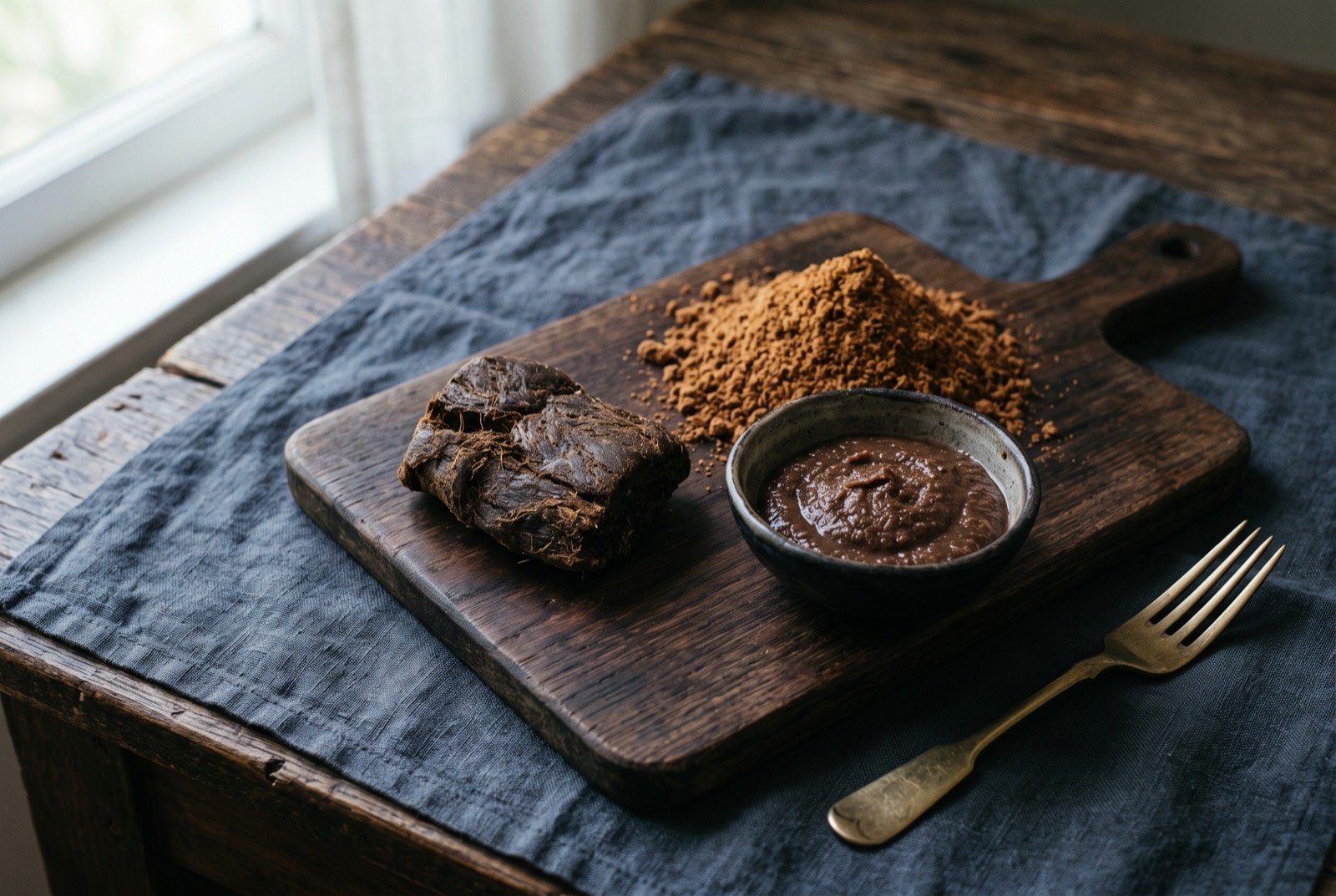
An illustration of the dish, not a photograph of it cooked.
- Researched
- 36 sources cited
- Reviewed
- Not yet reviewed from inside the tradition
- Cooked
- Not yet cooked and reported
Ripe pandanus fruit is cooked in the um, crushed and scraped, then spread on leaves and sun-dried over several days into a paste, te tuae, eaten as is, tasting something like a dense dried date or fig, often served with coconut cream. Pandanus paste, Wikipedia Taken a stage further, the dried paste is baked again in the um and pounded into te kabubu, a dry flour stored indefinitely and mixed with water as needed, eaten as a paste or drunk as a gruel. Because both the paste and the flour keep for months to years, this is the closest thing the atoll diet has to a true food reserve, historically carried on long inter-island voyages and relied on when babai pits and garden crops fail but pandanus, deep-rooted and salt-tolerant, keeps bearing. One tourism-adjacent source uses "te bero" for what other sources call "te tuae," without explaining whether this is a dialect variant, a different stage of the same product, or a source error; this chapter has not resolved that discrepancy and names it rather than silently picking one term as correct.
As tradition built it
Makes a store cupboard batch. Several days of sun drying for te tuae, then a second baking and pounding to flour; no source gives an exact time for either stage.
Ingredients
No written recipe exists for te kabubu: the dried pandanus is re dried and pounded by cue, and the chapter gives the method as it is told in Kiribati.
- ripe pandanus fruit
- as available leaves, for drying the pulp on
- to serve coconut cream, to serve
Method
- Cook ripe pandanus fruit for an extended period in the um.
- Crush and scrape to extract the pulp, discarding the fibrous core.
- Spread the pulp thinly on leaves and sun-dry over several days, turning periodically, to make te tuae.
- For te kabubu, bake the dried te tuae a second time in the um, then pound to a fine, dry flour.
- Store the flour dry; mix with water as needed, eaten as a paste or drunk as a gruel, or serve the paste stage, te tuae, with coconut cream.
What a modern chef changes
The same two-stage logic as jāānkun, given the same controlled treatment
Rungs 2 and 3
Method
- **Dry the pandanus pulp in a dehydrator** at a controlled low temperature for te tuae, rather than an open sun dry. Rung 2.
- **Second-bake in a stabilised Big Green Egg, then reduce to flour in a high-power blender and finish in a spice grinder**, reproducing te kabubu's second cooking and pounding with far more consistency and speed than the hand method. Rung 3.
- **Serve both stages side by side**, the whole te tuae paste with coconut cream and the te kabubu gruel, making the two-part technology visible on the plate rather than presenting only the more finished, more portable end state.