Melanesia, Micronesia and Polynesia · Volume 11, The Imu, the Camp and the Plate Lunch
Poi
Native Hawaiian
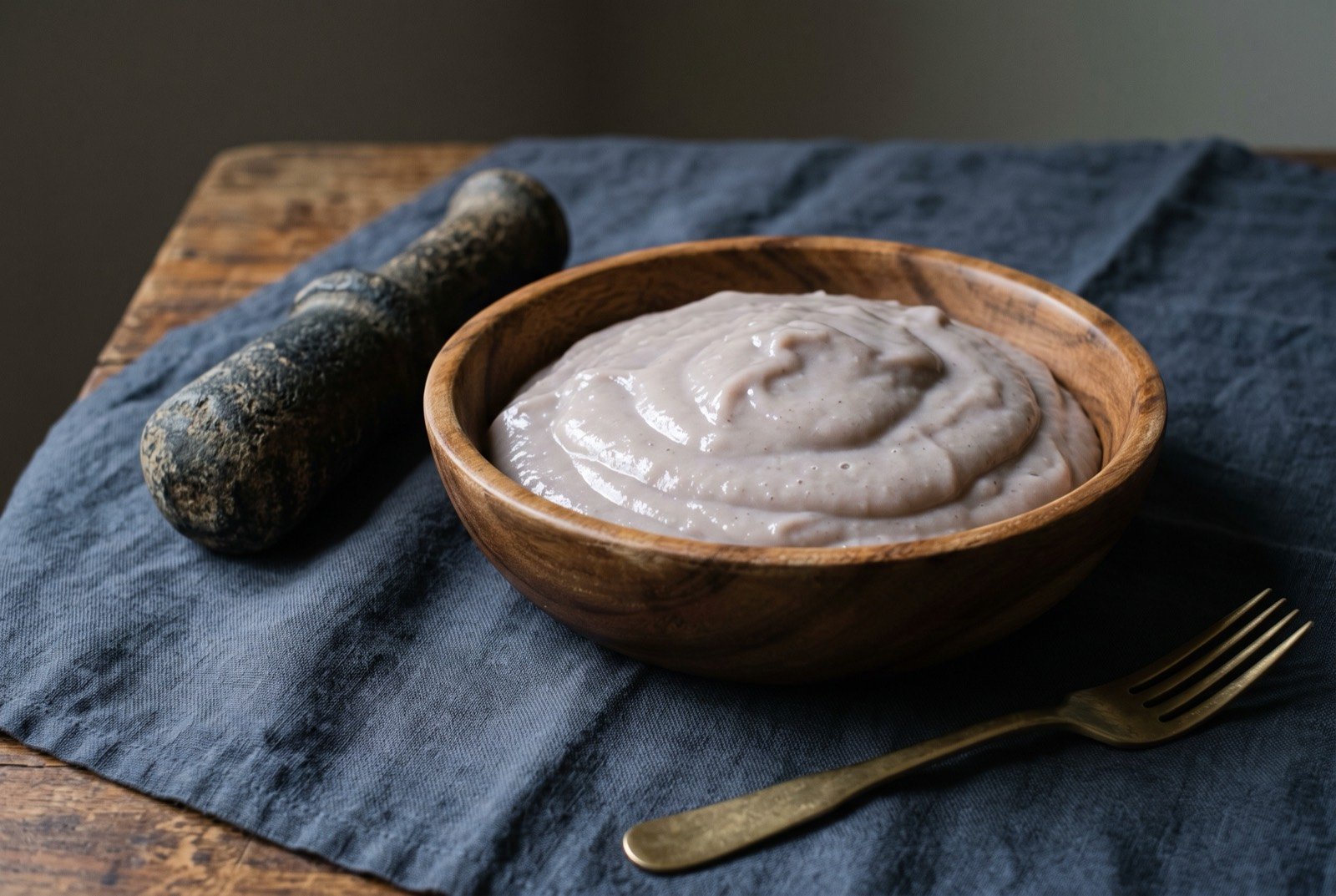
An illustration of the dish, not a photograph of it cooked.
- Time
- Not statedNo source states a time and the atlas has too few comparable dishes to estimate one.
- Reviewed
- Not yet reviewed from inside the tradition
- Cooked
- Not yet cooked and reported
Steamed kalo corms pounded on a stone board into paʻiʻai, then thinned with water into poi and left to sour at room temperature. One well-attributed oral account, kumu hula Edith Kanakaʻole serving "the most sour poi I've ever seen" to activist George Helm and a young Leimomi Apoliona in the 1970s, describes the custom of eating it communally, fingers in a shared bowl, and the belief that "you couldn't be mad at your company eating this way." That account is genuine and specific; this chapter does not extend it into a general rule beyond the one attributed telling.
As tradition built it
Makes about 1 kg. 2 to 3 days including fermentation.
Ingredients
- 1 kg fresh taro (kalo) corms, correct species Colocasia esculenta, peeled
- as needed water, as needed
Method
- Steam the peeled taro corms whole or in large pieces for 45 minutes to 1 hour, until a skewer meets no resistance.
- While still warm, pound on a heavy board with a stone or wooden pounder, working systematically until the fibre fully breaks down into a smooth mass. This is real physical labour and takes considerably longer than it looks like it should, 20 to 30 minutes of steady pounding for a home quantity.
- Work in water gradually until you reach a thick, spreadable paste, this is paʻiʻai, good eaten fresh.
- For poi proper, thin further with water to a pourable consistency, cover loosely, and leave at room temperature 2 to 3 days, tasting daily, until it reaches the sourness you want.
What a modern chef changes
The pounding mechanised, the fermentation held at a controlled temperature rather than left to the room.
Rung 3
Method
- Pulse the steamed corms in a high-power blender with only as much water as needed to move the blades, in short bursts rather than one continuous run, to approximate the stone pounder's shearing action without simply liquidising the fibre into a puree with a different texture.
- Ferment in a small, temperature-controlled chamber or a low oven with the door ajar, held around 25 to 28°C, rather than at the mercy of a British kitchen's cooler ambient temperature, for a fermentation that reaches the same two-to-three-day tang a Hawaiian kitchen gets for free.
- State the substitution honestly: correct-species taro (sold in Britain as eddoe or dasheen, see Sourcing in Britain) genuinely works for this; do not use a Xanthosoma "cocoyam," which is a different plant with a different starch structure.