Melanesia, Micronesia and Polynesia · Volume 12, The Umu, the Mission and the Sunday Table
Palusami
Samoa
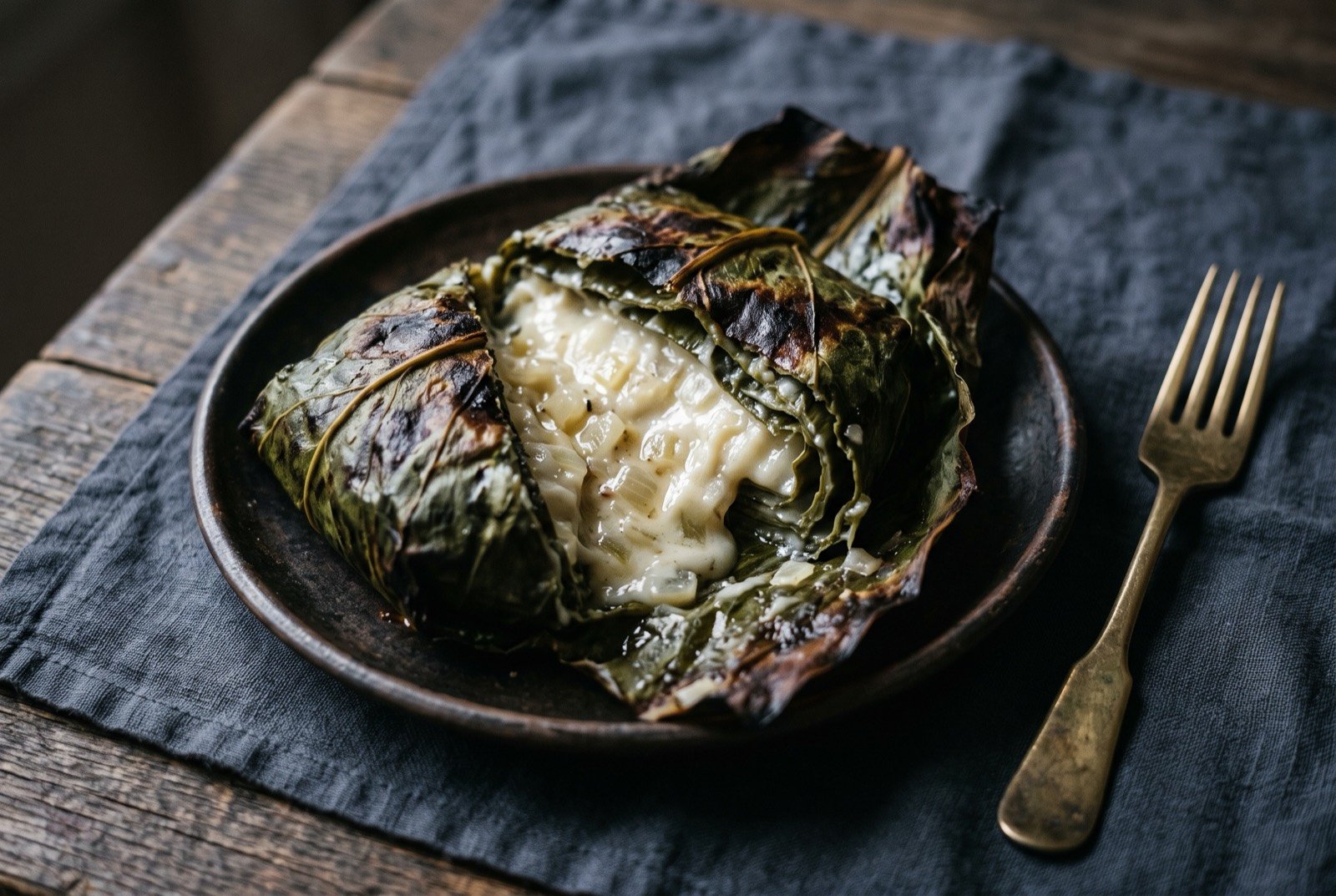
An illustration of the dish, not a photograph of it cooked.
- Time
- 1 hour
- Researched
- 29 sources cited
- Reviewed
- Not yet reviewed from inside the tradition
- Cooked
- Not yet cooked and reported
Coconut cream, onion and sometimes corned beef are wrapped inside young, tender taro leaves, themselves parcelled inside a second, tougher outer layer, and baked in the umu or a conventional oven until the leaf has softened fully and the cream inside has set into a rich curd. No source found in this research gives an exact leaf count or a precise ratio of cream to leaf from a named Samoan cook; this chapter reports the documented mechanism honestly rather than inventing a false-precision recipe. Polynesian Cultural Center, "Easy Palusami Recipe", used here only for mechanics, not cultural interpretation, since it is a Laie, Hawaii tourist attraction rather than a Samoan cultural authority.
As tradition built it
About 1 hour
Ingredients
- as available young, tender taro leaves, for the inner wrapping
- as available tougher, larger taro leaves, for the outer wrapping
- 2 x 400ml tins coconut cream
- 1 medium to large onion, finely diced
- 1 tin (400g), optional corned beef, optional
Method
- Select young, tender taro leaves for the inner wrapping and tougher, larger leaves for the outer layer.
- Fill the inner leaves with coconut cream, finely diced onion, and, if using, corned beef.
- Fold the inner leaves closed around the filling, then wrap the whole parcel in the outer, tougher leaves.
- Bake in the umu, or a conventional oven, for around an hour, until the leaf has fully softened and the coconut cream has set.
What a modern chef changes
After Michael Meredith at Metita and Monica Galetti at Mere, both of whom kept the leaf-and-cream parcel structurally exact while changing what it accompanies.
Rungs 3 and 4
Method
- Blanch and shock the inner leaves properly, timed rather than eyeballed, before they ever meet the filling. Rung 3.
- Treat the finished parcel as a modular component, built to sit beside a single named protein, whether a rib eye or a piece of offal, rather than only as the traditional whole-dish, family-style format.
- Reduce the coconut cream slightly before it goes into the parcel, a small departure from the raw-pour tradition, giving a single-portion plate a slightly more concentrated curd once baked. Rung 4.
Notes
At Metita, palusami is served as the accompaniment to a 900-gram Royalburn Station beef rib eye rather than as its own communal dish, the parcel's structural content unchanged. Broadsheet, "Metita" At Mere in Fitzrovia, now closed, Monica Galetti's version incorporated roasted veal sweetbread and smoky Morteau sausage into the taro-leaf-and-coconut-cream base, French charcuterie folded into an unchanged Samoan structural method rather than the other way round. Dinner and a Movie, "Mere Restaurant from Monica Galetti"