Asia · Volume 14
Sindh, Balochistan and the Frontier
The Langar, the Spit and a Coast Without a Restaurant
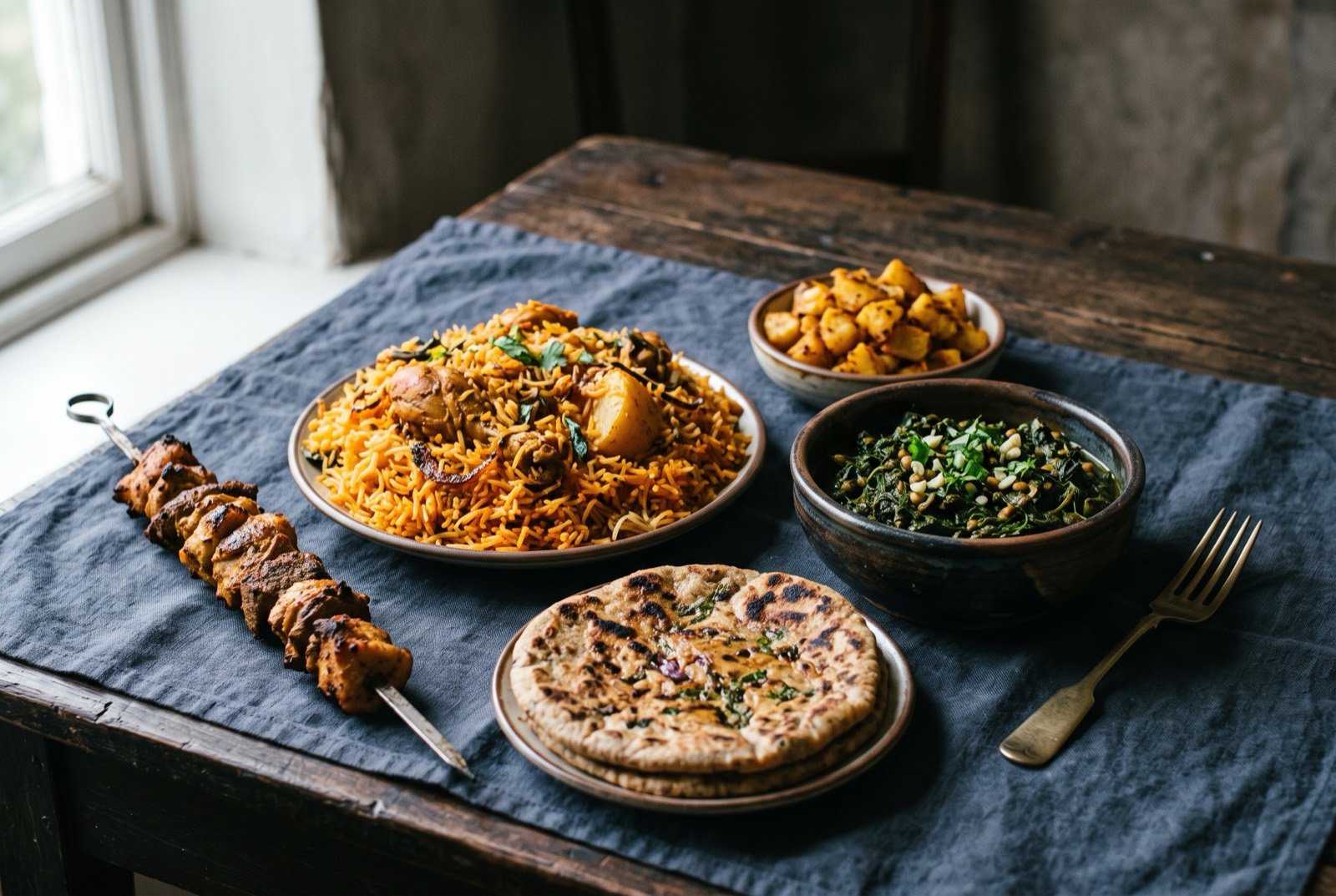
Sindh, Balochistan and Khyber Pakhtunkhwa, the Frontier, taken seriously: not Punjab's curry-house shadow but three separate food worlds bound together only by what they are not. The Indus delta's devotional fish and stacked-sour biryani, Balochistan's salt-and-ember whole-animal roasting, and the Frontier's wheat, walnut and cross-border kitchen, and every dish as tradition built it, then what a modern chef would change.
Sources and review · What this chapter does not assert · How we research · Spotted something wrong?
A Sense of Place
Pakistan beyond Punjab is not one country's regional footnote, it is three separate food worlds sharing a border on a map and very little else. Draw a line down from the Sulaiman range to the Arabian Sea and Sindh sits on the alluvial floodplain of one river, the Indus, its whole food logic built on what a river delivers: silt-fed wheat and rice, wetland vegetables, a migratory fish so bound up with the province's own idea of itself that its near-disappearance reads, in Sindhi writing, as an ecological grief rather than a market shortage. West and north of Sindh, Balochistan is the opposite ecology entirely: Pakistan's largest province by land and its driest and least populated, a pastoral world of camel, sheep and goat herded across a landscape too arid for anything but the toughest wheat and, on its terraces, some of the country's best dates. Its Makran coast, 634 kilometres of it, over 60 percent of Pakistan's entire coastline, is a third ecology again, a fishing economy that has more in common with the Gulf's dhow trade than with the Baloch interior's herding camps. And the Frontier, Khyber Pakhtunkhwa and the old tribal districts along the Durand Line, is neither of those: a hill and valley world where Pashtun cooking runs on wheat, walnut and whole-animal grilling, its kitchen vocabulary shaped as much by what crosses from Afghanistan as by what grows on the Pakistani side of a border that, for the people who live along it, has never fully closed.
What holds these three worlds together in one volume is not a shared cuisine, it is a shared exclusion. This is what Pakistan looks like once Punjab's wheat-and-dairy heartland and Kashmir's mountain valleys are set aside: everything that is not the country's demographic and culinary centre of gravity, and everything that the curry house diaspora in Britain, overwhelmingly built by Punjabi and Mirpuri Kashmiri migration, never carried west. A British reader who thinks he knows Pakistani food, from balti houses and karahi joints, has almost certainly never eaten any of the three cuisines in this chapter.
A table of peoples, logic and dishes
| Region | Defining logic | The dishes that carry it |
|---|---|---|
| Sindh, the river plain | Indus silt, Sufi shrine culture, a migratory fish as devotional symbol | Sindhi biryani, sai bhaji, koki, palla/hilsa |
| Sindh, Karachi's coast | A displaced fishing tradition, invisible to any restaurant | seiyo, chilla, baphu (named, not treated as recipes here) |
| Balochistan, the pastoral interior | Whole-animal cookery, salt as the defining seasoning, near-total spice restraint | sajji, rosh, tabaheg/landhi |
| Balochistan, the Makran coast | An Indian Ocean fishing economy distinct from the interior | Balochi fish biryani, Gwadari halwa |
| Khyber Pakhtunkhwa, the Frontier | Wheat, walnut, whole-animal grilling, a cross-border kitchen | chapli kebab, Peshawari karahi, Peshawari naan, namkeen gosht |
The structural logic in each world is genuinely different. Sindh's fat is ghee, its souring agents are yoghurt, tomato and dried plum stacked together, its starch is wheat flatbread or rice depending on whether the meal is workday or festive. Balochistan's fat is the animal's own rendered tail and back fat, its seasoning is salt applied with real deliberation rather than absence of technique, its starch is kaak, a hard stone-baked bread built for portability across a nomadic landscape. The Frontier's fat runs to tallow and ghee both, its aromatics lean on pomegranate seed and coriander seed rather than the wetter yoghurt-forward marinades of the plains, and its starch, like Balochistan's, is wheat rather than rice, because rice is the plains' crop, not the hills'.
The History in Layers
The indigenous core
Wheat cultivation in this part of the subcontinent runs deeper than any empire that later claimed it. Mehrgarh, in the Kacchi plain on Balochistan's own eastern edge, is one of the earliest known farming and herding settlements in South Asia, and the Baloch and Pashtun wheat economies of today sit on several thousand years of continuous cultivation on the same ground. Sindh's own indigenous core is the Indus itself: a river civilisation whose food logic, silt-fed grain, wetland vegetable, migratory fish, predates every layer that followed it by millennia.
Trade and empire
Kayseri's counterpart in this chapter is Kalat and Kandahar: caravan cities on the roads that carried Central Asian, Persian and South Asian goods across the passes, which is the route Kabuli pulao actually travelled, not a native Frontier dish but an Afghan one, most plausibly originating near Afghanistan's own northern border with Uzbekistan rather than in Kabul at all, adopted into elite Persian court cuisine as "Afghan pulao" during Iran's dispute with Afghanistan over Herat, and from there into Pashtun cooking on both sides of the Durand Line through shared ethnicity, refugee movement and trade rather than by birthright. Mantu, the steamed dumpling under a yoghurt sauce that the Pashto-language Wikipedia lists among the Frontier's own signature dishes, tells the same story from the other direction, a Silk Road dumpling technology that belongs, in this atlas, to Uzbekistan and Tajikistan (see Volume AS-58, already written in full), but that genuinely sits on Pashtun tables too, an honoured guest rather than a native. This chapter names both plainly rather than quietly annexing them, in keeping with the atlas's own rule that a dish gets one full home and a cross-link everywhere else it is truly eaten.
Religion and ritual
Sindh's is the layer most worth understanding properly, because it is misread as folklore when it is closer to infrastructure. The shrine of Lal Shahbaz Qalandar at Sehwan Sharif draws roughly a million pilgrims a year, and its langar operates at a scale that has nothing folkloric about it: one tandoor alone has been reported using around 1.6 tonnes of flour a day, enough for close to 5,000 rotis, entirely privately funded, feeding by local estimate close to half the town. Bhit Shah, the shrine of the Sindhi poet-saint Shah Abdul Latif, draws a comparable crowd during its own three-day urs, its langar described in the academic literature as serving pilgrims "regardless of religion or status." Before Partition, and in a diminished but real way after it, this hospitality culture was genuinely interfaith: at Sukkur, Hindus and Muslims worshipped jointly at the river shrine of Khwaja Khizr, known locally as Zindapir, "the water king," until an 1880s colonial court judgment split a previously unified practice into separate sites. Fish-and-rice niaz, holy food distributed to pilgrims, was served at these riverside festivals, a direct thread between the sacred and the ordinary catch of the river. This chapter has not found a source that states outright that Sindh's wider reputation for hospitality, mehmaan nawazi, descends causally from this shrine culture, so that connection is offered here as this chapter's own reading of the evidence, not a settled historical claim.
The colonial economy, and what it broke
The Sukkur Barrage, completed in 1932, and the Kotri Barrage, completed in 1954, were built to irrigate Sindh's cotton and wheat economy, and they worked, at the direct cost of the palla, the Indus hilsa that once ran as far upriver as Multan to spawn. The species does not attempt to cross a barrier, so the barrages simply ended its historic migration, confining it to the stretches of river between dams and turning what was once a seasonal event, described by Sindhis as their river's own devotional visitor, into something increasingly rare even in Hyderabad, the city that once emptied out to meet it.
The modern moment, honestly
Partition is the modern layer that shapes this chapter most directly, and it does not shape Sindh's food the way it shaped Punjab's, by moving the border through the middle of a shared kitchen. It removed a whole community from Sindh's kitchen and left its food behind. Roughly 1.2 million Hindu Sindhis left Sindh in 1947, overwhelmingly for India, with further dispersal worldwide, and unlike Punjab's or Bengal's Hindu refugees, they did not retain a Sindh-shaped home region to relocate to as a bloc. Writers from inside that diaspora, Rita Kothari, Pooja Makhijani, Samira Sawlani among them, describe food as doing memorial work for a community with no territory to return to, in Makhijani's own words "a cuisine without a country." Sai bhaji, dal pakwan, koki, Sindhi biryani, kadhi, aloo tuk, all of it lives in both Muslim Sindh today and in that scattered Hindu diaspora, sharing a common root but no longer one undivided lived tradition, and this chapter has tried to say, each time, which of the two threads a given claim actually belongs to.
The most important modern-moment finding this chapter can offer is a negative one, and it deserves to be stated as plainly as a positive claim would be. Karachi's actual indigenous coastal cuisine, built by the Sindhi- and Baloch-speaking fishing communities who worked this coast before Partition, dishes named seiyo, chilla and baphu, exists today in no restaurant at all. Journalist Ahmer Naqvi's 2023 investigation for New Lines Magazine, reporting from fishing communities including Ibrahim Hyderi and drawing on named fisherfolk activists, found that this cooking survives only in fisherfolk homes, because the people who made it have been physically and economically displaced from Karachi's own waterfront since Partition. Karachi has fine dining now, none of it built on this food. It has a casual sajji boom, spreading fast and cheap through delivery apps, none of it reinventing the dish. What Karachi does not yet have, anywhere this research could find, is a kitchen bringing indigenous Sindhi or Baloch coastal technique to the level of ambition this atlas asks of every volume it treats. That gap is this chapter's honest starting point, not something to write around.
The Flavour Arsenal
Seeds, pods and souring agents
| Ingredient | What it does |
|---|---|
| Danu khatta / anardana (dried pomegranate seed) | Sindh and the Frontier's dry souring agent, ground into koki and chapli kebab alike, whole in chutney, tart without adding liquid |
| Shahjeero (caraway, Carum carvi) | Sindhi biryani's earthy, smoky base note, routinely mislabelled "black cumin" on UK packaging though it is botanically caraway |
| Amchur (dried mango powder) | A second, sharper acid finish over Sindh's built-in sourness, used at the very end rather than cooked in |
| Aloo bukhara (dried sour plum) | Sindhi biryani's third and defining souring layer, rehydrated and stirred through the gravy rather than left as a garnish |
Leaves and greens
| Ingredient | What it does |
|---|---|
| Khatta paalak (sour-leaved spinach) | Sai bhaji's defining green when available, contributing sourness as well as bulk |
| Suva/sua (dill) and methi (fenugreek leaf) | The second and third greens in a proper sai bhaji, adding aniseed lift and bitterness against the spinach |
Sarson-adjacent bitterness is largely absent here; Sindh's green cooking runs on sourness, not the mustard-forward register of Punjab to its north.
Ferments and preserved proteins
| Ingredient | What it does |
|---|---|
| Landhi / tabaheg / siyala (wind-dried meat) | Balochistan and the Frontier's winter pantry meat, three regional names for close variants of one preservation technique, see the Ferment and Preserve Bench below |
| Palla / hilsa (Tenualosa ilisha) | Not preserved but seasonal and devotional, the Indus's own migratory fish, now scarce even fresh |
Chillies and heat
| Ingredient | What it does |
|---|---|
| Green chilli, fresh | The dominant heat source across all three sub-regions, used chopped rather than as dried powder, in chapli kebab, namkeen gosht and Sindh's everyday cooking alike |
| Kashmiri chilli, dried | Colour more than fierce heat, in Sindhi biryani's spice base |
Starches and staples
| Ingredient | What it does |
|---|---|
| Wheat (atta) | The Frontier and Balochistan's staple grain, and Sindh's everyday flatbread grain (koki, mani) even where rice carries the festive meal |
| Basmati rice | Sindh's festive and biryani grain, aged and long enough to survive dum steaming without breaking |
| Chana (chickpea, as channa dal) | Sai bhaji's base pulse and dal pakwan's spread, Sindh's everyday lentil of record |
| Dates | Balochistan's own crop rather than an import, the province supplying roughly half of Pakistan's national output from Kharan, Washuk, Panjgur and Kech across some 130 named varieties |
| Bhee (lotus stem) and phoolpatasha (lotus seed) | Interior Sindh's own wetland vegetables, indigenous rather than imported novelties |
The Technique Ladder
Rung 1. Salt as the whole seasoning, not the absence of one
Balochi sajji is salted, sometimes with a little oil to help the salt adhere, and nothing more. This reads to an outsider as simplicity, but a named Balochi voice, the literary figure Panah Baloch, describes the wider cuisine as built on "mild aromatic spices, less oil" rather than an absence of seasoning as doctrine, and the salt-only treatment of sajji specifically is a deliberate technique choice, not a lack of one: it lets the animal's own fat and the fire's smoke do the flavouring work that a spice rub would otherwise crowd out.
Rung 2. Radiant, indirect-heat spit roasting
Sajji's meat is planted upright around the perimeter of a ring of embers, cooking from the side rather than held over direct flame or set on a grill. This is genuinely different from barbecue in the Western sense: the meat never sits in the fire's hottest zone, and the two- to four-hour cook time this produces is long and gentle enough to render fat slowly without ever scorching the surface before the interior catches up.
Rung 3. The bhuna marker
Karahi cooking, whether Peshawari or elsewhere on the subcontinent, is gated by a visible signal rather than a clock: the tomato-ginger-garlic-chilli masala is cooked on high heat until the oil visibly separates back out from the paste, the marker that the raw spice smell has cooked off and the base has reached its full depth. This is a sensory checkpoint a good cook learns to read, not a timed step.
Rung 4. Rendered fat as both binder and cooking medium
Chapli kebab's crisp, cracked edge and moist centre depend specifically on rendered tallow or butter, not neutral oil, worked into the mince and used again in the pan. A leaner, oil-only version of the same recipe is missing the mechanism that makes the dish work, not simply a lighter version of it.
Rung 5. Stacked, sequential souring
Sindhi biryani's tartness is built in three separate moves rather than one squeeze of acid at the end: sour yoghurt in the marinade, charred tomato in the base, and rehydrated dried plums stirred through the gravy, balanced against a small deliberate pinch of sugar so the result reads as complex rather than simply sharp.
Rung 6. Dum sealing, trapped steam finishing
A rope of kneaded atta dough presses an airtight seal around the rim of the pot, so the last stage of cooking rice or a whole biryani happens on trapped, condensing steam as much as on direct stovetop heat, carrying the base masala's aroma up through every grain rather than leaving it pooled at the bottom.
The Ferment and Preserve Bench
This volume has one preserve worth calling a bench, not several, and it needs a correction stated plainly before anything else: landhi is not a Sindhi ingredient, despite an early planning error in this atlas's own working notes that placed it there. Every source this chapter's research could find, independently across two separate research streams, locates it firmly in Balochistan and the Pashtun frontier.
1. Landhi / tabaheg / siyala
A whole animal, goat, sheep, occasionally beef or camel, sliced into thin sheets, coated in salt and pomegranate powder, and sun-dried under fine mesh cloth for around ten days, the naming splitting by region: tabaheg in the Makran area, siyala or landhi in Barkhan, Dera Bugti, Kohlu and the country around them. Made specifically in the cold, dry months of December and January, when the weather itself supplies the drying conditions and the season coincides with peak fresh-meat availability after slaughter. The meat is first lightly roasted so surface fat melts into the flesh, then salted, rubbed with herbs and, critically, asafoetida, which works as a preservative in areas with no refrigeration, then pierced and hung on wooden bars or rope in a shaded, cold, dry-air yard for roughly two weeks to a month depending on conditions. To eat, it is boiled first specifically to wash off the excess salt and asafoetida, then cooked again, typically pressure-cooked, as a karahi-style curry, with rice, or as a soup with torn bread.
This chapter will not give landhi as a home recipe, and says so rather than quietly smoothing over the gap. Every source describing it depends on ambient cold, dry air held steady over two to four weeks, with no stated temperature or humidity control and no documented food safety data for a home kitchen attempting the same unrefrigerated, multi-week cure. A British cook wanting the genuine article should treat it as a dish to read about and, if the chance arises, eat in Balochistan or from a Pakistani cook who has made it before, not as a recipe to follow blind. A cook who wants the flavour idea behind it, salt-cured, air-dried lamb, is better served building a proper charcuterie-grade cure under refrigeration and a dehydrator, understanding plainly that the result is a modernist analogue inspired by landhi, not landhi itself.
Sourcing in Britain
Most of this chapter's staples are genuinely easy. Atta (Elephant, the dominant UK brand since 1962), besan (Natco, TRS), basmati suited to a proper Sindhi biryani's dum steam (Tilda, Laila, Daawat, the last aged two years and marketed on grain length), Shan and National's packaged Pakistani masalas, and dried dates (Aseel, a Pakistan-origin brand delivering UK-wide) are all stocked by mainstream South Asian grocers and a wide field of UK online retailers: The Asian Cookshop, Veena's, Quality Foods Online, SaveCo Online, Healthy Halal. Danu khatta is simply anardana under a different name, sold by essentially every UK Indian or Pakistani spice retailer, Sous Chef among them, though no shop uses the Sindhi term on its packaging, so search "anardana." Shahjeero is available too, from QURA on Amazon UK and The Asian Cookshop, with one real caveat: it is routinely mislabelled "black cumin" on English packaging when it is botanically caraway, so buying on the Latin name, Carum carvi, avoids the wrong jar arriving.
Whole halal lamb and goat, needed for a genuine sajji, is a solved problem, not a compromise: Healthy Halal, eFoods Direct, London Grocery, Salam Halal Butchers, and the wholesale trade suppliers IMS of Smithfield and Romford Halal Meats all sell whole or half animals and are used to non-standard requests, though none advertises a "sajji cut" by name, so asking the butcher directly to prepare a whole carcass or a leg and shoulder halved for skewering is the way in. A proper tandoor for naan is a real UK retail category rather than a niche import problem, with four named specialists, PURI Tandoors, Tandoor Store UK & Ireland, Baba Clay Ovens and Tandoor Master, selling home-sized clay ovens from roughly £300 to £600 and up. A Big Green Egg Large or XL, fitted with the official rotisserie attachment, is a genuinely credible sajji setup, well documented for a leg of lamb though not, this research found, for a genuinely whole carcass, which should be attempted as an adaptation rather than trusted as an established method on first try.
Palla, the fish Sindhi writing treats as close to sacred, is confirmed the same species as the hilsa or ilish sold by UK Bangladeshi grocers, Tenualosa ilisha, and buying frozen "ilish" or "Padma Hilsha" from efoodsdirect, Green Oranges or Grocee is a genuinely correct substitute, not an approximation dressed up as one. The honest caveat belongs alongside the recommendation rather than after it: the specific Indus-caught fish Sindhi writers eulogise has itself become scarce in Pakistan since the barrages, so a British cook buying Bangladeshi-caught ilish is arguably closer to what most people in Karachi actually eat today than to the river fish of Sindhi folklore.
Three items resist this chapter's usual confidence. Guchhi, the dried Himalayan morel occasionally named as a Sindh trade good, turns out on checking not to be verified as a Sindhi ingredient at all, only a Kashmiri one, and even setting that correction aside, no established UK specialist retailer stocking it could be found, only individual eBay listings from Kashmir-linked sellers; dried porcini or a European dried morel, honestly flagged as a different flavour rather than a hidden equivalent, is the better move. Dhingri, dried oyster mushroom, has the same problem in reverse: no UK retailer at all, only Indian marketplace listings, and since fresh oyster mushrooms are everywhere in British supermarkets and this reader owns a dehydrator, drying your own is the honest answer rather than chasing an import. Fresh bhee, lotus stem, is not established for direct UK delivery either; East and Southeast Asian grocers, which stock the same root for Chinese and Vietnamese cooking, are the realistic route, though this needs checking city by city rather than assumed.
Voices and Sources
- Sumayya Usmani, Karachi-born and Scotland-based, wrote Summers Under the Tamarind Tree (2016), the first Pakistani cookbook published in Britain and a Gourmand Best First Cookbook winner, spanning Punjab, Sindh, Balochistan and Azad Kashmir with named dishes including Sindhi mutton biryani and Baluchi chicken sajji; she is this chapter's single strongest in-tradition diaspora authority.
- Fatima Ali (1989 to 2019), Karachi and Lahore-raised, Culinary Institute of America-trained and a Top Chef: Colorado 2017 contestant, stated an explicit ambition to "pioneer eclectic, modern Pakistani cuisine" before her death; her project, pan-Pakistani rather than regional, never matured into a named restaurant, and this chapter names that honestly as an interrupted rather than a realised ambition.
- Sahar Habib Ghazi, a journalist writing from Pakistani-Afghan family history, produced the single most rigorously tested chapli kebab recipe this research found, distinguishing "ghar" home cooking from "dhaba" roadside cooking with real technical precision.
- Panah Baloch, a Balochi literary figure, is the strongest genuinely in-tradition Balochi voice this chapter located, writing for The Baloch News on the actual character of Balochi cuisine rather than the outsider's flattened "no spice" version of it.
- Maryam Jillani, writing for DAWN, and Rita Kothari, Pooja Makhijani and Samira Sawlani, writing from inside the Hindu Sindhi diaspora, together carry this chapter's account of Sindhi food's post-Partition split into two living threads.
- Ahmer Naqvi's October 2023 New Lines Magazine investigation, reporting directly from Karachi's fishing communities, is the most important single piece of writing this chapter drew on, precisely because it documents an absence, the fact that Karachi's own indigenous coastal cuisine exists in no restaurant at all, rather than celebrating a presence.
- Namak Mandi in Tooting, London, trading since 2010 and named for Peshawar's own karahi district, is this chapter's one living UK reference point for the real thing done properly, not reinvented, faithfully transplanted Pashtun cooking rather than the flattened curry-house version most British readers will have actually eaten.
Things this chapter has deliberately not asserted
- That kokum is a Sindhi ingredient: every source found ties it specifically to Maharashtra's Konkan coast, and it has been dropped from this chapter's arsenal rather than repeated from the original planning checklist that named it in error.
- That guchhi and dhingri are historic Sindh trade goods: no source supports this, and it is not asserted here.
- That "seyal bhaji" is a distinct named dish rather than an instance of Sindh's general seyal, onion-braised, cooking mode: not independently verified as a discrete recipe.
- That Sindh's shrine langar culture causally produced the province's wider reputation for hospitality: plausible, and offered above as this chapter's own reading, but no source states the connection directly.
- That the exact distance or temperature a sajji skewer sits from its embers is known to any specific figure: sources agree on the geometry, a ring of embers and radiant side heat, but not a precise measurement, and this chapter has not invented one.
- That the order and exact ratio of Sindhi biryani's three souring agents is settled beyond dispute: the strongest sources for this specific detail were a spice-brand blog and a generalist recipe site, not a Pakistani or in-tradition text, and the order given above should be read as well-corroborated rather than as a definitively fixed formula.
- That dampukht is a technique with its own distinct, independently documented method separate from rosh: it is named constantly alongside sajji and rosh as an example of Baloch indirect-heat, low-spice cookery, but no source this research reached describes its actual mechanism in enough detail to write with confidence, and this chapter has left it named rather than pretended to a recipe it does not have.
- That Peshawari naan's own history, as opposed to its well-corroborated recipe, is documented: it is not, in any source this research reached.
- That "Kabab Nagman Pach" is a real, verifiable Baloch dish: it surfaced only via an unverifiable search synthesis and is not used here.
- That Makran's name definitively derives from "fish eaters": a single-source etymological claim, offered nowhere in this chapter as settled fact.
- That any Karachi restaurant, elevated or casual, has genuinely reworked the technique of sajji, Sindhi biryani, or any dish in this chapter, rather than changing its format, room or accessibility: the strongest candidate found, The East End, elevates access and staging, and no source describes a corresponding change in cooking method.
- That any restaurant or chef in the UK, the US or the Gulf is doing modernist, technique-forward Sindhi or Baloch cooking specifically: none was found; Namak Mandi's Pashtun cooking in Tooting is real, admirable and faithful, not reinvented.
- That Pakistan has any presence on Asia's 50 Best Restaurants or a comparable international list: none was found, a real absence though, being a negative result, one this chapter holds less absolutely than its positive claims.
- That Balochi-language food writing exists online at any real depth: it does not appear to, a genuine and, this chapter thinks, underappreciated finding in its own right, since even Balochi's own regional cuisine is documented online chiefly in Urdu and Persian rather than in Balochi itself.
Research briefs: AS-14-tradition.md and AS-14-modernist-sourcing.md. Sourcing verified September 2026.
Salt as the whole seasoning, not the absence of one
Balochi sajji is salted, sometimes with a little oil to help the salt adhere, and nothing more.
Radiant, indirect-heat spit roasting
Sajji's meat is planted upright around the perimeter of a ring of embers, cooking from the side rather than held over direct flame or set on a grill.
The bhuna marker
Karahi cooking, whether Peshawari or elsewhere on the subcontinent, is gated by a visible signal rather than a clock: the tomato-ginger-garlic-chilli masala is...
Rendered fat as both binder and cooking medium
Chapli kebab's crisp, cracked edge and moist centre depend specifically on rendered tallow or butter, not neutral oil, worked into the mince and used again in...
Stacked, sequential souring
Sindhi biryani's tartness is built in three separate moves rather than one squeeze of acid at the end: sour yoghurt in the marinade, charred tomato in the...
Dum sealing, trapped steam finishing
A rope of kneaded atta dough presses an airtight seal around the rim of the pot, so the last stage of cooking rice or a whole biryani happens on trapped...
The dishes
- Sajji Balochistan
- Chapli kebab Peshawar, Khyber Pakhtunkhwa
- Sindhi biryani Sindh
- Sai bhaji Sindh
- Balochi rosh Balochistan
- Sindhi koki Sindh
- Peshawari karahi Peshawar, Khyber Pakhtunkhwa
- Aloo tuk Sindh
Sources and review
- Reviewed
- Not yet reviewed from inside the tradition
- Cooked
- Not yet cooked and reported
Where this volume comes from
3 research briefs on file for this volume, researched to the rules on How we research. Published 4 September 2026. Last changed 12 September 2026.
The brief's own account of its sources
Sindhi-language search: what was tried, what worked, what did not. Real Sindhi-script queries were run (سنڌي بریاني ترڪاري ذائقو, سائي ڀاڄي سنڌي کاڌو, سيوهڻ شريف لعل شهباز قلندر لنگر, پلو مڇي سنڌو درياھ سکر, سنڌي پکوان ڪوڪي دال پکوڙا, ڀٽ شاھ شاھ عبداللطيف ڀٽائي لنگر ثقافت, آلو ٽڪ سنڌي کاڌو, سنڌ جو کاڌو ثقافت رويت, مهمان نوازي سنڌ ثقافت رويت کاڌو مهمان).