The Indian subcontinent · Volume 18, The Ilish, the Chhena and a Border the Kitchen Never Kept
Rasgulla
West Bengal
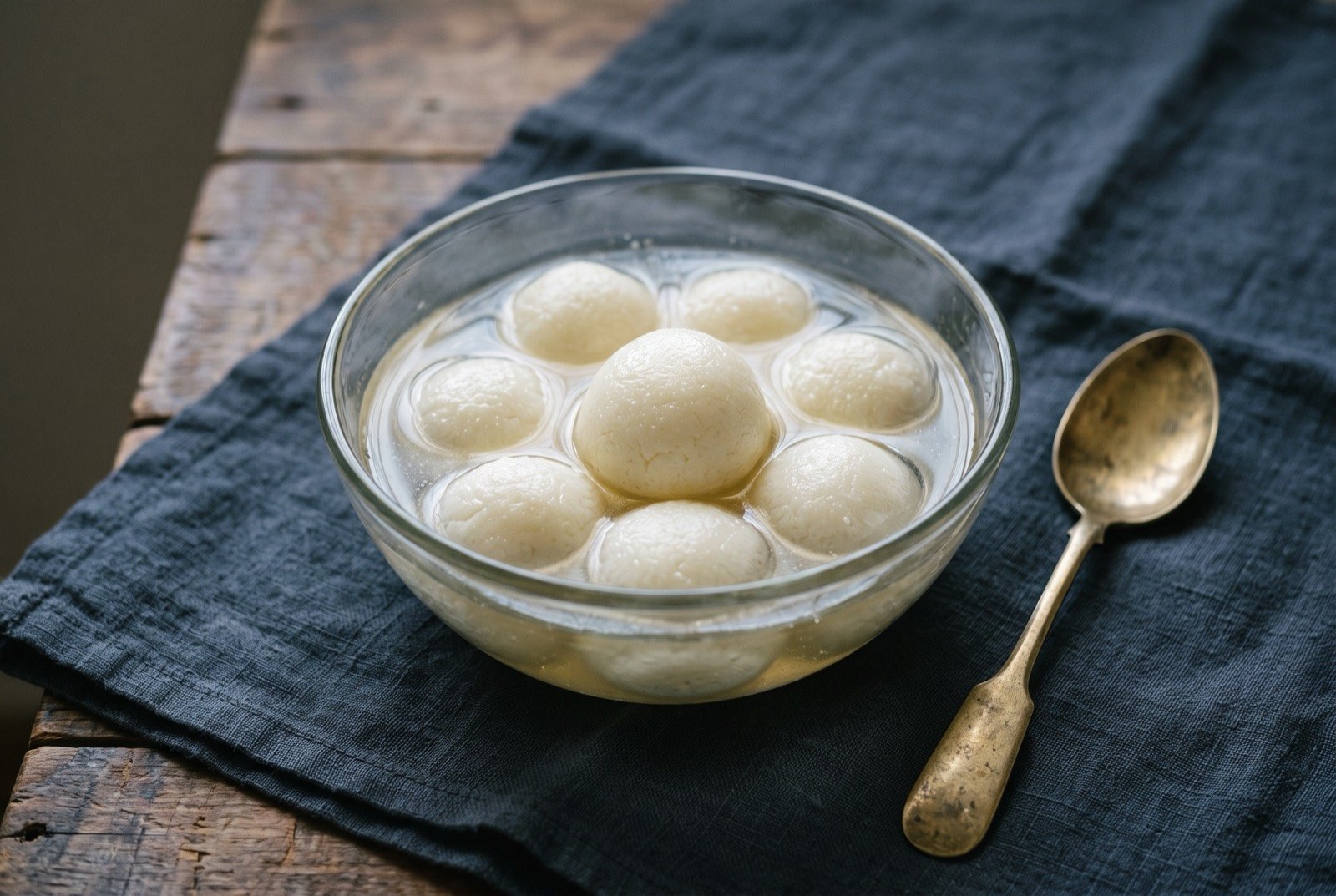
An illustration of the dish, not a photograph of it cooked.
- Time
- 1 hour
- Reviewed
- Not yet reviewed from inside the tradition
- Cooked
- Not yet cooked and reported
Chhena, kneaded smooth, shaped into balls and poached in sugar syrup until they double in size and turn light and spongy. The modern, spongy version is credited to Nabin Chandra Das of Kolkata; his son Krishna Chandra Das introduced vacuum tin-can packaging, reportedly India's first canned dessert, which let the sweet travel beyond the city for the first time. On 14 November 2017, India's Geographical Indications Registry granted West Bengal a GI tag specifically for "Banglar Rasogolla", covering the state's own particular style of the sweet, not the generic dessert as a category; Odisha had not filed its own application at that point but was free to, and has since obtained separate GI recognition for Odisha rasagola. Bangladesh, in turn, holds its own GI status for Gopalganj's rasgulla, a third distinct claim on the same sweet's name. The honest version of this story is that three flags now fly over one sweet, not that any one of them settled the matter.
As tradition built it
Makes about 20. Around 1 hour, once the chhena is made.
Ingredients
- 1 litre full-fat, non-UHT milk
- 2 tbsp lemon juice or white vinegar, or 1 tsp citric acid dissolved in a little warm water
- 1kg sugar
- 1 litre water
- to taste a few drops rosewater (optional)
Method
- Bring the milk to the boil, then add the acid gradually, stirring, until the curd separates cleanly and the whey runs clear, roughly 5 to 7 minutes at 80 to 85°C (Rung 1).
- Strain through muslin, rinse briefly under cold water to remove residual acid, and hang to drain 30 minutes.
- Knead the chhena by hand or in short pulses in a stand mixer or high-power blender, judging by touch rather than time, until smooth and faintly greasy and it holds together without cracking (Rung 1).
- Shape into smooth balls, free of cracks, roughly the size of a small walnut.
- Bring the sugar and water to a rolling boil. Slide in the balls and cook at a steady, rolling boil, covered, for 15 to 20 minutes, until they have roughly doubled in size and turned light and spongy. Add rosewater in the last minute if using.
- Cool in the syrup before serving, chilled or at room temperature.
Notes
No precise traditional quantities for rasgulla itself were sourced with full confidence; the ratios above follow the widely attested general method and the chhena-splitting chemistry described at Rung 1, and should be treated as a reliable indicative standard rather than one traced to a single named source.
What a modern chef changes
The knead judged, not guessed
Rung 1
Method
- Judge the curd's texture by touch at every stage, from the moment of splitting to the final knead, rather than by a fixed number of minutes, exactly as Rung 1 describes: this single discipline is what separates a properly light rasgulla from a hard, grainy one.
- Use a stand mixer's paddle attachment in short pulses, checking the texture by hand between each, for a more consistent knead than most home cooks achieve by hand alone.
- Serve one or two per portion, cold, with the syrup reduced separately to a light glaze rather than served swimming in the poaching liquid, a restrained, restaurant-table presentation rather than a change to the sweet itself.