The Indian subcontinent · Volume 18, The Ilish, the Chhena and a Border the Kitchen Never Kept
Sandesh
West Bengal
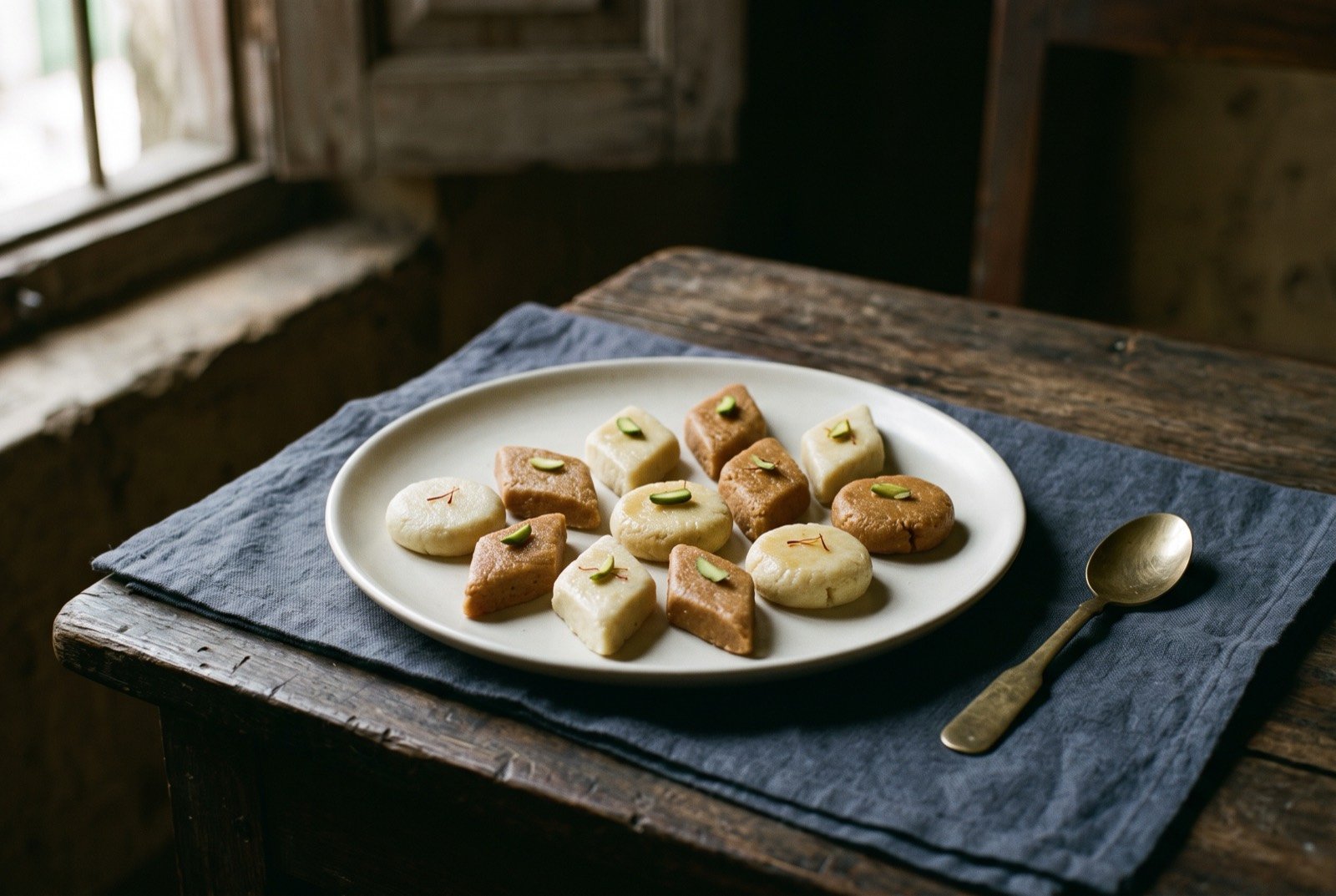
An illustration of the dish, not a photograph of it cooked.
- Time
- 30 minutes
- Reviewed
- Not yet reviewed from inside the tradition
- Cooked
- Not yet cooked and reported
Chhena cooked with sugar over direct heat until the sugar melts and the mixture turns slightly sticky, then pressed into a lightly ghee-greased tray or a carved wooden mould, cooled and cut, or shaped by hand and finished with pistachio and raisin. In winter the same chhena is worked instead with nolen gur, date-palm jaggery, for a seasonal version every historic Kolkata sweet house treats as a live specialty rather than a heritage curiosity: Bhim Chandra Nag, founded 1826 in Bou Bazar, whose founder's son created ledikeni, a fried chhena sweet, for Lady Canning's birthday in 1856; K.C. Das, on Esplanade East; Girish Ch. Dey & Nakur Ch. Nandy, "Nakur", founded 1844 in Hedua; and Balaram Mullick and Radharaman Mullick, founded 1885 in Bhowanipur, known today for gondhoraj lime sandesh alongside the classic nolen gur line.
As tradition built it
Makes about 15 pieces. About 30 minutes, once the chhena is made.
Ingredients
- 500g fresh chhena (see Dish 4, steps 1 to 3), well kneaded
- 100g sugar, or 100g nolen gur in winter
- 0.25 tsp ground cardamom
- to taste pistachio and raisin, to finish
Method
- Combine the kneaded chhena with the sugar or nolen gur and cardamom in a heavy pan.
- Cook over low to medium heat, stirring continuously, until the sugar melts fully and the mixture turns glossy and slightly sticky, pulling away from the pan's sides, roughly 8 to 10 minutes. Do not let it dry into a crumb; the point is a soft, cohesive paste (norom paak, soft-set), not a hard one.
- Press into a lightly ghee-greased tray, or shape by hand or in a carved wooden mould, while still warm.
- Cool fully before cutting into squares or diamonds. Finish with pistachio and raisin.
Notes
No precise traditional quantity ratio was found for sandesh; the ratio above follows the consistently described method, cooked chhena and sugar in roughly equal proportion by weight, and should be adjusted to taste and to how sweet the chhena's own base sugar or jaggery is.
What a modern chef changes
The paste judged as confectionery, not as a sauce
Rung 1, adapted
Method
- Cook in a wide, heavy-based pan over the lowest reliable heat, watching the mixture rather than the clock, since sandesh crosses from correctly soft-set to grainy and overcooked within a narrow window that a timer alone will not catch.
- Use nolen gur only in season, and say so on the plate, rather than reaching for a shelf-stable date jaggery substitute year-round and calling the result the same dish; the seasonal version's smoky, complex character is the entire point, not a flavour any other sweetener reproduces.
- Finish a portion with a shaving of frozen sandesh, made by pressing the warm paste thin and blast-freezing it, for a cold, clean-edged texture alongside the traditional soft, room-temperature piece, a genuine modernist contrast rather than a substitution.