The Indian subcontinent · Volume 18, The Ilish, the Chhena and a Border the Kitchen Never Kept
Panta bhat and panta-ilish
The whole delta
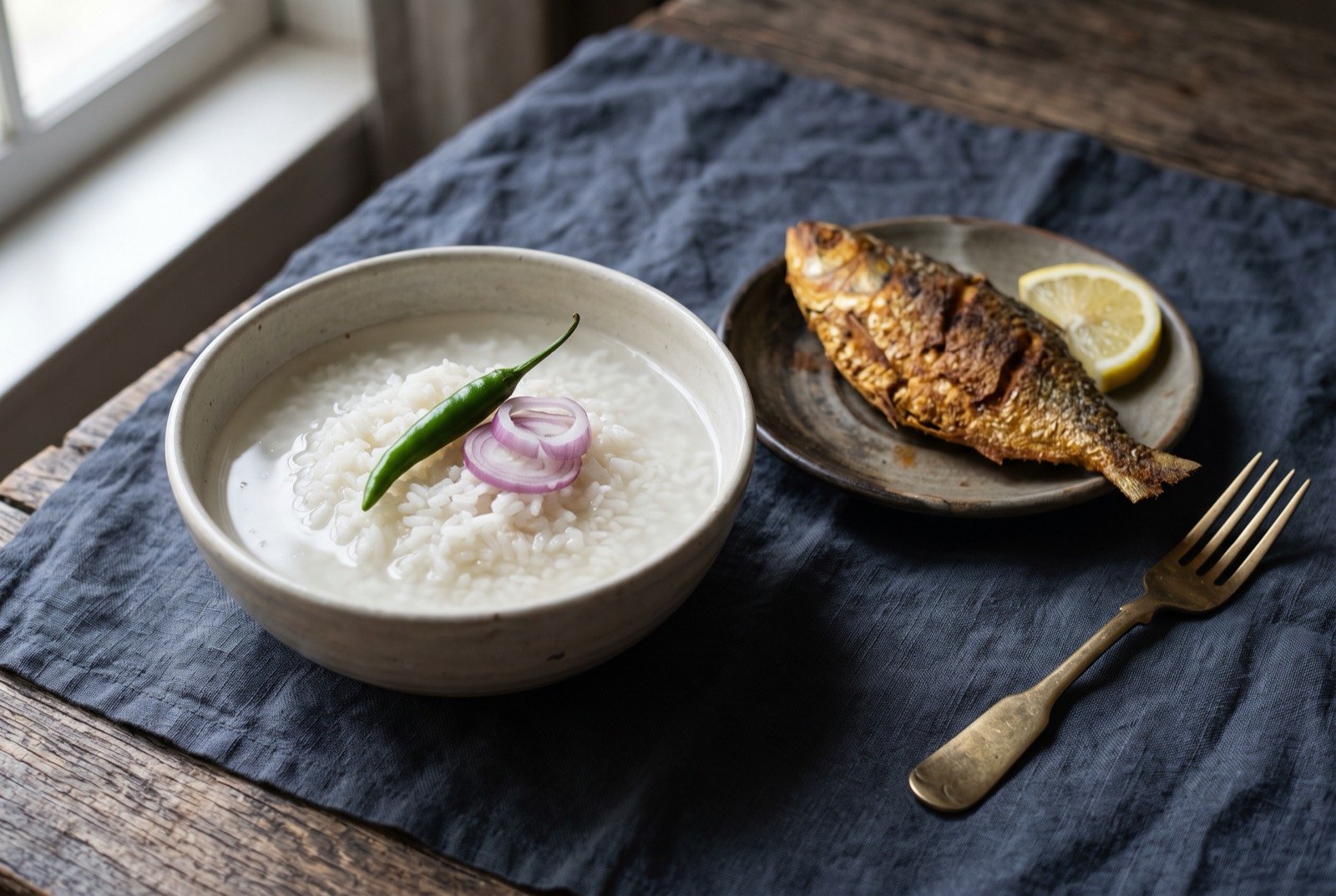
An illustration of the dish, not a photograph of it cooked.
- Time
- Hands on 10 minutes · Waiting 8 hours
- Reviewed
- Not yet reviewed from inside the tradition
- Cooked
- Not yet cooked and reported
Panta bhat, plain cooked rice left to soak in water overnight and eaten the next morning with salt, green chilli and raw onion, is old, ordinary agrarian breakfast food across the whole delta, nothing more than that for most of its history. The specific pairing of panta bhat with fried hilsa as an urban Pohela Boishakh, Bengali New Year, institution is not ancient at all: it began in the 1980s at Dhaka's Ramna Park, where a group of journalists and cultural activists serving each other fried hilsa alongside panta bhat on Boishakhi morning started a custom that spread nationally through the 1990s, reaching Chittagong's own DC Hill Park celebrations and beyond. This chapter treats it exactly as it has treated other debunked-modern-custom findings elsewhere in the atlas, fondue, boeuf bourguignon, stamppot and fårikål among them: real, popular, and recent, not timeless. There is a sharp irony sitting on top of the invented tradition too. Hilsa's rising price is now pricing the urban middle class out of the very panta-ilish custom their parents' generation popularised, a strain Bangladeshi press has covered directly as the tradition's own pocket-book crisis.
As tradition built it
Serves 4. About 10 minutes, plus overnight soaking.
Ingredients
- 4 portions cooked rice, day-old
- to cover water, to cover
- to taste salt
- 2 to 3 green chillies
- 1 small onion, sliced
- 4 pieces hilsa, fried whole or in pieces (see Dish 1 for the fish itself)
- 1, cut into wedges, to serve lemon, to serve
Method
- Cover the cooked rice generously with water and leave, loosely covered, at room temperature overnight.
- The next morning, serve the softened, faintly fermented rice cold, in its own soaking liquid, with salt, whole green chillies and sliced raw onion.
- Fry the hilsa pieces separately in a little oil until crisp at the edges, and serve alongside, with a wedge of lemon.
What a modern chef changes
The invented tradition, honoured rather than dressed up
Rung 5, adapted
Method
- Control the rice's fermentation deliberately, a controlled 12 to 16 hours at a set cool room temperature rather than an uncontrolled overnight soak, for a consistent, judged sourness rather than a result that depends on the weather.
- Fry the hilsa exactly to Rung 5's washing discipline, minimal water, minimal handling, so the fish carries its own fat and flavour cleanly into a dish whose other half is deliberately humble.
- Serve the two elements separately, not mixed, in the same unpretentious spirit the original Ramna Park gathering had, rather than plating panta-ilish as a composed, restaurant-style dish it was never meant to be: this is one of the few dishes in this whole atlas where the honest modernist move is restraint, not technique.