The Indian subcontinent · Volume 17, The Sealed Pot, the Ember and the Roasted Flour
Galouti kebab
Lucknow, Chowk
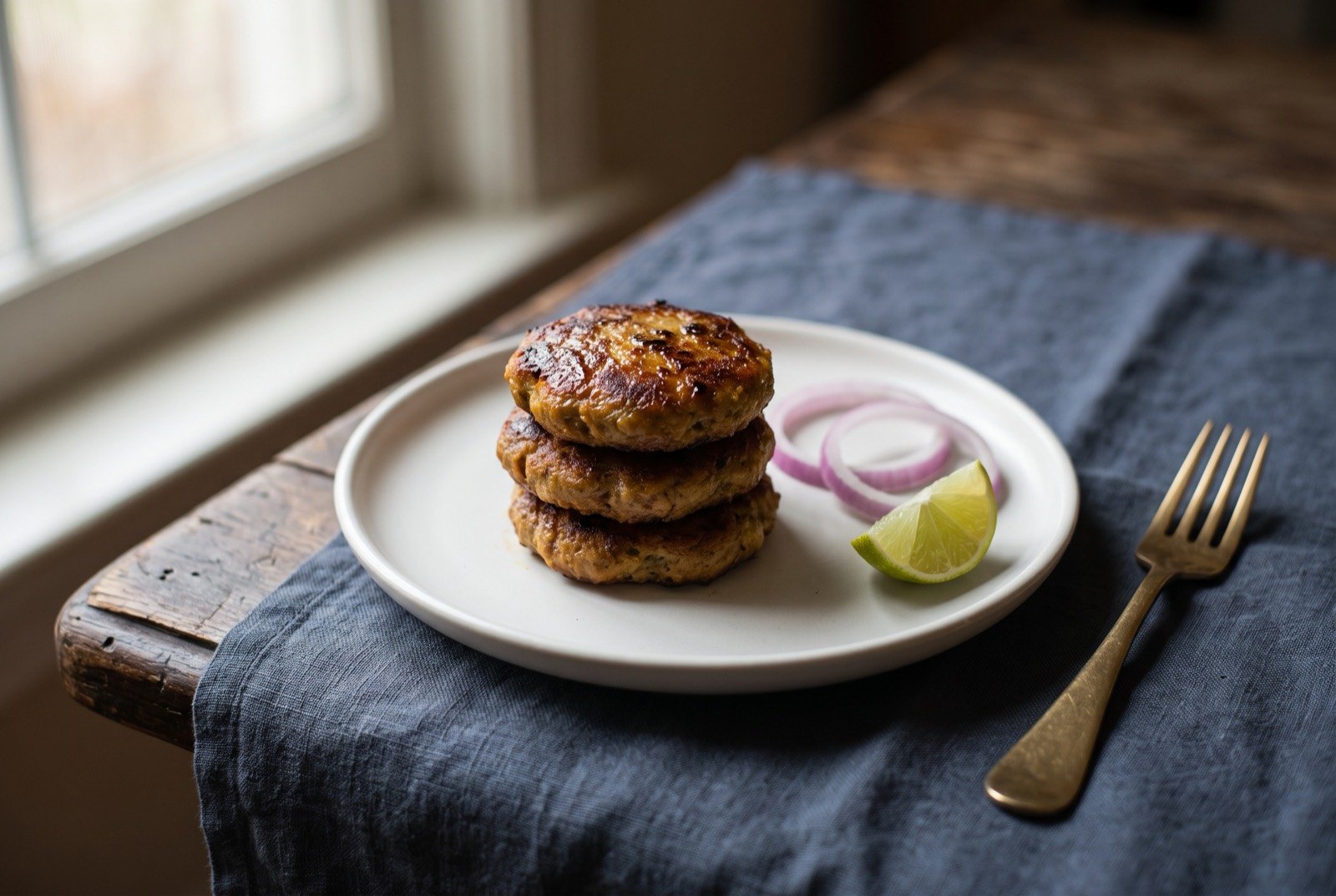
An illustration of the dish, not a photograph of it cooked.
- Time
- Hands on 30 minutes · Waiting 5 hours
- Reviewed
- Not yet reviewed from inside the tradition
- Cooked
- Not yet cooked and reported
Finely minced mutton, tenderised with raw papaya or kachri and worked with a dense whole-spice paste, rested for hours, then shallow-fried on a flat griddle rather than skewered and grilled, which is what lets it hold together as a soft patty.
The popular origin story, that Nawab Wajid Ali Shah, his teeth ruined by age, commissioned a chewless kebab that a cook called Haji Murad Ali, "Tunday," later perfected into the version served at his own restaurant, does not actually survive close inspection: Wajid Ali Shah was exiled from Lucknow in 1856 and died in Calcutta in 1887, while Tunday Kababi did not open until 1905, nearly two decades later, and no source this chapter's research reached, including the historian Rana Safvi, who elsewhere discusses very similar toothless-Nawab legends explicitly as legend, actually reconciles that gap. This chapter treats the story as restaurant folklore rather than settled history, most likely a later branding of a soft, tenderised kebab style that already existed somewhere in the wider Nawabi khansama tradition.
As tradition built it
Serves 4. About 30 minutes, plus 4 to 5 hours resting.
Ingredients
- 450g mutton, minced three times
- 2 tbsp raw papaya, blended to a paste (or 2 tsp kachri powder)
- 2 onions, finely fried and cooled
- 1 tsp black peppercorns, ground
- 1 tsp black cumin, ground
- 4 cloves, ground
- 4 green cardamom, ground
- 1 star anise, ground
- 1 bay leaf, ground
- 1 tsp dried rose petals, ground
- 0.5 tsp mace, ground
- 0.5 tsp nutmeg, ground
- 2 black cardamom, ground
- 0.5 tsp cinnamon, ground
- to taste salt
- enough for shallow-frying ghee, for frying
Method
- Combine the mince with the papaya paste, fried onion, salt and all the ground spices. Work together thoroughly by hand until the mixture begins to bind and feels emulsified rather than merely mixed.
- Cover and rest in the refrigerator, 4 to 5 hours, so the tenderiser has real time to work.
- Shape into small, flat patties, roughly 5cm across.
- Heat a well-seasoned flat griddle or heavy pan with ghee over medium heat. Shallow-fry the patties, 2 to 3 minutes a side, until deeply browned and cooked through but still soft at the centre.
Notes
No heritage or ethnographic source with real quantities was found for this dish; the recipe above is cross-checked across several contemporary Indian recipe sources rather than drawn from a single documented traditional standard, and the widely repeated claim that Tunday Kababi's own version uses 160 spices is treated in this chapter as an unverifiable trade legend, not a fact.
What a modern chef changes
A true emulsion, and a fresher spice bench
Rung 2
Method
- Process the mince in short pulses in a food processor rather than mincing by hand a third time, checking after each pulse until the texture reads as a genuine paste rather than chopped meat, which is what actually gives galouti its melting texture.
- Grind the whole spices fresh, the same day, in a dedicated spice grinder; pre-ground spice loses much of the aromatic volatility that carries this dish's identity.
- Finish on a hot plancha or cast-iron plate rather than a domestic non-stick pan, for a genuine seared crust at the edges while the true-emulsion centre stays soft.