Korea and Japan · Volume 55, The Jang, the Ferment and the Divided Table
Hamhung-style Bibim-naengmyeon
Hamgyong (via refugee Ojang-dong and Sokcho)
Illustration
- Time
- 30 minutes
- Researched
- 12 sources cited
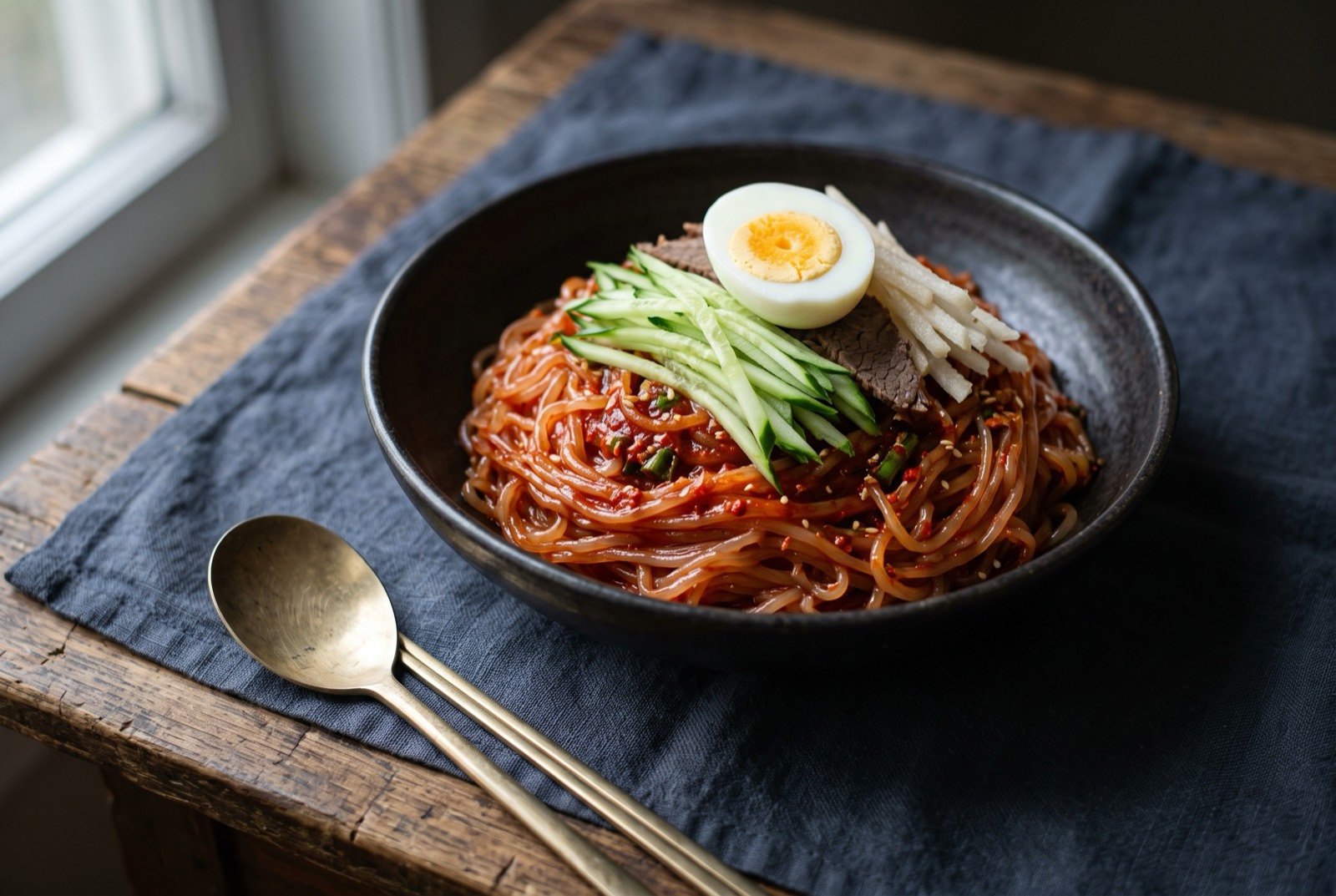
This dish's real story is not continuity, it is invention under displacement, and this chapter states that plainly rather than dressing the noodles in a false pre-division certainty. The ancestor dish, hoe-guksu, potato-starch noodles mixed with raw skate or flatfish and chilli sauce, existed in Hamgyong before division, made possible by Japanese colonial-era industrial potato-starch production established in Hamhung specifically. After the December 1950 Hungnam evacuation, Hamhung-origin refugees who settled in Seoul's Ojang-dong district renamed and remarketed the dish as "Hamhung naengmyeon," and it is this diaspora restaurant tradition, not Hamhung itself, that built the dish South Korea knows today. A South Korean government-affiliated cultural archive states this directly under the title "The Hamhung naengmyeon that doesn't exist in Hamhung," and argues, reasonably, that this makes it no less a real tradition, only a different and younger one than its name implies, exactly as legitimate a South Korean dish in its own right as Seoul's own Pyongyang naengmyeon houses are, on the same logic.
As tradition built it
Serves 4. About 30 minutes.
Ingredients
The method as the tradition gives it, with the ingredients named. Quantities follow as we verify them, lead dishes first.
- 400g sweet potato or potato starch noodles
- raw skate, flatfish or other white fish, thinly sliced (or omit for a vegetable-forward version)
- gochugaru, gochujang, vinegar, sugar, garlic, for the dressing
- for garnish cucumber, boiled egg, to garnish
Method
- Cook the starch noodles briefly in boiling water until translucent and chewy, then rinse in cold water.
- If using raw fish, dress it separately with a portion of the chilli dressing.
- Toss the noodles with the remaining chilli-vinegar dressing, adjusting sweetness and heat to taste.
- Top with the dressed fish, cucumber and boiled egg.
Notes
This chapter's research did not find an institutionally sourced ratio for the dressing; the method above reflects well-attested general proportions for this style of dish, not a single pinned historical recipe, since the dish's own documented history is one of restaurant-kitchen recreation from memory rather than a written, inherited standard.
What a modern chef changes
The dish's own honesty about its recent invention made a feature, not something to smooth over.
No numbered rung; a plating and framing discipline specific to this dish's real history
Method
- Do not chase an imagined "authentic Hamhung" version that predates the dish's real, documented South Korean diaspora history. There is no pre-1950 written standard to recover; the dish's actual tradition is the Ojang-dong and Sokcho refugee-restaurant one, roughly seventy-five years old, and that is the tradition worth respecting precisely, not apologising for.
- Use the springy, chewy texture that starch noodles give as the dish's genuine technical signature, not a lesser substitute for wheat or buckwheat; this dish exists because Hamhung had potato starch in unusual local abundance, and the noodle's texture is the direct trace of that specific, real economic history.
- Balance the chilli dressing hot and bright rather than softening it toward Pyongyang naengmyeon's mildness. The two dishes sit deliberately opposite each other in South Korea's naengmyeon culture, spicy against clear, chewy against soft, and collapsing that distinction erases the very thing that makes serving both together meaningful.