Korea and Japan · Volume 55, The Jang, the Ferment and the Divided Table
Baechu Kimchi
Nationwide
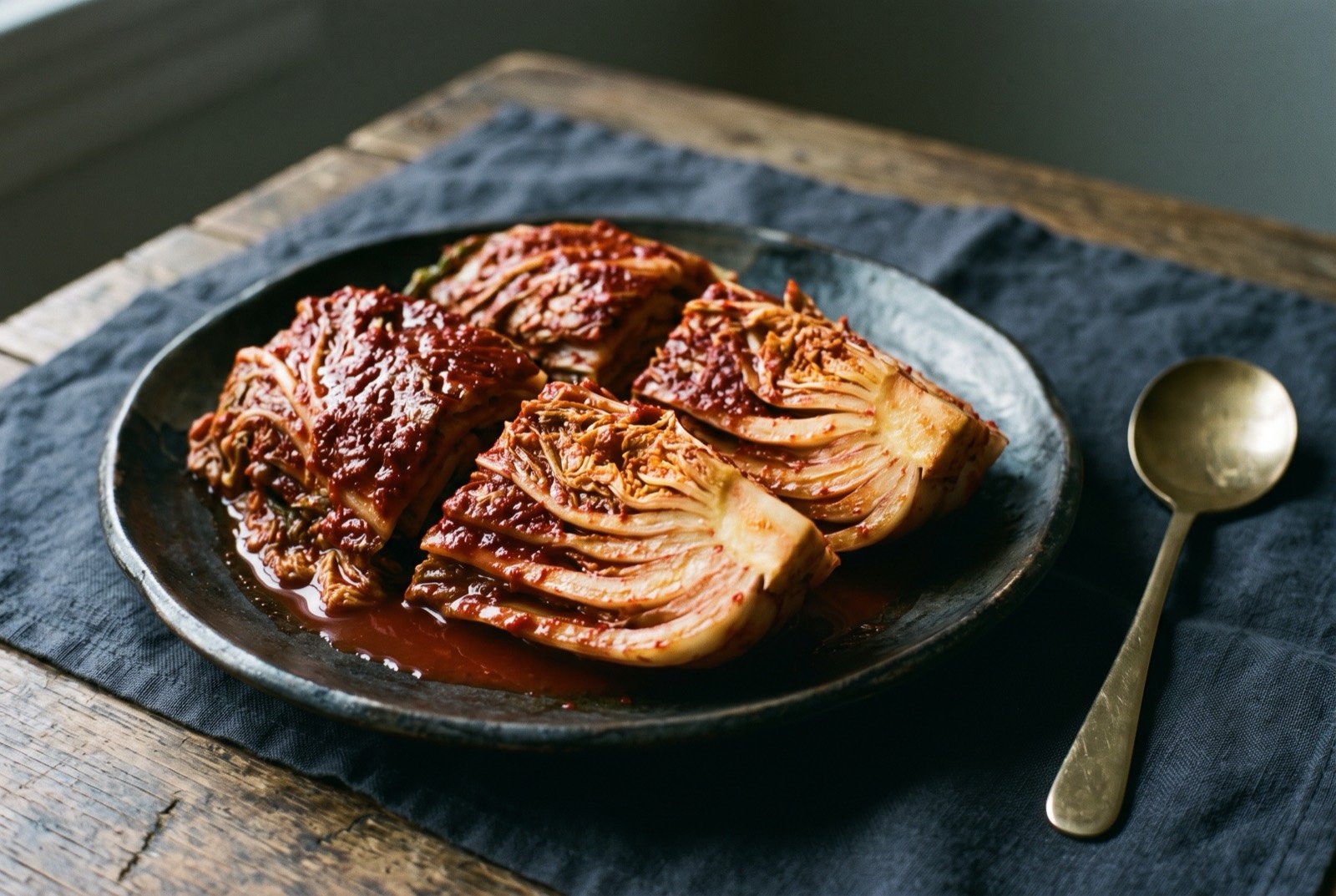
An illustration of the dish, not a photograph of it cooked.
- Time
- Not statedNo source states a time and the atlas has too few comparable dishes to estimate one.
- Researched
- 12 sources cited
- Reviewed
- Not yet reviewed from inside the tradition
- Cooked
- Not yet cooked and reported
The Rural Development Administration, a Korean government agricultural research body, publishes a standard seasoning ratio: 4.5g chilli powder to 2.0g minced garlic per 100g of prepared, salted cabbage. This is the one hard, citable figure behind this dish; the ginger, spring onion, jeotgal and sugar most home recipes add alongside it are traditional and near-universal but were not found pinned to an equivalent institutional ratio in this chapter's research, and are given below as sound, well-attested method rather than false-precision numbers.
As tradition built it
Serves a household through part of a winter. Salting overnight, seasoning and assembly a further hour or so, then weeks to months of fermentation.
Ingredients
- 1 whole napa cabbage, quartered
- to taste coarse sea salt, for salting
- 4.5g gochugaru, 2.0g garlic per 100g salted cabbage per 100g salted cabbage: 4.5g gochugaru, 2.0g minced garlic
- to taste ginger, spring onion, to taste
- to taste saeujeot or myeolchi aekjeot (fermented shrimp or anchovy sauce), to taste
- to taste a little sugar or Korean pear, to balance
Method
- Quarter the cabbage lengthways, salt generously between the leaves, and leave to draw out moisture, traditionally overnight, until the leaf base bends without snapping.
- Rinse thoroughly and drain, then weigh the salted, drained cabbage.
- Mix gochugaru and garlic to the ratio above, scaled to the cabbage's drained weight, then add ginger, spring onion, fermented shrimp or anchovy sauce and a little sugar or Korean pear to balance.
- Work the paste between every leaf by hand.
- Pack tightly into a jar or crock, pressing out air pockets, and ferment. This chapter's research could not pin an exact institutional fermentation time to a single figure; kimjang-scale kimchi is traditionally set down from November into December, once daytime temperatures settle around 6 to 7°C, and matures over weeks to months in cold storage rather than a fixed number of days.
What a modern chef changes
The fermentation stage held at a deliberate, chosen temperature rather than whatever a kitchen counter happens to be.
Rung 2
Method
- Ferment the packed kimchi at a controlled, stable 4 to 9°C rather than room temperature, using a dedicated fridge or a sous vide bath set to hold the low end of that range if a spare fridge is not available, reproducing the exact conditions the peer-reviewed research behind this rung associates with a cleaner, more complex, less rapidly softening result.
- Do not rush the salting stage. A properly drawn-out cabbage holds its texture through a long ferment; an under-salted one turns to mush regardless of how carefully the fermentation temperature afterwards is controlled.
- Taste and adjust the seasoning at the drained-cabbage stage, not after fermenting, since the RDA ratio above is a starting point calibrated to Korean cabbage and Korean chilli heat, not a fixed universal law; UK napa cabbage and UK-available gochugaru vary enough in water content and heat that the ratio is a baseline to check against, not a number to follow blindly.