Europe · Volume 12
Alsace, Lorraine and the Nord
Choucroute, Bière de Garde and the Double Border
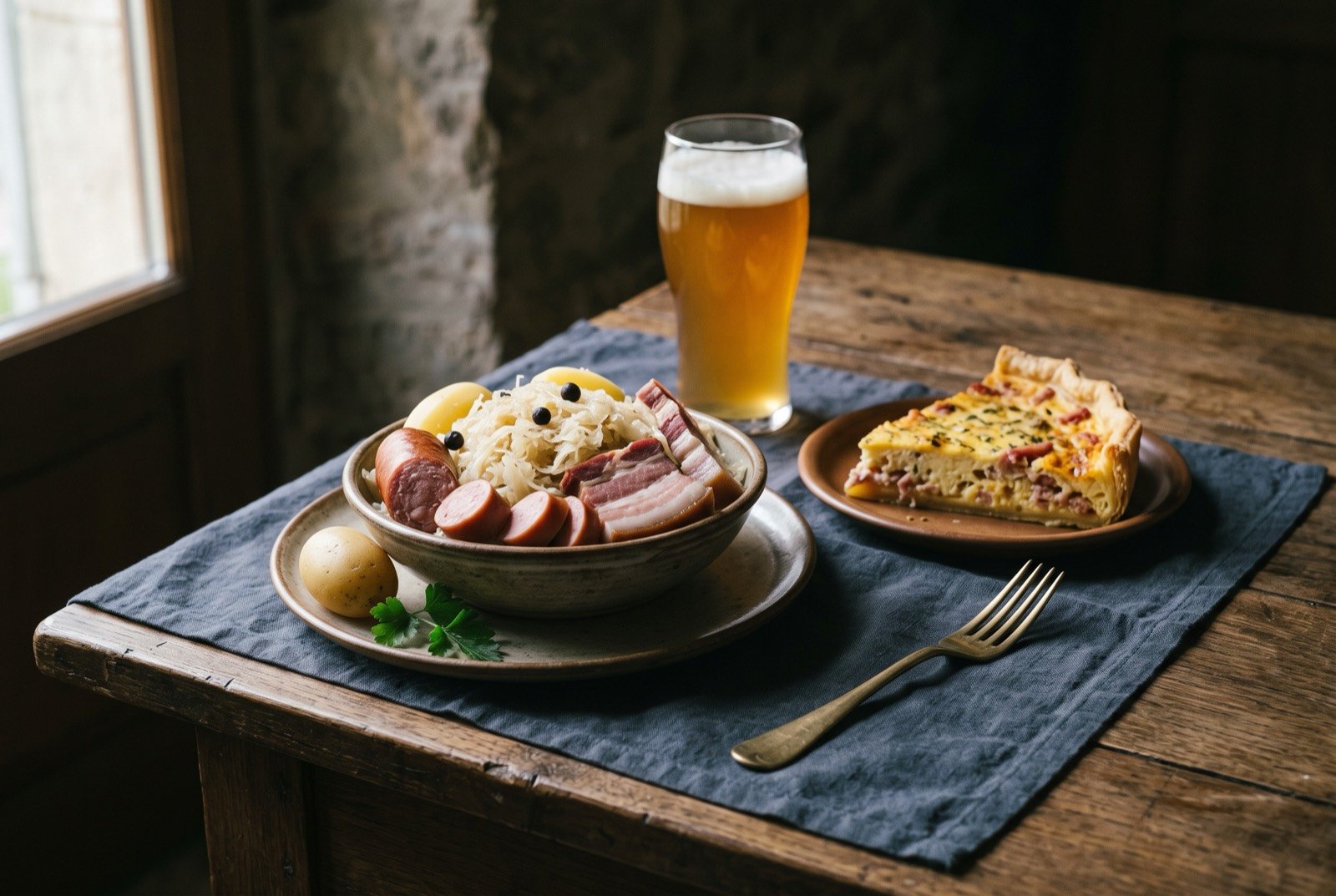
Two food worlds sharing one volume for reasons of scale, not one cuisine. Alsace and Lorraine sit on the German-French seam, changing sovereignty four times in under a century; the Nord sits on the French edge of historic Flanders. Both are pork, beer and cabbage countries in a nation that runs on wine and olive oil further south. Every dish as tradition built it, then what a modern chef would change.
Sources and review · What this chapter does not assert · How we research · Know this better? Tell us
A Sense of Place
Alsace and Lorraine, either side of the Vosges
Alsace is the Rhine's western terrace, a narrow, warm plain squeezed between the Vosges massif and the river, sitting in one of France's driest rain shadows: dry enough to be vineyard country, not merely border country. Lorraine, on the Vosges' other flank, is wetter and harder farming land: pig and cattle pasture, root vegetables, and the plum orchards on the hillsides above Metz and Nancy that make it, by a wide margin, the world centre of the mirabelle plum. The frontier that actually organises the cooking, dry Rhine terrace against wet Lorraine upland, is the Vosges ridge itself, arguably a more honest boundary than the administrative one drawn across it.
The traditional fats are pork lard and goose fat, with butter present too, a pattern the historian Lucien Febvre placed among the French regions where animal fat, not olive oil, structured the kitchen. The starch is potato and egg noodle, spätzle rather than rice or bread-thickened stew. The aromatic core is juniper berry and caraway seed, above all for choucroute, with bay, coriander seed and black pepper filling out the register.
The dialect matters more here than in almost any other French region. Alsatian, Elsässisch, is not generic German but specifically Low Alemannic, closer in structure to Basel German than to standard German, let alone French. This shows up directly on the plate: Flammekueche, "pie baked in the flame", Sürkrüt, choucroute, Bredele, the Christmas biscuits, Baeckeoffe, from Bäckerofen, "the baker's oven", and Bibeleskaes, literally "little chicks' cheese", are all dialect names that survive as the dish's actual name even in French usage. No other region of France names its signature dishes in a non-Romance vernacular, and that fact alone should tell a reader this is not a French region with local colour but a genuinely bicultural food world that happens to sit inside France's current borders.
The border itself is the history. Alsace has been French since the Peace of Westphalia in 1648, Lorraine since 1766; both were annexed into the new German Empire in 1871 as the Reichsland Elsass-Lothringen; both returned to France in 1918; both were re-annexed by Nazi Germany in 1940; both returned to France again in 1945. Four changes of sovereignty in under a century is unmatched anywhere else in French regional history, and it is the single fact that explains why this cuisine reads as genuinely dual rather than as a variant of French provincial cooking.
The Nord, two identities inside one department
The Nord, Hauts-de-France in its current administrative form, is not one culture either, and this chapter treats it as genuinely two. French Flanders, Flandre française, Frans-Vlaanderen, the arrondissement of Dunkerque and the Westhoek, was historically Dutch-speaking. Its dialect, West Flemish, known locally as Frans-Vlaams, has survived in isolation from standard Dutch since Louis XIV's annexation of the area between 1659 and 1678, and was only officially recognised as a French regional language in December 2021. The Picard or Ch'ti zone, further south around greater Lille and into Artois and Picardy, speaks picard, classified by linguists as a full Romance language rather than a patois. The word "ch'ti" itself is comparatively recent, coined during the First World War by soldiers from elsewhere to name their comrades from the Nord-Pas-de-Calais.
The flavour architecture runs on three fats in different registers: butter for pâtisserie and gaufres, beef kidney fat or suet for a proper frite, and pork fat for charcuterie and potjevleesch, with beer functioning almost as a fourth fat, a braising medium as much as a drink. The characteristic thickener, and the clearest single technical signature of this cuisine, is pain d'épices spread with mustard, dissolved into a beer braise. The starch is the potato, above all as frites, and the region is the overwhelming centre of French endive production, though, as the Flavour Arsenal below makes plain, that crop's claim to be a genuine Nord terroir product does not survive scrutiny.
What is shared with Belgium, honestly
Both halves of this volume sit against a border that is older and more porous than the modern French state. Alsace's border runs to the German-speaking Rhineland; the Nord's runs to Belgian Flanders and Wallonia, and several of this cuisine's most recognisable dishes, carbonnade, moules-frites, the double-fried frite itself, waterzooi, are claimed on both sides of that line, for good reason: the medieval and Burgundian history of the County of Flanders belongs to both, and French administrative sovereignty over the Westhoek and Artois only begins in 1659. This chapter follows the atlas's rule directly: one home per dish, attribute rather than adjudicate where a claim is genuinely shared, and name a cross-region link even to a volume that does not yet exist. Waterzooi's documented home is Ghent, and it belongs properly to a future Low Countries volume; it is named here, with real technique, because it is genuinely cooked in the Nord too, but it is not given the full twice-told treatment this chapter reserves for dishes whose home is here. The same goes for chicon au gratin, whose principal sources found for this chapter were Belgian. Carbonnade flamande and the double-fried frite are treated differently: both are cooked and eaten as Nord dishes in their own right, at least as much as Belgian ones, so both get the full treatment, with the shared history stated rather than smoothed over.
The History in Layers
Cabbage older than Germany, older than France
Fermenting cabbage in brine is not a Germanic invention transplanted onto French soil. The technique is documented in China more than two thousand years ago, and the route it took into Europe, a Mongol invasion, a Marco Polo transmission, several other proposed paths, is itself unresolved and this chapter does not adjudicate it. What is locally documented is choucroute specifically: attested in French from the fifteenth century, confirmed in sixteenth-century monastic records, and, in an eighteenth-century variant, made with freshwater Rhine fish rather than pork, a detail that reflects the diet of Rhine boatmen before pork became the standard garnish.
Alemannic settlement, and a border that keeps moving
Alsace's dialect reflects an early medieval Alemannic settlement pattern that ties the region linguistically to Basel and the Upper Rhine rather than to Frankish or generic German territory further north. No source consulted for this chapter connects the region's French-protected resettlement after the devastation of the Thirty Years' War, from 1648 onward, to a specific culinary change, and this chapter does not invent that link to make a tidier story.
The Reichsland years, 1871 to 1918, and a genuinely surprising finding. After the Treaty of Frankfurt, Germany governed Alsace-Lorraine as a Reichsland, an imperial territory without full federal rights, actively pursuing German-language administration; Alsatians who wished to keep French citizenship had to leave before October 1872, becoming known as the optants. The territory gained its own constitution only in 1911, before military dictatorship returned in 1914. The clearest, most counterintuitive finding of the research behind this chapter is that choucroute's status as a symbol of French patriotism is a direct product of this German annexation, not something that predates it. Before 1870, sources describe it as a confidential regional specialty, in places actively looked down on as poor people's food. Alsatians who left for Paris and other French cities after 1871 took it with them, and it began appearing in the brasseries around the Gare de l'Est, the station serving trains east toward the lost territory, associated with the hoped-for Revanche against Germany. This account rests on a single blog source for its specific Gare de l'Est detail and deserves a stronger citation before it is treated as fully settled, but the broader shape, that a regional dish became a national one specifically because it was fought over, is well attested and worth taking seriously rather than smoothing into an older, cosier story of unbroken tradition.
The interwar and Second World War periods, including the second, 1940 to 1945 annexation, turn up no specific culinary material in the sourcing behind this chapter. This is named as a real gap, not filled with plausible invention.
Is there an Alsatian cuisine, and who gets to say
This is a live question inside Alsace itself, not one this chapter imports. The food scientist Hervé This, an Alsace native, frames "is there an Alsatian cuisine" as fundamentally the same question as "is there an Alsatian culture", and argues the honest answer is not a fixed label but a continuous blend: French cookbooks from 1655 onward catalogue "sauces allemandes" that French kitchens absorbed and altered until, in Carême's own words, they had "been French for a long time." The Strasbourg endocrinologist and food historian Jean-Louis Schlienger, author of Le Mangeur alsacien: deux mille ans de gastronomie, is the best-credentialed named voice behind this framing. Tellingly, German-language sources describing the same cuisine tend to frame it the other way round, as a German base finished with French technique, "a successful synthesis of Alemannic heartiness and French finesse." Neither framing is adjudicated here; each is attributed to the language, and by extension the nation, doing the speaking, which is exactly the atlas's house rule for a genuinely contested inheritance.
The Nord: Flanders, Burgundy, and an industrial cabbage-and-beer economy
Flanders began as a Carolingian frontier march fixed by the Treaty of Verdun in 843, becoming a hereditary county from 863, nominally a vassal of the French crown throughout the medieval period. It passed to the Valois Dukes of Burgundy in 1384, becoming a core Burgundian Netherlands province, and then to the Habsburgs on the death of Mary of Burgundy in 1482. French annexation of the western edge, Artois and the Westhoek specifically, came via the Treaty of the Pyrenees in 1659 and the Treaties of Nijmegen in 1678, the same window that begins Frans-Vlaams's long isolation from mainstream Dutch. The medieval and Burgundian history is shared history, not a French story with a Flemish footnote; what is genuinely distinct to the French Nord is everything that follows 1659, above all the nineteenth and twentieth-century coal and textile economy of Roubaix and Tourcoing, which is the direct ancestor of the estaminet, the miner's and textile worker's second living room, warm, lit, sociable, serving beer with every course and never wine, and of the cheap, beer-braised, offal-and-cut-heavy dishes, carbonnade and potjevleesch chief among them, that turned tough or leftover meat into a Sunday meal. Genièvre, the region's grain-and-juniper spirit, was specifically the drink of miners and textile workers; at the industrial peak the region held roughly a hundred distilleries, of which three survive.
The Flavour Arsenal
Choucroute, and what fermentation actually requires
Choucroute d'Alsace has carried IGP protection since a 2012 French decree, with a specification requiring fermentation that is exclusively natural: no added starter cultures, no temperature manipulation. Alsace grows roughly 60,000 tonnes of cabbage for choucroute a year across about 500 hectares, some 70 per cent of French production. The method itself, per the Académie Nationale de Cuisine, a genuinely credible national culinary body and the single best-sourced technical claim in this chapter: cabbage sliced to roughly a millimetre; salt at 20 to 25g per kilogram of cabbage; massaged for 10 to 15 minutes to draw out the cabbage's own juice; packed tightly enough to stay submerged in that juice, topped up with a 20g-per-litre brine if needed; fermented at 15 to 20°C; a minimum of 21 days, with some traditions running to 4 to 6 weeks for a sharper result; only non-iodised salt, since iodine can inhibit the lactic bacteria; and the vessel never opened during the ferment. One source reports as many as 28 strains of Lactobacillus and 7 of Leuconostoc in artisanal Alsatian choucroute, a genuinely diverse living culture, and it is the reason a properly fermented choucroute tastes clean and complex rather than flat or merely sour.
Munster, and the dairy geography that ignores the modern region
Munster has carried AOC protection since 1969, now AOP: a washed-rind, soft cheese made from cow's milk, with a minimum 20g fat and 44g dry matter per 100g, and a minimum affinage of 21 days for standard Munster or Munster-Géromé, 14 days for the smaller "petit Munster", hand-rubbed and turned every two days in humid caves held at a constant 11°C. Its production zone spans seven eastern departments, Bas-Rhin, Haut-Rhin, Vosges, Meurthe-et-Moselle, Moselle, Haute-Saône and the Territoire de Belfort, straddling Alsace, Lorraine and Franche-Comté at once: a reminder that this pastoral cheese tradition was drawn by mountain geography long before any modern regional line was.
Mirabelle and quetsche, and a figure worth treating carefully
Lorraine is repeatedly said to grow around 90 per cent of the world's mirabelle plums, though the figure ranges from 70 to 90 per cent even across official-sounding sources, and it survives largely unchallenged for the simple reason that almost nowhere else grows the fruit commercially, not because anyone has rigorously audited it. Annual tonnage figures likewise range from roughly 6,000 to 8,000 tonnes up to a reported 14,683 tonnes in 2025, probably reflecting different measurement years or geographic scope rather than one another. Mirabelle de Lorraine became the first fruit in France to receive IGP status, in 1994 or 1995 depending on the source consulted, with over 200 registered producers. The often-repeated origin story, that Duke René II introduced the fruit to Lorraine in the sixteenth century, is flagged even by its own tellers as unverified legend rather than documented fact. This chapter states the figure as "the large majority of world production, exact share unaudited" rather than repeating any one precise percentage as settled.
Juniper, twice, in two different registers
Juniper appears on both halves of this volume's table, and it is worth naming the two registers as genuinely different rather than treating "juniper" as one flavour. In Alsace it is above all a culinary spice, dried and crushed into choucroute alongside caraway. In the Nord it is a spirit ingredient: genièvre is a grain-based spirit, fermented cereal wort distilled and then aromatised with juniper berries, the same lineage as Dutch and Flemish jenever, not a juniper distillate in the way some fruit eaux-de-vie are. Two working distilleries survive from the region's roughly hundred-strong nineteenth-century peak: the Distillerie de Wambrechies near Lille, founded as an oil mill in 1789 by a Belgian émigré and converted to genièvre in 1817, and the Distillerie de Houlle near Saint-Omer, active since 1812.
Maroilles, and the chicon question, checked carefully
Maroilles is a washed-rind, soft cow's-milk cheese from the Thiérache, south of Avesnes in the Nord, spilling into the Aisne, AOC since 24 May 1976. Its rind is deliberately cultivated: brushed to remove surface blue mould, then repeatedly washed in brine to establish Brevibacterium linens, the bacterium responsible for its brick-red rind, over a minimum affinage of 21 to 35 days depending on format. The chicon, or Belgian endive, is a genuinely contested case, and this chapter checked it carefully rather than repeating the comfortable local myth. Peer-reviewed academic sourcing is unambiguous: the vegetable is a Belgian discovery, conventionally traced to Schaerbeek, near Brussels, in the mid-nineteenth century, commercialised from 1867, and formally introduced into France by Henri de Vilmorin in 1873. "Chicon" is the original Belgian name; "endive" is the French-market name, though the Belgian name persisted specifically in the Nord. The crop only became dominant in Hauts-de-France agriculture after 1950, and the same academic source, writing in the journal Ruralia, concludes explicitly that the chicon is "a product of the territory", grown there and identified with it, rather than a genuine terroir product rooted in local soil and inherited practice, since production basins vary in soil type and growers frequently source roots from elsewhere. This chapter names the chicon as Belgian in origin and Nord in scale and identity, and does not repeat the terroir claim as settled fact.
The Technique Ladder
The argument, from inside
Olivier Nasti, at Le Chambard in Kaysersberg, two Michelin stars and Meilleur Ouvrier de France, treats choucroute the way Peskesi treats Cretan grain: not a peasant dish to be tolerated at the top table but, in his own words, "la grande cuisine ne s'oppose pas à la cuisine de terroir: elle en est l'aboutissement", fine dining does not oppose local cuisine, it is its culmination. He sources his cabbage from a named choucrouterie and his charcuterie from a named producer, cooking the cabbage in goose fat with white wine, juniper, coriander and cumin, and at the gastronomic end dries a fermented cabbage leaf into a crisp chip served with candied celeriac. Nicolas Stamm, at La Fourchette des Ducs in Obernai, helped rescue the Poule Noire d'Alsace, a heritage breed that had fallen below 300 birds after the war and is now a Slow Food Presidium, serving it cooked in the style of baeckeoffe: the elevation is the heritage ingredient, not an imported technique.
The clearest and most direct match to this whole series' animating idea comes from the Nord. Florent Ladeyn, Michelin-starred at Auberge du Vert Mont in Boeschèpe since 2014 and running two more addresses in Lille, has built an entire, near-absolutist philosophy on sourcing within roughly 50 kilometres of the restaurant: no pepper, no chocolate, no citrus, no olive oil, no vanilla, salt from Pas-de-Calais rather than Guérande, wine replaced by beer, some of it brewed on-site. He has said plainly that his own restaurant's early carbonnade, made with Spanish onions, Polish beef and German beer, was "Flamand seulement de nom", Flemish only in name: a dish can follow the correct recipe and still not be the real thing if every ingredient in it is a generic commodity import. That is, almost word for word, this atlas's own argument transplanted onto Flanders.
Honestly, though, this is not yet a movement in the way Ikoyi, Akoko and Chishuru represent one for West African food, or the way the Basque and Catalan new-cuisine generation did from the 1970s. The sourcing behind this chapter found a small number of serious, named individuals, Nasti and Stamm in Alsace, Ladeyn in the Nord, and an organised but modest institutional push, a choucroute-innovation competition run by the Fédération des Chefs d'Alsace, but not a coherent, self-identified cohort with a shared manifesto. That gap is named rather than papered over.
Rung 1. Ferment for weeks, not days
The industrial shortcut for choucroute, per producer-facing sourcing this chapter could not confirm against a primary document, compresses fermentation to roughly a week before pasteurising, which kills the live lactic culture responsible for a clean, complex sourness and leaves a flavour that was never properly developed in the first place. No amount of subsequent cooking recovers what a rushed ferment never built; this is the actual, mechanistic root of "boiled to death cabbage", the flat, vinegary, over-boiled disappointment served under a generic sausage in a bad brasserie.
What a cook does with this rung. Ferment your own, or buy live, unpasteurised sauerkraut rather than a jarred or tinned "choucroute royale": a proper UK fermentation crock with a water seal, cabbage at 20 to 25g salt per kilogram, held at 15 to 20°C for a genuine three to four weeks, is closer to Alsatian farmhouse practice than any pasteurised import on a supermarket shelf.
Rung 2. Seal the pot and let the wine cook itself
Baeckeoffe's terrine lid is sealed to its body with a rope of raw flour-and-water dough, not merely covered. That seal creates a genuinely airtight, self-basting environment: the wine's steam cannot escape, so it condenses on the lid and recirculates, concentrating rather than venting the dish's aromatics, which is the entire mechanical point of a technique historically left unattended at the village baker's oven all morning. A conventional lidded casserole, with its inevitable gap at the rim, loses that steam continuously and produces a beef-and-potato stew that merely happens to contain wine.
What a cook does with this rung. Make a simple bread-dough lute, work it into a rope, and press it firmly round the join between pot and lid before it goes into an oven that never exceeds 200°C, for a slow four hours. Do not lift the lid to check; the whole point of the technique is that you cannot.
Rung 3. Find real heat, not a compromise
Tarte flambée's dough, flour, water, salt and oil, no yeast, no proving time, is stretched thin by hand and baked in a wood-fired oven at 280 to 300°C for two to four minutes, in a two-chamber design where the flame burns below and heat circulates around the tarte in the chamber above. A domestic or export oven tops out at 220 to 250°C, far short of that benchmark, so the same dough has to bake longer at lower heat: the edge dries and toughens while the centre stays gummy under the wet cream and onion, which is the precise, mechanistic reason a bad export flammekueche reads as a thin frozen pizza rather than the real thing.
What a cook does with this rung. A Big Green Egg run hard, with a pizza stone and the dome closed to trap radiant heat, is the closest realistic substitute a British kitchen has for the wood-fired chamber: aim for the highest stable temperature the setup allows, and treat two to four minutes as the target, not a domestic oven's ten to fifteen.
Rung 4. Thicken with bread and spice, not flour
Carbonnade flamande's defining move is a slice or two of stale pain d'épices, thickly spread with strong mustard, laid on top of the beer braise so it dissolves into the sauce over two and a half to three hours, thickening it while releasing cinnamon, ginger and star anise, and standing in for a roux entirely. The failure mode of a bad export carbonnade is threefold and each part is mechanistic: a lean, quick-cooking cut that never renders collagen into the liquid; a generic lager standing in for a real bière de garde, giving nothing of substance to reduce; and skipping the pain d'épices step altogether, leaving a thin, watery sauce with incidental bitterness and no real body.
What a cook does with this rung. Use a genuine braising cut, chuck, shin or blade, never a quick-cooking steak; use a real bière de garde or bière brune, not a supermarket lager; and do not skip the bread-and-mustard step, since it is not a garnish but the sauce's actual thickener.
Rung 5. Trust the rind's own bacteria
Both Munster and Maroilles depend on a washed rind deliberately cultivated with Brevibacterium linens, developed over three or more weeks of humid-cellar affinage that the INAO's own documentation states plainly cannot be reproduced outside the region's specific cellar flora. A bland, underripe, or merely young washed-rind substitute has not had the time for that surface bacterial culture to develop, and what results is a generically cheesy sauce rather than the specific, hazelnut-and-brick-dust depth the real cheese is built to deliver.
What a cook does with this rung. Buy a properly ripe example from a specialist rather than the youngest, mildest-looking wheel on the shelf, and understand that the smell that puts some cooks off is not a fault but the entire point of the affinage: it is a controlled ferment, not a spoilage risk, in exactly the way the choucroute in Rung 1 is.
The Ferment and Preserve Bench
1. Choucroute Crue
Covered in full above. The single most important preserve in this volume, and the one whose UK supply chain is weakest: no verified UK importer sells the genuine raw, unpasteurised article, which makes fermenting it at home a genuinely superior choice, not merely a substitute.
2. Munster and Maroilles Affinage
Both cheeses depend on the same underlying mechanism: a rind deliberately colonised with Brevibacterium linens through repeated brine washing over three or more weeks in a humid cellar, the INAO's own documentation stating plainly that the specific cellar flora cannot be reproduced elsewhere. This is not a dish a home cook makes, but understanding it changes how the finished cheese should be bought and judged, see Rung 5.
3. Genièvre
A grain spirit, not a juniper distillate, distilled from fermented cereal wort and aromatised with juniper berries in the jenever lineage. Two working Nord distilleries survive from a nineteenth-century peak of roughly a hundred: Wambrechies, near Lille, and Houlle, near Saint-Omer.
4. Mirabelle Eau de Vie
Genuinely well stocked in Britain even where the fresh fruit is not: Miclo, Metté, Massenez and Joseph Cartron are all real, findable UK-stocked bottlings, and a small glass finishing a warm tart or macerating dried fruit is a legitimate way to bring real mirabelle character into a British kitchen out of season.
Sourcing in Britain
Verified August 2026. Where a supplier could not be fully confirmed, that is said rather than smoothed over.
A time-sensitive warning, stated plainly. Since 1 July 2025, Defra has suspended imports of unpasteurised and low-heat-treated French and Italian cheeses as a safeguard against lumpy skin disease in cattle, still in force as of spring 2026 reporting with no confirmed lifting as of this chapter's research. This affects exactly the category Munster and Maroilles sit in. Raw-milk Munster fermier from Alsace is very unlikely to be legally on sale in Britain right now; what is on shelves is pasteurised, and buyers should ask a retailer directly which they are getting, since this changes month to month while the restriction remains in force.
The ranked list: what decides great from grim
- The choucroute itself, live and properly fermented, not pasteurised-jarred. A home ferment or good UK-made raw sauerkraut beats any tinned choucroute royale on the market.
- Genuinely smoked, not merely smoked-flavoured, pork. A real smoked knuckle, or better, a shoulder smoked at home on a Big Green Egg, is a different food from a boiled gammon joint with liquid smoke added.
- Munster or Maroilles bought properly ripe from a specialist. Mons Cheesemongers stocks Munster from Ferme du Houtrou; La Fromagerie and Mons Cheesemongers both stock Maroilles, currently the easier of the two to find given the import restriction above.
- A dry Alsace Riesling, not a supermarket generic "German-style" white, for coq au riesling. Waitrose Cellar and Majestic both carry a proper range; save Vendange Tardive and Grand Cru bottlings for drinking, not the pot.
- Genuine bière de garde, not a generic French lager. Beers of Europe stocks Trois Monts and Ch'Ti Triple; no UK craft brewery was found making a dedicated version of the style, so this is an import-only category.
- Mussel freshness and provenance. Scottish rope-grown mussels, from Marks & Spencer or a good fishmonger, are a genuine product of the same rope-and-pole technique as French bouchot mussels, not merely a compromise, and are the practical, sustainable choice for a British cook.
- Real Morteau or Montbéliard sausage, genuine IGP, natural casing, actually smoked, the best-stocked charcuterie category found for this chapter, via Fine Food Specialist and several other importers, rather than a generic continental "smoked sausage."
- Mirabelle eau de vie of real quality (The Whisky Exchange, Master of Malt) rather than a generic "plum brandy", for the specific honeyed, low-acid character the fruit is actually known for.
Kit notes for this volume
A fermentation crock with a water seal is the single most valuable piece of kit here, given how weak the UK's raw-choucroute supply chain is; a Big Green Egg is genuinely useful both for smoking pork for choucroute garnie and baeckeoffe and, run hot with a stone, as a realistic stand-in for tarte flambée's wood-fired oven; a dehydrator earns its place concentrating mirabelle flavour when only imported, less-ripe fruit is available; sous vide is the honest modernist tool for a baeckeoffe cooked with more control over each of its three meats than the single long communal braise allows.
Voices and Sources
From inside the tradition
- Olivier Nasti, Le Chambard, Kaysersberg. Two Michelin stars, Meilleur Ouvrier de France, treats choucroute as a manifesto of Alsatian terroir rather than a dish to be merely tolerated at a starred table.
- Nicolas Stamm, La Fourchette des Ducs, Obernai. Two Michelin stars, directly involved in rescuing the Poule Noire d'Alsace from near-extinction as a heritage breed.
- Florent Ladeyn, Auberge du Vert Mont, Boeschèpe, plus two addresses in Lille. The clearest single match in this chapter to the atlas's own animating idea: his stated judgement that an early carbonnade made from imported commodity ingredients was "Flemish only in name."
- Jean-Louis Schlienger, Strasbourg endocrinologist and food historian, author of Le Mangeur alsacien: deux mille ans de gastronomie. The best-credentialed named voice on Alsatian food history found for this chapter.
- Hervé This, food scientist and Alsace native, writing for the Académie d'Alsace on whether an Alsatian cuisine, and by extension an Alsatian culture, genuinely exists.
- Gilles Pudlowski, French gastronomic critic writing for the regional Dernières Nouvelles d'Alsace, whose annual "Pudlo Alsace" ranking reviews winstubs on technical execution rather than authenticity alone.
- The Fédération des Chefs d'Alsace, whose choucroute-innovation competition is the clearest evidence of an organised, if modest, institutional push behind this chapter's technique ladder.
- INAO (Institut National de l'Origine et de la Qualité), the primary regulator for Choucroute d'Alsace IGP, Munster AOP, Maroilles AOP and Mirabelles de Lorraine IGP.
- Manouvrier, writing in the peer-reviewed journal Ruralia, the key scholarly voice behind this chapter's honest treatment of the chicon's Belgian origin.
The UK diaspora, honestly named as thin
No UK restaurant was found operating at a genuinely serious, technique-driven level with this cuisine. London venues trading on Alsatian or Nord identity, Fl'Amour and Flamboree among them, read in the sourcing behind this chapter as casual or novelty operations built around delivery and variation rather than technique, and no restaurant treating Nord or Ch'ti food specifically as its own serious regional cuisine was found in Britain at all; UK moules-frites exists widely, but as generic "Belgian beer café" fare, not as anything claiming this chapter's specific Nord lineage.
Things this chapter has deliberately not asserted
- That choucroute's Gare de l'Est, post-1871 patriotic association is fully corroborated history. It rests on a single source for its specific detail and is presented as well-attested but not settled.
- Baeckeoffe's supposed connection to Jewish hamin or cholent. Plausible given Alsace's historic Jewish population, but resting on a single uncorroborated source; offered as a genuine open question, not fact.
- Any single precise figure for Lorraine's share of world mirabelle production. Sources range from 70 to 90 per cent; this chapter states "the large majority, exact share unaudited" rather than repeating one number as settled.
- That there is a coherent, named Alsatian or Nord culinary revival movement on the scale of the Basque or Catalan new-cuisine generation, or of Ikoyi, Akoko and Chishuru for West African food. The evidence supports a small number of serious named individuals and one modest institutional competition, not an organised cohort.
- That any UK restaurant cooks this cuisine at a genuinely serious level. None was found; the London examples uncovered read as casual or novelty operations.
- The precise industrial choucroute-fermentation timeline sometimes quoted as seven to ten days before pasteurisation. Repeated across a couple of French sources but not confirmed against a primary trade or scientific document, nor attributed to a named producer.
- The chicon, or Belgian endive, as a genuine Nord terroir product. Peer-reviewed sourcing states plainly it is Belgian in origin and only a "product of the territory" in Hauts-de-France, not a terroir product rooted in local soil and inherited practice; this chapter repeats that finding rather than the comfortable local shorthand.
- Waterzooi and chicon au gratin as home dishes of this volume. Both are documented as Belgian in origin, Ghent for waterzooi, Schaerbeek for the chicon itself; both are named here, with real technique, but their full twice-told treatment belongs to a future Low Countries volume, per the atlas's one-home-per-dish rule.
- Which mussel, French bouchot or Dutch and Zeeland stock, is authentically used for Nord moules-frites. Sources actively conflict and this chapter leaves the question open rather than asserting either side.
- Welsh's transmission route into the Nord "via the Côte d'Opale." A single low-authority source, uncorroborated by any historical account found for this chapter.
- Any specific culinary effect of the interwar or Second World War periods, 1918 to 1945, on Alsatian or Lorrain food. A real gap in the sourcing behind this chapter, not filled with invented material.
- Current UK stock or pasteurisation status of any specific named cheese product beyond the general Defra restriction stated above. Retailer stock is inherently volatile; every product named in the sourcing section should be treated as verified to exist and be listed at the time of this chapter's research, not as a guarantee of what is on the shelf today.
Ferment for weeks, not days
The industrial shortcut for choucroute, per producer-facing sourcing this chapter could not confirm against a primary document, compresses fermentation to...
Seal the pot and let the wine cook itself
Baeckeoffe's terrine lid is sealed to its body with a rope of raw flour-and-water dough, not merely covered.
Find real heat, not a compromise
Tarte flambée's dough, flour, water, salt and oil, no yeast, no proving time, is stretched thin by hand and baked in a wood-fired oven at 280 to 300°C for two...
Thicken with bread and spice, not flour
Carbonnade flamande's defining move is a slice or two of stale pain d'épices, thickly spread with strong mustard, laid on top of the beer braise so it...
Trust the rind's own bacteria
Both Munster and Maroilles depend on a washed rind deliberately cultivated with Brevibacterium linens, developed over three or more weeks of humid-cellar...
The dishes
- Choucroute Garnie Alsace
- Quiche Lorraine Lorraine
- Baeckeoffe Alsace
- Tarte Flambée Alsace
- Kougelhopf Alsace
- Tarte aux Mirabelles Lorraine
- Bibeleskaes Alsace
- Carbonnade Flamande The Nord
- Welsh The Nord
- Potjevleesch The Nord, specifically Dunkerque and the maritime Westhoek
Sources and review
- Researched
- 10 sources cited
Where this volume comes from
4 research briefs on file for this volume, researched to the rules on How we research. Published 28 August 2026. Last changed 20 September 2026.
The brief's own account of its sources
Alsace-Lorraine pass: of roughly 25 distinct sources, the genuinely strong, local, institutional or credentialed sources are INAO (Munster, Mirabelles de Lorraine), the Académie Nationale de Cuisine (choucroute fermentation), the Académie d'Alsace (Hervé This, Schlienger), the Consulat général de France à New York (Baeckeoffe history), the Ministère de l'Agriculture (macarons de Nancy, mirabelles), and France Mémoire/INA (1871 annexation history), roughly 8 to 9 solid sources.