Europe · Volume 15
Paris and the Classical Table
Sauce, the Brigade and the Bistro Underneath
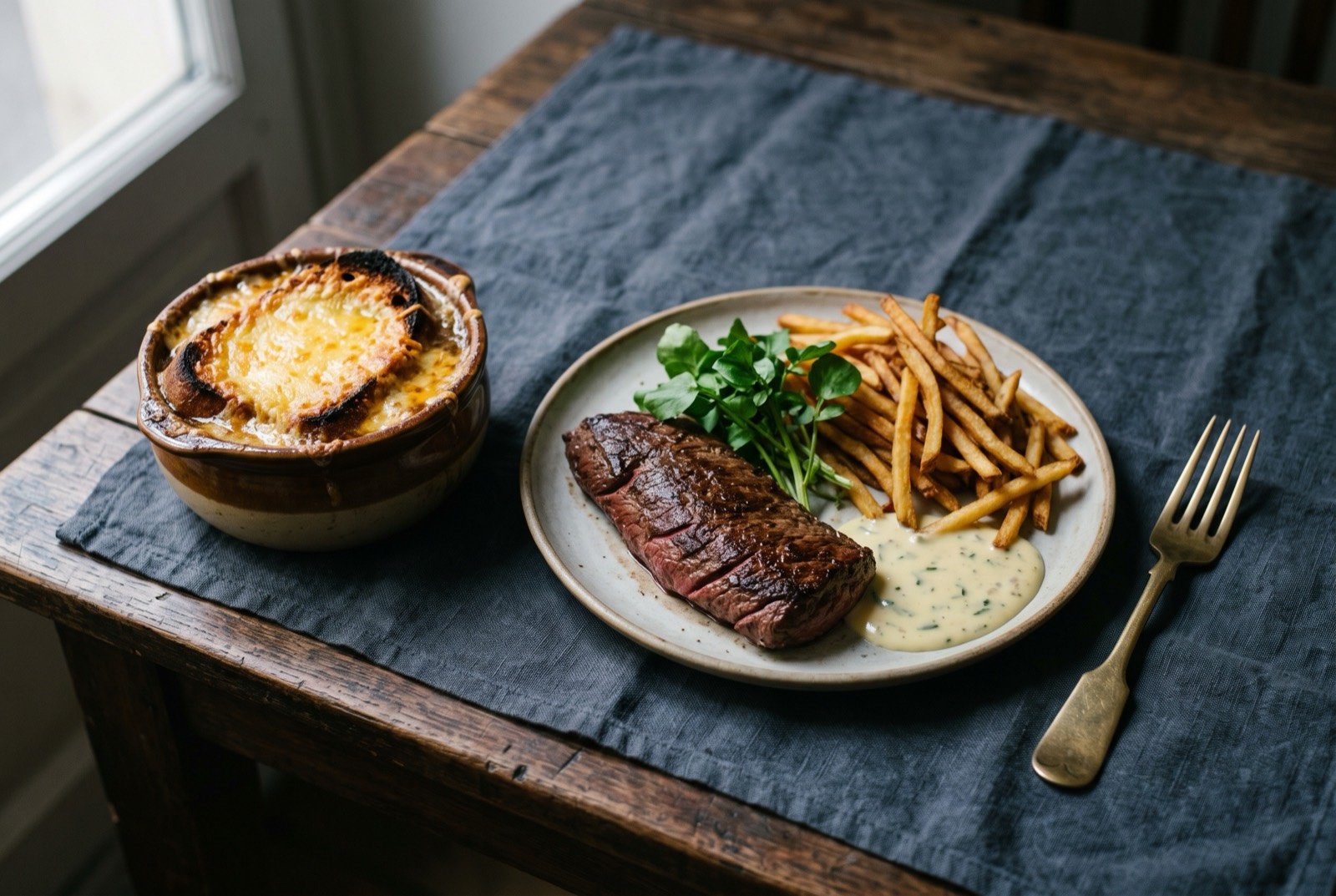
Not one ecology this time, but a role. Paris did not give French cooking its butter, its wine or its wheat, the provinces did that. What Paris gave it was codification: a court chef who classified sauces into families, a hotel chef who turned a kitchen into a standing army, and, underneath it all, a wine merchant's back room feeding the city its actual daily food. Every dish as tradition built it, then what a modern chef would change: tradition, then modernist technique.
Sources and review · What this chapter does not assert · How we research · Spotted something wrong?
A Sense of Place
Ten regional volumes in this series each open by describing what grows, what the fat is, what the starch is. Paris breaks that pattern, and the break is the argument. Paris sits on no distinctive ecology of its own. Its food identity was built by four separate mechanisms operating on top of whatever the provinces sent in, and understanding the city's table means understanding those four mechanisms rather than a landscape.
The codifying mechanism: a court, then a hotel, then a magazine
Marie-Antoine Carême, cooking for Talleyrand, Tsar Alexander I and eventually the Rothschilds in the first third of the nineteenth century, was the first to publish a systematic classification of French sauces into a small number of "grandes sauces" with derivative "daughters," a move that turned an oral craft into a codified system a stranger could learn from a book. Auguste Escoffier, at the Savoy, the Ritz and the Carlton at the turn of the twentieth century, did the same thing to the kitchen itself, organising it into a brigade of named stations under a single chain of command, explicitly modelled on his own experience feeding an army under fire. Between them, and the critical press that grew up alongside them (Grimod de La Reynière's restaurant guide from 1803, Brillat-Savarin's philosophy of taste in 1825, the Michelin Guide from 1900), Paris became the place where French cooking got written down, graded and exported. This is a genuinely different kind of culinary authority from Bologna's guild-regulated mortadella or Norcia's pork-curing confraternity: not a place defending what its own soil and climate produce, but a place defending a method of organising and judging food produced somewhere else entirely.
The everyday mechanism: the bistro and the brasserie
Running the whole time underneath the codified kitchen, mostly ignoring it, is a separate register that was never haute cuisine simplified. The bistro is a wine merchant's back room that started feeding customers: small, informal, a chalkboard menu, home cooking (pot-au-feu, blanquette de veau, hachis parmentier) scaled up just enough for commercial service. The brasserie is a brewery that started serving food continuously, all day, and Paris's brasserie culture as it survives today, Lipp, Bofinger, choucroute garnie itself, is not generically French at all but specifically Alsatian, carried in by refugees from the 1871 annexation of Alsace-Lorraine. Neither register waited for Escoffier's permission and neither is a diminished version of his system.
The supply mechanism: a market, then a warehouse twelve kilometres south
For eight centuries the city fed itself from one site, Les Halles, expanded under Napoleon III into Baltard's iron-and-glass pavilions and mythologised by Zola as the city's own digestive organ. In 1969 the whole apparatus moved to Rungis, outside the city, in a single logistical operation described at the time as "the move of the century." The move was not neutral: small restaurants built around feeding market porters and workers lost their entire clientele overnight, and the relationship between the city's kitchens and its food supply changed permanently. Paris still eats, disproportionately, off a market most of its restaurants' customers will never see.
The absorbing mechanism: successive waves of people who were never French by the map's own definition
Belleville is Southeast Asian by way of ethnic-Chinese traders who fled Vietnam, Laos and Cambodia after 1975, many of whom had never lived in mainland China. The Marais is Ashkenazi Jewish by way of pogrom refugees from Romania, Austria-Hungary and Russia between 1881 and 1914, then Sephardic by way of North African decolonisation. Barbès and Belleville are North African by way of Kabyle labour migration from the 1920s, then the much larger 1962 wave of pieds-noirs after Algerian independence. Château Rouge is West African, though a rigorous French urban-studies survey found that two thirds of the people who actually shop there do not live there at all, and travel in from the suburbs and further provinces specifically for the trade the neighbourhood concentrates. None of this is a garnish on top of "real" Parisian food. It is what Parisian food, eaten by actual Parisians on an actual Tuesday, has substantially been for over a century.
Read together, these four mechanisms explain something the ten-dish repertoire below cannot on its own: why "French cuisine" and "Parisian food" are not the same claim, and why this chapter treats the codified sauce system and the bistro's onion soup as equally central rather than one as the real thing and the other as its shadow.
A note on Nice, addressed here rather than left implicit. This chapter's account of the classical, codified table sometimes runs up against dishes that get claimed for it loosely in popular writing, salade niçoise chief among them. Salade niçoise's home is Nice and the Mediterranean volumes already written, not here; where a version of it turns up on a Parisian bistro menu, that is Paris borrowing a dish it did not codify and does not get to speak for, not evidence that the dish is originally a Parisian one. This chapter treats that as a live Paris-versus-Nice authorship question worth naming, not one to quietly resolve in the capital's favour just because the capital writes more of the criticism.
The History in Layers
Carême, and the myth of the single inventive genius
Carême's own birth year is not settled, 1783 or 1784, since the Paris civil registry that could confirm it was destroyed by fire in 1871. The standard story that he was an abandoned orphan pushed onto the street at ten is his own account, and one historian's research indicates it does not correspond to reality: he was apparently placed in apprenticeship by his father, with whom he kept in contact. Apprenticed at 13 near the Palais-Royal, he rose through Talleyrand's kitchen, created pièces montées for Napoleon's table modelled on real architecture (he studied Vignola and Palladio at the Bibliothèque Nationale for this), cooked in London for the Prince Regent, briefly and unsuccessfully attempted a posting in Saint Petersburg, and finished his career with the Rothschilds.
In his five-volume L'Art de la cuisine française au XIXe siècle, unfinished at his death in 1833 and completed by his disciple Armand Plumerey, Carême classified four "grandes sauces": espagnole, velouté, allemande and béchamel. Tomate and hollandaise, which most people now assume were always part of the core four, he classified separately as "petites sauces." The popular claim that Carême single-handedly invented the mother-sauce system as a clean act of genius does not survive close reading of his own text. The classifying impulse itself, sauces as a family tree with mothers and daughters, was already circulating in French culinary writing before him: a specific 1844 usage in the Revue de Paris, eleven years after his death, refers to "la grande espagnole" as "une sauce-mère" in language that assumes the reader already understands the framing. Carême systematised the idea more completely and more influentially than anyone before him. He did not originate it from nothing, and his own four mothers are not the four most people now name.
Escoffier, and an army kitchen theorised as a hotel kitchen
Auguste Escoffier apprenticed at 13 in his uncle's restaurant in Nice, and during the Franco-Prussian War of 1870 to 1871 served as head chef at the Rhine Army's headquarters in Metz, then at Marshal MacMahon's quarters in Wiesbaden, an experience he later said taught him to keep work moving methodically under pressure. He drew directly on that military experience to theorise the brigade de cuisine, the kitchen organised into a chain of named stations under one command, first at the Savoy under his partnership with César Ritz from 1890, then, after both men were dismissed in 1897 amid allegations of financial impropriety, at the Ritz Paris and finally at the Carlton in London, where he commanded sixty cooks serving roughly five hundred covers a service.
Le Guide Culinaire, 1903, was co-authored with Phileas Gilbert and Émile Fétu, not written by Escoffier alone, and it is still called the profession's bible more than a century later. The "five mother sauces" now taught everywhere, béchamel, velouté, espagnole, tomate, hollandaise, is not quite what the 1903 French text says. Escoffier's original French edition named four grandes sauces de base: espagnole, velouté, béchamel and tomate. Hollandaise was a petite sauce, a daughter, and mayonnaise was named separately as the mother sauce for cold preparations, a category the popular five-sauce list drops entirely. Hollandaise was only promoted to mother-sauce rank in the 1907 English abridged edition, a change that never appears in Escoffier's own French. The version now taught worldwide is an Anglophone synthesis of a French original, and this chapter would rather say so than repeat the tidier but slightly wrong story.
Escoffier also demoted Carême's allemande, folding it in as a daughter of velouté (velouté enriched with egg yolk and cream), and around the outbreak of the First World War renamed it sauce parisienne, since a sauce named for the enemy was an awkward thing to have on a French menu mid-war. Contemporary French press was direct about what Escoffier's career actually was: a 1920 piece in L'Echo de Paris credited him with doing more for French influence abroad than diplomats or writers, and in 1935 the president of the Paris chefs' society wrote in Le Journal that Escoffier had imposed French staff and French produce at the openings of palace hotels worldwide, acting as "a first-rate commercial agent" for French cuisine. He received the Légion d'Honneur in 1920, reportedly the first chef to do so, for exactly that role.
The brigade, and how much of it is still real
Escoffier's own stated reason for the brigade, in his own words, was to secure "a sure, regular and methodical progress of the work amid the most incredible service rushes," an industrial-organisational answer to the problem of feeding hundreds of covers at once, not a hierarchy for its own sake. At its largest his brigades ran to more than twenty distinct stations: saucier (sauces, stocks and braises, the most prestigious post), poissonnier (fish), rôtisseur (roasted and grilled meats), garde-manger (cold work), entremetier (vegetables and starches), pâtissier (desserts), tournant (a floating relief cook with no fixed post), friturier (fried work), the aboyeur barking orders at the pass, and beneath the chefs de partie a ladder of demi-chefs, commis, plongeurs, communards and apprentices.
How much of this survives is genuinely contested rather than settled either way. One serious source states plainly that the brigade's organisational foundation has not changed since Escoffier. Against that, trade sources across the industry describe the full twenty-station brigade as now rare outside the largest hotel and multi-starred kitchens, with most restaurants running a compressed version, an executive chef, a chef de cuisine and versatile all-rounders standing in for what would once have been several separate posts, and the aboyeur specifically reported as having disappeared as a dedicated role, its function folded into the head chef's own job of calling orders. This chapter's honest position is that the underlying principle, specialised stations under a clear chain of command, scaling output past what an unstructured kitchen can manage, is Escoffier's durable legacy, and the twenty-name roster is now mostly kept alive by culinary schools rather than by daily service.
Grimod, Brillat-Savarin, and criticism as a Parisian invention
Before either Carême or Escoffier, Alexandre Grimod de La Reynière had already created restaurant criticism, the tasting jury and culinary advertising almost single-handedly, publishing the Almanach des gourmands annually from 1803 to 1812 and convening twelve friends weekly for five-hour meals in his own home to formulate what counted as good. Jean Anthelme Brillat-Savarin's Physiologie du goût, 1825, thirty years in the writing and published anonymously, fused gastronomic writing with philosophy and had immediate success: Balzac admired it, Carême was jealous of it, and Baudelaire later held it in contempt, a small detail worth keeping because it shows the field's founders never agreed with each other either.
The restaurant did not need the Revolution, but the Revolution built its labour force
The popular story, that the Revolution simply threw aristocratic cooks onto the street and they promptly opened restaurants, is too clean, and this chapter says so rather than repeating it as received wisdom. The restaurant format predates the Revolution outright: Antoine Beauvilliers, chef to the Prince de Condé, opened La Grande Taverne de Londres on rue de Richelieu in 1782, seven years before the Revolution, explicitly serving dishes as eaten at Versailles in an elegant public setting. And the transition for displaced aristocratic cooks was not instant or smooth: the authorities of the new Republic constantly suspected them of keeping ties to their former masters, and Beauvilliers's own restaurant, along with Méot's, actually struggled through the early 1790s, with custom falling further during the Terror despite revolutionaries themselves eating there. Restaurant culture only really took off after Robespierre's fall in 1794, in the more celebratory atmosphere of the Directoire. What is true, and load-bearing for this chapter's argument, is that the Revolution mass-produced unemployed aristocratic kitchen staff who, after a period of real hardship, became the labour force and the technical capital behind the Directoire-era restaurant boom that followed. One secondary source's approximate figures, roughly 100 Paris restaurants at the 1789 Revolution, 600 under the Empire, 3,000 under the Restoration, should be read as order-of-magnitude rather than precise.
Michelin, and a guide with its own bias
The Michelin Guide began in 1900 as a free promotional booklet for tyre customers, timed to the Paris Exposition. It only turned toward gastronomy after 1918, with the Michelin brothers concentrating early scrutiny on Paris, Lyon, Marseille and the Côte d'Azur; regional editions followed from 1926, and the star system was largely settled through the interwar period. The guide has long been criticised for favouring highly codified cuisine centred on French and European haute technique at the expense of street food and popular traditions, and even today, with a visible recent push toward rural and provincial addresses, Paris and its suburbs still carry more starred tables, over sixty of them, than any comparable concentration elsewhere in France.
Curnonsky, and a counter-story worth telling in full
This chapter set out expecting to find a clean story of Paris absorbing provincial dishes and renaming them as its own, cassoulet and bouillabaisse folded into a homogenised "French cuisine" by the capital's critical machinery. The sourced material does not support that story, and points, if anything, the other way. The documented twentieth-century movement to elevate regional cooking is associated with a Paris-based critic actively campaigning against the palace-hotel establishment's neglect of it. Maurice Edmond Sailland, writing as Curnonsky, was voted Prince des Gastronomes in a 1927 poll of 3,388 readers, and from 1919 made it his explicit project to rehabilitate cuisines he considered sidelined by haute gastronomie's prestige. Touring France with journalist Marcel Rouff between 1921 and 1930, he co-produced the Trésor Gastronomique de France, 28 of a planned 32 volumes, an inventory of French regional cooking, and founded the Académie des Gastronomes in 1928 in Brillat-Savarin's honour. Bouillabaisse's own 1980 Charter of Marseille Bouillabaisse, drawn up specifically against a documented "Parisian bouillabaisse" made with Atlantic rather than Mediterranean rockfish, reads as regional self-defence against capital-driven dilution, not evidence of the capital quietly annexing the dish. This chapter does not assert a general Paris-absorbs-and-renames mechanism, because the material found does not support one; the more interesting and better-evidenced story is of critics pulling in both directions at different moments, Escoffier's system centralising prestige, Curnonsky's project fighting to decentralise it again.
The bistro's own history, and a word whose origin does not survive checking
The popular story that "bistro" comes from Russian soldiers occupying Paris after 1814 shouting bystro, quickly, at slow waiters, commemorated on a plaque in Montmartre, does not survive checking, and this chapter treats it as a debunked legend rather than one theory among several. The CNRS's own etymological dictionary dates the word's first attestation to 1884, seventy years after the supposed origin, meaning tavern-keeper, and states plainly that the Russian derivation "is not sufficiently founded," classifying the word's true origin as obscure. A more plausible candidate traces it to the Poitevin dialect word bistraud, originally a little servant, then a wine merchant's assistant, then the wine merchant himself, which fits the pattern that bistro, like troquet, first named the keeper of an establishment before it named the establishment.
The brasserie's history is better documented and genuinely tied to a specific historical mechanism rather than a vague beer culture. Brasserie meant simply a brewing works from 1371, only acquiring its restaurant sense from 1844. Paris's surviving brasserie culture, Lipp, Bofinger, Zimmer, dates directly to the Treaty of Frankfurt of 10 May 1871, which ceded Alsace-Lorraine to the new German Empire: a wave of Alsatians who wished to remain French relocated to Paris by the new railway network, and wealthy Alsatian families opened these establishments. Choucroute garnie as a codified restaurant dish, not the peasant preservation food it started as, is dated to this same 1870s moment: Alsatian brasseries took the plain fermented cabbage and elevated it with charcuterie into "choucroute royale."
Les Halles, Zola's belly of the city, and the move that hollowed a quarter
The market's roots trace to a relocation under Louis VI around 1110 to drained marshland known as Champeaux. Architect Victor Baltard's competition-winning design for a new central market initially proposed stone pavilions; construction began in September 1851, but after visiting the site in June 1853 Napoleon III rejected it outright, reportedly telling Haussmann he wanted "vast umbrellas, nothing more," and demanded iron and glass instead. Twelve iron-and-glass pavilions went up across the 1850s to 1870s, a fourfold expansion on the old market's footprint, and Émile Zola used them as the setting for Le Ventre de Paris, 1873, describing the market as a living organ, Paris chewing mouthfuls for its two million inhabitants.
In 1960 Charles de Gaulle decided to move the wholesale market twelve kilometres south to Rungis, citing hygiene, congestion and the plain impossibility of running modern goods logistics through a nineteenth-century city-centre site. The move itself, over the night of 2 to 3 March 1969, relocated more than 20,000 people, 1,000 wholesale businesses and 5,000 tonnes of merchandise in what was called at the time "the move of the century." The cost to the neighbourhood was real and specific, not incidental colour. Small restaurants that had depended on market workers and porters for their entire trade saw that clientele disappear overnight, and surrounding food shops closed progressively in the years that followed. The vacated site, nicknamed le trou des Halles, became the underground Forum des Halles shopping centre. Rungis today is described as the largest wholesale food market in the world, roughly a million square metres across 234 hectares, and 45 per cent of Parisian restaurateurs still source from it at least once a week, which is worth holding next to the fact that most of their customers have never seen it and probably could not find it on a map.
The Marais, Belleville, Barbès, Château Rouge: four neighbourhoods, four different mechanisms
The Marais became a majority Yiddish-speaking Ashkenazi quarter, the Pletzl, through a specific, dated wave: roughly 20,000 people settled there between 1881 and 1914, fleeing pogroms and persecution in Romania, Austria-Hungary and Russia. A second, later layer, Sephardic communities from North Africa after decolonisation, arrived and opened shops alongside the older Ashkenazi establishments, so that Ashkenazi kreplach and strudel are now sold beside Sephardic dafina and pastilla in the same streets. Jo Goldenberg, the emblematic rue des Rosiers restaurant, is a documented case of the neighbourhood's fragility as much as its continuity: on 9 August 1982 it was the target of a terrorist attack, a grenade thrown into the dining room and gunfire on the street, killing six people and wounding twenty-two. The restaurant carried on for another two decades before closing in 2006 for failing hygiene standards; the site is now a clothing shop that kept the original mosaic facade.
Belleville turned Southeast Asian specifically between 1975 and 1980, following the fall of the communist regimes in Vietnam, Laos and Cambodia, and the crucial detail most accounts flatten is that many of the earliest arrivals were ethnic Chinese who had never lived in mainland China at all, long-settled merchant communities in Vietnam, Laos and Cambodia who fled as wealthy francophone traders when the communists took power. The first Chinese restaurant on rue de Belleville opened in 1978. A separate, demographically distinct cluster formed in the 13th arrondissement's Triangle de Choisy around the same mid-1970s moment, disproportionately Teochew and Cantonese-speaking refugees from Cambodia, Laos and southern Vietnam, who settled specifically because unpopular, largely vacant new tower blocks from a failed urban-renewal scheme happened to offer available housing, and who turned to food retail, including the anchor supermarket chains Tang Frères and Paristore, having been excluded from professions that required recognised French qualifications.
Barbès carries the deeper political history of Paris's North African population. Algerian cafés and cantines existed there from as early as the 1920s, and the neighbourhood is documented, in the historian Hajer Ben Boubaker's own words, as "the mother house of immigration's struggles," where cafés doubled as meeting places for early Algerian independence activists and as sites of anticolonial political organisation, not neutral eating spaces. 1962, and the arrival of pieds-noirs repatriated after Algerian independence, marks a second, larger and quite different wave from the earlier Kabyle labour migration, one that brought couscous fully into mainstream French eating, a dish France's own Musée national de l'histoire de l'immigration notes is routinely and wrongly labelled Moroccan in French popular usage, its actual Algerian, Tunisian and Berber layers erased in the telling.
Château Rouge is the neighbourhood where the sourced evidence most sharply corrects an easy assumption. It is popularly described as Paris's African quarter, and a rigorous French urban-studies survey found that this identity is a commercial practice, not a residential one: two thirds of the people who actually shop there do not live in the neighbourhood at all, travelling in from the Île-de-France suburbs and further provinces specifically for the food, cosmetics and textile trade concentrated there, drawn from 24 different African nations. Chinese and Indian merchants, who supply and run much of the retail infrastructure, arrived first, around 1989; African-owned fashion retail moved in afterward. The residential population, meanwhile, is gentrifying and diversifying away from the image the market projects, a tension the chapter would rather name than smooth into a tidier story of one settled community.
None of the sourcing behind these four neighbourhoods, worth stating plainly rather than letting it pass silently, comes from writers inside the Southeast Asian, West African or (with one partial exception in Barbès) North African traditions themselves. It is French civic, academic and institutional material describing these communities from outside, and this chapter would rather say that than let the citations quietly imply otherwise.
Viennoiserie: the clearest case of Paris absorbing an outside technique and keeping the credit
August Zang, an Austrian entrepreneur and former artillery officer, opened the Boulangerie Viennoise on rue de Richelieu around 1838, bringing a patented steam oven and Viennese breads including the kipfel, a crescent roll that gave the croissant its shape, though not yet its lamination, which is a later French development built onto the imported form. Imitators followed within roughly two years. Zang himself did not stay: the bakery ran for about two years before he returned to Vienna to found a newspaper, and the man popularly credited as the croissant's father left baking behind entirely. This whole account rests on English-language secondary history rather than French archival material and should be read as plausible rather than fully verified, but the underlying shape of the story, Paris absorbing a Viennese technique and keeping the international credit for the result, fits this chapter's whole argument about what Paris actually does to food that arrives from elsewhere.
The Flavour Arsenal
Butter, and the two designations that actually matter
Two AOP designations govern the butter this volume's classical dishes assume: Beurre d'Isigny, Normandy, AOP since 1986, and Beurre Charentes-Poitou, spanning Charente, Charente-Maritime, Deux-Sèvres, Vienne and Vendée. Both are genuinely regulated by France's INAO alongside EU control bodies; the Charentes-Poitou specification requires milk collected within 72 hours of milking and, since a 2022 tightening, cows fed mainly on local, GMO-free feed, with a minimum twelve-hour slow biological maturation of the cream before churning. That slow cultured maturation, not marketing, is the actual reason a beurre blanc or a beurre noisette built on real AOP butter tastes different from one built on a UK block butter: it gives the fat a nutty, faintly cheesy depth the standard product simply does not have.
Veal stock, and what it is actually built from
Fond brun de veau, the base of the whole brown-sauce family, is built by roasting veal bones and vegetables hard, 200 to 220°C for 30 to 40 minutes, a deliberate Maillard reaction, before a long, slow simmer of seven to eight hours. Demi-glace is a further reduction, historically a half-and-half combination of espagnole and additional brown stock, and reducing two litres of stock to roughly a tenth of its volume yields around 25cl of genuinely concentrated meat glaze. This is codified straight out of Escoffier's own 1903 text and remains the professional repertoire's actual foundation, not a stylised description of it.
Mustard, and a label that guarantees a method, not a place
Moutarde de Dijon is not a protected geographical designation. A 1937 French decree defines it as a manufacturing method and recipe, brown or black mustard seeds, verjuice or white wine, a specific de-hulling and grinding process, not a place of origin, so mustard made anywhere to that method can legally carry the name. This is genuinely useful to know rather than pedantic: it means brand matters more than the words on the jar. Moutarde de Bourgogne, by contrast, does carry a real PGI, and its seeds must be grown in Burgundy.
Tarragon, shallots, and the difference precision makes
French tarragon, Artemisia dracunculus 'French', not the flavourless Russian tarragon commonly sold as a lookalike, is the variety a proper béarnaise needs, and it is not reliably available fresh in a UK supermarket, which makes growing one hardy perennial plant the more useful long-term answer than a wilting herb pot. Shallots and onions are treated as genuinely different ingredients in French classical technique, not interchangeable: shallots hold their shape better when finely diced, cook faster, and carry a sweeter, less sulphurous bite, which is exactly why a béarnaise or a red-wine reduction calls for one and not the other.
Cheese for the bistro table
Comté and Gruyère are both routinely called for in gratins and onion soup, and they are not the same thing: Gruyère AOP is Swiss, aged a minimum of ten months; French recipe writing's casual use of "gruyère" for a hard melting cheese often actually means Comté or Beaufort in practice, worth checking rather than assuming. Emmental, widely stocked, is fine for a croque-monsieur but a poor substitute for either in a proper gratin, where its blandness shows up next to real depth.
The Technique Ladder
The argument, from inside
Every rung below is doing the same underlying thing Escoffier's brigade was doing to a kitchen: taking a process that used to depend on a cook's accumulated feel and giving it a controllable structure. That is the actual, defensible link between this volume's classical dishes and a British kitchen carrying a Big Green Egg, a sous vide bath, a dehydrator, a high-power blender, a chinois and a dedicated spice grinder. None of that kit is a foreign import displacing French tradition; sous vide itself was invented in a French kitchen, at Troisgros, in 1974, specifically to stop foie gras losing fat and texture under conventional heat, fell out of professional fashion for decades, and has only recently come back into style. The tradition was already chasing precision. Modern kit just gets there more reliably.
Rung 1. Build a roux-based sauce as a controlled reduction, not a lucky guess
Béchamel (roux blanc, milk), velouté (roux blond, white stock) and espagnole (roux brun, brown stock plus mirepoix and tomato) are the same underlying move at three different points on a colour scale, fat and flour cooked to varying degrees before a liquid is worked in. Escoffier's own sauce tomate, worth stating precisely because most people assume the opposite, is built on a blond roux and a white stock, not a brown one, and stays fluid, closer to a velouté in body than to the thick reduction most home cooks now expect from the name.
Rung 2. Mount a sabayon emulsion off direct heat
Hollandaise and its daughters, béarnaise chief among them, work by a wholly different mechanism from the roux sauces: egg yolks whisked over gentle heat to around 65°C until they thicken into an aerated sabayon without scrambling, then mounted with warm clarified butter in a thin stream exactly as a mayonnaise, roughly one yolk to 60g butter. Skip the sabayon stage and what remains is not a lighter version of the sauce, it is a different, flatter thing, which is exactly the diaspora failure this chapter comes back to below.
Rung 3. Hold a genuinely controlled low temperature, the way confit already did
Classical confit works by submerging meat in fat and holding it at a controlled 80 to 90°C for hours, too hot and the meat dries out, too cool and it does not cure properly. A sous vide bath at a precise 82°C, held for as long as the dish needs, is not a foreign substitute for this, it is a tighter version of the same idea the tradition was already reaching for by feel, before a domestic stove could hold a temperature that precisely for that long unattended.
Rung 4. Reduce toward clarity, not just toward thickness
A demi-glace is not simply a thickened stock, it is a stock reduced until its gelatine and flavour compounds concentrate and its impurities have been skimmed and strained away through a genuine fine-mesh chinois, not a coarse conical colander sold under the same name. Consommé clarification, an egg-white raft dragging cloudiness out of a simmering stock, is the same discipline applied to the opposite end: reducing not for body but for transparency.
Rung 5. Let patience do the work heat cannot
Onion soup's entire technique is caramelisation, twenty to sixty minutes of genuinely slow, patient stovetop cooking, stirred occasionally rather than constantly, over moderate rather than high heat. Rushing this stage, browning onions in ten minutes instead of forty, is the single most repeatedly named way the dish fails, and no amount of cheese piled on top afterward fixes what the onions themselves never had time to become.
Rung 6. Laminate in cold, controlled stages
A croissant is fundamentally a temperature-management problem: butter that is too warm smears into the dough rather than sheeting through it in distinct layers, and butter that is too cold cracks. Working in a genuinely cold kitchen, chilling the dough between folds, and using a proper high-fat European butter rather than a standard UK block, at roughly 84 per cent fat or above, are all the same discipline applied at three different points in the same process.
The Ferment and Preserve Bench
1. Choucroute, an imported technique this chapter names rather than claims
Choucroute, cabbage salted and left to lacto-ferment, is not a Parisian invention at all, it is Alsatian, carried to Paris by the specific 1871 refugee wave discussed above and elevated by Alsatian brasseries into a restaurant centrepiece. Its home, and its own full tradition-and-elevation treatment, belongs to the future Alsace and Lorraine volume of this atlas (EU-12), not to Paris; this chapter names the technique and the mechanism that brought it here rather than claiming the dish.
2. Gelée, the classical kitchen's own preservation logic
A properly clarified stock set with gelatine, whether encasing a pâté en croûte or standing alone as an aspic, is a preservation technique as much as a garnish: a sealed, set layer that keeps the meat beneath it from drying out or oxidising, doing the same practical job a duck-fat confit does by a different mechanism.
3. Demi-glace as a preserved reduction
A properly made demi-glace, reduced hard and concentrated, keeps far longer under refrigeration than the stock it was built from, which is exactly why the classical kitchen bothered reducing it that far in the first place: not only for flavour, but so a sauce base could be held and drawn on over days rather than made fresh for every single service.
Sourcing in Britain
Verified August 2026. Where a supplier could not be fully confirmed, that is said rather than smoothed over.
The ranked list: what decides great from grim
- Real cultured AOP butter, not UK block butter, for a beurre blanc or any classical emulsified sauce. A beurre blanc is nothing but emulsified butter, shallot and acid; if the butter has no depth, the sauce has none. Stocked at Waitrose and via specialist importer Épicerie Corner.
- Real veal stock, or a proper reduced glace, not a stock cube, for any classical brown sauce. The gap between a stock-cube gravy and a real reduced fond de veau is the entire difference between a sauce that tastes of itself and one that tastes of salt. Essential Cuisine's demi-glace mix, via Sous Chef UK, is the realistic middle path for a cook not rendering bones on a weeknight.
- Banana shallots, not brown onions, in a béarnaise or a classical mirepoix meant to finish delicately. A genuinely different flavour, not a texture preference. Stocked at Waitrose and specialist grower Parrish Farms.
- British rose veal, sourced ahead from a named butcher, not an assumption veal is buyable off a supermarket shelf. UK veal crates were banned in 1990, EU-wide in 2007, and British rose veal exists partly as an ethical corrective to the dairy industry's unwanted bull-calf problem. Named suppliers: HG Walter, The Dorset Meat Company, The Black Farmer. Order ahead and expect a real price premium over beef.
- A true boiling fowl, not a supermarket chicken, for pot-au-feu or a proper poule au pot. A young bird poaches to shreds; an old hen holds its structure and gives a stock with real body. Named suppliers: Palmers Butchers, Porterford Butchers.
- High-fat European-style butter (ideally AOP Charentes-Poitou pastry grade, 84%+ fat) for lamination, not standard UK block butter. Below that fat percentage, butter will not sheet cleanly through croissant dough and the pastry loses definition in the oven, a mechanical failure, not just a flavour one.
- Fallot or another stone-milled Dijon over a generic supermarket "Dijon-style" mustard, particularly where the mustard is a primary flavour rather than a background condiment. Edmond Fallot, stone-milled in the Dijon area, via Sous Chef UK.
General sourcing notes
Comté is better bought as an aged wedge than pre-grated: La Fromagerie stocks it by age grade. Neal's Yard Dairy sells Comté to the trade only, not retail, despite being an obvious first guess. French tarragon is worth growing rather than chasing fresh through supermarkets; Herbalhaven sells verified plants by post. A proper stockpot for real fond reduction and a genuine fine-mesh chinois, not a coarse conical colander sold under the same name, are both available in professional-grade sizes from Nisbets; Borough Kitchen stocks Mauviel's copper range for sugar work, crêpes and general classical sauce-pan needs.
Voices and Sources
The codifiers
- Marie-Antoine Carême (1783 or 1784 to 1833). Cooked for Talleyrand, Napoleon, briefly for Tsar Alexander I, and finally the Rothschilds; the first to publish a systematic sauce classification, though not the four mothers now popularly credited to him.
- Auguste Escoffier (1846 to 1935). Theorised the brigade de cuisine directly from his own Franco-Prussian War kitchen experience; co-authored Le Guide Culinaire, 1903, still the profession's reference text.
- Alexandre Grimod de La Reynière (1758 to 1837) and Brillat-Savarin (1755 to 1826). Between them created French gastronomic criticism as a genre.
- Curnonsky (Maurice Edmond Sailland, 1872 to 1956). Voted Prince des Gastronomes in 1927; spent the 1920s campaigning to rehabilitate regional French cuisines that haute gastronomie's Paris-centred prestige had sidelined.
The bistronomie generation
- Yves Camdeborde, La Régalade (1992), Le Comptoir du Relais. Widely credited with launching the bistronomie movement; his own account is that he "didn't invent anything," and simply shared what he knew with people like himself.
- Iñaki Aizpitarte, Le Chateaubriand (2006). Self-trained, leading the movement's more maverick wing outside the classic training pipeline.
- Bertrand Grébaut, Septime (2011, with Théophile Pourriat). Trained under Robuchon and Passard; built a group explicitly moving away from haute cuisine's ceremony toward inclusive service and named producer relationships. Grébaut died on 4 July 2026, aged 44, after a cancer diagnosis the previous autumn; who now runs Septime's kitchen was not established in the research behind this chapter.
- Grégory "Frenchie" Marchand, Frenchie (2009). Trained at Gramercy Tavern, Jamie Oliver's Fifteen and the Mandarin Oriental Hong Kong before returning to Paris; sources heavily from Terroirs d'Avenir.
Cooking now
- Alain Passard, L'Arpège. Took the restaurant fully plant-based from July 2025, built on his own permaculture gardens and a reduced vegetable "consommé" replacing meat jus, elevating tradition through indigenous method rather than any imported fashion.
- Yannick Alléno. Modernises the classical sauce specifically through cryoconcentration, freezing and centrifuging ingredient juices to extract flavour without the denaturing heat-reduction risks.
- Guy Savoy, Restaurant Guy Savoy. A useful reference for restraint as its own technique: each move is meant to exalt the ingredient's own taste, never to mask it.
The gap, named
No UK diaspora chefs specifically cooking this volume's classical or bistro register were researched for this chapter, unlike the Italy volume of this atlas, which names several. This is a genuine gap rather than an assumption that none exist, and a follow-up pass specifically on London's serious French kitchens would strengthen this section. Confirmation of who currently runs Septime's kitchen after Bertrand Grébaut's death was not reached and should be checked directly before this section is treated as current.
Things this chapter has deliberately not asserted
- That Carême single-handedly invented the mother-sauce system, or that his own four mothers match the four now popularly credited to him. His actual scheme named espagnole, velouté, allemande and béchamel as mothers, with tomate and hollandaise classified separately as daughters; the classifying concept itself was already circulating in French culinary writing before his own codification.
- That the "five mother sauces" now taught everywhere is exactly what Escoffier's own 1903 French text says. His original French edition named four grandes sauces plus mayonnaise as the cold mother; hollandaise was only promoted to mother-sauce rank in the 1907 English abridged edition, a change absent from the French original.
- That Paris systematically absorbed, renamed or reframed specific provincial dishes such as cassoulet, bouillabaisse or boeuf bourguignon as an act of capital-driven codification. The material found for this chapter does not support that as a general mechanism, and points if anything toward the opposite dynamic, Curnonsky's twentieth-century campaign to defend regional cuisine against Paris's own haute-gastronomy prestige, and bouillabaisse's own 1980 charter defending itself against a documented "Parisian" version.
- That "bistrot" derives from Russian soldiers shouting "bystro" in 1814. The CNRS's own etymological dictionary dates the word's first attestation to 1884, seventy years later, and states the Russian derivation is not sufficiently founded, classifying the true origin as obscure.
- That "on ne va pas au restaurant pour manger les rideaux" originated with Yves Camdeborde. At least one source attributes a near-identical line to the earlier critic Curnonsky; this chapter treats the attribution as contested rather than settled.
- The precise origin and date of the word "bistronomie." Genuinely disputed between a 1998 coining credited to journalist Sébastien Demorand and a 2000 to 2004 popularisation via Le Fooding and its founder Alexandre Cammas.
- That any named French chef or critic has publicly diagnosed, in these terms, why exported "French food" tastes wrong. The diagnosis in this chapter's technique-ladder and dish sections is this volume's own synthesis of sourced, specific technique failures (a demi-glace built from a stock cube, a béarnaise built without its sabayon, onions caramelised for ten minutes instead of forty), not a quotation from a named French voice, and this chapter would rather say so than borrow authority it does not have.
- Precise gram-for-gram quantities for hachis parmentier, choucroute garnie, oeuf mayonnaise or pâté en croûte's filling. No source consulted for this chapter gave a disciplinaire-level figure for any of the four; the quantities given are working proportions consistent with the sourced technique, not a cited official recipe, and this chapter has not invented false precision to fill that gap.
- That salade niçoise is a Parisian or bistro-codified dish. Its home is Nice and the Mediterranean volumes of this atlas; this chapter names the crossover without re-treating the dish.
- That August Zang's Boulangerie Viennoise opened on an exactly confirmed date, at a confirmed address, with a confirmed number of imitators within two years. This whole account rests on English-language secondary history rather than independently located French archival material, and should be treated as plausible rather than settled.
Volume Fifteen of Europe, Not Just Stew. Research briefs: EU-15-tradition.md, EU-15-modernist-sourcing.md, and EU-15-uk-sourcing.md. Sourcing verified August 2026.
Build a roux-based sauce as a controlled reduction, not a lucky guess
Béchamel (roux blanc, milk), velouté (roux blond, white stock) and espagnole (roux brun, brown stock plus mirepoix and tomato) are the same underlying move at...
Mount a sabayon emulsion off direct heat
Hollandaise and its daughters, béarnaise chief among them, work by a wholly different mechanism from the roux sauces: egg yolks whisked over gentle heat to...
Hold a genuinely controlled low temperature, the way confit already did
Classical confit works by submerging meat in fat and holding it at a controlled 80 to 90°C for hours, too hot and the meat dries out, too cool and it does not...
Reduce toward clarity, not just toward thickness
A demi-glace is not simply a thickened stock, it is a stock reduced until its gelatine and flavour compounds concentrate and its impurities have been skimmed...
Let patience do the work heat cannot
Onion soup's entire technique is caramelisation, twenty to sixty minutes of genuinely slow, patient stovetop cooking, stirred occasionally rather than...
Laminate in cold, controlled stages
A croissant is fundamentally a temperature-management problem: butter that is too warm smears into the dough rather than sheeting through it in distinct...
The dishes
- Soupe à l'oignon gratinée Paris (Les Halles)
- Pot-au-feu Paris
- Blanquette de veau Paris
- Oeuf mayonnaise Paris
- Steak-frites, sauce béarnaise Paris
- Hachis parmentier Paris
- Pâté en croûte Paris
- Croissant Paris, out of Vienna
Sources and review
- Researched
- 14 sources cited
- Reviewed
- Not yet reviewed from inside the tradition
- Cooked
- Not yet cooked and reported
Where this volume comes from
4 research briefs on file for this volume, researched to the rules on How we research. Published 28 August 2026. Last changed 8 September 2026.
The brief's own account of its sources
Approximately 53 web searches and page fetches were run across the two research passes that fed this synthesis (roughly 33 for the classical-codification pass, roughly 20 for the bistro/market/immigrant pass, plus 7 targeted page fetches in the second pass). The large majority, roughly 44 of 53, were run as French-language queries or fetches of French-language sources, per the house rule to search in the language of the place rather than English queries with one French word inserted. Balance of sources.