France and the Alps · Volume 16, Altitude, Cheese and a Border the Kitchen Never Drew
Fondue moitié-moitié
Fribourg
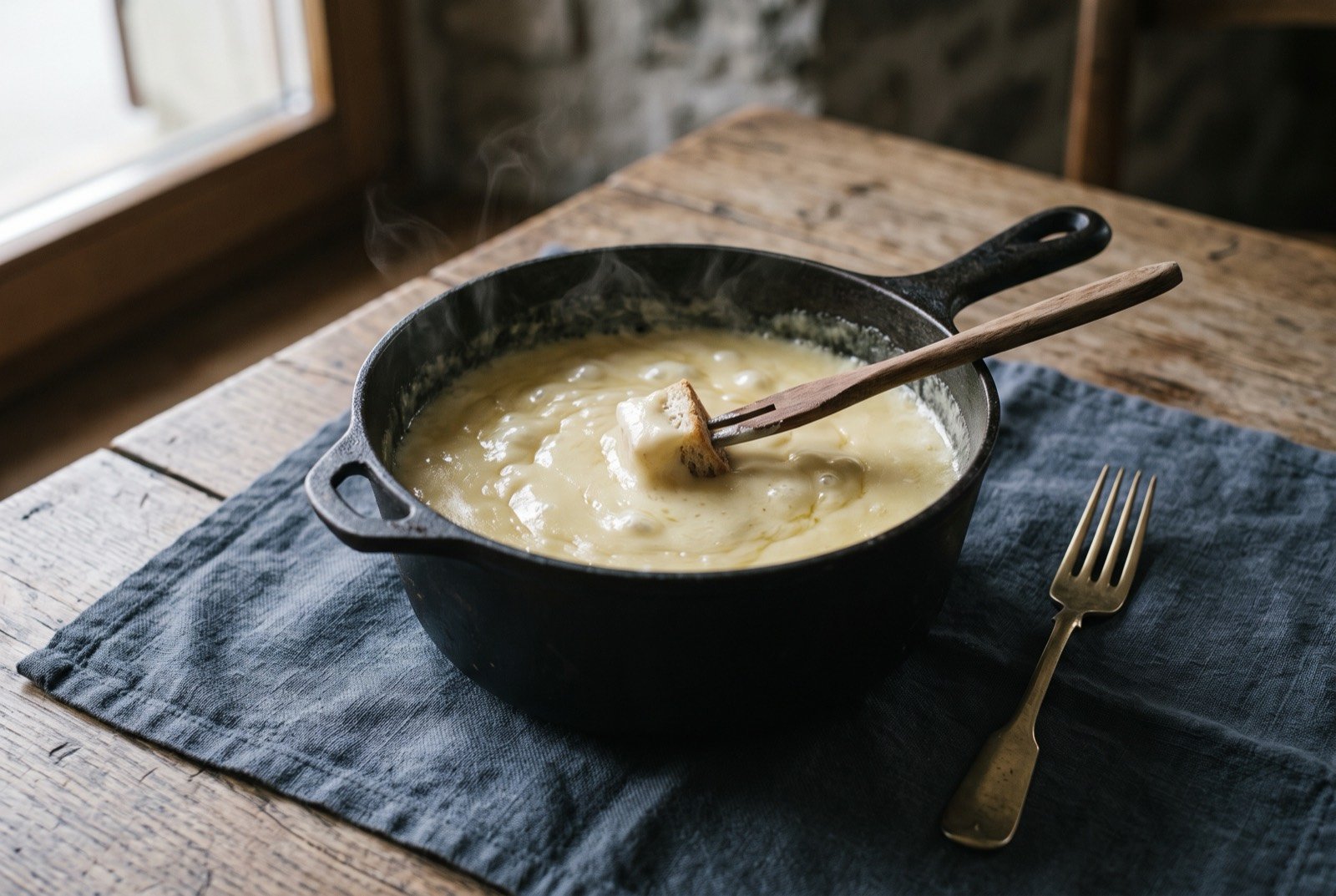
Illustration
- Time
- 20 minutes
- Researched
- 22 sources cited
Fribourg. The real Fribourg fondue, distinct from both Vaud's own Gruyère-only house version and Savoie's later, Emmental-and-Beaufort adoption of the dish. See the history section above for why none of these should be presented as ancient.
As tradition built it
Serves 4. About 20 minutes.
Ingredients
- 400 g each (800 g total, serves 4) equal weights of Gruyère AOP and Vacherin Fribourgeois AOP, roughly 200 g cheese per person
- 1 garlic-rubbed caquelon
- 3 dl dry white wine (Chasselas)
- to taste a splash of kirsch, optional
Method
- Rub the caquelon vigorously with a cut garlic clove.
- Warm the wine gently in the pot.
- Add the grated Vacherin first and work it smooth before adding the grated Gruyère, since the two cheeses do different jobs: Gruyère supplies the fruity flavour and characteristic elastic stretch, Vacherin the creamy binding body.
- Melt over low heat, stirring constantly in a figure of eight, holding the mixture at or near 70°C and never allowing it to boil, stirring in a splash of kirsch near the end if using.
- Serve immediately over a table burner, with cubed bread and small hot potatoes for dipping.
What a modern chef changes
A measured starch addition and a rescue technique, both grounded in the ETH Zurich rheology study
Rung 1
Method
- Weigh a precise 3% cornflour by weight against the total cheese, whisked into a small measure of the cold wine before it joins the pot, rather than relying on the traditional flour-dusted-cheese method to introduce starch inconsistently. This is the exact figure the ETH Zurich rheometer study found to hold a fondue smooth without stringiness at 70°C, and measuring it precisely removes the single most common cause of a home fondue splitting.
- Cook with an actual probe thermometer clipped to the pot, not by eye or feel, holding the mixture within a few degrees of 70°C throughout rather than approximating "low heat."
- Keep a high-power blender on standby as an emergency rescue, off the heat, not as the primary tool. If the mixture does begin to split under a guest's own inexpert stirring at the table, a short, low-speed blend redistributes the clumped fat and protein back into suspension, the same physical logic as the original emulsion, worked mechanically rather than by hand.