France and the Alps · Volume 16, Altitude, Cheese and a Border the Kitchen Never Drew
Raclette
Vaud and Fribourg by origin claim, though the practice is properly Valaisan
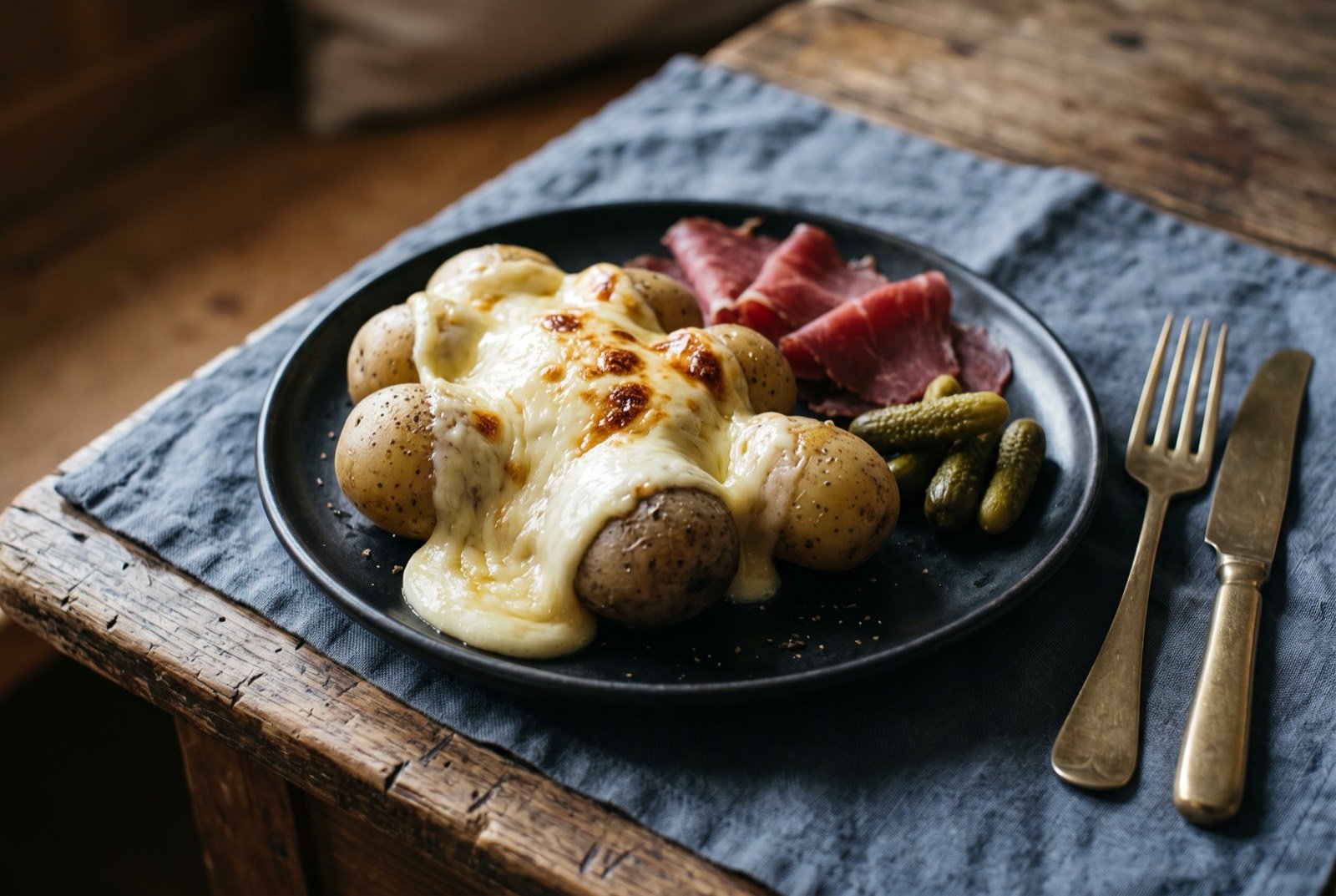
An illustration of the dish, not a photograph of it cooked.
- Time
- Not statedNo source states a time and the atlas has too few comparable dishes to estimate one.
- Researched
- 22 sources cited
- Reviewed
- Not yet reviewed from inside the tradition
- Cooked
- Not yet cooked and reported
Vaud and Fribourg by origin claim, though the practice is properly Valaisan, French-speaking Switzerland's most exported dish. See the history section for why this is a 19th-century-named shepherd's practice, not ancient food, and why the industrial version sold under this name is a genuinely separate, documented problem from the dish's own age.
As tradition built it
Per person, roughly 200 to 250 g cheese.
Ingredients
- 200 to 250g per person, or to taste a half-wheel or large piece of raclette cheese
- to serve boiled potatoes
- as available cured meats, cornichons and pickled onions, to serve
Method
- Hold the cheese near an open fire, traditionally, and scrape, "raclée," the melted surface directly onto the boiled potatoes as it liquefies.
- Repeat the scraping as successive layers melt.
- Serve with cured meats, cornichons and pickled onions.
Notes
No single quantified traditional recipe exists beyond this method; the modern electric individual-tray appliance, developed through a Rippoz and Tefal partnership in 1975 in Savoie, is a tourism-era domestication of the fire-and-scrape original, not the traditional technique itself.
What a modern chef changes
Sourcing as the actual technique, and a controlled melt for the tabletop format
Rung 3
Method
- Buy by named producer and visible rind, not by the word "raclette" on a pack. A comparative French consumer-body test found that only around 5% of raclette cheese sold in ordinary French supermarkets actually originates in Savoie, the rest industrially produced elsewhere under regional-sounding branding, and a separate panel test scored an industrial raclette product worst among tasters, described specifically as having a rubbery texture and absent taste. A wedge with a defined, actively rubbed rind from a named producer is the single highest-leverage decision for this dish, more consequential than any cooking technique that follows it.
- Run a genuine half-wheel machine rather than the compact tabletop format where the format itself is available, since the half-wheel's slower, larger melting surface reproduces the fire-and-scrape original's actual mechanism, a continuously refreshed melted layer scraped away before it can overcook, far more closely than an individual grill-pan tray does.
- Where only the tabletop format is practical, hold each individual pan under the grill element rather than directly on it, checking by eye every 30 seconds rather than setting a timer, since the cheese's actual doneness, a fully liquid surface with the faintest blister at the edge, is a visual cue the traditional fire-and-scrape method reads by eye too, not a fixed duration.