West Africa · Volume 03, The Gulf of Guinea
Party Jollof
Nigeria, by way of the Jolof Empire
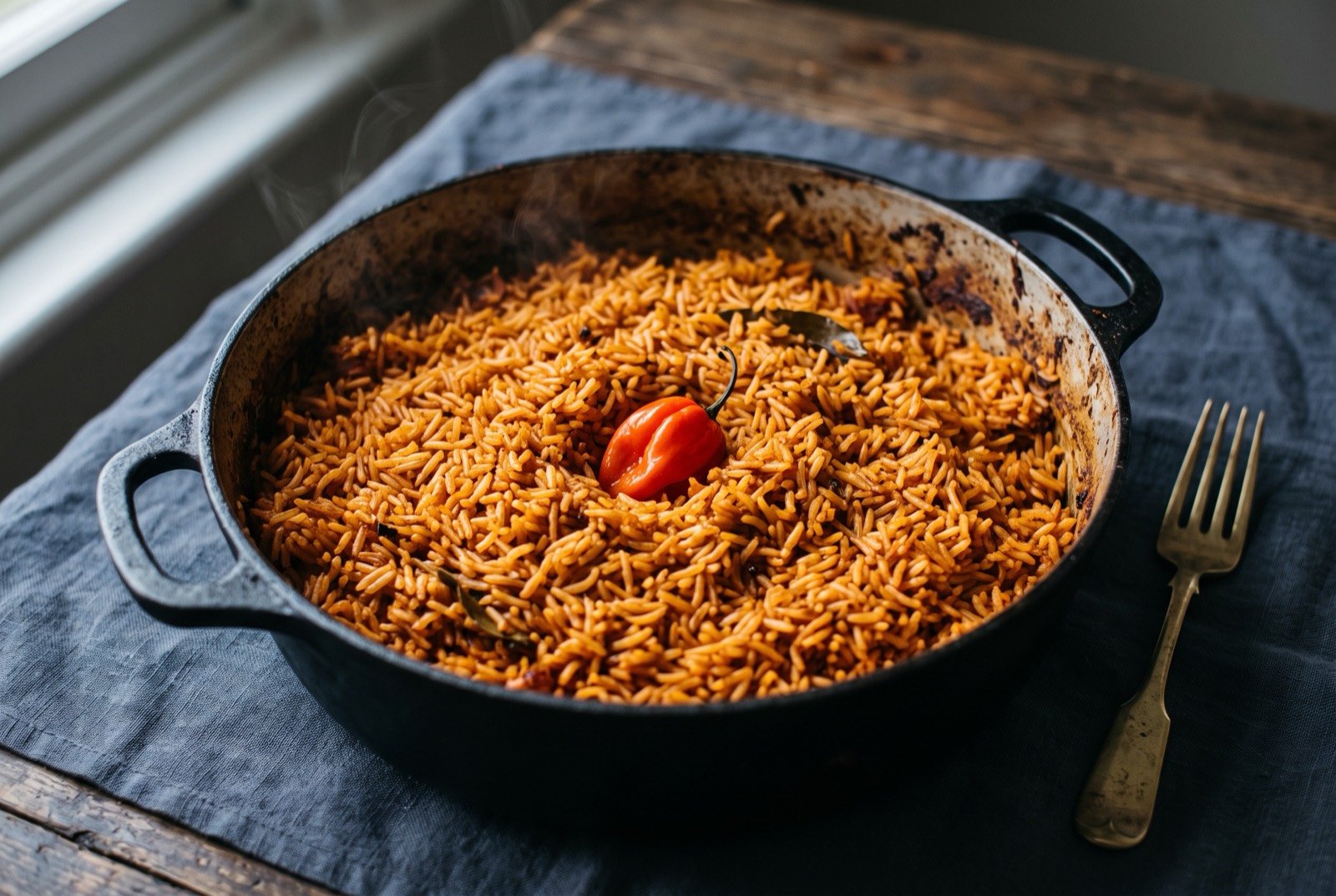
Illustration
- Time
- 1 hour
- Researched
- 11 sources cited
The name traces to the Wolof people and the medieval Jolof Empire of Senegambia, whose ancestral dish is ceebu jën, which we cooked in Volume One. The historian James McCann argues it spread through West Africa via the Djula Muslim trading diasporas out of the old Mali empire. The red form is necessarily post-Columbian, because tomato and chilli are New World. And the punchline that ends the Jollof Wars: UNESCO inscribed Senegal's ceebu jën as Intangible Cultural Heritage, so the internationally recognised jollof is neither Ghanaian nor Nigerian.
Ghanaian and Nigerian jollof are optimised for different things, and calling one better is a category error. Nigerian jollof optimises for the grain: separate, firm, smoke-scented, built on parboiled rice chosen for structural integrity. Ghanaian jollof optimises for aroma: fragrant basmati steamed in seasoned stock, where the perfume of the rice is a co-star. Cook both.
As tradition built it
Nigerian party jollof
Serves 6 · 1 hour, plus stock
Ingredients
- 800g long-grain parboiled rice (golden sella or easy-cook), washed until the water runs clear
- 800ml strong meat stock, hot
- 450ml obe ata base (above)
- 150ml the oil you fried your meat in
- 3 tbsp tomato purée
- 2 tsp curry powder, 1 tsp dried thyme
- 1 tsp ground white pepper
- 2 bay leaves
- 1 scotch bonnet, whole and pierced
- 30g butter, to finish
Method
- Heat the oil in a heavy pot with a tight lid. Fry the tomato purée for three minutes, then add the obe ata base and cook it down for ten more, until thick and glossy.
- Add the stock, curry, thyme, white pepper, bay and the whole scotch bonnet. Simmer five minutes and taste. It should taste slightly too intense: the rice will dilute it.
- Add the rice and stir once, only once, to submerge it. The liquid should sit about a centimetre above the grain.
- Seal the pot with a sheet of foil, then the lid on top. Turn to the lowest heat your hob will give. Thirty minutes. Do not stir. Do not lift the lid.
- Uncover, dot the butter over, fold through very gently with a fork.
- The bottom pot. Turn the heat to high for five to eight minutes, in 9jafoodie's phrase, "just until you can smell the burn". Then off the heat, lid back on, rest ten minutes. Scrape the scorched base up and fold it through.
What a modern chef changes
Smoked jollof, crab custard beneath
Rungs 01, 08, 09, 14 · Serves 6
Method
The crab custard
- Whisk 3 egg yolks and 1 whole egg into 250ml of hot shellfish stock that you have enriched with 60g brown crab meat and passed through a fine sieve. Season carefully: it wants to be a touch under-salted.
- Fold in 180g picked white crab meat and a pinch of ground ehuru.
- Pour into the base of a wide cast iron casserole. Bake in a bain-marie at 140°C for 22 to 26 minutes, until just set with a faint wobble. Leave it in the dish.
The rice, on the Egg
- Set the Egg up indirect at 170°C with the plate setter in, and add one small chunk of oak or a handful of soaked wood chips. One chunk. Wood smoke in a ceramic kamado is far more concentrated than in a kettle, and over-smoked jollof tastes of ashtray.
- Build the jollof exactly as in the traditional method, in a separate pan, up to the end of step 3.
- Spoon the rice and its liquid over the set crab custard, seal with foil and the lid, and put the casserole on the Egg. 35 minutes, undisturbed.
- Lift the lid, take the dome temperature to 230°C with the vents, and give it eight minutes uncovered to build the scorched base.
- Rest ten minutes with the lid on. Carry it to the table lidded, and lift the lid in front of people. The smoke that comes out is the dish.
Notes
Ikoyi's signature is smoked jollof with crab custard, served in a lidded vessel and portioned by the guests themselves. The crab is beneath the rice, so it arrives as fat and sweetness under the smoke. You can build this at home, and the Egg makes it straightforward.
No Egg? Two workarounds. Sit a small foil cup holding one lit charcoal lump on the surface of the finished rice, drip half a teaspoon of oil onto it, and clamp the lid on for four minutes. Or scorch a single cup of rice separately in a dry cast iron pan until genuinely blackened in places, and fold it through the pot. Both beat smoked paprika, which reads as bacon rather than firewood.