Africa · Volume 02
Guinea, Sierra Leone & Liberia
The Cassava-and-Bitter-Leaf Belt
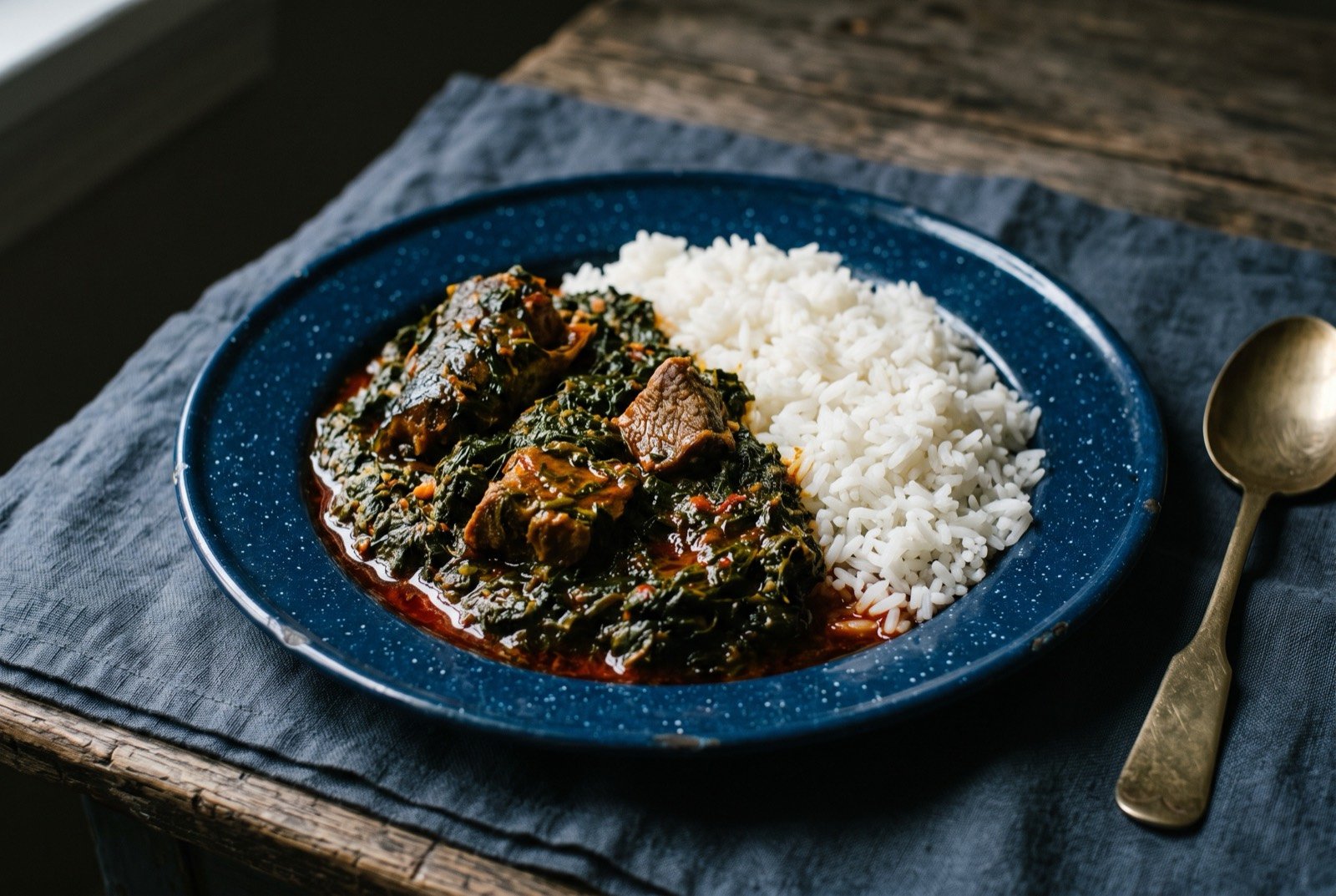
The Rice Coast, taken seriously. Three modern states laid over one continuous mangrove and forest coastline that pre-dates all three borders by millennia, and every dish as tradition built it, then what a modern chef would change.
Sources and review · What this chapter does not assert · How we research · Know this better? Tell us
A Sense of Place
The deepest rice culture on the West African coast, three colonial founding stories that could hardly be less alike, and a chapter that says plainly where its own sourcing runs thin.
European slavers called this stretch the Rice Coast, or the Windward Coast, and the name was not decorative. It named a technology worth stealing: the specific knowledge of growing rice in tidal mangrove swamp with no dam and no engineered water control, held by the Baga, Nalu and Temne farmers of this coast, and then extracted along with the people who held it to build the rice economies of colonial Carolina and Georgia. Guinea, Sierra Leone and Liberia sit on that single continuous rice coast, cut into three states by French and British colonial administration and, in Liberia's case, by a private American colonisation project that answers to neither empire.
Coastal and Lower Guinea
Conakry, the Baga and Nalu mangrove coast, Rio Nunez, Rio Pongo. Susu, Baga, Nalu, Landouma and Mikhifore peoples farm a tidal estuary coast running some 160 miles from Conakry to the Rio Nunez, women working the swamp rice, men fishing and tending palm and kola. Palm oil is the universal fat here, smoked fish and hot chilli the aromatic base.
Middle Guinea and the Fouta Djallon highlands
Labé, Mamou, Pita, Dalaba. A mountainous sandstone plateau, source of the Niger, Gambia and Senegal rivers, colonised by pastoral Fulani from the seventeenth century and turned by the 1720s into a Fulani-ruled Islamic theocracy, the Imamate of Fouta Djallon. Clarified butter enriches the pastoral milk dishes; fonio, the region's most widespread grain, and millet carry the starch load. This is the highland thread that this chapter shares, genealogically, with the Sahelian volume elsewhere in this atlas.
Upper Guinea
Kankan, Siguiri, Kouroussa, the upper Niger valley. Malinké and Djallonké farmers on the Sudanian alluvial plain, sharing mythological and kinship ties with the Mandé rice-growing world documented further inland. Rice only became the dominant local crop here from around the Second World War; before that the economy leaned on wild rubber gathering, which never amounted to much.
Guinée Forestière, the forest region
Nzérékoré, Kissidougou, Guéckédou, Macenta, Yomou. Dense Upper Guinean rainforest running into Liberia and Sierra Leone across a border drawn by colonial administrators, not by ethnicity. The Kissi are rice farmers of the wet valleys; the Kpelle, called Guerzé in Guinea, lean more on root crops, gathering and hunting. This is the region where, in December 2013, a two year old boy in the village of Méliandou near Guéckédou became patient zero of the West African Ebola epidemic, after contact traced to a bat, and the epidemic then crossed into Sierra Leone and Liberia along exactly the kinship and market routes that carry food across this same forest.
The dish that crosses every Guinean border
Lafidi: rice, okra and eggplant, eaten mostly at breakfast, cooked under a different name in every language spoken in the country, lafidi in Maninka, fouti among the Peul, malé khoulangni in Susu. Guinea is actively seeking UNESCO intangible-heritage status for it, on the specific grounds that it belongs to no single ethnicity. If one dish argues for treating Guinea as a single food world rather than four, this is it.
Sierra Leone: the Colony and the Protectorate
Sierra Leone's food map runs on a fault line the whole volume shares in different forms: a small settler-descended coastal population against a much larger indigenous interior, the coastal group's food identity built from displacement rather than from a single ancestral cuisine.
Krio, or Creole, Freetown and the Western Area. Formed between 1787 and the 1850s from four distinct streams: the Black Poor of the failed 1787 Province of Freedom; roughly 1,200 Black Loyalist Nova Scotian Settlers who founded Freetown proper on 11 March 1792; about 550 Jamaican Maroons landed in 1800; and tens of thousands of Liberated Africans, recaptives taken off intercepted slave ships after Britain's 1807 abolition and resettled from 1808 onward, drawn from Yoruba, Igbo, Akan, Bakongo, Ewe and dozens of other nations. By 2022 Krios numbered only about 104,000, roughly 1.2 per cent of the population, but their culinary imprint on the whole country is out of all proportion to that number.
Mende, south and east, and Temne, north. The two largest ethnic groups, and the two most explicitly rice-identified peoples on the entire coast. Temne farmers appear in national iconography cultivating flooded rice fields; Mende ritual practice soaks African rice in palm oil as an offering to ancestors. Both maintain the Poro and Sande initiation societies that structure much ceremonial feeding.
Kissi, Sherbro, Vai, Limba, Kono, Loko. The Kissi of Kailahun district, upland rice farmers and former iron workers, and the coastal, canoe-faring, trading Sherbro extend across the Liberian border; the Vai, mostly in Liberia with a south eastern Sierra Leonean minority, are credited with inventing an indigenous syllabic script in the nineteenth century.
Liberia: Americo-Liberian, Kwi, and sixteen indigenous nations
Americo-Liberian, or Congo, settlers, Monrovia and the coastal counties. Founded from 1822 by the American Colonization Society: freeborn and emancipated African Americans, some 15,000 to 19,000 arriving between 1822 and the 1860s, joined by recaptives pulled off intercepted slave ships after 1808 and nicknamed Congos because the ships had been taken off the Congo River mouth. The settlers declared the Republic of Liberia in 1847. Their descendants and the wider Westernised, Christian, cash-economy elite came to be called Kwi, from the Kpelle kwi-nuu, foreigner or civilised person, a term indigenous Liberians first applied to the settlers in the 1800s and that still marks the divide today.
Kpelle, Bassa, Kru, Grebo, Lorma, Gio, Dan, Mano, Kissi, Vai, Gola, Belle, Krahn, Mandingo, Mende, Sapo: the sixteen recognised indigenous groups. The Kru and Grebo of the south eastern coast are historically seafarers and stevedores, so famous for refusing capture into slavery that slaving ships avoided their coast altogether. The Lorma of Lofa County, in the forested north west, are associated with torborgee, the fermented palm oil eggplant stew that has become one of Liberia's most distinctive regional dishes. The Gola and Kissi are considered the oldest surviving inhabitants of the territory that became Liberia.
A note on how this chapter was researched, stated up front
The three countries in this volume are not evenly served by the sources available in English or French. Sierra Leone has the strongest documentation, thanks chiefly to its own tourism board, a Freetown-born and grandmother-taught chef with a published cookbook, and a Sierra Leonean journalist writing in English about her own country's food. Guinea is served by genuine French-language Guinean sources but not by a Guinean agricultural-research institute this chapter's research could reach directly. Liberia is the thinnest of the three by a wide margin: no Liberian food-press outlet and no in-country chef publication could be found to anchor its sections the way Sierra Leone's could. This chapter says so at each point where it matters, rather than smoothing three very different depths of evidence into one uniform voice.
The History in Layers
Indigenous foundations, and a genuinely open scientific question
Rice cultivation on this coast is old enough that its exact origin point remains a live scientific argument, and that argument matters for how confidently this chapter can call Sierra Leone and Guinea a rice heartland in their own right rather than a secondary offshoot of the inland Niger delta documented elsewhere in this atlas.
The French agronomist Auguste Chevalier, and later Roland Portères, argued for decades that Oryza glaberrima, African rice, had a single centre of domestication in the inland Niger delta of Mali, diffusing outward to secondary centres on the Senegambian coast and in what Portères called "the Guinea highlands." Genomic work has substantially revised this picture. A 2018 study of 246 rice genomes found the sh1 non-shattering gene mutation, one of the core domestication traits that turns a wild grass into a farmable crop, most plausibly originating specifically on the coast of Guinea and Sierra Leone, a genuinely distinct genetic signal from the Malian sh4 mutation, and the paper's own conclusion argues for a diffuse, multi-centre domestication process rather than one origin radiating outward. Read plainly: this coast is very plausibly one of Africa's own independent points of rice domestication, alongside the inland Niger delta, not downstream of it. This chapter treats that as a live, contested finding, not a settled one, and does not repeat the still-common claim that rice reached Sierra Leone "about 3,500 years ago," a specific figure this chapter's research could trace only to a single non-academic advocacy site.
The Rice Coast as a slaving target, named with precision. The historical name for this stretch, from the Casamance through Guinea to Sierra Leone, was not incidental. Enslavers sought captives from this coast, and Temne captives specifically, because they carried the knowledge of tidal and swamp rice cultivation, and then forced that knowledge to build the Carolina and Georgia rice economy in the Americas, diking marshes and flooding fields using the same techniques. This chapter treats the widely repeated Sierra Leone to Carolina Gold lineage as plausible and extensively asserted in Western secondary sources, but has not been able to verify it against a primary historical or peer-reviewed source, and says so rather than repeating it as settled fact.
States, jihad and empire
The Imamate of Fouta Djallon. Fulani pastoralists had lived in the Fouta Djallon highlands for generations before a Fulbe and Malinke jihad, launched in the mid-1720s under Karamoko Alfa and then Ibrahima Sori, converted the plateau into a Muslim theocratic state that came to dominate central and coastal Guinea until French absorption in 1896. Sources vary between 1725 and 1727 for the exact founding moment; "the mid-1720s" is the safe form. This is the layer that gives Middle Guinea its milk-and-fonio Fulani cuisine its specific religious and political grounding, distinct from the purely pastoral Fulani thread documented elsewhere in this atlas: here the Fulani built a mountain state, with settled towns, Quranic schools and a landed peasantry of their own, not only transhumant herding.
The founding of Freetown, a settlement built explicitly on the wreckage of slavery
This is the single most unusual food history in the volume, and it earns the space given to it here.
1787, the Province of Freedom. The first attempt, backed by the British abolitionist Granville Sharp, brought 411 Black Poor, freed African Americans and Afro-Caribbeans from London, to the Sierra Leone peninsula. Disease and conflict with the local Temne all but destroyed it; fewer than 100 survived, and only 64 remained by 1791.
1792, the Nova Scotian Settlers. The Sierra Leone Company, a British commercial-abolitionist body, backed a second attempt. On 15 January 1792, Lieutenant John Clarkson led roughly 1,200 Black Loyalists, formerly enslaved African Americans who had won freedom fighting for the British in the American Revolutionary War and had been resettled first in Nova Scotia, across the Atlantic in fifteen ships. They founded Freetown proper on 11 March 1792, arriving with a documented food culture already shaped by one displacement: American plantation cooking carried north to Nova Scotia, then carried again across the Atlantic to West Africa.
1800, the Jamaican Maroons. Around 550 Maroons from Cudjoe's Town in the Jamaican mountains, deported to Nova Scotia in 1796 after the Second Maroon War, found they could not grow the tropical crops central to their food culture in the Canadian climate. In 1800 they were shipped on to Sierra Leone, where they helped suppress a Nova Scotian rebellion against the Sierra Leone Company and were rewarded with the Nova Scotians' own best houses and land.
1808 onward, the Liberated Africans. After Britain's 1807 abolition of the transatlantic slave trade, the Royal Navy's anti-slavery squadron intercepted slave ships and landed tens of thousands of recaptives in and around Freetown, drawn from Yoruba, Igbo, Bakongo, Ewe, Akan and dozens of other peoples. By 1855 more than 50,000 freed people had made Freetown their home.
What this did to the food, specifically. Krio cuisine is not one ancestral cuisine adapted to a new place, the way most national cuisines are described. It is four separate displaced culinary memories, American Southern plantation cooking, Jamaican Maroon cooking, a pan-continental liberated-African repertoire with no single origin, and the surrounding indigenous Temne, Mende and other Sierra Leonean traditions, thrown together on one small peninsula and cooked into a single kitchen grammar over roughly seventy years. Foofoo, indigenous pounded cassava, is finished with a palaver sauce whose very name, from the English word for a drawn-out dispute, reflects the trading-post pidgin culture of the coast. The awujoh memorial feast, with its beans, plantain, akara and palm-oil sweet potato, reads as a genuinely syncretic funerary food practice built from all four streams at once.
The founding of Liberia, and the Kwi divide
1816 to 1822. The American Colonization Society, founded in Washington DC in December 1816, aimed explicitly at removing free and freed Black Americans from the United States by resettling them in West Africa, a project with deeply mixed motives, some abolitionist, many more concerned with removing free Black people from American society altogether. Land was secured in April 1822 about 150 miles down the coast from Sierra Leone by an American agent who, according to the documented account, held a gun to the head of the local ruler known to Europeans as King Peter. This is worth stating exactly as it happened rather than softening it: Liberia's founding land transfer was made under armed threat. The settlers named their capital Monrovia after US President James Monroe and their territory Liberia, land of the free. Between 1822 and the 1860s, some 15,000 to 19,000 free-born and emancipated African Americans and Afro-Caribbeans relocated there. Liberia declared independence in 1847.
The Kwi divide. Settler descendants, joined by recaptives nicknamed Congos because the intercepting ships had been taken off the Congo River mouth, merged into a distinct Americo-Liberian elite. Indigenous Liberians applied the Kpelle-derived term Kwi, foreigner or civilised person, to this group and to any outsider marked by Western dress, Christianity, literacy and a cash economy rather than a subsistence one. This divide runs directly through the food: Americo-Liberian cooking imported specifically US Southern elements, most visibly collard greens stewed with smoked meat and served with cornbread, layered on top of, rather than replacing, indigenous Kpelle, Bassa, Kru, Grebo and Vai cooking built on palm oil, cassava, rice and bushmeat. It is a documented, datable, one-directional import of a specific regional American cuisine grafted onto an existing indigenous one, worth reading against the Krio fusion in Sierra Leone rather than in isolation from it, since the two settler food cultures share a broad shape while differing in every particular.
Colonial extraction, three different mechanisms
French Guinea built the port capital of Conakry from the mid-nineteenth century and reorganised land tenure around it. Hut taxes forced farmers into producing sellable export crops, and forced labour was systematic on coffee, rubber and palm oil estates and in mines, disrupting the traditional rice-and-tuber subsistence base and pushing production toward groundnut and palm oil monoculture for export. The Imamate of Fouta Djallon was absorbed into this system in 1896. Guinea won independence from France in 1958, the first French African colony to do so, after voting no in de Gaulle's referendum on continued association with France, a decision that cost it immediate and punitive French withdrawal of aid, personnel and infrastructure.
British Sierra Leone formally declared a Protectorate over the interior in 1896, entrenching a division between the small, Krio-dominated coastal Colony and the much larger, indirectly ruled Protectorate, governed through paramount chiefs. To fund this administration, Governor Frederic Cardew imposed a hut tax in 1898, assessed by hut size, with an important local accommodation: in areas where cash was scarce, residents could pay the tax in rice instead, a direct colonial acknowledgement of rice's role as the region's real store of value. Chiefs who had not been consulted about the Protectorate objected; the Hut Tax War of 1898 followed, with the Temne chief Bai Bureh leading resistance in the north and the Mende chief Momoh Jah leading a parallel rebellion in the south. Bai Bureh surrendered in November 1898 and was exiled to the Gold Coast. After the revolts were suppressed, colonial railway building opened the interior to export of palm nuts, kola nuts, rubber and rice, previously moveable only as headloads; exports tripled between the revolts and 1912.
Twentieth century wars, and what they did to what people actually ate
Sierra Leone, 1991 to 2002. An eleven-year civil war devastated the agricultural economy: rice production, already down to around 460,000 tonnes in the mid-1990s from over 500,000 tonnes in the late 1980s, collapsed to just 198,000 tonnes at the 1999 peak of the fighting, with roughly 180,000 farm families directly affected by the loss of seed, tools and storage. Post-war recovery has been real but partial: output climbed back to about 78 per cent of its pre-war level, but the country remains a significant food importer, and the current Feed Salone strategy targets 2030 for self-sufficiency.
Liberia, 1989 to 2003, with a pause 1997 to 1999. By 1996, mid-war, paddy rice production had fallen to roughly 30 per cent of pre-war levels, while cassava production had actually intensified, reaching about 200 per cent of pre-war output, as farmers switched to the more resilient, less labour-intensive crop when rice became scarce and expensive. That wartime substitution left a durable mark: cassava's importance relative to rice in the ordinary Liberian diet is measurably greater today than it was before 1989, a genuine dietary shift caused directly by conflict rather than by taste or preference.
Guinea and the 2014 Ebola epidemic. The epidemic that killed over 11,000 people across the three countries by its end began in Guinée Forestière, and its containment measures, above all the bushmeat bans discussed below, reshaped protein sourcing and hunting practice across the forest region in ways still visible in the record a decade on.
The modern scene
Maria Bradford's Sweet Salone: Recipes from the Heart of Sierra Leone (Hardie Grant, 2023) is the most substantial single English-language cookbook treatment this volume's territory has received. Guinea's lafidi UNESCO bid, and the joint project of chefs Yaya Barry and Mamadi Touré to refine Guinean technique without abandoning it, are the clearest current instances of a state and a profession actively building a food-heritage claim. Slow Food's Kenema Kola Nut Presidium, discussed below, is the clearest institutional food-heritage project rooted specifically in this volume's territory, explicitly framed as post-war knowledge recovery rather than simple marketing.
The Flavour Arsenal
The fats
| Ingredient | Character and use |
|---|---|
| Palm oil | The base fat of almost every savoury dish across all three countries. Deep red-orange, mildly nutty, faintly sweet. Sold both fresh and in a specifically Liberian torborgee grade, fermented and smoked for a deeper, more pungent backnote. Represents around 14 per cent of Sierra Leonean GDP through its full value chain |
| Palm butter, or palm nut cream | A whole-fruit cream, genuinely distinct from oil: the whole palm nut boiled, pounded and pressed, carrying pulp solids, protein and fat together. The base of Liberia's signature soup |
| Groundnut oil | The everyday alternative to palm oil, more neutral, used where a lighter fat is wanted or palm oil is scarce |
| Palm wine, poyo | Fermented palm sap, drunk fresh and mildly alcoholic, used as bread yeast, and distilled further into cane-juice spirit in Liberia, called gana gana |
The leaves
| Local name | Species | Character and country |
|---|---|---|
| Cassava leaf (gbassajama, Liberia; cassava leaf plasa, Sierra Leone; tâdè/taadè bourakhè, Guinea/Susu) | Manihot esculenta leaf | Tough and fibrous raw, must be pounded or finely ground and cooked long. Carries cyanogenic compounds, part of the reason for the long cook. The most consistently claimed national-dish candidate in Sierra Leone |
| Potato leaf (petehteh leaf, Sierra Leone; bourakhè, Susu) | Ipomoea batatas, sweet potato leaf, not the leaf of the Irish potato | Tender and mild, cooked briefly to keep bite. Rich in vitamin A, C and B2 and in lutein |
| Bitter leaf | Vernonia amygdalina | Genuinely bitter raw, softened by sun-wilting then repeated rinsing and squeezing between changes of water. Present but less central here than further along this coast |
| Jute, or palava leaf | Corchorus olitorius | The mucilaginous green used in Liberian palava sauce |
The umami spine
| Ingredient | Character and dosing |
|---|---|
| Maggi and other bouillon cubes | Near universal since the mid-twentieth century, to the point that Sierra Leonean recipes specify a Sierra Leone-branded Maggi sauce by name as against other national variants. No documented equivalent of soumbala or dawadawa was found specific to this volume's territory, a genuine gap against the fermented-legume seasoning systems documented elsewhere in this atlas |
| Smoked and dried fish | The everyday protein and umami source. Bonga, a shad found along the whole coast, is the workhorse species: about 70 per cent of the total West African fish supply is marketed smoked or dried rather than fresh |
| Konkoué | A Guinean coastal catfish, scaleless and very smooth-skinned, described in Guinean sourcing as impossible to eat without being smoked. Smoking here is not a preservation choice layered onto an edible fish, it is the only route to an edible fish at all |
| Kola nut | Bitter and stimulant, central to greeting, hospitality and the sealing of agreements rather than to everyday cooking |
| Dried shrimp | A common addition to leaf stews for a second, cheaper layer of savoury depth alongside smoked fish |
The wild and forest-gathered
Bushmeat, smoked: antelope, cane rat, porcupine, monkey and, historically and now far more dangerously, bat. A 2004 Monrovia survey found bushmeat ranked second only to fish among preferred proteins in the capital itself, not only in rural areas. Following the 2013 to 2016 Ebola epidemic, governments across the region imposed bans on bushmeat hunting and sale; researchers have since found real, measurable declines in bushmeat consumption during and after the epidemic, alongside documented unintended consequences where the ban simply displaced the trade rather than ending it. This chapter holds both facts at once: bushmeat is a deep and legitimate tradition, and it is now genuinely, epidemiologically dangerous in a way it was not treated as being before 2014, and this chapter does not carry a bushmeat recipe for that reason.
The Columbian arrivals, now indispensable
Cassava, groundnut, chilli, tomato and maize. Cassava is dated as arriving in the Gulf of Guinea region by the end of the sixteenth century and has since become so central to both leaf cookery and the fufu and dumboy starch tradition that it reads, wrongly, as indigenous. Sweet potato is itself an American import whose leaf, not its root, became one of this volume's two defining leaf vegetables. The scotch bonnet itself is a New World cultivar of Capsicum chinense, originating in the Amazon basin, adopted across West Africa and the Caribbean rather than indigenous to the region, worth stating plainly rather than assuming.
Part Two
The Technique Ladder
An honest scene, thinner in places than the rest of this atlas
This is a thinner fine-dining picture than Ghana or Nigeria, and Liberia's is the weakest showing of any single country documented in this atlas so far. Say so plainly rather than dressing it up. But Sierra Leone has something none of Senegal, the Gambia, Mali, Burkina Faso or Niger can currently claim: a British-based, Sierra Leonean-born chef holding a genuine Michelin recognition.
Maria Bradford, Shwen Shwen, Sevenoaks, Kent, is the reference point of this chapter. Born and raised in Freetown, taught by her grandmother, later trained formally at Leiths School of Food and Wine in London. She founded Maria Bradford Kitchen in 2017, which became the catering brand Shwen Shwen, Krio for "fancy," before opening a fixed restaurant. In the 2026 Great British Chefs & Ireland Guide she was awarded a Michelin Bib Gourmand and the Michelin Opening of the Year award. She has no Michelin star, and this chapter is not going to inflate a Bib Gourmand, a real and specific tier recognising good food at a benchmark value point, into something it is not. Her cookbook, Sweet Salone: Recipes from the Heart of Sierra Leone (2023), is split into street food, Afro-fusion and traditional sections, and her named menu dishes, lamb belly with palm oil, mackerel with mango and cassava flatbread, beef short-rib with a groundnut and coconut sauce, are this chapter's clearest evidence of the coast's own technique read at a genuinely elevated level.
In Freetown itself, Cole Street Guest House, run by chef Miatta Marke with her husband and business partner Matthew Short, occupies a mid-twentieth-century building that belonged to Lati Hyde-Forster MBE, the first Sierra Leonean woman to graduate from Fourah Bay College, Marke's own grandmother. Billed as the country's first restaurant dedicated wholly to Sierra Leonean traditional cuisine, it was named by National Geographic one of 21 best restaurants in the world for 2024, the only West African entry on the list.
In Guinea, chef Yaya Barry, of Le Jacquier in Conakry, is candid that Guinean cuisine has a reputation problem, criticised, in her own words, for being excessively heavy and salty, and her answer is not to abandon the food but to refine its execution: proper plating, sauces started ahead, vegetables pre-chopped and blanched, and a genuinely striking format solution, tô presented in an oyster spoon as a starter-format taste rather than a full bowl. Her weekly Friday Fonio menu runs fonio from a savoury course through to a coconut-milk dessert, working with chef Mamadi Touré, based in Copenhagen, on the shared ambition of getting a Guinean dish onto UNESCO's intangible heritage list. No Guinean-heritage chef holds a star anywhere in the world, at home or abroad, on the evidence available to this chapter, and that gap is worth naming directly rather than papering over.
Fatmata Binta belongs to this volume as much as to the wider Sahelian world: born in Freetown to first-generation Fulani parents of Guinean descent from Fouta Djallon, her heritage sits precisely on the seam this chapter covers. Her mother ran a street food stall; her grandmother ran a restaurant where Binta washed dishes as a child. When Sierra Leone's civil war broke out, the family fled to Guinea, where she says she learned to produce food sustainably and from scratch, before training at Boma International Hospitality College in Nairobi and becoming, in 2022, the first African chef to win the Basque Culinary World Prize. Her pop-up Dine on a Mat and her Fulani Kitchen Foundation are built on fonio, the Fouta Djallon staple she champions internationally, though her public work is based mostly outside Guinea.
Liberia's picture is the thinnest in this chapter, and this chapter is not going to dress it up. Monrovia's own fine dining is largely imported technique rather than elevated indigenous cooking: a rooftop restaurant fronted by a sushi chef, another crediting a blend of local ingredients and international method without a named chef or dish this chapter could verify. No Liberian chef, restaurant or named dish built on the region's own techniques, dumboy pounding, palm butter extraction, potato leaf cookery, could be found presented at anything describable as elevated craft level, in Monrovia or anywhere else. The real Liberian diaspora food economy sits in the United States, not Britain, concentrated in the Washington DC, Maryland and Virginia area: Emma's Liberian and African Cuisine in Germantown, Emma's Kitchen in Glenarden, Sumah's West African Restaurant in DC, several more in Baltimore, all home-style and carryout businesses rather than a graduated career ladder into fine dining. No dedicated Liberian restaurant or shop exists anywhere in Britain on the evidence this chapter's research could find.
Rung 1. Pound the cassava leaf hard and cook it long, because you are running a genuine detoxification, not a texture step
Home cassava leaf stew is often chopped leaves boiled with whatever is on hand. Correct traditional practice pounds the leaves in a mortar for a minimum of about ten minutes until well macerated, then cooks the resulting mass, per the traditional method described by cooks from the tradition, for upward of two hours.
Why it works, chemically. Cassava leaves carry cyanogenic glucosides, chiefly linamarin, compartmentalised away from the enzyme linamarase that breaks them down. Pounding ruptures the plant cells and brings the two into contact, releasing hydrogen cyanide, which then needs to escape or be washed out. A documented protocol pounds for at least ten minutes then washes twice in twice the leaves' weight of water, reducing total cyanide to about 8 per cent of its starting level, with two further washes bringing it to about 3 per cent, against the FAO and WHO safe threshold of 10 parts per million. The responsible enzyme works best around 40 to 60°C, active for three to five hours, which is the scientific logic behind the long simmer as much as the pounding: this is not a dish that tolerates being rushed, and a hurried, lightly blended, briefly boiled batch is not merely a worse dish, it may not have been properly detoxified.
Rung 2. Extract palm butter by boiling, pounding and sieving, and stop before you squeeze it bitter
The traditional method boils fresh palm fruit, pounds it in a mortar carefully, without cracking the hard inner kernel, mixes the pulp with water, then sieves it through muslin with a gentle twist, and boils again.
Why it works. The palm fruit's fleshy pericarp, not the kernel, is what you want: it is the site of the fruit's oleic and palmitic acid and its carotenoid pigment, the source of both the dish's colour and its fat. Pounding ruptures the pericarp cells to release this oily pulp as a coarse suspension; sieving through cloth removes the woody fibre and the bitter compounds concentrated in the kernel's outer coat. Twisting the cloth aggressively rather than gently is the single most common home error, because it forces bitter fibre-bound compounds through the mesh along with the fat, and there is no way to correct a batch once this has happened.
Rung 3. Parboil the rice, and know exactly what the steam buys you
Sierra Leone and Guinea sit inside the oldest and deepest rice culture on this coast, and parboiling, riz étuvé, remains an active area of Guinean agronomic research, including a comparative study at Faranah that itself notes plainly that "the technology of parboiling in a peasant environment is still not mastered," an honest, current gap rather than a settled tradition.
Why it works. Parboiling, soaking the paddy, steaming it under pressure, then drying before milling, drives water-soluble vitamins from the bran inward into the starchy endosperm before milling strips the bran away. Milled parboiled rice retains substantially more thiamine than milled raw rice at the same degree of polish, one study measuring 342 to 673 micrograms per 100g in parboiled samples against 210 to 337 in non-parboiled, and historically, populations eating parboiled rather than plain milled rice have shown lower rates of beriberi, the thiamine-deficiency disease. Separately, parboiling gelatinises and then re-sets the starch, which is why parboiled rice grains stay firmer and more separate on reheating and are more forgiving of a slightly careless cook than fully milled raw rice.
Rung 4. Break the groundnut paste's emulsion by frying it out, then rebuild it with a second fat
Raw groundnut paste stirred straight into liquid gives a thin, unstable, raw-tasting sauce. The Sierra Leonean groundnut soup method fries onion, chilli, garlic and ginger first, adds stock and the peanut paste, then boils until oil visibly rises, a stage that itself takes a further fifteen to thirty minutes after an initial fifteen-minute simmer, meaning the sauce is deliberately taken well past the point most home cooks stop.
What is specific to this cuisine. Bradford's beef short-rib dish shows the region's own extension of the technique beyond the basic emulsion break: introducing a second fat, coconut milk, rather than a fermented paste, to re-lighten and extend the sauce once the peanut has been driven hard. Coconut fat is mostly medium-chain saturated fat, lauric and myristic acid, which reads cleaner and less cloying than more peanut oil would, while still carrying enough body to bind the sauce.
Rung 5. Treat gari as a live fermentation with a safety function, not a dry pantry starch
Gari is made from grated bitter cassava pulp, pressed under weight in sacks, left to ferment for two to four days, then sifted and toasted over fire.
Why it works. The fermentation step is not flavour-only. It is a second, slower route to the same detoxification chemistry as Rung 1: lactic acid bacteria proliferation over the multi-day ferment continues breaking down residual cyanogenic compounds, while the acidic environment they produce suppresses pathogenic and spoilage organisms, extending shelf life. This is also why damp, under-fermented or improperly dried gari is a genuine safety issue and not merely a texture complaint: a 2016 assessment of gari sampled in Liberia found measurable heavy metal and microbial contamination in market product, the specific, documented downside of gari made or stored carelessly.
Rung 6. Build umami from smoke and dried shellfish, deliberately, because the fresh fish is often unusable raw
Konkoué catfish, dried bonga and dried crayfish are not simply flavourings of convenience. In konkoué's case, smoking is described in Guinean sourcing as the only way the fish can be eaten at all, given its scaleless, very smooth skin. Crayfish, dried and used whole or ground, and stockfish, soaked overnight then simmered up to 45 minutes until tender, both go into cassava leaf sauce and palava sauce specifically for their concentrated aroma.
Why it works. This is the same glutamate-and-inosinate synergy documented for dried marine ferments elsewhere in this atlas, delivered here through this coast's own smoked catfish and dried crayfish. Smoking additionally denatures surface proteins and drives off water, concentrating flavour compounds and making the product shelf-stable without refrigeration, which is exactly why it became this coast's answer to a fish that spoils fast in a hot, humid climate.
Part Three
The Ferment and Preserve Bench
1. Gari, made properly
Peel and grate bitter cassava root, press the grated pulp under weight in cloth sacks to drive off excess liquid, and leave to ferment for two to four days. Sift the fermented, pressed mash, then toast it dry over a fire or in a heavy pan, stirring constantly, until it dries to a coarse, granular meal. This is not a flavour step alone: the multi-day ferment is a second, slower detoxification route alongside Rung 1's pounding, and the acidic environment the fermentation bacteria produce also suppresses spoilage organisms. Buy from an established retailer subject to UK food safety law rather than an informal import: documented Liberian market sampling has found measurable heavy metal and microbial contamination in some poorly made or poorly stored gari, a genuine safety marker rather than only a quality one.
2. Smoked bonga, at home
Clean whole bonga or a similar oily small fish, salt lightly, and hot-smoke over a controlled fire or in a stovetop smoker until the skin blisters and the flesh firms throughout. This is the region's own answer to a fish that spoils fast in a hot, humid coastal climate, denaturing surface proteins and driving off water to concentrate flavour and extend shelf life without refrigeration. A home version will not match a fish smoked over the specific coastal firewood used commercially, but it delivers the same functional depth for the leaf stews and soups in this chapter.
3. Torborgee, approximated
The real thing is palm oil deliberately fermented and smoked over an extended period, and a British kitchen has no safe or practical way to replicate that process from scratch. Buy the genuine, country-labelled product rather than attempting a home approximation: unlike the guedj gap documented for a different volume of this atlas, torborgee is genuinely available in Britain, sourced from Liberia, and there is no good reason to substitute for it.
4. Kola nut storage
Lay fresh kola nuts on a mat, cover with banana or mango leaves, and soak with water. The skin rots off in about a week. Line storage containers with fresh mango leaves; nuts stored this way keep for over six months. This is a genuine Sierra Leonean Slow Food Presidium practice, centred on Kenema district, and the mechanism, plausibly some antimicrobial property of the mango leaf, is not confirmed by any technical source this chapter's research could find. Treat the outcome as documented and the mechanism as unconfirmed.
Sourcing in Britain
Verified August 2026.
The one genuine strength of this volume's sourcing
Unlike the fermented-seasoning gap that runs through the rest of this atlas, this volume has a real win: at least two UK retailers sell red palm oil explicitly branded to Sierra Leone and Liberia rather than generic or Nigerian-labelled product. Hax Brand Sierra Leone Palm Oil, via SurulereFoods, and Torborgee Red Palm Oil, Liberia, via African Delights Store, both genuinely country-labelled.
Cassava and potato leaves
Frozen cassava leaves, sold as pondu, are widely and reliably stocked: Niyis (niyis.co.uk), Duaba Afro Foods, Rombi's African-Caribbean Store in Belvedere, African Delight Foods, Afrimartuk, Alphanso Foods, Adam Afro in Milton Keynes and Afrobuy all carry it. Potato leaves are markedly harder to find: no dedicated UK retailer stocking sweet potato leaf under this name was confirmed for this chapter, a genuine scarcity worth naming plainly rather than implying it is as available as cassava leaf. Young beetroot leaves or turnip greens are the closer substitute in texture and slight bitterness than spinach.
Dried and smoked fish
Ogbongeh (Belvedere, nationwide delivery), Afrobasket UK and Destined247 African Stores all sell bonga fillets. Buy whole crayfish rather than pre-ground powder, which loses its volatile aroma within weeks of grinding.
London
Peckham and Rye Lane: Stella's Groceries, Kumasi Market, and Mingles Bar & Restaurant, whose signature dish is tender cassava leaves slow-cooked in palm oil with smoked fish and beef. Southeast and Greenwich: Ibb's on Arnside Street, known for krain krain and pepper soup, and The Calabash on Trafalgar Road. North London: Letticia's Sierra Leone Kitchen. No dedicated Guinean shop or restaurant was found anywhere in Britain. The Guinean diaspora here is small and has left almost no retail or restaurant footprint this chapter's research could confirm; this is a real gap, not a research failure, and it is stated plainly rather than papered over. No dedicated Liberian shop or restaurant was found in Britain either. As above, the functioning Liberian diaspora food economy is American, not British.
Outside London
The general nationwide West African grocers catalogued elsewhere in this atlas will carry gari, palm oil and dried fish as general stock, but none was individually verified for frozen potato leaves, konkoué-style smoked catfish, or country-labelled Sierra Leonean or Liberian palm oil. For those specific items, ordering online from a London-facing retailer is the safer route for a reader outside the capital.
The ranked list: what decides great from grim
- Red palm oil, unrefined and country-labelled where possible. It sets the sauce, carries the colour, and is the single most-substituted ingredient when it is missing.
- Properly pounded and long-cooked cassava leaves. Both the defining dish of the whole region and, per Rung 1, a genuine detoxification step.
- Dried or smoked fish and crayfish, whole rather than powdered.
- Parboiled rice, correctly cooked.
- Fresh, unrancid groundnut paste, fried out properly before the sauce is built.
- Dry, properly fermented gari. A genuine food-safety marker, not just a freshness one.
- Fonio, for the Guinea and Fouta Djallon strand of this chapter, and the direct link to Fatmata Binta's own heritage.
- Fresh scotch bonnet or a good dried country pepper, not a blended powder.
- Tamarind, for the acid balance most diaspora versions skip.
- Potato leaves, when you can find them at all. Rarer than cassava leaf in UK retail and worth naming as a genuine sourcing gap.
Quality markers
Cassava leaves should be vivid dark green when thawed, with a grassy smell, not sour or ammoniacal; large ice crystals or a browning, khaki colour through the packet film mean a batch that has thawed and refrozen. Palm oil should be deep, almost brick red, solid or semi-solid below about 24°C; a pale orange bottle has been bleached and deodorised, stripped of the carotenoid content that is the whole point of the ingredient. Gari should be dry and squeaky between the fingers, with a clean, faintly sour smell from its own fermentation; damp, clumped or musty gari is a genuine contamination risk, not just a quality complaint.
Voices and Sources
From inside the tradition
- Maria Bradford, Shwen Shwen, Sevenoaks. Freetown-born, grandmother-taught, Michelin Bib Gourmand and Opening of the Year 2026. Her cookbook Sweet Salone is the single most substantial English-language treatment this volume's territory has received.
- Miatta Marke, Cole Street Guest House, Freetown, granddaughter of Lati Hyde-Forster MBE, the first Sierra Leonean woman to graduate from Fourah Bay College. National Geographic's only West African entry in its 2024 world-best restaurant list.
- Yaya Barry, Le Jacquier, Conakry, and Mamadi Touré, Copenhagen. Working together on refining Guinean technique without abandoning it, and on a joint UNESCO ambition for a Guinean dish.
- Fatmata Binta, Freetown-born, Guinean Fulani by family line, first African chef to win the Basque Culinary World Prize, 2022.
The honest gaps, named plainly
No Guinean-heritage chef holds a star anywhere in the world. No Liberian chef, restaurant or named dish built on this coast's own techniques could be found presented at elevated craft level, in Monrovia or anywhere else. This chapter's Guinean material rests more heavily on French-language tourism and lifestyle sources than on Guinean agricultural-research literature, which its own research could not reach directly. Its Liberian material rests on Wikipedia, Western recipe blogs and one peer-reviewed contamination study, and on no Liberia-based food writer or food-press outlet, because none could be found. Sierra Leone alone, of the three countries, is served by a genuinely local tourism board, a Sierra Leonean journalist writing in English about her own country's food, and a Freetown-born, cookbook-published chef.
Things this chapter has deliberately not asserted
- That rice reached Sierra Leone about 3,500 years ago. That specific figure traces only to a single non-academic advocacy site and could not be cross-checked against a primary archaeobotanical source. This chapter says "several thousand years" instead.
- That this coast is settled, rather than merely plausible, as an independent centre of rice domestication. The 2018 PLOS Genetics finding is real and citable, but its own conclusion describes a diffuse, non-centric domestication process, not a relocated single centre of origin. This chapter treats the claim as one of several plausible independent centres, not as the birthplace.
- That this coast is, in some settled scholarly sense, "the deepest rice culture in West Africa." That framing is this chapter's own synthesis of a real, verifiable technical fact, the coexistence of the full spectrum of pre-industrial rice technique from raw tidal opportunism to upland broadcast farming, plus the historical fact of being the coast targeted for rice-growing captives. It is a defensible synthesis, not a quoted verdict from a rice historian, and this chapter does not present it as one.
- The Sierra Leone to Carolina Gold rice lineage, as a fully settled historical fact. Widely asserted in Western secondary sources, and highly plausible given the documented targeting of Rice Coast captives, but this chapter could not verify it against a primary historical or peer-reviewed source, and does not present it as closed.
- A single, official "national dish" for Sierra Leone. Sources split between cassava leaf stew and jollof rice, sometimes within the same source, and there is no official state designation this chapter could find. Both are presented here as widely claimed candidates.
- The mechanism behind mango leaf's apparent preservative effect on stored kola nuts. The outcome, six months of storage, is documented by the Slow Food Presidium; no food-science source confirming why could be found.
- The precise mechanism by which chefs Barry and Touré cut a traditional three to four hour Guinean preparation down to service time. Asserted by both chefs in interview, but the specific steps shortened are not explained in any source this chapter could read.
- A UK Liberian community population figure comparable to the Sierra Leonean census data cited above. No comparable figure could be verified, so none is printed.
- That any general nationwide West African grocer outside London stocks potato leaves, konkoué-style smoked catfish, or country-labelled Sierra Leonean or Liberian palm oil. Only the London-facing and delivery-nationwide retailers named above were directly verified for this chapter's specific ingredients.
Volume Two of Not Just Stew. Research briefs: vol02-tradition.md and vol02-modernist-sourcing.md. Sourcing verified August 2026.
Pound the cassava leaf hard and cook it long, because you are running a genuine detoxification, not a texture step
Home cassava leaf stew is often chopped leaves boiled with whatever is on hand.
Extract palm butter by boiling, pounding and sieving, and stop before you squeeze it bitter
The traditional method boils fresh palm fruit, pounds it in a mortar carefully, without cracking the hard inner kernel, mixes the pulp with water, then sieves...
Parboil the rice, and know exactly what the steam buys you
Sierra Leone and Guinea sit inside the oldest and deepest rice culture on this coast, and parboiling, riz étuvé, remains an active area of Guinean agronomic...
Break the groundnut paste's emulsion by frying it out, then rebuild it with a second fat
Raw groundnut paste stirred straight into liquid gives a thin, unstable, raw-tasting sauce.
Treat gari as a live fermentation with a safety function, not a dry pantry starch
Gari is made from grated bitter cassava pulp, pressed under weight in sacks, left to ferment for two to four days, then sifted and toasted over fire.
Build umami from smoke and dried shellfish, deliberately, because the fresh fish is often unusable raw
Konkoué catfish, dried bonga and dried crayfish are not simply flavourings of convenience.
The dishes
- Lafidi Guinea, every ethnicity, under a different name
- Konkoé Guinea, Susu coast
- Soupe kandia Guinea, shared with the wider Mandé and Senegambian world
- Cassava leaf Gbassajama in Liberia, cassava leaf plasa in Sierra Leone, tâdè bourakhè in Guinea
- Potato leaf plasa Sierra Leone
- Groundnut stew Sierra Leone, groundpea soup in Liberia
- Jollof rice Sierra Leone and Liberia both
- Foofoo, dumboy and fufu The pounded cassava swallow, under three names, and the clearest technical distinction in the whole cassava family
- Palm butter soup Liberia
- Torborgee Liberia, associated with the Lorma people of Lofa County
- Akara and olele Sierra Leone breakfast and awujoh feast food
Sources and review
- Researched
- Researched from 133 sources in the brief
Where this volume comes from
4 research briefs on file for this volume, researched to the rules on How we research. Published 27 August 2026. Last changed 15 September 2026.
The brief's own account of its sources
Of the roughly 65 sources cited in this brief, I estimate: about 20 percent are local or in-tradition in the sense the house style asks for (the Sierra Leone Tourism Board, Slow Food Foundation field documentation naming named local producers, Le360 Afrique reporting Guinean voices directly quoted, French-language Guinean food sites Guinée Gourmande and Makoory, and diaspora practitioner sources with a direct lived claim to the food: Maria Bradford/Sweet Salone, the Okra Pantry blog's Liberian author writing about her mother's cooking).