Africa · Volume 05
Mali, Burkina Faso & Niger
The Sahel Interior
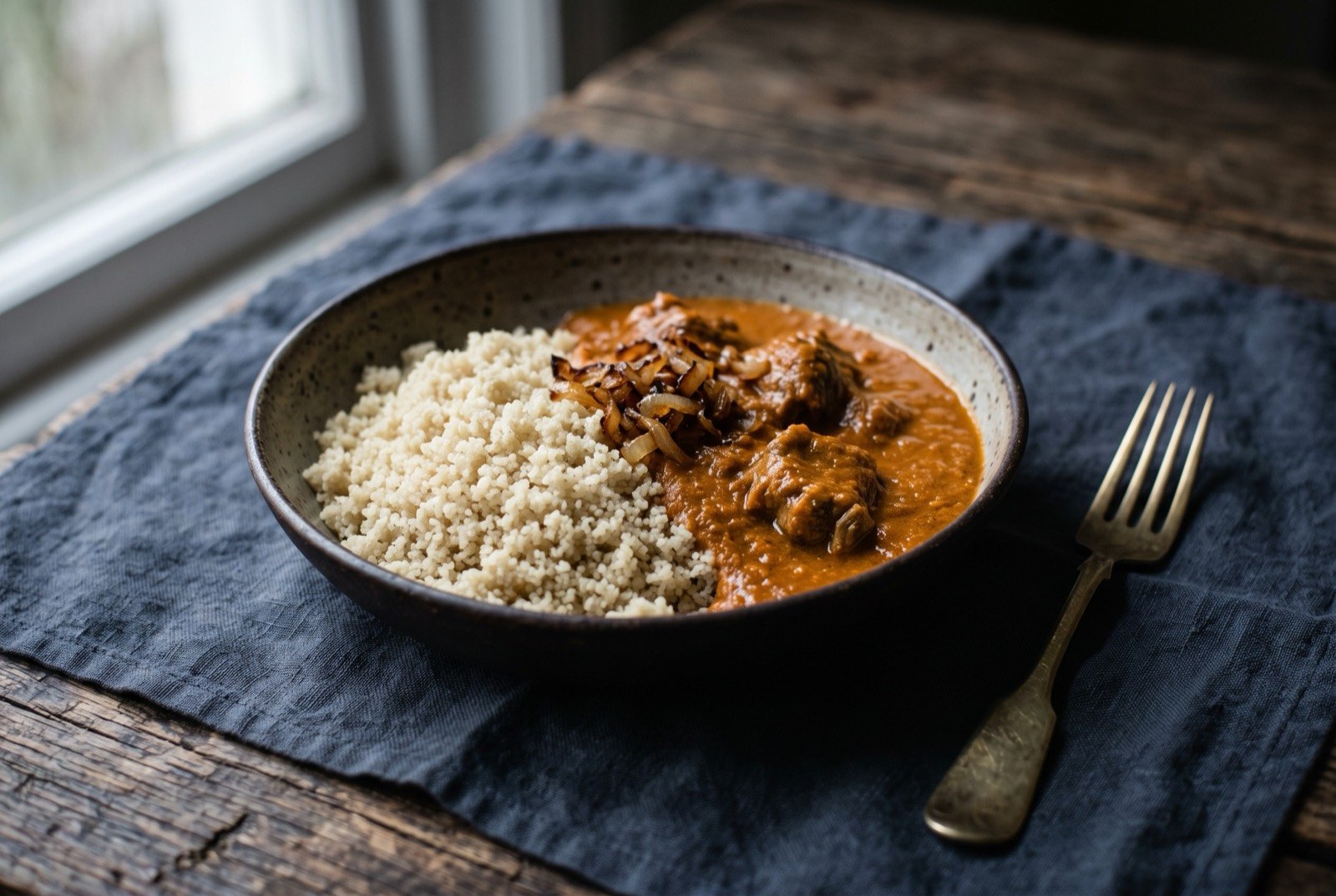
Mali, Burkina Faso and Niger, taken seriously. The grain cuisines of the interior, built on millet, sorghum, fonio and African rice rather than on cassava and palm oil, with a technique ladder assembled from Sahelian method and every dish as tradition built it, then what a modern chef would change.
Sources and review · What this chapter does not assert · How we research · Know this better? Tell us
A Sense of Place
Three landlocked states, six culinary worlds, and a cuisine that stops making sense the moment you organise it by country.
The four volumes before this one were coastal, running on cassava, oil palm, yam and salt-water fish, and their ecological argument was north to south. This volume turns that axis ninety degrees: the organising fact here is water, or the lack of it, and the way a single river cuts across a drying continent.
Define these kitchens by fat, thickener, aromatic and starch and the borders stop mattering. There is no palm oil worth speaking of: there is shea butter, groundnut oil and, in the pastoral zone, butter from cows, goats and camels. There is no yam culture: there is millet, sorghum, fonio and rice. And the umami does not come from the sea, because there is no sea. It comes from a river, from fermented seeds, and from a fermentation of the African locust bean that is one of the great condiments of the world.
The inland Niger delta and the Niger bend
Mopti, Djenné, Timbuktu, Gao. The Bozo and Somono fish it, the Songhai and Marka farm it, the Rimaibe work it, the Fulani graze the bourgou pastures on its margins.
The inland delta is a seasonally flooded basin roughly the size of Belgium, and it is the only place on earth where a great river floods into a desert rather than out of one. That single hydrological accident produced an urban, literate, trading civilisation deep in the Sahel, and it produced a rice.
The Mande heartland
Bamako, Ségou, Sikasso, Kayes, Kita. Bambara, Maninka, Khassonké and Soninké, with the Juula merchant lineages threaded through all of them. Sudanian savanna: groundnut and cotton country, rains more reliable than further north.
This is the ancestral home of the groundnut sauce, and the Bambara name for it, tiga dèguè na, means groundnut-paste-sauce. Every "West African peanut stew" on every menu in Britain descends from what is cooked here, through a merchant network rather than a colonial one.
The Mossi plateau
Ouagadougou, Koudougou, Ouahigouya, Kaya, with Bobo, Bwa, Lobi, Senufo and Dagara to the west and south. Densely farmed, tree-poor, fragile, one short rainy season and a long hungry gap. The Mossi kitchen is a hungry-gap cuisine that has become a proud one, and that transformation is the best story in this volume.
Shea butter is at its most genuinely culinary here. Thickening is done with leaves cooked with potash, and with okra and groundnut. Beside soumbala sit rabilé and bikalga, a second fermented condiment made from roselle seed. The starch is sorghum, millet or maize tô. The plates that matter are tô with sauce feuille or sauce gombo, babenda, zamnè, gonré and dolo.
The pastoral Sahel
The Fulbe and the Kel Tamasheq, transhumant, whose kitchen is a fire, a mortar, a calabash and a herd. There is no thickener in this cuisine because milk is the sauce.
Fat is butter and clarified butter from cow, goat and camel. Aromatics are salt from Taoudenni, Bilma and the Amadror, dates, wild fennel, pepper and tea. Starch is pounded millet, semolina and fonio. Taguella baked in sand, eghajira, fura da nono and gappal are what this looks like on the ground, and the international profile of Fulani cooking currently rests on one chef working out of Accra.
Hausaland and the Zarma-Songhai southwest
Maradi, Zinder, Niamey, Dosso, Tillabéri, with Kanuri towards Lake Chad. The Hausa kitchen thickens with kuka, baobab leaf powder, and with okra, egusi, groundnut and ground melon seed. Its aromatics are yaji, the suya blend, dawadawa (soumbala under a Hausa name), kanwa (mined natron), dried chilli, ginger and cloves. Its starch is millet and sorghum tuwo, cowpea as dan wake, and rice near the river.
Zarma-Songhai cooking in the southwest is close but not identical, and dambou marks the difference: a steamed grain rather than a stiff paste, with moringa folded through it.
The Saharan salt and date road
Agadez, Bilma, Taoudenni, and above all the Timbuktu kitchen. This is the trans-Saharan overlay and the strangest layer in the volume: cinnamon, cumin, anise seed, bay, dates, wheat, roast lamb, stews closer to a tagine than to a savanna sauce.
Timbuktu documents a fourteen-component spice mixture unlike anything else in the Sahel, in which cinnamon, cumin and anise sit beside pounded date paste, dried tomato, roasted onion and maray, which is soumbala: the caravan trade surviving in a domestic larder. The botany in the surviving account is shaky and is not asserted here. The shape of the blend is the fact worth having.
The History in Layers
The indigenous foundation
The Sahel is one of the world's independent centres of plant domestication. Pearl millet, sorghum, cowpea, Bambara groundnut, fonio and African rice are all African, and five of the six are still central to what this chapter cooks.
Djenné-Djeno is the anchor fact. Excavated by Roderick and Susan Keech McIntosh between 1977 and 1981, occupied from roughly 200 BC to AD 1400, over sixty acres by the fifth century AD, with domesticated rice, sorghum and millet in the deposits. A dense, ancient, trading urban society in the inland delta, built on grain and fish, a thousand years before Mansa Musa.
African rice. Oryza glaberrima is a separate domestication from Asian rice, and a study of 246 rice genomes places the strongest single signal in the inner Niger delta of northern Mali around three thousand years ago, with Saharan aridification driving it as wild stands retreated. That reading is contested, and the final section sets out the genetic case for a diffuse, multi-centre process instead. The same genetics dates the decline of African rice to the sixteenth century, when Portuguese traders brought higher-yielding Asian varieties.
Fonio grows on roughly 300,000 hectares and feeds three to four million people. Fast landraces yield grain six to eight weeks after sowing and slow ones take 165 to 180 days, so staggered planting gives a rolling harvest through the hungry gap. It is at once a famine crop and a prestige crop, cosmologically significant to the Dogon and used in bride price and ancestor rites. Very few foods carry both meanings.
Shea. Kirikongo in western Burkina Faso gives the longest continuous single-site sequence of shea processing known, from about 100 to 1500 CE, with testa thickness suggesting deliberate management of the trees inside farmed fields. That is an agroforestry parkland, not casual gathering: fifteen centuries of an unbroken fat.
The trade layers
Trans-Saharan. Salt south, gold north. Taoudenni slabs, cut from a dry salt-lake bed about ten metres down, moved by azalai camel caravan to Timbuktu and then by river pinasse. In a grain-and-legume diet with no marine input that salt was a physiological necessity, which is why the medieval sources describe it trading weight for weight against gold. Coming the other way: wheat, dates, cinnamon, cumin, anise, and cooking ideas.
The Wangara or Juula Mande merchant diaspora is the volume's connective tissue: gold traders in al-Bakri in the eleventh century, expanding south into the Volta basin in the fifteenth and sixteenth and founding Begho, Bonduku, Salaga, Buna, Kong and Wa, east into Hausaland from the fourteenth century, west into Senegambia in the seventeenth and eighteenth. They carried gold, kola, cloth, indigo, leather and Islam in the pacifist Suwarian tradition.
That corridor maps almost exactly onto the modern belt in which one-pot rice dishes are cooked, and it is tempting to say the Juula carried the dishes as well as the goods. I looked for a source connecting the diaspora specifically to the spread of a rice dish and did not find one. It is presented here as inference, and it is in the final section.
Ibn Battuta, 1352. At Walata he was given millet with honey and yoghurt and was insulted by the modesty of it; from the sultan he received three loaves, a piece of beef fried in shea butter and a gourd of yoghurt, and was insulted again. The joke writes itself, but the ethnographic value is high: millet, soured milk, honey, shea butter and a subterranean legume, in 1352, four of them in this chapter.
The Columbian Exchange, and the crop that replaced its own ancestor
Chilli, tomato, maize and groundnut arrive from the sixteenth century by Atlantic and Saharan routes. Groundnut is the transformative one, and the reason is precise: it displaced an indigenous crop that was already doing the same culinary job. The Bambara groundnut, Vigna subterranea, is African, still eaten, now marginal.
There is no evidence the groundnut sauce technique is new. Far more likely, an existing sauce built on Bambara groundnut or sesame was reformulated around a higher-yielding, higher-fat American legume that behaved better in the pot. That is the Volume Three and Four argument in a different ecology: the Americas supplied the plants, West Africa supplied the cooking.
The colonial economy
After the abolition of French slavery in 1848, Bordeaux merchants pushed groundnut cultivation across Senegal and into the Sudanese interior, replacing food crops with a cash crop and producing a structural food dependency that broke in the price shocks of 1914 to 1918 and the 1930s.
The Office du Niger is the most consequential single project in this volume's history and almost nobody cooking Malian food in Britain has heard of it. Conceived in the 1910s and developed under Émile Bélime from the late 1920s, the plan was 1,850,000 hectares of irrigated land and the forced relocation of one to three and a half million Malian peasants, to grow cotton for French mills, watered by diversion at the Markala dam thirty-five kilometres downstream of Ségou. Tens of thousands were made to work in appalling conditions.
It never came close. By 1948, 20,000 hectares and fewer than 23,000 farmers; at nationalisation in the early 1960s, 42,000 hectares. After independence it switched from cotton to rice and now produces around 320,000 tonnes, roughly 40 per cent of Mali's rice, with large tracts leased to foreign investors since 2008 including a 100,000 hectare Libyan project. Every plate of Malian riz au gras sits on top of a colonial cotton scheme that failed at its own purpose and succeeded at something else.
Upper Volta, now Burkina Faso, was dissolved as a colony in 1932 and partitioned between Côte d'Ivoire, French Sudan and Niger, largely as a labour reserve, then reconstituted in 1947. Fifteen years of administered labour migration towards the coast is an under-discussed vector of culinary exchange, running both ways.
Drought, the cube, and rice
The droughts. The 1930s and 1940s droughts on the Mossi plateau, out of which babenda was born. Then the Sahel famine of 1968 to 1974 and again 1983 to 1985, which destroyed herds, broke the Fulani and Tuareg dairy economy and made powdered milk ordinary: Nigerien accounts note that Tuareg households now buy it in the cold months. A dairy culture that buys milk has been through something.
The bouillon cube. Introduced in the 1960s, an urban staple by the 1980s, now near universal. An ethnography from Bobo-Dioulasso puts it plainly: it is difficult to find a Burkinabè sauce prepared without at least one Maggi cube, while rural areas still use soumbala because it is cheaper and locally made. This needs treating without condescension. The cube displaced soumbala so easily precisely because soumbala is, chemically, a naturally produced glutamate source. The cube did not introduce a foreign taste. It industrialised one that was already there. What it cannot do is the rest of it, and that is Rung 1.
Rice. West African per capita rice consumption rose from about 12 kg a year in 1961 to 27 kg by 1990, and urban Sahelian diets have moved from grain paste towards rice within living memory. Tô is not an ancient survival: it is a living staple losing ground to a bowl of rice, which is a different thing and a sadder one.
Insecurity. Since 2012 in northern Mali and roughly 2015 across the Liptako-Gourma, conflict has closed Timbuktu, Gao and much of the Mossi and Sahel regions to outsiders and disrupted the salt caravans. Any chapter written now is written at a distance. This one is.
The Flavour Arsenal
If you buy three things for this volume, buy soumbala, whole fonio and a genuinely fresh dark-roast groundnut paste.
The umami spine
There is no sea here. Savour is built from a river, from fermented seeds and from dried protein, and the difference between a good Sahelian sauce and a flat one is almost entirely in this table.
| Name | Where | What it is | Flavour and dosing |
|---|---|---|---|
| Soumbala | Bambara sumbala; Mooré kalgo; Hausa and Fulfulde dawadawa; Wolof néttetou; Songhai maray | Alkaline Bacillus ferment of néré seed, Parkia biglobosa | Ammoniacal, cheesy, faintly tallowy, deeply savoury. Sold as hard black balls, crushed in a mortar with dried fish and chilli. Dosed far more heavily than Western recipes suggest: 40 to 71 g per 100 to 500 g of principal ingredient |
| Dried and smoked river fish | Bambara jèguè jalen | Various Niger species | Salt, smoke and glutamate. Pounded, not floated. 14 to 88 g per portion of sauce in the field formulas |
| Bikalga | Mooré; datou in Mali; dawadawa botso in Niger | Alkaline ferment of roselle seed, Hibiscus sabdariffa | Sourer and grainier than soumbala. Steeped in warm water first, and the steeping water goes into the sauce |
| Rabilé | Mooré | A local fermented condiment | 12 to 209 g per sauce in the recorded baobab and jute formulas. Glossed in English as "yeast", which at those quantities is almost certainly wrong |
| Stock cube | "Maggi" generically | Maggi, Jumbo, Royco | In essentially every household formula recorded in Burkina Faso, at 11 to 34 g per sauce. Pretending otherwise would be a lie about how this food is actually cooked |
On the safety of the ferments, which is worth printing. In a field survey of eighty soumbala producers in Burkina Faso, 43.8 per cent of fermentation vessels were dirty, 56.3 per cent of consumers had found sand, plastic, insects or debris, and 15 per cent reported digestive illness, with no documented quality control anywhere. Bacillus cereus and other enterotoxin-producing species have been isolated from both soumbala and bikalga. The rule: cook these condiments into a simmering sauce for at least ten minutes, and never use them as a raw finishing seasoning.
The alkalis
Solid potash is mined trona or natron stone, Hausa kanwa, used at 3 to 21 g per sauce in the recorded formulas. Liquid potash is filtered wood-ash lye at roughly pH 11, used at 17 to 304 g. The data imply an exchange rate of about 1 g solid to 15 to 20 g liquid, which is the most useful conversion in this chapter.
Its jobs, in order: it solubilises pectin and hemicellulose so fibrous savanna leaves collapse in half an hour rather than two; it holds chlorophyll green by preventing the acid-driven conversion to olive-brown pheophytin, which is why a proper sauce feuille is startlingly green; and it extends mucilage, increasing the draw of okra and jute. Cooks correct with it consciously: the babenda instruction is literally to add potash if the pot has gone too sour. And it costs something, because alkali destroys thiamine and some vitamin C. Every technique here is a trade, and this one has a nutritional invoice attached.
The fats
Shea butter, Vitellaria paradoxa, Dioula si, Mooré taanga, is solid at Sahel ambient temperature, melts on the tongue, and tastes faintly nutty and smoky with a green cocoa-butter edge. It goes into a leaf sauce at around 25 g: a finishing enrichment, not a frying medium. In 2000 shea was Burkina Faso's third export after cotton and livestock, and 300,000 to 400,000 rural Burkinabè women work in it, which is why it is called women's gold. Culinary shea is a different grade from cosmetic shea, and that distinction is the biggest sourcing problem in the chapter.
Groundnut oil is the everyday frying fat, 25 to 165 g per sauce. Cottonseed oil is ubiquitous because of the cotton economy: cheap, neutral, a colonial-era arrival nobody romanticises. Butter and clarified butter carry the pastoral kitchen. Palm oil appears only at the southern edge, and if a recipe for a Mossi or Songhai dish calls for it, be suspicious.
The leaves and wild greens
| Local name | Species | Character |
|---|---|---|
| Bito (Mooré) | Hibiscus sabdariffa, roselle leaf | Sharply acidic. Needs blanching, usually potash |
| Burumbura (Mooré) | Amaranthus sp. | Sweet, spinach-like, softens slowly |
| Bulvaka (Mooré), fakoye (Songhai) | Corchorus olitorius, jute mallow | Very slippery. The draw green, met in Volume Four as adémè |
| Kennedbo (Mooré) | Cleome sp. | Peppery, mustardy |
| Keeba vaado (Mooré) | Onion leaf | Used in quantity, 49 to 241 g in the recorded sauces |
Jute mallow appears here as bulvaka and fakoye, in Volume Four as adémè and crincrin, and in Egypt as molokheya. One species, one slippery texture, from Cairo to Bamako to Abidjan: a continental fact, not borrowing in either direction.
The wild, the gathered and the volatile
Zamnè, the seed of Senegalia macrostachya, gathered wild, is the flagship Burkinabè ingredient on the competition circuit. It is extremely hard and must be soaked and long-boiled with alkaline salts to become edible. I could not obtain the process papers and therefore cannot give a soak time, an alkali dose or a boil time. They are not in this chapter, and I would rather say that than invent them.
Néré pulp, the yellow floury pulp around the locust bean, is eaten as a sweet, which tells you néré is a two-product tree. Tamarind sours millet tô and zoom-koom and is also a starch lever, on which see Rung 3. Roselle calyces, bissap, do double duty as a drink and as the sour agent in sauces. Kinkeliba is the everyday bush tea.
Two spices matter most, both shared with the coast. Grains of paradise, Aframomum melegueta, carries humulene and caryophyllene plus paradol and shogaol, and the practical fact is chemical: in storage gingerols convert to shogaols and pungency falls, so an old jar is not a weaker version of the spice but a flatter, different one. Uda, Xylopia aethiopica, should be toasted, bruised, infused and removed, never ground in, because the woody pod is bitter.
Part Two
The Technique Ladder
First, an honest problem
Volume Four had no starred restaurant to argue with anywhere in the world and said so. This volume has the opposite problem, which is subtler.
There is a Michelin-starred chef of Malian heritage, and there is exactly one. Mory Sacko at MoSuke in Paris, one star since 2021. He is genuinely relevant: he works fonio, baobab, hibiscus, attiéké and mafé. But MoSuke is a French restaurant built by a Franco-Malian chef against Japanese technique, and Sacko would be the first to reject the framing that it stands in for a national cuisine.
Inside the three countries the picture is honest and thin. Bamako has serious restaurants with named cooks, of whom Samba Sangaré is the most technically articulate on record. Ouagadougou has a competition circuit and real medal-winning cooks but not yet a documented restaurant scene in the sense Abidjan has one. Niamey, on the evidence I could verify, has nothing at that level at all. And London, where you actually eat, offers three starred West African restaurants, Ikoyi, Akoko and Chishuru, none of which is Sahelian: what they supply this chapter is transferable technique, not Malian cooking, and it would be dishonest to borrow their credentials.
So the ladder below is built from mechanism. Fatmata Binta's line on method is the best epigraph available and it is not a technical one:
Fulani women cook from the heart and measure with your eyes.
The project of this chapter is to work out what the eyes were measuring.
Rung 1. Savour is built twice, from a stock and a ferment, never from a cube
The default British and takeaway build of a Sahelian sauce is meat, onion, tomato, groundnut paste and water, with a cube for savour. The restaurant build is meat browned hard, deglazed, simmered in a stock made from the same animal, with a second aromatic pass on top. Akoko's jollof is the proof: the rice is cooked in a sweet pepper stock, and the reviewer's highest praise, scoring it 16 out of 20, was that the rice was full of the flavour of the stock.
Why the stock matters. Water contributes nothing. A stock contributes gelatin, which raises viscosity and coats the tongue, extending the time flavour compounds spend near the receptors; free amino acids, chiefly glutamate; and nucleotides from muscle, chiefly inosinate. Those two are supra-additive rather than merely additive, which is why the Sahelian cook who pounds dried fish into a groundnut sauce is doing, unknowingly, what a Japanese cook does with kombu and katsuobushi. Dried sardine carries roughly 40 to 50 mg per 100 g of glutamate and 350 to 800 mg of inosinate; katsuobushi 30 to 40 and 470 to 700.
Why the ferment is a different axis. Soumbala, dawadawa, netetou and iru are all alkaline Bacillus fermentations of the same seed. Bacillus subtilis and B. pumilus proteolyse the seed protein, liberating free amino acids and ammonia, which is why the ferment smells ammoniacal and why the pH climbs rather than falls. Bikalga is the same logic applied to roselle seed.
A stock cube gives you monosodium glutamate and salt on a flat curve: it hits hard and vanishes. An alkaline Bacillus ferment gives you glutamate plus a peptide and volatile profile including pyrazines and sulphur compounds, which is why soumbala reads as savoury and aged rather than merely salty. Build the stock, then build the ferment in on top of it.
Rung 2. The reserved gruel: tô is two-stage starch engineering
This is the most important technique in the volume and it is almost universally mis-described in Western sources as stirring flour into water. The real method, documented with weighed quantities in a field study of household recipes in Burkina Faso and Benin, is a two-stage build with a viscosity brake held in reserve.
Sorghum tô, per 1000 g flour: 2251 g water. One third of the flour is slaked cold to a smooth flour milk and poured into boiling water to make a thin gruel, which cooks 5 to 10 minutes. A portion of that gruel is then removed and set aside, which is the brake. The remaining flour goes in and is beaten hard for 15 minutes as the paste seizes; the reserved gruel is beaten back in over two or three additions; and the whole thing cooks a further 15 to 20 minutes until it pulls cleanly from the pot wall. Dish 1 gives it as a method.
Millet tô, per 1000 g flour: 2535 g water, plus 160 g tamarind juice, the tamarind going into the boiling water at the start. White maize tô, per 1000 g flour: 3981 g water, with a shorter beat of about four minutes. Sorghum wants 2.25 times its weight in water and maize nearly four times, because maize flour is finer and its starch swells more, and treating the three grains as interchangeable is why so many attempts fail.
Why it works. Millet and sorghum starches gelatinise at high temperature and set fast. Dump dry flour into boiling water and you get lumps with raw cores, because the outside of each clump gelatinises into a waterproof shell before the inside has wetted. The pre-slaked flour milk hydrates every particle first. The reserved gruel is then a controlled viscosity brake: once the bulk flour has gone in and seized, you can let the paste back down in stages and keep beating, instead of adding water and diluting both flavour and set.
This convergence is worth naming, because it runs across the atlas. Southern African nshima solves the identical problem the opposite way round: it reserves dry flour and adds it at the end to bring a thin porridge up to stiffness. Sahelian tô reserves cooked gruel and adds it at the end to bring a stiff paste back down. Both are two-stage builds with a reserved fraction; one brakes upward, the other downward. Two cuisines a continent apart arrived independently at the same insight, which is that a stiff grain paste cannot be made in one pass.
Rung 3. Alkali and acid are one lever, and you choose which end to pull
British cooks treat alkali as an oddity and acid as a garnish. Here they are two ends of one structural control, and knowing which end to pull is a chef's lever almost nobody in Britain knows exists.
On the leaves, pull alkaline. Potash collapses fibrous leaves in twenty to thirty minutes rather than two hours, keeps chlorophyll from converting to pheophytin so the sauce stays green, and extends mucilage chains, which is why a potash-cooked okra or jute sauce draws properly and one made without it does not.
On the paste, you have a choice, and it gives you two different dishes. A study of sub-Saharan thick porridges tested composite flours at neutral, acid and alkaline pH. Acid-treated slurries gave higher peak viscosities; alkaline treatment raised the pasting temperature; and alkaline-cooked porridge was significantly darker. Instrumental toughness ran from 0.21 to 0.58 kg and shear work from 0.83 to 5.95 kg-mm, with cassava-heavy blends reading soft and glossy and cereal-dominant blends firm.
So: tamarind or lemon water for a firm, pale tô that holds a quenelle and that sauce clings to; ash or potash water for a darker, softer, more aromatic one. At mildly acidic pH amylose leaches more readily and the paste thickens harder; alkali degrades starch polymers and drives Maillard browning at lower temperatures, which is why potash-cooked porridge goes dark.
Two consequences follow. Never add acid to a draw sauce at the start: same polysaccharide chemistry Volume Four's Rung 5 reached from the okra side. And never add acid to a leaf sauce you want green: the moment the tomato goes in early the sauce is going brown, and no potash later will bring it back. Brightness comes from a relish beside it.
Rung 4. Break the groundnut emulsion on purpose, then rebuild it
The home cook stirs peanut paste into liquid and hopes. The restaurant cook fries the paste out first, over low heat with the aromatics, until the oil separates and the paste darkens, then adds stock in stages and reduces until the oil re-emulsifies to a gloss.
The in-tradition method is subtler than either, and starts by diluting the paste rather than frying it: whisk one volume of groundnut paste into two volumes of water before it meets the pot, then pour it in and simmer ten minutes stirring constantly before anything else joins it.
Why the constant stirring is not fussiness. Groundnut paste is roughly half fat held in a protein and fibre matrix. Whisked cold into water it forms a coarse, unstable emulsion, and stirring through the first ten minutes stops the protein flocculating and catching on the base. As the sauce cooks the protein denatures and the emulsion inverts, releasing free groundnut oil.
That oil slick is the completion signal, not a fault. A well-made tigadegena is glossy with a thin film of separated oil on top. A badly made one is chalky, split and tastes rawly of nut. Undercooking is the classic error, and the sauce tells you when it is done if you know what you are looking at.
Frying the paste out does three things dilution does not. It drives Maillard reactions on the residual protein and sugars, generating the pyrazines raw paste lacks; it drives off the green volatiles, chiefly hexanal, which are also the markers of rancidity; and it liberates free oil early, to be re-dispersed as small droplets stabilised by the peanut's own protein and by gelatin from your Rung 1 stock. Mory Sacko lightening a mafé with miso is the same instinct from the other direction, and it is not fusion: it is the substitution a Bamako cook makes with soumbala, executed with a different ferment.
Rung 5. Shea is a fat that sets, so use it where setting is the point
Substituting sunflower oil for shea butter is not a small change. It is a change of texture class, and it is the most common structural failure in Sahelian food cooked outside the Sahel.
Shea is 85 to 90 per cent stearic and oleic acid, solid at British and at Sahel ambient temperature both. It sets a sauce as the sauce cools, gives a body a liquid seed oil physically cannot, and releases volatiles progressively as it melts at body temperature rather than all at once. Traditional practice already treats it correctly, as a late enrichment: fokahoy, the Timbuktu sauce of powdered okra leaf and shea, is the clearest case of shea as sauce fat rather than fryer, and fakoye is the second.
The restaurant extension is a cure. MoSuke's signature is beef fillet cured in shea butter, served with a peanut-based mafé, and it is the most chapter-relevant technique in world fine dining because shea is this chapter's fat. A cure in a largely saturated, high-melting fat excludes oxygen so the surface does not oxidise, and because the stearic fraction stays solid it sits on the meat rather than soaking in, giving a lacquered, faintly nutty surface without greasiness.
And here is the honest problem. Food-grade shea butter is essentially unobtainable in Britain: see the sourcing section. Do not eat cosmetic-grade shea. The honest substitute for texture and for the way it sets a sauce on cooling is clarified butter or ghee. Coconut oil is not one: the lauric acid gives a soapy note and the aroma is wrong in every direction.
Rung 6. The narrow windows: fonio, volatile spice, and what cannot be held
Some ingredients here have a wide margin and some have almost none, and the ones with none are what make British versions fail.
Fonio has the narrowest window in the larder, and the numbers say why. Its starch granules are around 8 micrometres. It has the highest gelatinisation enthalpy of the common gluten-free cereals at 11.45 J/g, the narrowest gelatinisation temperature range at 9.96°C, and a peak gelatinisation temperature of 73.5°C. It has the highest water absorption index and swelling power of the group at 7.7 g/g and the lowest water solubility index at 0.7 g per 100 g, roughly three times lower than rice.
Read those together and the technique writes itself. A narrow gelatinisation range means the gap between undercooked and gluey is very small, and a homogeneous granule population means the whole batch crosses that line at once. High swelling with very low solubility means fonio grabs water fast but does not leach much amylose to lubricate itself, so it clumps mechanically rather than turning to soup. That is why the traditional method is steaming, not boiling: steam delivers heat and moisture gradually and lets you interrupt.
And the corollary is a service rule. The dominant British format for West African food is the hot counter: trays held at 63°C for hours. Stews improve with an overnight rest. They do not improve under a lamp. Over four hours the volatiles are driven off, leaf sauces oxidise from green to olive, and rice starch retrogrades and dries. The dish you are served at four in the afternoon is the ghost of a dish that was correct at ten in the morning. That is a service-format decision rather than a recipe one, and it is the largest single cause of bad West African food in Britain.
Part Three
The Ferment and Preserve Bench
1. Soumbala
The most important condiment in the volume, and one to buy rather than make, though knowing the process changes how you use it.
The recorded method, from a survey of eighty producers in Burkina Faso: first boil 24 to 40 hours, some producers adding potassium ash. Dehull by pounding the softened seeds with ash or sand as an abrasive, then wash. Parboil twice, 1 to 3 hours each. Ferment spontaneously 2 to 3 days at 25 to 30°C, dominated by Bacillus subtilis. Sun dry about 8 hours, then a further two or three days, and mould by hand into balls.
Why the absurd first boil. It is not cooking, it is hydrolysis. Parkia seeds have an extremely hard, impermeable coat, and the long boil plus alkaline ash is what makes dehulling possible at all. Then Bacillus subtilis, proteolytic and alkalophilic, deaminates the protein and raises the pH as it works, producing free glutamate and the ammoniacal, cheesy top note.
That free glutamate is the point and also the tragedy. Soumbala is a naturally produced glutamate source, which is exactly why a manufactured one displaced it so easily. The cube did not win by being better. It won by being the same thing, cheaper, cleaner and always identical.
2. Bikalga, datou, dawadawa botso
The second ferment of the plateau: the same alkaline Bacillus logic applied to roselle seed rather than néré. Mooré bikalga, Bambara datou, Hausa dawadawa botso, sourer and grainier than soumbala.
The documented process: clean and winnow dry, wash, then cook 12 to 24 hours with an alkaline ash leachate to raise the pH, ferment either in one phase of 3 to 4 days or two phases of 2 to 3 days each, steam overnight, and sun dry 1 to 3 days. The pH climbs to 8 to 9 during cooking and fermentation and falls back to around 6 with steaming and drying. Carbohydrate falls by roughly half, protein holds, and potassium exceeds 2,500 mg per kg because of the ash.
The technique note nobody tells you: bikalga is steeped in warm water first, and the steeping water goes into the sauce. A few minutes is enough, and throwing that liquid away throws away most of what you bought.
3. Dolo
Sour sorghum beer, brewed by women, drunk warm and cloudy from calabashes at the cabaret, which is a social institution rather than a bar. Roughly 600 dolotières in Ouagadougou alone produce about 36 million litres, over three-stone firewood hearths.
Red sorghum predominantly. Steep 14 to 24 hours. Germinate 3 to 4 days. Sun dry the malt 2 to 3 days. Mill, then mash at 1 part malt to 5 to 10 parts water. Decant 20 minutes to 12 hours, then heat the sediment to 97 to 98°C while holding back the supernatant, and reincorporate it. Ferment with indigenous yeasts carried over on the vessel from the previous brew. The finished beer runs 1.40 to 3.50 per cent ABV at pH 3.2 to 3.6, yielding about 4 litres per kilogram of malt, and the souring is lactic.
Why the hot-and-cold split is clever. Sorghum starch gelatinises at a higher temperature than barley's and sorghum malt is amylase-poor. Boiling only the settled solids gelatinises the starch hard while preserving the enzymes held in the reserved liquid, which is poured back to saccharify. That is a decoction mash, arrived at independently in West Africa. The sources give neither the fermentation duration nor the form in which the yeast is carried between brews, and I am not going to guess.
4. Nono, fènè and kossam, and dèguè from them
Milk is soured spontaneously in a calabash that is never fully washed, so the vessel carries its culture forward. Fulfulde kossam, Hausa nono, Bambara fènè. Butter is churned by rocking a gourd in a sling.
Dèguè is steamed millet couscous, cooled, folded into the soured milk with sugar and sometimes vanilla, nutmeg or crushed baobab fruit: a dessert, a Ramadan fast-breaking dish, and a first cousin of Senegalese thiakry.
Sourcing in Britain
Verified August 2026. Where a supplier could not be fully confirmed, that is said rather than smoothed over.
The one that has no answer
Food-grade shea butter is the hardest ingredient in this book to buy in Britain, and I could not verify a single UK retailer selling it. What UK searches return is cosmetic-grade unrefined shea from skincare wholesalers, which is not sold to food standards and may have been processed on non-food equipment. Do not eat it.
If you pursue it, look for the words "food grade" or "edible", a stated origin, and sun-dried rather than smoke-dried processing, because fire-smoking introduces contaminants. Shea from the Mossi plateau of Burkina Faso is higher in stearic acid and therefore firmer, which is the classic Sahelian texture. The two producers named in reporting as making food grade, Baraka and Hamamat, are both non-UK and I could not verify UK shipping. Until that changes, use clarified butter or ghee, and know what you are trading.
Nationwide online, verified trading
- Niyis (niyis.co.uk), Reading RG2 0BF. The strongest verification in this list, with dated content to August 2026. Shipping from £7.99 at 2 to 4 working days, next day from £10.99, free over £120. The default recommendation.
- Ogbongeh (ogbongeh.com), Belvedere DA17 6BP. States nationwide delivery. Iru and locust beans at £3.39.
- Fonioka (fonioka.com), London registered. Fonio grain in 250 g and 1 kg and flour in 500 g, from a women-led West African cooperative. The closest thing Britain has to a dedicated Sahelian grain supplier. No date stamp on the site, so trading status is inferred from an active storefront: worth a test order.
- UK Afrifoods, 58 Ridley Road, London E8 2NR, is London delivery only, stated in their own FAQ. Excellent for Londoners, useless elsewhere. They do list dawadawa.
For bulk, Buy Wholefoods Online lists organic fonio from 250 g to 20 kg, the only large format I found, though the product page would not render for verification. Amazon.co.uk carries soumbala, sumbara and netetou under those Sahelian names in 50 g whole grain, which is Malian and Burkinabè nomenclature rather than Nigerian, and is the fastest route to the correct product for a Mali recipe.
Physical shops
Rye Lane, Ridley Road and Brixton in London; Moston Lane in Manchester, where Global African Ltd carries the widest spread outside London; Handsworth and the Bull Ring Open Market in Birmingham; Chapeltown and Harehills in Leeds; Stapleton Road in Bristol; City Road in Cardiff; Alaoma Food Hub in Sheffield's Moor Market; Granby Street and Lodge Lane in Liverpool. Glasgow is the strongest non-London cluster in the country, led by Solly's African Village, established 1992. Newcastle is the thinnest of the major cities.
The ranked list: what decides great from grim
- Soumbala, netetou or dawadawa. Whole fermented grains, not powder, which oxidises fast and is usually cut. Near-black, sticky-matt, aggressively ammoniacal. If it smells of nothing it is dead. Freeze it airtight or it perfumes the cupboard.
- Real stock instead of water. Gelatin plus glutamate plus inosinate is the architecture of a Sahelian sauce and water supplies none of the three.
- Fresh, unadulterated, dark-roast groundnut paste. 100 per cent peanut, opaque jar, batch date, bought small and often. Oil separated on top is a good sign, and "no-stir" means the emulsion has been stabilised, which is what you want to break. Rancidity gives the hexanal and nonanal that read as cardboard; and in a Gambian survey of 85 peanut butter samples, 9.4 per cent carried detectable aflatoxin B1 at 2.91 to 38.76 ppb, market-bought worst at 13.33 per cent against home-made at 5.56. Buy from a retailer subject to UK food law.
- Fonio bought whole and washed properly. Uniform pale cream, no grit when you swirl a spoonful in water, and grain rather than flour. There is no honest substitute.
- Smoked or dried fish, whole and frozen. Skin on, crayfish whole rather than ground, and it should snap. Katsuobushi is the technically correct substitute at 470 to 700 mg of inosinate per 100 g.
- Food-grade shea butter, if you can find it. See above.
- Finely milled millet or sorghum flour, talc-fine. Wholegrain millet flour from a health-food shop makes gritty tô, and tô is the plate, so its failure is total.
- Your acid, tamarind or hibiscus, as wet block pulp rather than the tar-like concentrate. Both a seasoning and a starch lever.
- Whole grains of paradise and uda pods, ground or bruised at service, and vividly green leaf powder, because khaki is oxidised chlorophyll and tastes of hay.
- Onions in quantity, 151 to 244 g per sauce, and salt in layers: these sauces are seasoned at four stages, and the habit of one hit at the end is why so much diaspora cooking tastes harsh rather than deep.
Voices and Sources
From inside the tradition
- Mory Sacko, MoSuke, Paris 14e. Franco-Malian, opened September 2020, one Michelin star within a year, the only chef of Malian heritage at that level anywhere. His position is this series' argument from inside: that African cuisine merits standing beside French, Italian and Japanese cuisine rather than being dismissed as tasty street food. He rejects the word fusion and calls it alchemy. His signature is beef fillet cured in shea butter with a peanut-based mafé, and he lightens a mafé with miso, which is a soumbala substitution by another ferment. He is candid that he moderates intensity and fat load for a Western room, a compromise his own mother questions.
- Fatmata Binta, Dine on a Mat and the Fulani Kitchen Foundation, Accra. Born in Freetown to a Fulani family of Guinean descent, first African chef to win the Basque Culinary World Prize, FAO Regional Goodwill Ambassador, working with over three hundred families in northern Ghana. Her list of essential Fulani ingredients is worth having whole: fonio, sun-dried okra, African locust bean, sun-dried cayenne, salted fish, ghee and shea butter, plain yoghurt, palm oil. Dine on a Mat is a plating solution disguised as hospitality: rather than force a sauce-and-starch cuisine onto a plate, it changes the vessel so the cuisine's own format is the format.
- Samba Sangaré, Le Bafing, Bamako. The most technically articulate account from inside the three countries: brown the meat properly, cook the fakoye about 30 minutes, then add water and the rest and simmer an hour to an hour and a half. The restaurant's pitch is local recipes without the cube, which tells you cooks in Bamako see the same problem this chapter describes.
- Fousseyni Djikine, BMK Paris-Bamako, the most serious Malian restaurant business in Europe: a restaurant, a fine-grocery arm and a cookbook. His stated mission is to make Africa's unknown or undervalued patrimony known.
- Moussa Compaoré, Idrissa Ouédraogo and Diamilatou Bazié, gold medallists for Burkina Faso at the first Festival International de la Gastronomie Ivoirienne, Bouaké, May 2025, where the country took seven medals. Bazié's plate was a taco stuffed with zamnè, moringa and three peppers, which is the current shape of Burkinabè high-end cooking: competition craft rather than restaurant craft.
- Pierre Thiam, Senegalese, whose fonio specification this chapter teaches and whose Yolélé built the Mali fonio supply chain with the processor Mali Shi, in a venture touching over 23,000 shea collectors and farmers. Shea and fonio move through the same rural economy, which is why the two rise and fall together.
The gap, named
I could not verify a single named chef, restaurant or culinary project in Niger operating at restaurant-craft level, and Niger contributes kilishi, dan wake, dambou, fura da nono and a great deal of the alkali and mucilage technique in this chapter. Sahelian food is the least commercially visible major African cuisine in Britain. Even the good West African outlets here are Nigerian or Ghanaian, and tô, fonio, soumbala and fakoye have almost no commercial presence. A Malian dish cooked in a Nigerian kitchen with Nigerian substitutions is a translation of a translation, and that is the best most British readers can get without cooking it themselves. Which is precisely why this volume exists.
Things this chapter has deliberately not asserted
The section that makes the rest of it trustworthy.
- That African rice was domesticated in the inner Niger delta three thousand years ago. A 246-genome study says so flatly and a separate PLOS Genetics analysis explicitly rejects a single centre, describing a diffuse process with sh4 from Mali, sh1 from coastal Guinea and Sierra Leone and PROG1 from Central Africa, across at least five genetic groups. This chapter prints the disagreement: West African domestication around three thousand years ago, strongest single signal in the inland delta, a multi-centre process rather than a birthplace.
- That the Juula or Wangara diaspora carried jollof, or any rice dish, across West Africa. The diaspora is exceptionally well documented as a commercial and scholarly network, but I found no primary or scholarly source connecting it specifically to the spread of a rice dish, and the best source I could check attributes the spread to trade routes and shared cooking logic in general while explicitly declining to credit Dyula merchants. A plausible modern inference hardened into fact by repetition, and presented above as inference. James McCann's Stirring the Pot would settle it.
- That tiga dèguè na is the original and mafé the derivative, or the reverse. Both circulate. The Bambara name is transparently descriptive and Mali is the groundnut heartland, which supports Malian priority, but there is no dated documentation either way.
- The zamnè cooking parameters. I could not obtain the full text of either process study, so soak time, alkali type, alkali dose and total boil time are absent rather than guessed at. Zamnè is named in the arsenal and the competition record and given no recipe, which is the only honest option.
- The capitaine timings, distances and marinade proportions. The source is a recipe aggregator with the structure and tone of generated content. The composition is internally sensible and the soumbala is a good sign, but these are not authenticated numbers. They are printed with the caveat attached, and the modernist version replaces the clock with a probe temperature for exactly this reason.
- That babenda originated in the 1930s and 1940s droughts. Stated by Burkinabè press and repeated widely, plausible and internally consistent. But a leaf-and-grain pottage of this type is certainly older, and what the drought most likely did is fix, name and stigmatise a version rather than invent the idea. Mossi oral history and colonial-era agricultural reports for Haute-Volta would settle it.
- That Awa Korbéogo won a world title for babenda at Hammamet in February 2025. Reported by Vox Sahel and echoed across Burkinabè media. I did not find the organiser's own results page. Reported here as reported, not as verified.
- Two of the fourteen Timbuktu spices. Kábay is given as a lichen under a name that is not a valid botanical binomial, probably a species of Evernia, and wangaray maffay jay is unidentified. The single source is a small, apparently locally authored site. The shape of the blend is asserted; the botany is not.
- That rabilé means yeast. It appears in the recorded formulas at 12 to 209 g per sauce, which is absurd for a leavening agent, so the gloss is almost certainly loose for a fermented condiment. Named here without a translation.
- That kilishi originates in the Sokoto jihad period. Post-1804 dating is a specific claim needing a specific source, and dried meat for caravan provisioning is certainly far older. The chapter calls it an elite and caravan food without dating it.
- The dolo fermentation duration and the form of the yeast carry-over. The published review gives ABV, pH, yield and mash ratio and gives neither of these. Absent above rather than invented.
- Anything at all from eleven named recipe sites. The research identified a cluster returning confident, detailed, unsourced and mutually contradictory content on Sahelian dishes, several presenting invented "traditional" quantities, with the signature of AI or SEO generation. None is cited here, directly or at second hand. This subject area is more polluted by generated content than any previous volume, which is itself a fact about how invisible Sahelian food is: nobody bothers to fake a cuisine anyone is watching.
Volume Five of Not Just Stew. Research briefs: vol05-tradition.md and vol05-modernist-sourcing.md. Sourcing verified August 2026. Written at a distance: since 2012 in northern Mali and roughly 2015 across the Liptako-Gourma, conflict has made travel to most of the region impossible, and this chapter does not pretend otherwise.
Savour is built twice, from a stock and a ferment, never from a cube
The default British and takeaway build of a Sahelian sauce is meat, onion, tomato, groundnut paste and water, with a cube for savour.
The reserved gruel: tô is two-stage starch engineering
This is the most important technique in the volume and it is almost universally mis-described in Western sources as stirring flour into water.
Alkali and acid are one lever, and you choose which end to pull
British cooks treat alkali as an oddity and acid as a garnish.
Break the groundnut emulsion on purpose, then rebuild it
The home cook stirs peanut paste into liquid and hopes.
Shea is a fat that sets, so use it where setting is the point
Substituting sunflower oil for shea butter is not a small change.
The narrow windows: fonio, volatile spice, and what cannot be held
Some ingredients here have a wide margin and some have almost none, and the ones with none are what make British versions fail.
The dishes
- Tô with sauce gombo Burkina Faso, the Mossi plateau
- Babenda Burkina Faso, the Mossi plateau
- Tiga dèguè na Mali, the Mande heartland
- Riz au gras, or zaamè Mali and Burkina Faso
- Fonio, steamed twice Across the Sahel; Mali, Burkina Faso, Guinea
- Fakoye Northern Mali, Gao and Timbuktu
- Capitaine grillé Mali, Mopti and Bamako
- Katta Timbuktu and Gao, Mali
- Kilishi Niger and Hausaland
- Dambou Niger, the Zarma-Songhai southwest
- Taguella Tuareg, northern Niger and Mali
Sources and review
- Researched
- Researched from 106 sources in the brief
- Reviewed
- Awaiting a reader from inside the tradition
- Cooked
- Awaiting a cook report
Where this volume comes from
4 research briefs on file for this volume, researched to the rules on How we research. Published 26 August 2026. Last changed 8 September 2026.