West Africa · Volume 05, The Sahel Interior
Kilishi
Niger and Hausaland
Illustration
- Time
- Not statedNo source states a time and the atlas has too few comparable dishes to estimate one.
- Researched
- Researched from 106 sources in the brief
- Reviewed
- Awaiting a reader from inside the tradition
- Cooked
- Awaiting a cook report
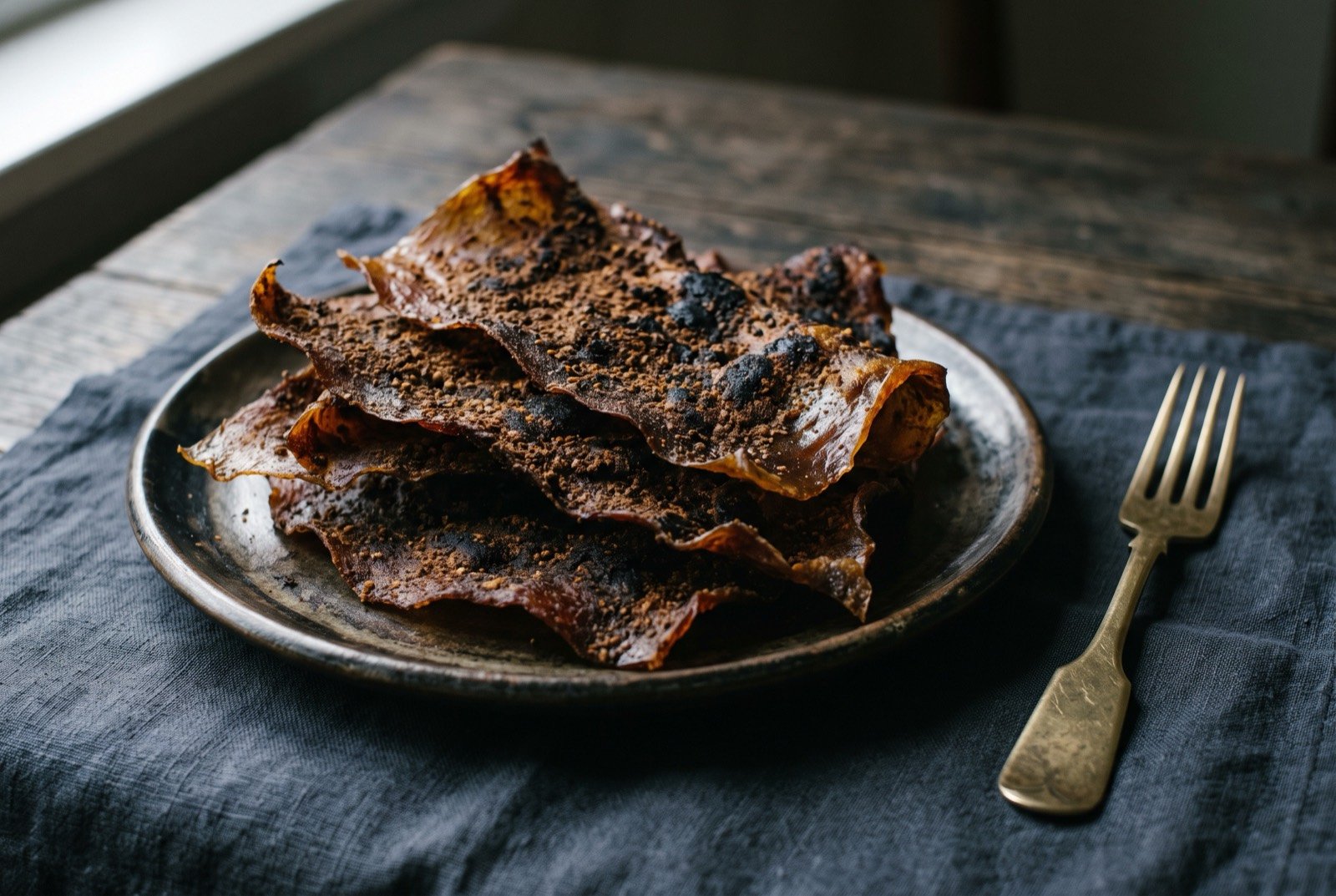
Kilishi is beef, or lamb, mutton, goat or camel, sliced with the grain from the hindquarter and teased out by hand into a translucent sheet, sun-dried, dipped in a groundnut slurry, dried again and roasted hard over open fire. It keeps for months without refrigeration and was historically an elite and caravan food, though the dating to the Sokoto jihad period that circulates online is a claim I could not source and have not asserted. Field measurement of Nigerien and Nigerian producers gives real numbers, and they matter because this is the one dish here where practice and optimum diverge measurably. Slices ran 0.98 to 4.09 mm, most around 2.0 mm. The first sun-dry ran about 4 hours 30 at 28 to 36°C, to a critical moisture content averaging 1.24 kg water per kg solid. The labu slurry measured water 50.43 per cent, groundnut paste 45.45, salt 2.09, chilli 0.61, ginger 0.60, onion 0.55. Producers dip 3 minutes; the study found 35 minutes optimal. Why it works. The first drying is a dehydration-driven pump: pulling the sheet down to low water activity creates an osmotic gradient, so that when you dip it the meat drinks the seasoned slurry through its whole thickness rather than wearing it as a coating. The second drying sets that slurry as a skin, and the roast caramelises the groundnut sugars.
As tradition built it
Makes about 300 g. Two days.
Ingredients
- 1 kg beef topside or silverside, in one piece
- 250 g groundnut paste
- 275 ml water
- 12 g salt
- 4 g ground dried red chilli
- 4 g ground dried ginger
- 3 g onion powder
Method
- Slice the beef with the grain into sheets about 2 mm thick, then tease each sheet out by hand, stretching it thin and translucent without tearing.
- Rack the sheets and dry about 4 hours 30 in sun at 28 to 36°C, or in a dehydrator at 35°C, until leathery and stiff at the edges.
- Whisk the paste, water, salt, chilli, ginger and onion powder smooth. Roughly half water, half paste by weight.
- Dip the dried sheets in the slurry. Producers dip 3 minutes; the measured optimum is 35 minutes.
- Dry a second time, about 3 hours, until the coating is set and matt.
- Roast briefly over a hot open fire, seconds a side, until it blisters and smells of toasted groundnut. It crisps as it cools.
What a modern chef changes
The dehydrator used to hold the numbers, the infusion taken to the optimum, the roast done properly
Rungs 6, 4 and 1
Method
- Take the infusion to 35 minutes, not 3. The research is explicit that the traditional dip is a throughput compromise and that uptake continues well past it. This is the rare case where measurement genuinely improves on practice, and the reason to say so is that it is rare.
- Use the dehydrator to hold conditions, not to save time. 35°C with good airflow reproduces the sun without the flies and without the humidity swing that makes traditional batches inconsistent. The point is constancy.
- Roast over charcoal or a konro, not under a domestic grill, which is neither hot enough nor fast enough: you want blistering before the sheet dries further.
- Buy the groundnut paste with more care than anything else here. The slurry is 45 per cent paste by weight, going onto meat that will not be cooked long again, and nothing in this process hides rancidity.