West Africa · Volume 02, The Cassava-and-Bitter-Leaf Belt
Cassava leaf
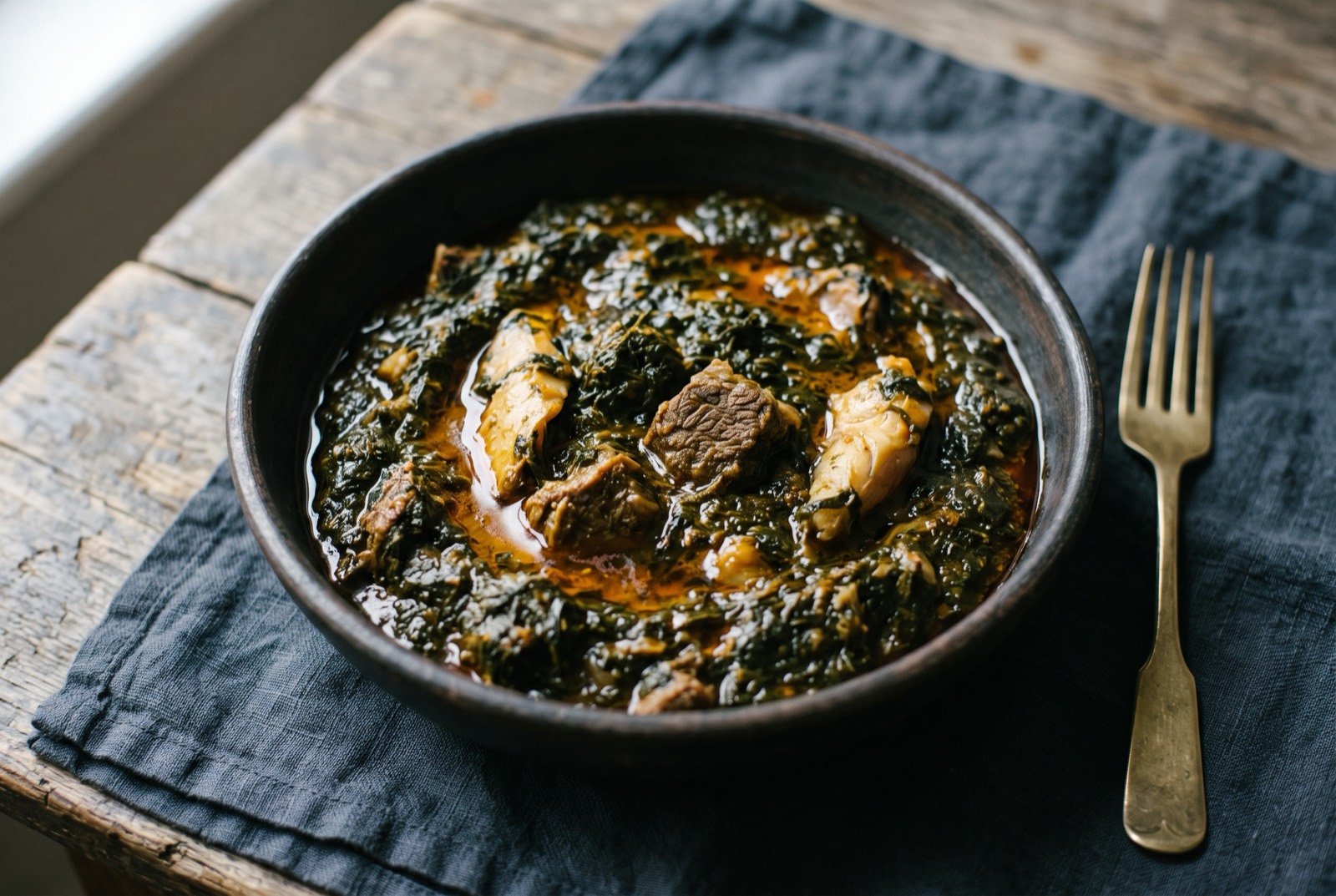
Gbassajama in Liberia, cassava leaf plasa in Sierra Leone, tâdè bourakhè in Guinea
Illustration
- Time
- 2 hours
- Researched
- Researched from 133 sources in the brief
As tradition built it
Serves 6. Up to 2 hours for the traditional version.
Ingredients
- 500 g stewing meat
- 500 g cassava leaves, ground or pounded
- 250 g smoked fish
- 100 g dried shrimp
- 1 onion, halved
- 2 scotch bonnet or habanero chillies
- 120 ml groundnut paste
- 60 ml palm or groundnut oil
Method
- Grind or pound the leaves to a paste. This is not optional garnish prep. It is the step that turns a tough, fibrous leaf into something a spoon can manage, and, per Rung 1, the step that begins releasing the leaf's cyanogenic compounds so they can be cooked and washed out.
- Brown the meat, seasoned with salt, bouillon and half the onion, then simmer in about three cups of water per 500 g meat until tender.
- Add the pounded leaf, smoked fish and remaining onion, and cook. A fast household version runs to ten minutes; the traditional, slow version runs to upward of two hours, simmered down until the mass collapses into a thick, dark green stew. Both are real. This chapter is not going to pick one and pretend the other does not exist.
- Finish with the palm or groundnut oil, dried shrimp, groundnut paste and chillies, a further ten minutes.
What a modern chef changes
The detox chemistry made explicit and timed, rather than left to a cook's memory of how long is enough
Rung 1
Method
- Pound for a minimum of ten minutes, then wash the pounded leaf twice in twice its weight of water before it goes anywhere near the pot. This is the documented protocol that brings cyanide content down to a fraction of its raw level, and it is worth doing as a discrete, timed step rather than trusting a long simmer alone to do all the work.
- Simmer long, not fast. The enzyme responsible for releasing the leaf's cyanogenic compounds works best around 40 to 60°C for three to five hours of total exposure across preparation and cooking; a ten-minute household shortcut trades some of that margin for convenience, which is a legitimate choice for a busy cook to make, but not one this chapter is going to pretend is equivalent.
- Add the groundnut paste and oil only at the very end, as an enrichment sitting on top of the reduced leaf mass rather than something cooked out from the start.