Central Africa · Volume 09, Where Desert Meets Forest
Ngunza
Central African Republic, national
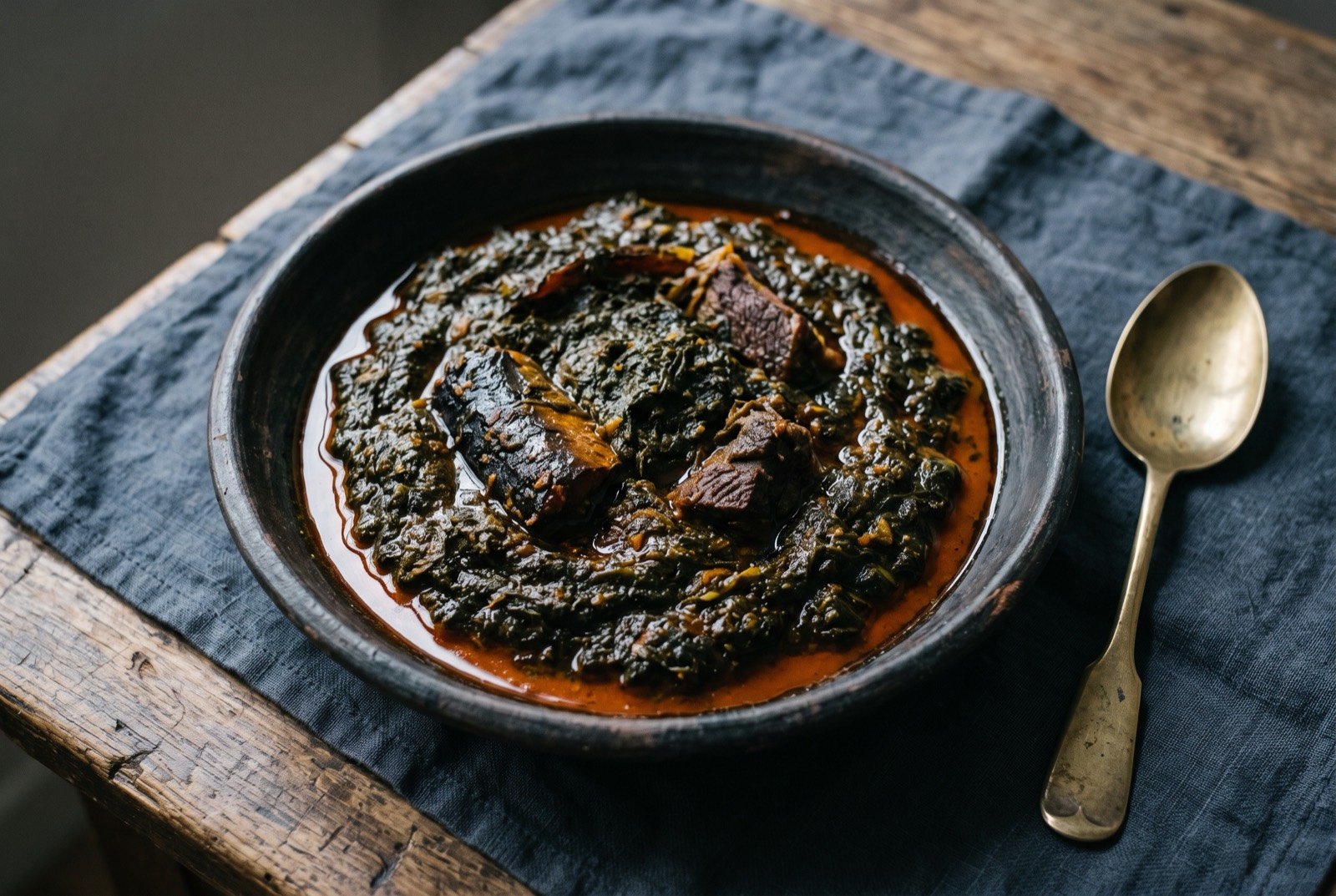
Illustration
- Time
- 3 hours
- Researched
- Researched from 142 sources in the brief
The most eaten dish in the volume, on the tables of almost the entire population at a figure of 95 per cent, once or twice a week in most households. Acewala says the leaves must be boiled by traditional methods to remove bitterness, and that ngunza takes several hours. Here is the tension the dish contains. J. H. Bradbury's group at the Australian National University tested a three-step "mild method" against four cultivars. Pounding brings residual cyanide to an average of 28 per cent; standing, 2 hours in the sun or 5 hours in the shade, brings it to 12 per cent; three consecutive rinses bring it to 1 per cent, with the leaves staying bright green and holding far more of their vitamins, protein and methionine. By contrast, boiling pounded leaves for 30 minutes costs 58 per cent of the protein and 71 per cent of the methionine. So the long boil is what makes ngunza taste like ngunza, and it is also what costs most of the nutrition. This chapter gives both and tells you what each buys.
As tradition built it
Serves 6. Several hours.
Ingredients
- 1 kg cassava leaves, fresh, or 200 g dried and rehydrated in hot water
- 200 g groundnut paste, 100 per cent peanuts
- 100 ml red palm oil
- 2 onions, chopped
- 400 g beef, or fresh or smoked fish
- to taste chilli, salt
Method
- Pound the cassava leaves in a mortar until they break into a coarse dark mass. This is the step that matters and it is heavy work.
- Cover with water and boil. The sources say several hours and give no agreed figure, so judge it on bitterness and on the leaf giving up its structure.
- Add the beef, or fresh or smoked fish, the onions, red palm oil and groundnut paste.
- Season with the chilli and salt, then cook on until the sauce is thick, dark and coherent and oil shows at the edges.
- Serve with gozo, mangbere, kpangaba, plantain or rice.
What a modern chef changes
Pound, stand and wash before the pot; palm oil in two stages; the emulsion built
Rungs 4 and 2
Method
- Do Bradbury's pound, stand and wash first, then cook shorter. Pound, spread and leave to stand (5 hours in shade is the tropical figure; give it a full working day at British room temperature), then rinse three times. You arrive at the pot with 1 per cent residual cyanide instead of 100, so the boil no longer has to do the detoxification and can be shortened to what the flavour needs. This changes the dish. It is also, on the published numbers, worth 58 per cent of the protein.
- Build the groundnut paste into an emulsion rather than stirring it in. Loosen with a ladle of hot liquor and shear with a stick blender before it goes into the pot. Nut paste dropped into a boiling pot separates, and the separated oil is what makes a bad ngunza look greasy rather than glossy.
- Palm oil in two stages. Half in for depth, half stirred through off the heat for colour and aroma. Volume Four gives the figures: 59 per cent beta-carotene loss at 200°C over two hours against 15 per cent at 150°C. A sauce that has boiled with all its palm oil for three hours is brown, and it did not need to be.