Central Africa · Volume 09, Where Desert Meets Forest
Gozo
Central African Republic, national
Illustration
- Time
- 25 minutes
- Researched
- Researched from 142 sources in the brief
- Reviewed
- Awaiting a reader from inside the tradition
- Cooked
- Awaiting a cook report
The southern half of the boule convergence: retted, dried, milled cassava kneaded into boiling water and rolled into balls, the standard partner for ngunza. Its sisters are chikwangue, mangbere and kpangaba. The interesting part is upstream of the pot. Cassava's toxicity is bound as the cyanogenic glucoside linamarin, and linamarase, the enzyme that liberates it, sits in a separate cell compartment. Retting ruptures cell walls so enzyme and substrate meet, and supports a lactic fermentation that drops pH and lets the liberated hydrogen cyanide volatilise away. Boiling alone does not work, because it denatures linamarase before it has done its job, which is why boiled-only cassava can retain bound cyanogens, and why the three-day wait exists. Farmers had that operationally correct centuries before anyone could name the enzyme. The numbers come from a study of five cassava accessions at SAMBA in Ombella M'Poko, in the Central African Republic itself. Retting was monitored over 70 hours at 22 to 26°C, with 26°C optimal. Fresh tuber HCN ran 100.66 to 144 mg/kg, falling to 13.3 to 23 after retting and 0.23 to 0.60 in the final product, comfortably inside the Codex limit of 2. Retting eliminates more than 90 per cent of endogenous cyanogens, where a 4 hour soak removes only about 20 per cent of free cyanide.
As tradition built it
Serves 4. 25 minutes from flour.
Ingredients
- 500 g fermented cassava flour
- 1 L water
- 1 tsp salt
Method
- Salt the water and bring to a bare simmer in a heavy pot.
- Rain in the fermented cassava flour steadily, stirring hard with a strong wooden spatula.
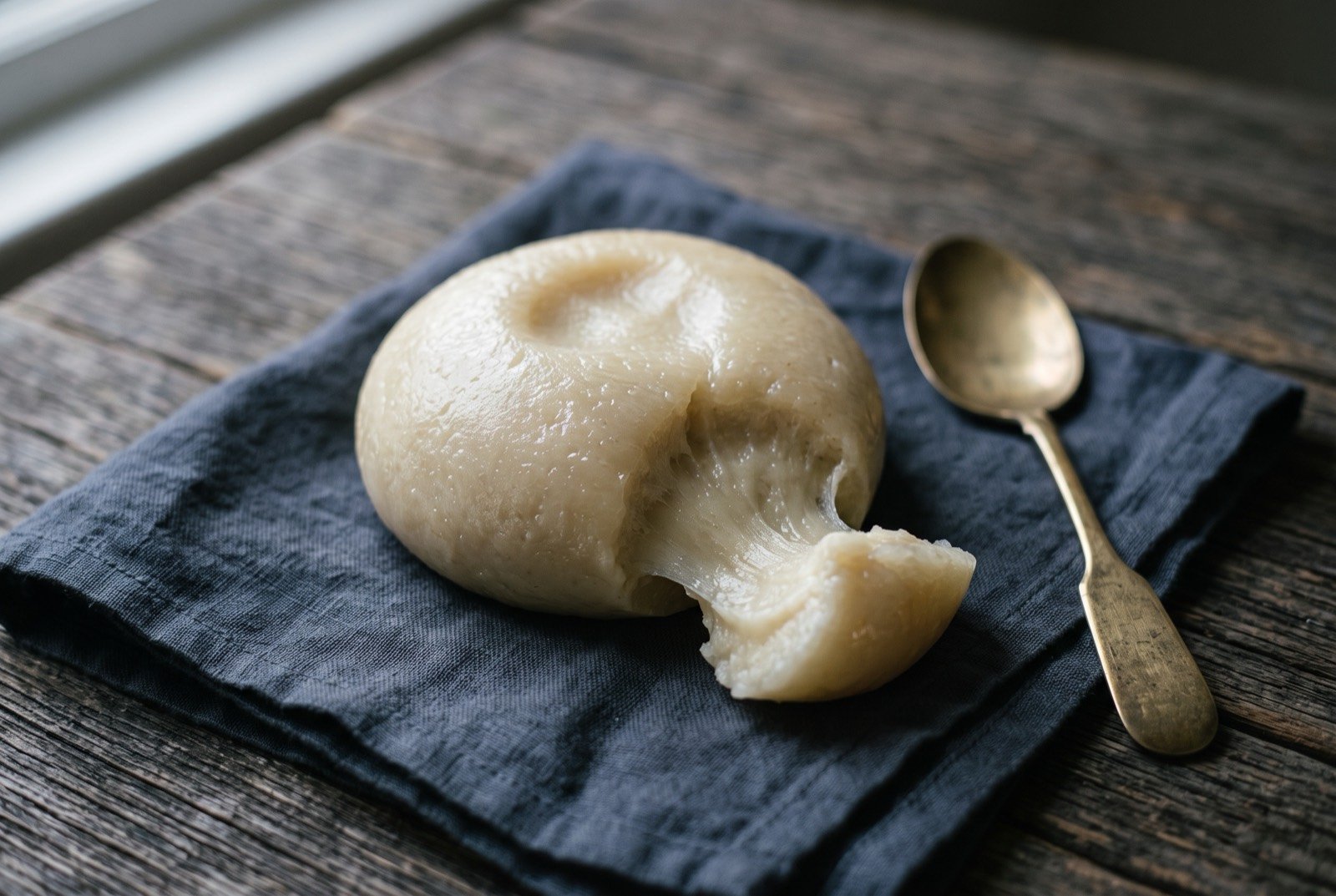
- Work it hard for 15 to 20 minutes. It passes through a lumpy stage, then a heavy dough stage, then goes smooth, glossy and translucent. Stopping short leaves it raw and grainy.
- Wet your hands and roll into balls.
Notes
In Britain you start from imported cassava flour, already retted and dried.
What a modern chef changes
Cold-slaked, acidity measured, portioned
Rungs 1 and 4
Method
- Slake it cold first. Mix the flour to a smooth slurry with 300 ml cold water before it meets heat, then rain that into the remaining 700 ml at a simmer. No lumps and half the stirring. Note what has just happened across the continent: this is the cold-slake insurance that placali, tô, funge and ugali all arrived at, and the Chadian boule solves the identical problem in the opposite direction by reserving hot water. Two solutions, one piece of physics.
- Taste the slurry and measure the sourness. Retted cassava flour varies enormously between batches because the retting time and temperature varied. Flat, and 30 ml of strained lacto-ferment brine restores acid on the axis it originally had. Aggressive, and you hold back and let the ngunza carry the plate.
- Buy flour, not roots, because a cold, slow rett is a rett that does not finish and the point of the process is detoxification. This is one of very few places in this book where I would tell you not to do the traditional step yourself.