Central Africa · Volume 09, Where Desert Meets Forest
Maboké
Central African Republic, shared with the Congo
Illustration
- Time
- 40 minutes
- Researched
- Researched from 142 sources in the brief
- Reviewed
- Awaiting a reader from inside the tradition
- Cooked
- Awaiting a cook report
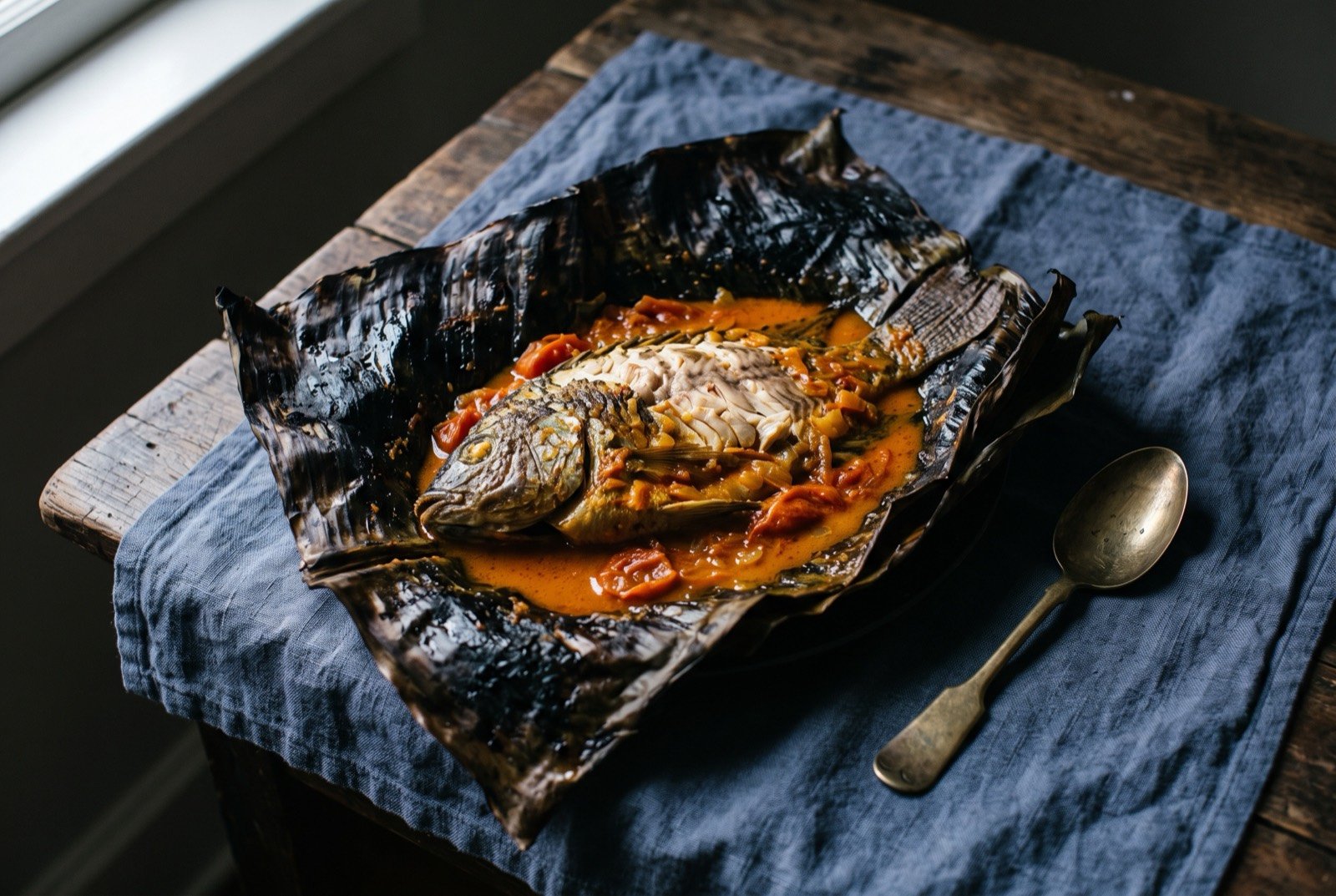
Fish, seasoned with roasted spices, wrapped in cassava or banana leaves and cooked: the same technology as kanda in its street sense, and the Central African relative of the liboke of Volume Eight. The leaf is not packaging. It is the vessel and it is also an ingredient. The fish steams in its own moisture at a temperature that cannot exceed 100°C, so the surface cannot dry before the centre is cooked; the leaf's own volatiles transfer into the fat on the fish; and the parcel can be laid straight in embers, so the exterior chars while the interior poaches. A two-temperature cook with one fire and no equipment.
As tradition built it
Serves 2. 40 minutes.
Ingredients
- 1 whole fish, about 800 g, scaled and gutted, or Nile perch (capitaine) steaks
- 2 tomatoes, chopped
- 1 onion, sliced
- 2 garlic cloves, crushed
- 1 chilli
- 2 tbsp red palm oil
- to taste dongo ti kèkè if you have it, salt
- enough to wrap banana or cassava leaves
Method
- Toast the dry spices until aromatic, then grind them.
- Season the whole fish inside and out with the ground spice, salt, garlic cloves and the dongo ti kèkè if you have it, or ordinary chilli.
- Lay it on the softened banana or cassava leaves with the tomatoes, onion and red palm oil. Wrap tightly, folding the ends, and tie.
- Cook in embers, or in a covered pan over a low fire, or at 180°C, about 30 minutes for a fish this size.
- Open the parcel at the table. The liquid inside is the sauce and there is more of it than you expect.
Notes
The sources describe the technique and give no weighed specification, so quantities here are a working scale.
What a modern chef changes
A measured internal temperature, the leaf treated properly, the liquor finished separately
Rungs 3 and 5
Method
- Soften the leaves over a flame before wrapping, and mean it. Pass banana leaf over a burner until it turns glossy and darkens slightly. This wilts the midrib so the parcel folds without splitting, and it releases the leaf's volatiles so they reach the fish instead of staying locked in a rigid cell wall.
- Cook to a temperature, not a clock. Take the fish to 52°C in the thickest part and pull it; the parcel carries enough residual heat to climb another three or four degrees resting. Every overcooked maboké is a parcel left in the embers because nobody could see inside it. A probe through the leaf solves a problem the technique has always had.
- Split the liquor at the pass. Pour the parcel juices into a small pan, settle, lift the palm oil off, reduce the water phase by half, whisk the oil back in off the heat. A glossy concentrated sauce instead of a thin orange puddle, and the carotenoids survive.
Notes
Part Four