Europe · Volume 02
Southern Italy, Sicily & Malta
Durum, Oil and the Arab-Norman Kitchen
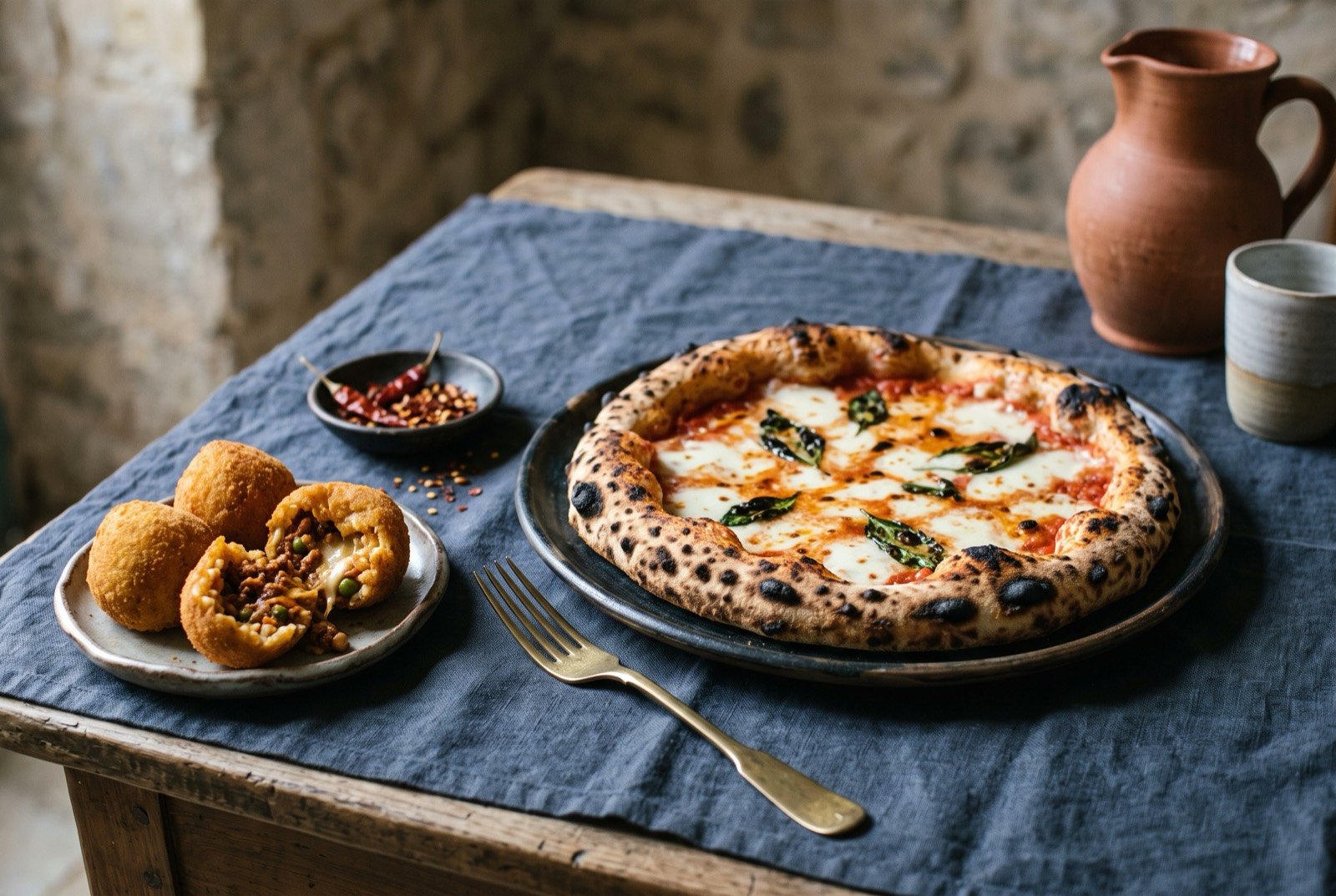
Campania and Naples, Calabria, Puglia, Basilicata, Sicily, Sardinia and Malta, taken seriously. Not five or six accents on one food world, but five or six food logics that share a sea, a wheat economy and, in places, an Arabic vocabulary layer, and arrived at their present shape by genuinely different routes. Every dish as tradition built it, then what a modern chef would change.
Sources and review · What this chapter does not assert · How we research · Spotted something wrong?
A Sense of Place
Southern Italy, Sicily and Malta are not one food world dressed in five accents. They are five or six food logics that share a sea, a wheat economy and, in places, an Arabic vocabulary layer, but arrived at their present shape by genuinely different routes: repeated conquest without erasure in Puglia and Sicily, deliberate isolation in Sardinia, grinding urban and rural poverty inside a single kingdom in Naples, Calabria and Basilicata, and outright food dependency on imported grain, run by a succession of outside rulers, on a small island in Malta. The fat, starch, aromatic and protein logic differs region by region, and the differences are load-bearing, not decorative.
Naples and Campania
A dense port city with an urban poor-food identity built on wheat pasta and foraged greens before it was built on tomato. Neapolitans were "mangiafoglie," leaf eaters, before they were "mangiamaccheroni," pasta eaters, the shift driven by the spread of durum wheat cultivation and the mechanical pasta press in the seventeenth and eighteenth centuries. The Naples poor, the lazzari, are documented in tourist accounts eating vermicelli by hand in the street near the port, because their housing had no kitchens; King Ferdinand I of Bourbon reportedly did the same and was nicknamed "Tata Maccherone" by the crowd. Fat: olive oil and, on the coast, buffalo dairy. Starch: durum wheat pasta and bread. Protein: fish, buffalo mozzarella, and, at court, a genuinely separate register of meat cookery under the monzù, see below. Aromatic: tomato once it arrived, garlic, basil.
Calabria
A rural mountain-and-coast tradition run on chilli and pork. Calabria has the highest per-capita chilli consumption of any Italian region; chilli was nicknamed "the poor man's lard" by the nineteenth-century Calabrian journalist Vincenzo Padula, standing in for meat fat and functioning even as a form of barter among labourers, whose daily food could be bread, onion and a drizzle of chilli-infused oil. Fat: pork fat, rendered and preserved. Starch: bread and pasta. Aromatic: peperoncino, structurally, not decoratively. Protein: pork, cured.
Basilicata
Historically the poorest and most isolated of the three mainland sub-regions, defined by the cave-dwelling Sassi of Matera, an overcrowded settlement with no running water or sewers, forced cohabitation with livestock, evacuated only under a 1952 sanitation law. Carlo Levi's 1945 memoir Cristo si è fermato a Eboli, describing his political exile there in 1935 and 1936, is the most cited literary witness to this poverty, but he was a Piedmontese doctor-writer exiled to Basilicata, not a Lucanian voice, and should be credited as an outsider's account rather than a local one. Basilicata's own regional bodies describe its food identity as cucina povera, of farming and shepherding, but rich in strong, savoury colours, built on durum wheat and bread, pig, sheep and goat farming, dried sweet pepper and beans. Fat: pork lard and sheep's cheese. Starch: bread, above all Pane di Matera. Aromatic: peperone crusco, the dried sweet pepper, which functions almost as a spice. Protein: cured pork, pecorino.
Puglia
A long, thin Adriatic-and-Ionian territory shaped by a documented stratification of rule, Messapian, Greek, Roman, Byzantine, Norman, Swabian, Angevin and Spanish, that layered without erasing what came before. The received framing in Italian food writing, essentially poor and simple cooking reflecting a population of shepherds and fishermen, is a repeated trope more than a checked historical claim, though it is directionally true of the actual repertoire: fave e cicorie, taralli, panzerotti. Fat: olive oil, produced here at a scale unmatched anywhere else in Italy, Puglia holds 31.5 per cent of Italy's olive-growing land, the most stable figure available; production-share claims range from 40 to over 60 per cent of the national total depending on year and methodology, and should be cited as a range, not a single number. Starch: durum wheat, above all as orecchiette, made by hand for centuries, mostly by women, with semola and water only, no egg. Aromatic: wild fennel, capers. Protein: legumes, dairy from sheep and cattle raised on the same masseria land that grows the grain, and, on the coast, mussels and small fish.
Sardinia
A genuinely different logic again, built not by successive coastal rulers but by an interior that stayed deliberately separate from a coast that was, for centuries, periodically uninhabitable. Fat: sheep's milk cheese and, on feast days, roast pork fat. Starch: durum wheat as pane carasau, shepherd's travel bread, twice-baked, historically keeping up to a year, and as malloreddus and fregola. Aromatic: saffron, Spanish-introduced, and myrtle. Protein: sheep, above all, plus, along the Cabras lagoon specifically, mullet roe. Sardinia's internal split matters more than any external comparison: the pastoral interior, Barbagia, sheep, pecorino, porceddu, pane carasau, and the lagoon-coastal tradition, Cabras, bottarga di muggine, are more sharply distinguished from each other than either is from Puglia. See the pairing question below.
Sicily
The Arab-Norman layer here is the real thing, not a tourist flourish, and it is unusually well attested by name, which sets Sicily apart from Puglia's much vaguer "Byzantine influence is somewhere in here" claims. Fat: olive oil, and, in pastry, lard and almond paste. Starch: durum wheat pasta and, distinctly in the Trapani area, couscous. Aromatic: the Arab-period quartet of wild fennel, saffron, raisins and pine nuts, still structural in pasta con le sarde; citrus, sugar and almonds in pastry. Protein: bluefin tuna, historically, via the mattanza, now a dead tradition, last practised at Favignana in 2007, and swordfish, plus, inland, sheep and goat.
Malta
An island whose food logic is defined less by what grows there than by what has always had to be imported. Malta has historically been a food-importing society, not a self-sufficient farming one: during the Order of St John period roughly two-thirds of wheat consumption was imported, from Sicily and France, and even in the Roman period Malta was itself an olive-oil exporter to Rome. The academic source behind this point, Elise Billiard, frames it directly: the specificity of Maltese food culture lies in its people and their practices of combining imported ingredients, which makes Malta "a precursor of today's global world" rather than an exception to Mediterranean self-sufficiency. Fat: olive oil, and, from the British period, lard and dripping. Starch: leavened bread, ftira above all, and, more recently, from roughly the turn of the twentieth century, pasta. Aromatic: garlic, parsley, and a genuinely Semitic vocabulary layer running under the whole cuisine, see below. Protein: rabbit, above all culturally; fish; pork, whose prominence Billiard reads partly as a religious-identity marker, a Christian island distinguishing itself from Muslim North Africa across the water.
The History in Layers
Magna Graecia roots, mainland south and Puglia
This is the part of Italy where Greek colonisation is most directly relevant to the food, more so than it would be for Sicily's much later, much better documented strata. Archaeological sources confirm wheat, olive and vine cultivation were already central to the Magna Graecia economy of Campania, Calabria and Basilicata, and Greeks are locally credited with popularising olive oil. The strongest, best-attested claim in this whole cluster is lucanica, the ancestor sausage of the entire Italian salume family: the Roman writer Varro is cited as stating that Roman soldiers learned to stuff spiced minced pork into intestine casings from the Lucani, the people of ancient Lucania, Basilicata plus parts of Campania and Calabria, giving the sausage its name. The classical citations here were not independently checked against primary texts and should be verified before being stated as settled fact. In Taranto, Puglian mussel farming in the Mar Piccolo is separately attested from the Greco-Roman period of natural gathering, with the first documents referring to "cozze negre" as a resource dating to 1525.
Bourbon Naples and the monzù
Naples' court cuisine is described as a genuine fusion cultivated under the Bourbons: in 1768, when Ferdinando IV married Maria Carolina of Austria, her sister Marie Antoinette is said to have sent two chefs from Versailles to the Bourbon court, starting the monzù phenomenon, aristocratic kitchens in Naples and Sicily run by French-trained chefs whose title corrupts "monsieur." The result was a genuine two-track cuisine: 'O Scarpariello, street food, alongside the monzù at court, sharing ingredients across very different registers. The 1768 date and the Marie-Antoinette detail are widely repeated but were not independently cross-checked against an academic source.
The tomato's contested arrival
Genuinely unresolved, and this chapter does not paper over it. Two incompatible popular dates circulate for the tomato reaching the Kingdom of Naples' orbit. The first: 31 October 1548, when Cosimo de' Medici received a basket of Florence-grown tomatoes from seed reportedly sent to his wife Eleonora of Toledo by her father, the Spanish viceroy of Naples, tying the Kingdom of Naples to the tomato's very first Italian appearance, via Spain, decades before Naples ate it as food. The second, very widely repeated but separately sourced: tomatoes landed in Campania around 1770 as a gift from Peru to Ferdinand IV, planted between Naples and Salerno in what is now San Marzano, the popular origin story for the name specifically. These are not the same event, and this chapter's sourcing does not reconcile them. The most defensible summary: tomatoes reached the Kingdom of Naples' orbit via Spain in the 1500s as an ornamental curiosity, and only became a real food crop, and eventually a named local variety, generations later. Pizza itself long predates the tomato topping: the documented ancestor is a seventeenth-century plain flatbread dressed with garlic, lard, salt and sometimes caciocavallo and basil, with the tomato topping documented from Vincenzo Corrado's treatise on Neapolitan eating habits, written 1715 to 1725.
The Grande Emigrazione, roughly 1880s to 1920s
After 1890 the majority of Italian emigration came from the Mezzogiorno; roughly four-fifths of Italian immigrants to the United States came from the south, particularly Calabria, Campania, Abruzzo, Molise and Sicily. Italian-American cuisine emerged because emigrants, disproportionately Campanian and Sicilian, already had wheat pasta, tomato preserves, pizza and olive oil as staples, but adapted because exact ingredients were not easily or affordably available in the US, fusing with American tastes and other immigrant influences. The single most cited "invented in America, not Italy" example is spaghetti with large meatballs, traced to a Sicilian habit of serving small meatballs with pasta but documented as an Italian-American invention in its familiar large-meatball form. No source consulted for this chapter gives a documented, region-specific account of exactly what Campanian, Calabrian or Lucanian dishes travelled largely intact versus what was invented in the diaspora, beyond the general staples point and the Sicilian-linked meatball case.
Puglia's Greek, Byzantine, Norman and Spanish layers
Taranto was founded by Greek colonists in 706 BC and became a major Magna Graecia centre; after Rome's fall the region was contested by Byzantines, Lombards and Arab raiders, with Byzantine rule persisting under heavy taxation before Normans and allied Lombards took the Catepanato d'Italia. This layering is broadly correct and matches standard accounts of Apulian history, but the sourcing behind it is generalist regional-history and tourism copy, not scholarly. This chapter does not claim that Byzantine, Norman or Spanish rule left specific, identifiable traces in named Apulian dishes, as opposed to language, architecture and general historical presence, because the sourcing found was generalist and did not connect any single Puglia dish to a specific ruling period the way the Aragonese-Sardinia connection below is documented. Puglia's culinary distinctiveness rests more securely on its agrarian and pastoral structure, wheat, olive, legume, dairy, than on a traceable political-layering argument.
Sardinia's Nuragic, Phoenician, Roman and Aragonese layers, and its genuine linguistic distinctness
Nuragic civilisation, roughly the sixteenth to third century BC, built over 7,000 nuraghi, attesting a complex agro-pastoral society: sheep and goat herding, cereal cultivation, legumes, vine and almond growing, and Mediterranean trade. Phoenicians reached Sardinian shores from around the ninth century BC; Carthaginian naval power later blockaded the ports of the free Nuragic zones, cutting them off from their most fertile land and driving Nuragic decline by around the second century BC, when Roman conquest followed. Aragonese-Catalan conquest began in 1323, reached Alghero in 1353, and completed control of the island by 1420; Spanish rule lasted roughly four centuries until the eighteenth century. This Spanish layer is genuinely distinct and well corroborated, not a generic "Spain ruled here" claim: panadas, savoury filled pastries whose name and form probably derive from the Iberian empanada; aragosta alla catalana, Catalan-style lobster salad specific to Alghero, still nicknamed "la Barceloneta d'Italia"; widespread saffron use; and a plausible Spanish-verb etymology, cebar, to fatten, for seadas, alongside a competing Latin sebum, fat, root. Sardinian is not a dialect of Italian but a distinct Romance language; Latin's penetration of the island was slow and difficult, especially in the interior, because of Sardinia's geographic isolation, so Sardinian-language influence on food naming has been unusually strong and durable.
Sicily's Arab-Norman layer: the real historiography, not the tourist sentence
The flattened tourist version of Sicilian food history is one sentence: the Arabs conquered Sicily and gave it citrus, sugar and rice. The real historiography is more specific and better sourced than that, anchored by a genuine academic source, Anna Martellotti, a philologist formerly of the University of Bari specialising in medieval gastronomy and Arab contact. Her book, a direct philological comparison of two surviving fourteenth-century "Norman" recipe collections held in the British Library against the Kitab al-Tabikh of Ibn Sayyar al-Warraq, Baghdad, circa 950, and later Islamic culinary manuals, concludes that the dishes derive directly from Arab-Persian gastronomy, adapted to the taste of "Francicised" Nordic conquerors, compiled at the court of William II of Sicily around 1177, the year of his marriage to Joanna, daughter of Henry II of England, a marriage connection that carried these Norman-Arab dishes to England quickly. The more popular narrative credits the Arab period, ninth to eleventh century, with introducing apricots, sugar cane, citrus, sweet melons, rice, saffron, raisins, nutmeg, cloves, pepper, pine nuts and cinnamon, and asserts that by the year 1000 Sicilian cuisine was centuries ahead of the rest of Europe, already making pasta; this is tertiary and popular rather than primary, and this chapter presents it with the Martellotti-level specificity available rather than the flattened version wherever possible.
Malta's Phoenician, Arab, Siculo-Arabic, Order of St John and British layers
Consistent across every source, Maltese and Italian alike: Phoenician, Roman, Byzantine, Arab, roughly 870 AD to the Norman conquest around 1091 to 1127, Sicilian and Norman-Angevin-Aragonese, the Order of St John, 1530 to 1798, French, brief, 1798 to 1800, and British colonial, 1800 to 1964. The Semitic linguistic layer deserves real weight as evidence of the depth of Arab influence, precisely because the political-religious history of the Arab period proper is comparatively thin in the archival record while its vocabulary trace survives with unusual clarity. Maltese is officially, and uniquely in Europe, a Semitic language with EU official-language status, derived from medieval colloquial Arabic with subsequent heavy Romance overlay. Maltese Wikipedia's own article on the Semitic element gives concrete food-vocabulary evidence: tina, fig, tuffieħa, apple, basal, onion, and ħobż, bread, itself about as structurally central a food word as a language has. A Maltese-language blog survey of Sicilian-Maltese word pairs gives food-specific examples including passuluna/passolina, dried black olives, and zibbibu/żbib, the raisin grape. One Italian academic-adjacent source compares qagħaq tal-għasel, Maltese honey rings, to the Arabic sweet k'ab al-ghazal, and bigilla, Maltese bean dip, to Egyptian and Levantine foul, while explicitly cautioning that these culinary echoes are real but subtle, and that the linguistic evidence of Arab heritage in Malta is considerably more prominent and better preserved than the culinary evidence specifically. This caveat, that the language carries the Arab period far more visibly than the food does, matters and this chapter preserves it rather than smoothing it into a stronger culinary-continuity claim than the sources support.
The British colonial layer in Malta is real, lived-in and, per Billiard's academic paper, actively written out of "traditional Maltese food" discourse for reasons of class and postcolonial identity rather than history. Corned beef, "bully beef," arrived and was sold in Malta from around the turn of the twentieth century, the same period macaroni was becoming integrated into Maltese domestic cooking, yet corned beef is explicitly not treated as "traditional" despite comparable age and ubiquity, because British-associated food in Malta tends to be culturally coded as industrial. Dishes with genuinely decades-deep, family-specific Maltese versions, such as trifle and shepherd's pie, are routinely excluded from "national cuisine" framings even though Billiard's own fieldwork found them well integrated into the domestic repertoire.
What is contested or mythologised, named plainly
Pizza margherita's 1889 origin story, Raffaele Esposito, Queen Margherita, the tricolour symbolism, Pizzeria Brandi, is now widely treated by food historians as largely fakelore: a 2014 academic study by Zachary Nowak, cited here only via secondary English-language coverage and not read directly, argues the supporting letter is fraudulent and that pizza with the same tomato, mozzarella and basil topping is documented in Naples as early as 1796 to 1810, decades before Esposito. This claim rests on Western secondary sourcing in the research behind this chapter and should not be repeated as settled history without that flag. Burrata's 1956 origin story, brothers Vincenzo and Lorenzo Bianchino at Piana Padura inventing the product during a snowstorm to avoid wasting cream, is widely told and mechanically plausible, but is not independently documented by any archival source found; it survives as oral and family tradition. Ragù alla genovese's Aragonese-Genoese tavern origin is explicitly presented as a hypothesis in the sources themselves, not a settled fact.
The Puglia and Sardinia pairing question, named plainly
This needs naming rather than absorbing into a blended regional narrative, because the evidence resists that treatment. Puglia's food logic is coastal-agrarian, built by repeated waves of external rule layered onto a grain, olive and legume economy with two different seas at its edges, Adriatic and Ionian. Sardinia's food logic is built by isolation itself, and this is genuinely, specifically documented isolation, not a romantic trope: malaria, described in Italian sources as Sardinia's historic enemy, was endemic on the coasts and plains for centuries and eradicated only in 1946 to 1950 by the Rockefeller Foundation's post-war campaign; coastal areas were also subject to Barbary raids; as a result, communities clustered inland in less hospitable but safer terrain, and a productive system grew up in which lowland malarial communities depended on renting their land to mountain shepherds, the mountains functioning as a refuge and the primary anthropological home of Sardinians rather than mere scenery. Sardinia also underwent four centuries of Spanish rule that left a distinct, well-documented culinary fingerprint, panadas, aragosta alla catalana, saffron, seadas, with no equivalent political-culinary layer shared with Puglia. Sardinian is, further, a genuinely distinct Romance language, not an Italian dialect, unlike anything on the mainland side of this volume.
If anything, the strongest evidenced throughline is internal to Sardinia itself, not connective to Puglia: Sardinia's own pastoral interior, Barbagia, sheep, pecorino, porceddu, pane carasau, myrtle, and its lagoon-coastal tradition, Cabras, bottarga di muggine, mullet fishing managed as an extensive natural fishery since the fourteenth century, function almost as two food worlds within Sardinia alone. This split is better documented and more pronounced than any line connecting Sardinia to Puglia.
This chapter keeps the current pairing for coverage reasons, and treats Puglia and Sardinia as two clearly bounded, separately introduced sub-chapters throughout, resisting any connective-tissue language, shared fat, shared aromatic logic, shared history, that the evidence does not actually support, exactly as this volume's companion handled its own hinge zone. Beyond that, this is worth flagging as a possible volume-map adjustment for a future pass: whether Sardinia would sit better as its own future volume, or regrouped with other Spanish-ruled, historically isolated Mediterranean islands, rather than being permanently filed alongside Puglia for coverage convenience. This chapter surfaces that question rather than resolving it.
The Flavour Arsenal
Mainland deep south
San Marzano tomato, Pomodoro di San Marzano dell'Agro Sarnese-Nocerino DOP, protects specifically the peeled and peeled-fillet product types, not the fresh fruit generically: uniform red colour, elongated shape 60 to 80mm long, drained weight at least 65 per cent of net weight, pH 4.2 to 4.5. Mozzarella di bufala campana DOP, made exclusively from fresh whole buffalo milk of the Italian Mediterranean breed raised within the designated zone, DOP obtained 1993. The buffalo's own origin is contested in the sources themselves, one account credits Norman kings around 1000 with spreading buffalo from Sicily where Arabs had introduced them, a competing account argues for an indigenous Italian population; this chapter presents both, unresolved.
Peperoni cruschi di Senise IGP: three permitted morphological types, hand-harvested at full ripeness only, dried on nets then strung into garlands called serte, a dialect term specific to Senise, sun-dried until minimal moisture remains, mechanical drying prohibited. Pane di Matera IGP: re-certified 2018; the "millennium of tradition" claim is traditional lore, not a verified date. Soppressata di Calabria DOP: noble cuts for the lean, lard at 4 to 15 per cent of mixed weight, aged naturally 45 days. Pecorino di Filiano DOP: 30 comuni in Potenza province, whole raw sheep's milk, hard, semi-cooked wheels 2.5 to 5kg.
Puglia
Olive oil: 31.5 per cent of Italy's olive-growing land, roughly 1,000 active mills, about 20 per cent of Italy's total. Burrata di Andria IGP: registered EU IGP 2016, the disciplinare specifies the whole of Puglia, not just Andria, as the milk, processing and packaging area. Wild fennel and capers are repeatedly cited as central Apulian aromatics. Caciocavallo podolico, a Slow Food Presidio, made from Podolica cattle still grazing semi-wild on the Gargano promontory. Cozza nera di Taranto, a Slow Food Presidio, grown on lentisco branches suspended pergola-style over freshwater springs on the seabed of the Mar Piccolo.
Sardinia
Pecorino Sardo DOP: whole sheep's milk, two types, dolce, sweet, aged 20 to 60 days, and maturo, mature, aged minimum two months. Sheep raised semi-wild, feeding predominantly on spontaneous grasses and shrubs; the entire process must occur within Sardinia, per the MASAF disciplinare, the strongest single citation in this section. Casizolu, a pear-shaped pasta filata cow's-milk cheese from Montiferru, traditionally hand-kneaded into shape by women, a Slow Food Presidio since 2000, worth including specifically because it complicates a too-simple "Sardinia equals sheep" picture. Mirto: myrtle liqueur, dark berries standard, a rarer white variant, taken very cold, four to six degrees Celsius.
Sicily and Malta
Capers, Pantelleria IGP and Salina Presidio: Pantelleria flowering May to September, buds picked before dawn, two salting stages of roughly ten days each. Salina capers, the prized Nocellara variety, hand-harvested May to August traditionally by local women, dried in shade, layered with coarse salt, keep two to three years. Gbejniet: Malta's cheeselets, fresh, dried and peppered, sheep's or goat's. Ġbejna tan-nagħaġ received EU PDO status on 27 January 2025, the first Maltese food product ever to receive an EU Geographical Indication, requiring every production stage within the Maltese islands and restoring traditional lamb rennet. Kunserva: Malta's tomato paste, used as a flexible seasoning addition even to dishes like fenkata, functioning similarly to how peperoncino functions in Calabria, a structural pantry staple rather than a garnish.
Part Two
The Technique Ladder
The argument, from inside
This volume has real starred kitchens across nearly every one of its sub-regions, and the same distinction this series draws elsewhere matters here too: some of them are formalising indigenous technique, and it is worth naming the clearest example directly. Nino Rossi, at Qafiz in Santa Cristina d'Aspromonte in Calabria, self-taught, converted his family's countryside home into the restaurant, and his stated method is alimurgia, the systematic study and use of wild and foraged plants of the Aspromonte, alongside three hectares of his own olive and orange groves, using his own DOP oil as the house condiment. His own framing: the Aspromonte has become an assist and not an obstacle, it suggests to him through nature how to evolve the territory and his cuisine. That is close to this whole series' animating idea, arrived at independently in Calabria: the technique is already indigenous, the job is to do it deliberately.
Ciro Salvo, at 50 Kalò in Naples, is the clearest case for pasta and dough specifically. A third-generation pizzaiolo, he has spent two decades formalising fermentation, flour choice and hydration into something closer to a laboratory discipline while keeping the AVPN disciplinare's core intact, pushing hydration toward 70 to 75 per cent, high for this style, and calibrating it to the day's humidity and flour absorption rather than a fixed ratio. He opened a branch near Trafalgar Square in London in 2018, the first time this specific formalised approach travelled intact to Britain.
The honest gap sits in Malta. None of the sources behind this chapter describe a Malta-based chef explicitly formalising a named indigenous technique, bread fermentation, ġbejna curing, kunserva reduction, the way Salvo has formalised Neapolitan hydration or Rossi has formalised Aspromonte foraging. The 2026 Michelin guide lists 48 restaurants across the islands and 7 stars, and its own language repeatedly credits Malta with "local inspiration with modern technique," but this chapter could not find that phrase cashed out into a specific documented method for any of the seven starred kitchens. This may exist and simply not have surfaced in the research; it is treated as unconfirmed, not absent.
Rung 1. Treat long fermentation as the technique itself, not the wait before the technique
The AVPN disciplinare for Neapolitan pizza dough specifies flour, water, salt and yeast only, no added fat or sugar, with fermentation of 8 to 24 hours entirely at room temperature. During that time yeast converts sugars to ethanol and carbon dioxide, the CO2 trapped in the gluten matrix forming the bubbles that become the crumb's open structure, and enzymes break starches down gradually, developing flavour precursors and a more extensible gluten network that a fast rise cannot replicate. Pane di Altamura DOP works the same principle harder: a natural sourdough starter refreshed at least three times, built to roughly 20 per cent of the semolina weight, builds a stable population of wild yeasts and lactic acid bacteria specific to the terroir, which the DOP regulation credits for the bread's distinctive sourness and keeping quality.
What a cook does with this rung. Treat hydration and fermentation time as variables to calibrate against your own flour, kitchen temperature and humidity, the way Ciro Salvo does, rather than a fixed number copied from a recipe. A cool larder, a temperature-controlled proving box, or a domed oven like a Big Green Egg brought up to 400°C plus with a stone can run a genuine staged ferment, a poolish held 12 to 16 hours in the fridge, then hydration pushed in small increments, autolysing longer at higher hydration to build strength before salt goes in.
Rung 2. Salt and dry rather than reach for vinegar or fire
Pantelleria's capers are picked by hand before dawn, then layered in sea salt for ten days with daily turning, drained, and salted a second time for a further ten days. This is a genuine fermentation, not just a brine steep: the raw bud is naturally bitter, and the slow salt cure drives a malolactic-type process converting harsh malic acid into softer lactic acid, which produces the caper's actual savoury, floral flavour rather than merely preserving it. This is why capers packed in vinegar, the common British supermarket format, taste flatter and sharper than the salt-cured original: vinegar preserves without fermenting. Bottarga di Cabras works a related but distinct principle: mullet roe sacs are washed, salted for two to four hours depending on size, pressed, and air- and sun-dried for around three months, the salting drawing water out by osmosis and concentrating flavour while the slow drying lets flavour compounds develop rather than simply dehydrating the roe, which is why fast-dried, industrially produced bottarga from elsewhere tastes blunter and saltier without the same depth.
What a cook does with this rung. Where a recipe calls for a "preserved" ingredient of this family, ask specifically whether the traditional version is salt-fermented or vinegar-packed before substituting; they are not interchangeable, and a dish built assuming the fermented depth of a proper salted caper will taste thin and one-note with the vinegar version standing in for it.
Rung 3. Seal before you fry, and hold the fry temperature precisely
Sicilian arancini are sealed in a flour-and-water pastella before crumbing, specifically to stop the rice grains splitting open in the fryer; the best versions are crumbed twice for a thicker, more durable crust, then rested in the fridge before frying, because that rest is what determines whether the crust holds together in the oil or shears off. The pastella forms a starch gel skin around the rice ball, and refrigeration lets that gel set fully before the crust goes on, so the whole assembly acts as one sealed unit in the fryer. Frying temperature is held at 170 to 180°C, in enough oil to nearly submerge the arancino, three to four minutes to gold, and only a few at a time so the oil temperature does not collapse, which is exactly the failure mode behind most bought arancini splitting, weeping oil or turning soft rather than shattering: the pastella seal and the fridge rest are skipped entirely, going straight from shaping to fryer.
What a cook does with this rung. A dedicated deep-fry thermometer or an induction hob with real temperature lock solves the overcrowding failure directly. A dehydrator run at low heat overnight, or a careful pre-chill, can dry the outer pastella layer further before frying, tightening the shell and reducing oil uptake without changing the traditional composition at all.
Rung 4. Respect a hand skill as a skill, and do not look for a gadget to replace it
Culurgiones are sealed with the spighitta, the wheat-ear pinch: the disc is held in the weak hand, and the strong hand's thumb and forefinger pinch and fold the edge repeatedly from the base upward, producing a plaited seam that resembles an ear of wheat, considered the mark of real skill and traditionally carrying a wish for a good harvest. The plaited pinch creates overlapping layers of dough at the seam rather than a single pressed join, which is mechanically stronger under boiling and is the specific reason the dish does not burst open in the pot; a poorly executed spighitta, or a simple fold, is more prone to failure exactly at that seam. Orecchiette runs the same principle: the dough is kept deliberately dry, almost granular, because too much water makes it easier to work but harder to shape into a clean concave orecchietta, and the concave shape comes specifically from dragging a small piece of dough with a table knife and turning it back over the thumb, so the hollow holds sauce.
The honest note for this rung. There is no meaningful modern-equipment substitute for either of these. The elevation available to a home cook is in ingredient quality, properly aged pecorino sardo, fresh rather than dried mint, good durum semola, not in method, and repeated practice is the only real path to the technique itself.
Rung 5. Live ember and constant rotation as the primary cooking technology
Porceddu, Sardinia's most representative festive dish, is traditionally spit-roasted, a whole suckling pig skewered on a long wooden spit over aromatic embers, classically myrtle or holm oak, with constant rotation, and, in Barbagia specifically, a near-vertical spit close to live embers. Sources converge on roughly three to four hours of slow, constant-temperature cooking. The alternative method, wood-fired oven roasting, is often covered with myrtle branches, sometimes under a dome of leaves or earth.
What a cook does with this rung. A Big Green Egg run at a genuinely low, indirect temperature, with real myrtle or a close substitute added to the coals for aroma, and the joint rotated by hand at regular intervals rather than left static, replicates the constant-rotation, aromatic-ember principle far more closely than a static roasting oven ever can.
Rung 6. Balance sweet and sour as a genuine flavour-contrast mechanism, not a garnish
Caponata's agrodolce, a sweet-sour reduction of wine vinegar and sugar, is credited to Arab influence during the ninth to eleventh century domination of Sicily. Frying the aubergine first drives off moisture and lets it take on the dressing rather than diluting it, and the vinegar-sugar balance sharpens the aubergine's natural mildness the way the dish's earlier fish-based version, using capone, would have cut through an oily fish before the cheaper aubergine substitution became the standard. The same logic runs through fenkata's own split personality, below, where frying and stewing sit as two genuinely different, equally traditional ways of cooking the same rabbit, not a right answer and a shortcut.
What a cook does with this rung. Treat agrodolce as a calibrated contrast, not a fixed ratio: taste as the reduction concentrates, and stop when the sourness cuts the dish's richness cleanly rather than when a recipe's stated quantity has simply run out.
Part Three
The Ferment and Preserve Bench
1. Colatura di Alici di Cetara
DOP status only from 2020, a recent formalisation of an ancient technique: anchovies salted in wooden barrels, mbuosti, each August, later filtered through wool caps, described as a descendant of Roman garum refined by medieval Amalfi coast monastic communities. The single most concentrated, savoury liquid seasoning in this whole volume's arsenal, and worth treating with the same restraint as a fish sauce, a few drops rather than a pour.
2. Pomodorino del Piennolo del Vesuvio DOP
The piennolo technique: hanging clusters of small, thick-skinned, long-keeping tomatoes tied with natural string under the vaults of rural buildings, documented from the nineteenth century, keeping whole unprocessed tomatoes through winter for 7 to 8 months without modern preservation, in cool, ventilated rooms. A genuine indigenous preservation technology, not a rustic curiosity.
3. Bottarga di Muggine di Cabras
Fish are caught by hand at the gills, ammanuncadura, specifically to keep the two roe sacs intact, since a damaged sac cannot be cured. The whole sacs are washed, salted 2 to 4 hours depending on size, pressed, and air- and sun-dried for around three months. A Slow Food Presidio product, and the strongest single institutional citation in the Sardinian material behind this chapter.
4. Gbejniet
Sheep's milk heated until it curdles, cut, and set into small perforated moulds called qwieleb, giving the cheese its characteristic woven-basket surface pattern; the recipe of milk, salt and rennet is described as essentially unchanged for centuries. Produced fresh, dried or peppered as distinct preservation states of the same base product, and, as of January 2025, the first Maltese food product ever to carry an EU Geographical Indication.
Sourcing in Britain
Verified August 2026. Where a supplier could not be fully confirmed, that is said rather than smoothed over.
The ranked list: what decides great from grim
- Salted Pantelleria capers, not vinegar-packed. The distinction is structural, not a preference: salted capers are genuinely fermented, vinegar-packed ones are not, and most UK supermarket capers are the vinegar version. Stocked salted by Cibi Market, Prezzemolo e Vitale and Sicilian NQ.
- 'Nduja di Spilinga in traditional budello casing, not the jarred spread, for the more authentic texture. Stocked by Sous Chef, Affetto Italiano and Pacco Italiano.
- Genuine Sardinian bottarga di muggine. Stocked by Shop The River Cafe, The Fish Society and Vallebona UK, the last marketing its cure specifically as the traditional salt, press, air-dry method.
- DOP Puglian olive oil, checked for the mark specifically. Plenty of blended southern Italian oil is sold under looser regional branding without it. The Olive Tree Company stocks a De Carlo Terra di Bari DOP; The Olive Oil Co carries a Coratina monovarietal for the single, robust, high-polyphenol variety.
- Pecorino Sardo PDO, from The Cheese Lady UK, and Fiore Sardo specifically from Capo Caccia.
- Whole dried Calabrian chillies, for grinding fresh. Vorrei sources from a family Sila mountains firm established 1998; Bread Tree carries braided dried peperoncino, closer to the traditional home-drying presentation than a jarred product.
- San Marzano DOP tomato, genuine tins carrying both the EU DOP stamp and the Consorzio Agro Sarnese-Nocerino's own logo. Sold through the Gustarosso cooperative's UK importers.
Maltese ingredients, honestly
This is the weakest part of UK sourcing for this volume, and it is stated plainly rather than papered over. Kunserva, ġbejniet and zalzett tal-Malti, Maltese sausage, do not have an established, easily findable dedicated UK importer the way Sardinian, Calabrian or Puglian products do. Escape to Malta Eats sells kunserva but ships from Malta itself, which makes delivery time and cost a real barrier for regular cooking. Parparellu, in Hammersmith, is the one credible in-person UK source for genuine Maltese food, including imported frozen pastizzi, but is a single shop, not a mail-order operation. The honest guidance: readers wanting to cook Maltese dishes properly will likely need to substitute, a good Italian passata reduced further and salted more aggressively for kunserva, a young, well-salted pecorino fresco or a firm feta as an imperfect gbejna substitute, rather than sourcing the genuine article.
Voices and Sources
From inside the tradition
- Marianna Vitale, Sud Ristorante, Quarto, one Michelin star since 2012. Naples born, raised in Porta Capuana. Describes her cooking as popular cooking that does not revisit tradition, it reinvents it.
- Ciro Salvo, 50 Kalò, Naples and London, third-generation pizzaiolo. Formalised Neapolitan hydration into a laboratory discipline over two decades while keeping the AVPN disciplinare's core intact.
- Nino Rossi, Qafiz, Santa Cristina d'Aspromonte, Calabria, one Michelin star, self-taught. His alimurgia, systematic foraging of the Aspromonte, is one of the clearest indigenous-technique elevation projects found anywhere in this atlas.
- Anna Martellotti, philologist formerly of the University of Bari, whose direct philological comparison of surviving Norman-Sicilian recipe collections against Arab-Persian sources is the single strongest academic anchor in this whole volume.
- Carmel Cassar, Professor at the University of Malta, Chairman of the Programme for Mediterranean Culinary Culture there, founder of the Slow Food Malta Convivium. His 1994 fenkata monograph is the genuinely local, named academic authority behind Malta's most culturally weighted dish.
- Elise Billiard, affiliated with the Université de Provence and the University of Malta. Her critical anthropological framing, that Maltese "national cuisine" narratives deserve scrutiny for how selectively they are constructed, is the single most important interpretive lens the Malta material in this chapter offers.
The UK diaspora
- Michele Pascarella, Napoli on the Road, London, started as a mobile Ape Piaggio van, named Best Pizza in Europe two years running by 50 Top Pizza.
- Ciro Salvo's 50 Kalò, near Trafalgar Square since 2018, bringing his formalised hydration technique to London more or less intact.
- Pulia, Borough Market, a specifically Puglian restaurant and deli, foregrounding Andria burrata and orecchiette done the traditional way.
- Parparellu, Hammersmith. A genuine Maltese cafe and shop; tellingly, everything is made fresh in house except pastizzi, which are shipped frozen from Malta itself, even the diaspora's own restaurant importing the real thing rather than replicating the pastry technique locally.
The gap, named
No source consulted for this chapter describes a Malta-based chef formalising a specific indigenous technique at restaurant level, the way Salvo has formalised Neapolitan hydration or Rossi has formalised Aspromonte foraging, despite Malta's genuine 2026 Michelin weight. This may exist and simply not have surfaced in the research available; it is named as an open question, not asserted as an absence. No dedicated Calabrian, Sardinian or Sicilian-regional restaurant of note, beyond generic arancini shops, surfaced in the UK diaspora research for this chapter, a real gap worth a further search pass.
Things this chapter has deliberately not asserted
- The tomato's arrival date in Campania or the Kingdom of Naples. Two incompatible popular dates circulate, 1548 and 1770, and this chapter's sourcing does not reconcile them; neither is asserted as fact.
- Pizza margherita's 1889 origin story as debunked with certainty. The fakelore reading rests on Western secondary coverage of a 2014 academic study not read directly in the research behind this chapter, and should ideally be corroborated in Italian before being stated with full confidence.
- The exact cooking time for ragù napoletano. Sources genuinely disagree, from three hours to seven or eight; this chapter states a range, not a single figure.
- 'Nduja's exact smoking and ageing duration as a single fixed figure. Sources range from unsmoked home practice to seven days smoking, and from 40 days to a flat three-month minimum ageing; this chapter treats the Slow Food Presidio specification as the more authoritative baseline while naming the range.
- That Byzantine, Norman or Spanish rule left specific, identifiable traces in named Apulian dishes, as opposed to language, architecture and general historical presence. The sourcing found was generalist and did not connect any single Puglia dish to a specific ruling period.
- That the 1956 Bianchino burrata origin story is archivally documented rather than orally transmitted family tradition. Treat as plausible and widely repeated, not as a proven historical event.
- Any precise date or route for kapunata's introduction from Sicily to Malta. The dish's Sicilian origin and name are not in dispute, but when and how it became a Maltese household staple was not established by any source consulted.
- That fenkata's resistance narrative is uncomplicated, settled fact rather than also the dish's own founding myth. Cassar's academic source documents the history genuinely; Billiard's academic source is explicit that this is also how the dish's national-dish status gets constructed. This chapter holds both at once.
- That any single "traditional Maltese dish" claim can be taken at face value regarding its claimed antiquity. Billiard's own argument, grounded in the thinness of Malta's popular-food archival record, is that almost any dish can be, and often is, retrospectively claimed as traditional with little means of verification either way. This is the single most important interpretive caveat for how this whole chapter, not only its Malta section, handles claims of antiquity.
- The Puglia and Sardinia pairing as a claim of culinary kinship. Explicitly not asserted; see the pairing question above in full. The two are covered together here only for volume-map convenience.
Volume Two of the Mediterranean, Not Just Stew. Research briefs: EU-02-tradition.md and EU-02-modernist-sourcing.md. Sourcing verified August 2026.
Treat long fermentation as the technique itself, not the wait before the technique
The AVPN disciplinare for Neapolitan pizza dough specifies flour, water, salt and yeast only, no added fat or sugar, with fermentation of 8 to 24 hours...
Salt and dry rather than reach for vinegar or fire
Pantelleria's capers are picked by hand before dawn, then layered in sea salt for ten days with daily turning, drained, and salted a second time for a further...
Seal before you fry, and hold the fry temperature precisely
Sicilian arancini are sealed in a flour-and-water pastella before crumbing, specifically to stop the rice grains splitting open in the fryer; the best versions...
Respect a hand skill as a skill, and do not look for a gadget to replace it
Culurgiones are sealed with the spighitta, the wheat-ear pinch: the disc is held in the weak hand, and the strong hand's thumb and forefinger pinch and fold...
Live ember and constant rotation as the primary cooking technology
Porceddu, Sardinia's most representative festive dish, is traditionally spit-roasted, a whole suckling pig skewered on a long wooden spit over aromatic embers...
Balance sweet and sour as a genuine flavour-contrast mechanism, not a garnish
Caponata's agrodolce, a sweet-sour reduction of wine vinegar and sugar, is credited to Arab influence during the ninth to eleventh century domination of Sicily.
The dishes
- Pizza Napoletana Naples
- Ragù Napoletano Naples
- 'Nduja Calabria
- Crapiata Materana Basilicata
- Orecchiette Puglia
- Porceddu Sardinia, above all Barbagia
- Arancini Sicily
- Couscous alla Trapanese Western Sicily
- Ftira Malta
- Fenkata Malta
- Pastizzi Malta
Sources and review
- Researched
- 16 sources cited
- Reviewed
- Not yet reviewed from inside the tradition
- Cooked
- Not yet cooked and reported
Where this volume comes from
3 research briefs on file for this volume, researched to the rules on How we research. Published 28 August 2026. Last changed 8 September 2026.
The brief's own account of its sources
This section quantifies the local-versus-Western-secondary split across all three underlying research passes, and names the specific gaps each pass itself flagged. Mainland deep south pass (27 Italian-language searches): the substantial majority of citations are Italian regional government agricultural bodies (Regione Campania agricoltura), Italy's Ministry of Agriculture (Masaf), Fondazione Qualivita, Fondazione Slow Food, the official Gazzetta Ufficiale disciplinare text, a named Campanian food writer/critic (Pignataro), a named Italian food historian (Cesari), and Italian regional