The Mediterranean · Volume 02, Durum, Oil and the Arab-Norman Kitchen
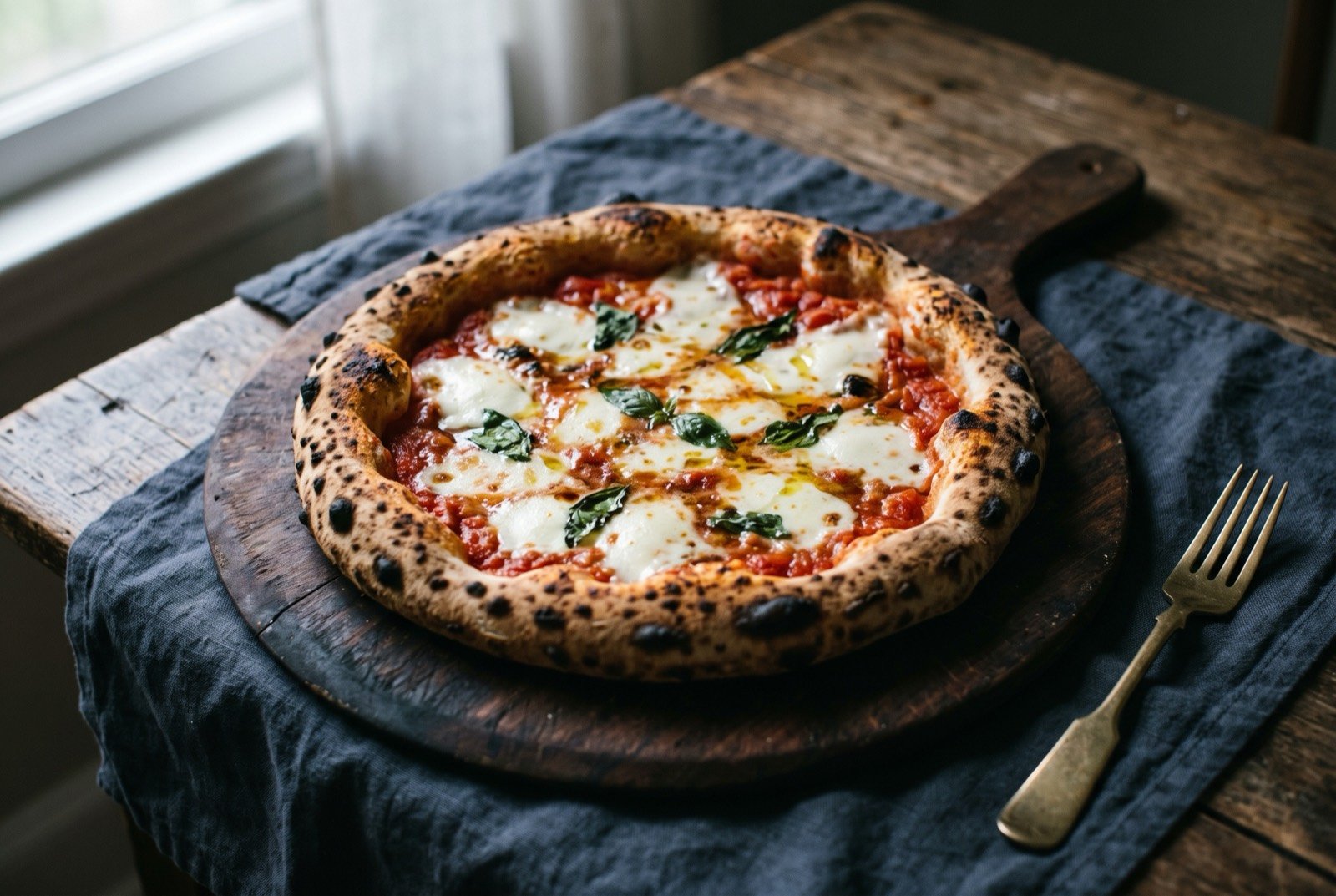
Pizza Napoletana
Naples
Illustration
- Time
- 24 hours
- Researched
- 16 sources cited
Registered as an EU Traditional Speciality Guaranteed on 5 February 2010. The Gazzetta Ufficiale disciplinare text is the definitive source; this chapter works from summaries corroborating it.
As tradition built it
Makes 4 pizzas. About 24 hours, mostly unattended.
Ingredients
- 1 kg 00 flour
- 600 to 650 ml water, roughly 58 to 62% hydration
- 3 g fresh yeast
- 30 to 35 g fine salt
- 60 to 80 g San Marzano tomato, crushed, per pizza
- 80 to 100 g mozzarella di bufala or fior di latte, torn, per pizza
- a few basil leaves, per pizza
- 4 to 5 g olive oil, per pizza
Method
- Dissolve the yeast in the water, mix with the flour for about 10 minutes to combine.
- Add the salt, continue mixing a further 20 minutes to develop elasticity. Final dough temperature must not exceed 23°C.
- Bulk ferment about 2 hours at room temperature.
- Divide by hand into balls of roughly 250g each. Dividing and shaping must be by hand, only mixing may be mechanised.
- Second fermentation, individual balls: a minimum of 6 hours, up to 24 in total from the start, entirely at room temperature. No refrigeration under a strict reading of the STG.
- Stretch by hand from the centre outward, never with a rolling pin, leaving a raised border.
- Top with crushed San Marzano tomato, torn mozzarella, a scatter of basil, a thread of olive oil.
- Bake in a wood-fired oven reaching 485°C, 60 to 90 seconds, until the cornicione is leopard-spotted and blistered.
What a modern chef changes
Hydration treated as a daily calculation, and a staged cold ferment
Rung 1
Method
- Run a genuine indiretto. Hold a poolish, equal parts flour and water plus a trace of yeast, in the fridge for 12 to 16 hours before building the final dough, rather than the disciplinare's simpler diretto method, for a more complex, more digestible crumb.
- Calibrate hydration to the day, not to the recipe. After Ciro Salvo, push toward 70 to 75% in small increments, judging by how the dough feels rather than a fixed figure, autolysing longer at higher hydration to build strength before the salt goes in. This is a genuine intensification of the traditional method, not a departure from it.
- Get as close to 485°C as your equipment allows. A Big Green Egg with a pizza stone, run wide open, can reach 400°C plus, close enough to give real leoparding in 90 seconds to 2 minutes rather than the pale, gummy result a domestic oven's 250°C ceiling produces.