The Mediterranean · Volume 02, Durum, Oil and the Arab-Norman Kitchen
Arancini
Sicily
Illustration
- Time
- 1 hour
- Researched
- 16 sources cited
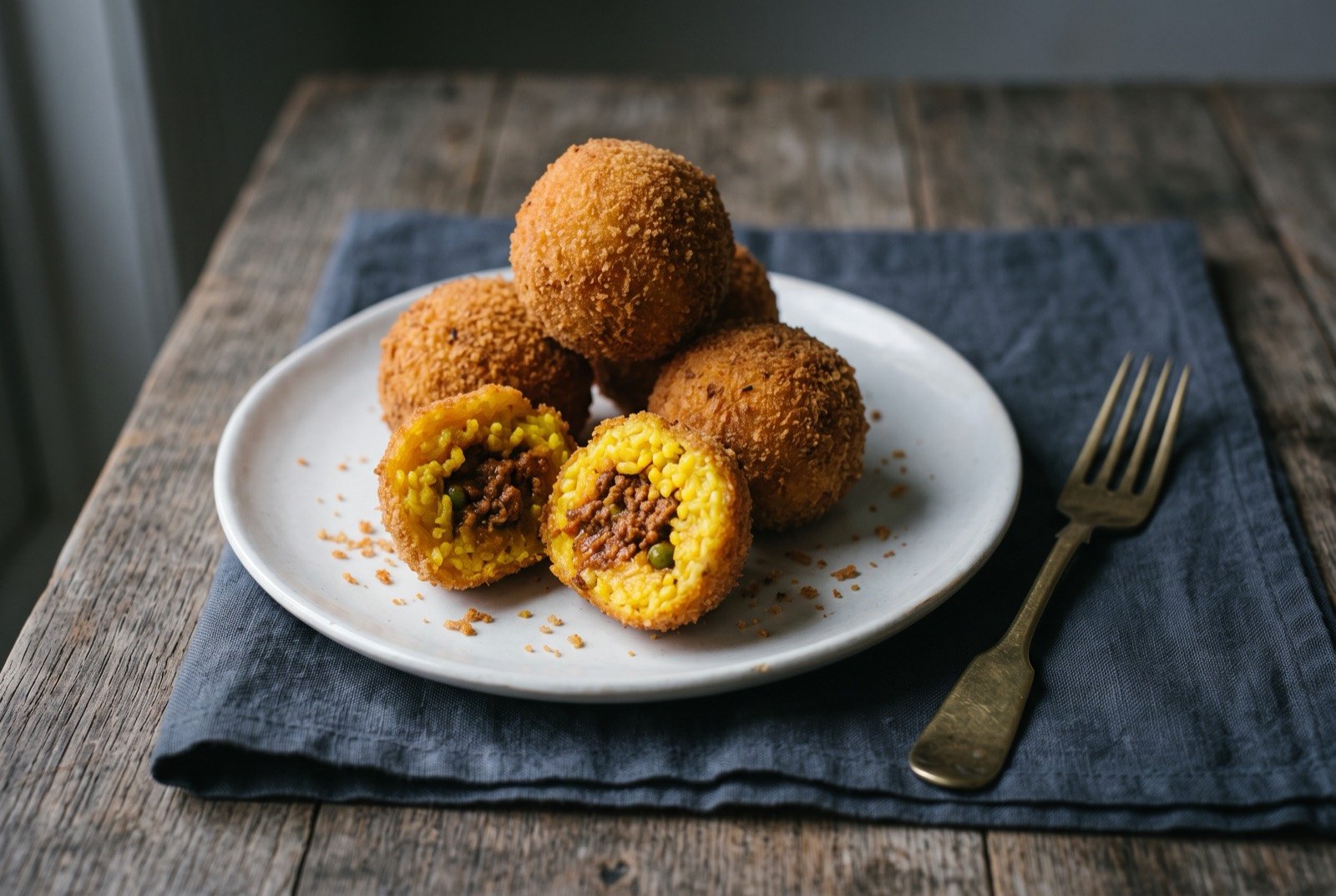
Palermo's arancina, feminine, round, named for its orange shape, is dipped in a water-and-flour batter before breadcrumbing, giving a thinner crust; Catania's arancino, masculine, conical, said to evoke Mount Etna, is dipped in beaten egg first, giving a thicker, darker crust. The Accademia della Crusca ruled in 2016 that both forms are valid Italian, a real, checkable ruling, not a myth, with arancino the more dialectal form and arancina linguistically more consistent because Italian typically uses the feminine for fruit-derived diminutives.
As tradition built it
Makes about 10. About 1 hour, plus resting.
Ingredients
- 500 g risotto rice, cooked and cooled, seasoned with saffron
- 300 g ragù, meat and peas, or ham and béchamel
- enough to coat each ball flour and water pastella, or beaten egg for the Catania style
- enough to coat twice dried breadcrumbs
- enough to nearly submerge the arancini oil for deep frying
Method
- Mould a portion of the cooled, seasoned rice around a spoonful of filling, either the meat and pea ragù or the ham and béchamel, sealing it fully inside.
- Dip in the pastella, or beaten egg for the eastern style.
- Coat thoroughly in breadcrumbs, twice, for a thicker, more durable crust.
- Rest in the fridge before frying. This determines whether the crust holds together in the oil or shears off.
- Deep fry at 170 to 180°C, in oil deep enough to nearly submerge the arancino, 3 to 4 minutes to gold, turning gently, only a few at a time so the oil temperature does not collapse.
- Drain and serve hot.
What a modern chef changes
A held temperature and a dried shell
Rung 3
Method
- Use a dedicated thermometer to hold 170 to 180°C precisely, frying in small batches so the oil never drops below that range; a collapsed oil temperature is the single most common reason bought or badly made arancini turn greasy rather than crisp.
- Dry the coated shell in a dehydrator, or a long fridge rest, before frying, to tighten the crust and reduce oil uptake beyond what refrigeration alone achieves.
- Double-crumb without exception. A single coat, however well rested, is more likely to fail exactly where the modernist brief behind this chapter identifies the common failure: at the seal, under the pressure of the fryer.