Central Africa · Volume 08, The Forest Larder
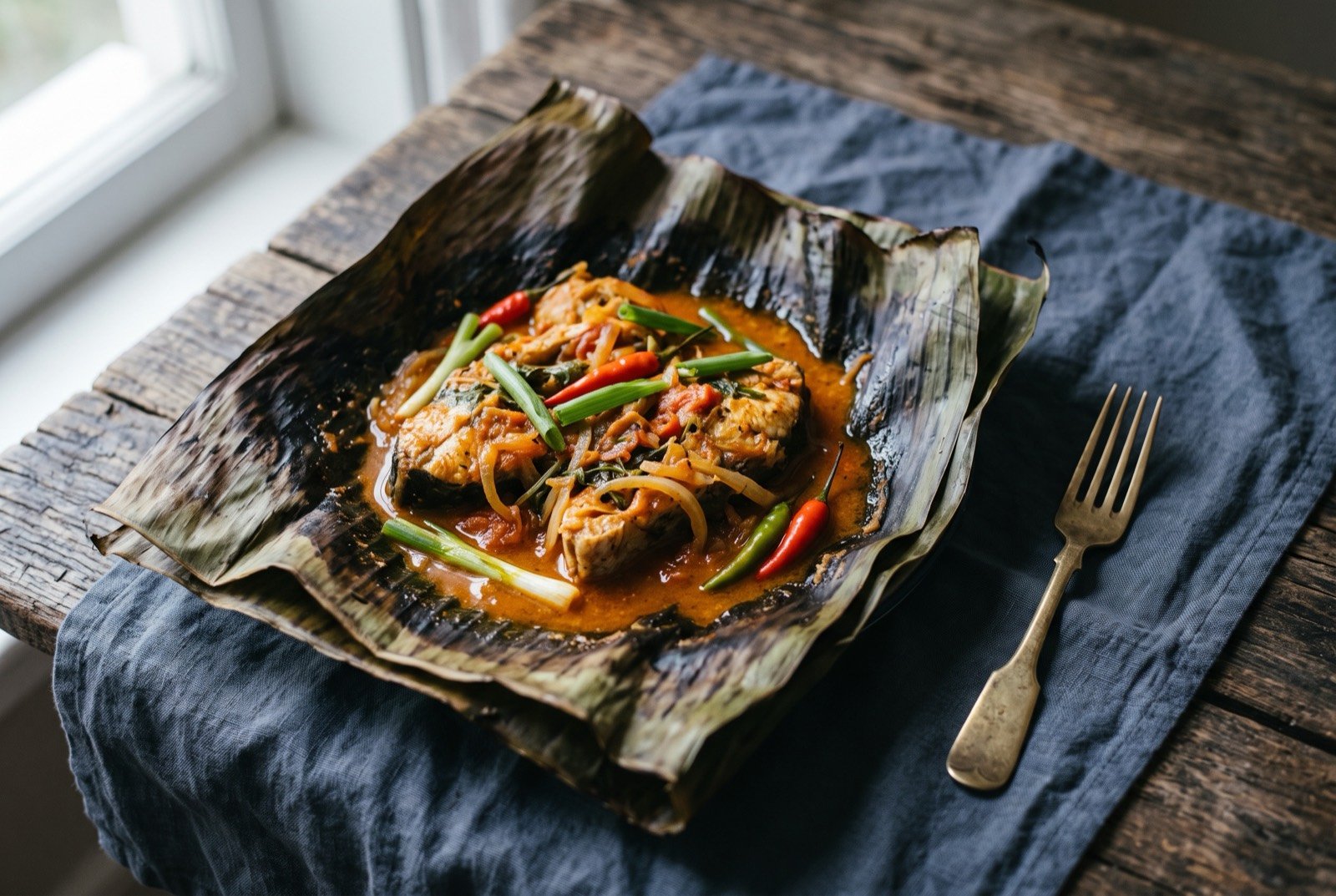
Liboke ya malangwa
The Congo river world
Illustration
- Time
- 1 hour 30
- Researched
- Researched from 103 sources in the brief
- Reviewed
- Awaiting a reader from inside the tradition
- Cooked
- Awaiting a cook report
Rung 6 as a dish, with a specific failure mode: a leaking packet.
As tradition built it
Serves 4. 1 hour to 1 hour 30 at 180°C.
Ingredients
- 4 pieces of malangwa or another firm river fish
- 2 tomatoes
- 3 spring onions
- 3 garlic cloves
- 1 onion, sliced, half reserved
- 2 fresh chillies
- 3 tbsp oil
- 4 ladles about 4 ladles of water
- to taste lemon, salt, fish stock cube in the original
- 2 layers each 2 layers of aluminium foil and 2 layers of banana leaf
Method
- Clean the pieces of malangwa or another firm river fish with lemon and warm water. Season.
- Blend the tomatoes, spring onions and garlic cloves, and combine with the fish.
- Add the oil and about 4 ladles of water, the fresh chillies and the reserved sliced onion.
- Line a large deep bowl with 2 layers of aluminium foil and 2 layers of banana leaf. Pass the leaves over a flame first or they crack when folded.
- Arrange the fish so the liquid covers roughly three quarters of it. That ratio is for a sauce-rich result and it is deliberate.
- Fold and seal. Hermetically. This is the skill of the dish.
- Oven at 180°C for 1 hour to 1 hour 30, with a water-filled tray beneath to generate steam and stop the leaves drying.
Notes
After the method of Congolese cook Gisèle Mbeku.
Wood fire or embers is the traditional route and the better one. The timing conflict is real: a second Congolese account of the same named dish gives about 20 minutes at 200°C. Variants worth naming: liboke ya ntaba (goat), liboke ya mbika (cucurbit seed), maboke of wild mushrooms.
What a modern chef changes
Cook to a core temperature, brine first, open it at the table
Rungs 6, 3 and 5
Method
- Stop cooking to a clock and cook to a probe. This is the answer to the twenty-minute-against-ninety-minute problem, and it is what "by thickness" means. Slide a thin probe through the seal at the thickest point. Firm river fish or catfish to 55°C in the centre, a delicate fillet to 50°C. A 3 cm packet gets there in around 25 minutes at 180°C; a 2 kg whole fish in a big packet takes an hour and a half. Both source timings were right about their own packet.
- Brine the fish 20 minutes in 5 per cent salt water first. In a sealed vessel nothing evaporates, so seasoning cannot concentrate the way it does in an open pan. Brining is how salt gets into the flesh rather than into the liquor.
- Use smoked fish stock for two of the four ladles. Rung 3. The packet concentrates nothing, so whatever liquid goes in is what you taste. Water dilutes; stock does not.
- Seal properly and open it in front of people. Rung 6. Fold the leaf into a double lock and tie it. The burst of leaf-scented steam is a component of the dish and it exists once. A liboke decanted in the kitchen has thrown away half of what it is.