Central Africa · Volume 08, The Forest Larder
Chikwangue, or kwanga
Kongo Central and everywhere downstream
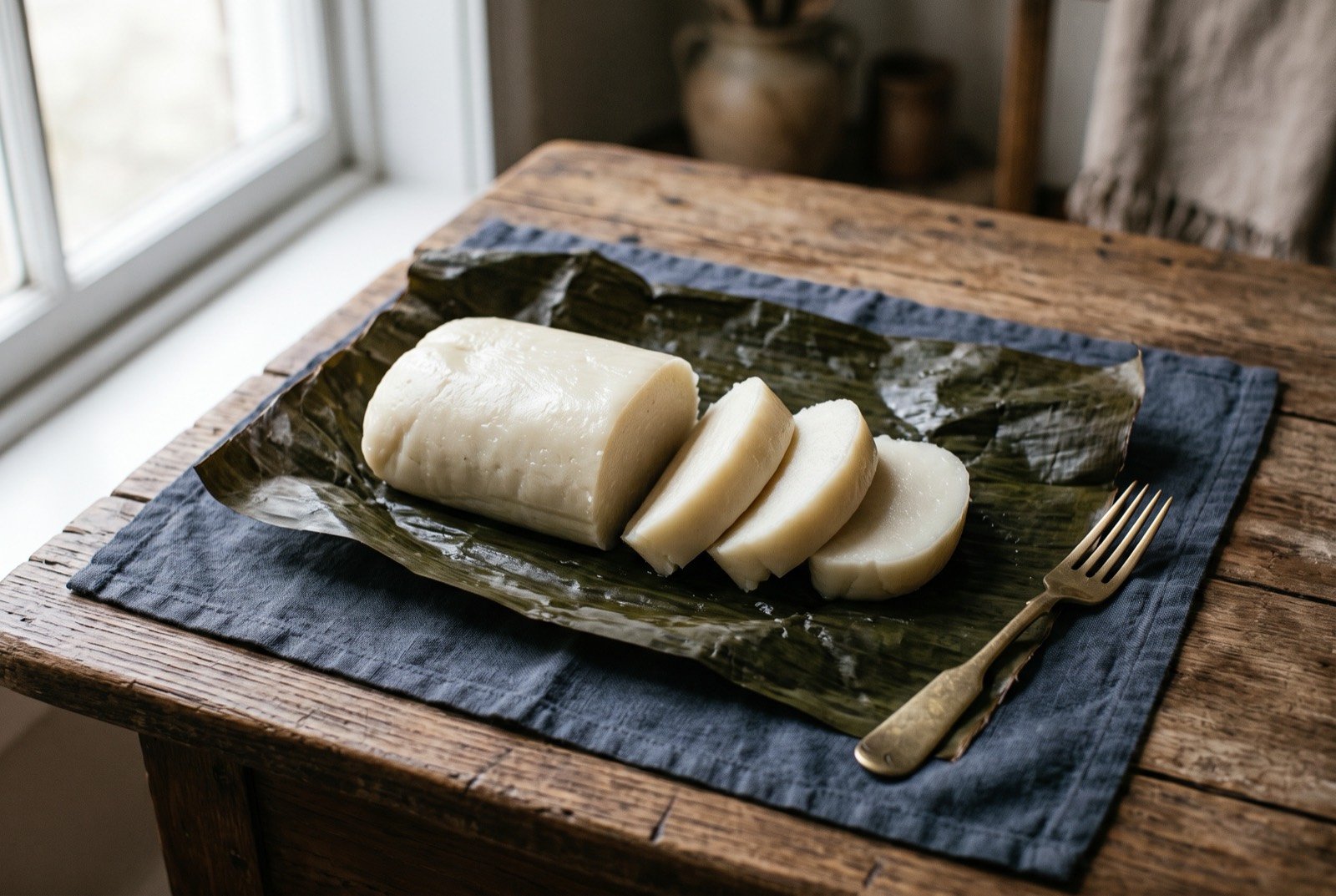
Illustration
- Time
- 20 minutes
- Researched
- Researched from 103 sources in the brief
Read the first half of this rather than cooking it. The full village process cannot responsibly be reproduced in a British kitchen. What follows is the real process, so you know what you are buying, and then the honest domestic version, which is a reheat and a service technique. The nine stages are peeling, retting, defibring, laminating or sieving, pre-cooking, kneading, shaping, wrapping in wild leaves, and final cooking. Retting decides everything and is also the risk: roots destined for fufu are most often retted three days or less, roots for chikwangue appreciably longer, and one source citing 2016 work gives up to fourteen days. The honest statement is that retting time is the main quality variable and the main risk factor, and that shortening it is precisely how konzo outbreaks begin. Pre-cooking: the paste is formed into balls 20 to 30 cm in diameter and cooked 45 to 60 minutes. Final cooking, inside the leaf: generally 1 hour to 1 hour 30, with 32 per cent of producers faster and 29 per cent slower. Why two cookings. The first gelatinises the starch and sets a workable paste. The kneading between the two develops the elastic, slightly rubbery structure by aligning the gelatinised starch and expelling water. The second, inside the leaf, pasteurises the surface, completes gelatinisation and sets the loaf so it holds shape without refrigeration. The elasticity is the point. Chikwangue is not bread and it is not fufu. Women prepare on average twelve chikwangues per session, range one to sixty, and judge one acceptable for an average of 4.5 days and inedible after about 7.5 days. Named regional types by weight: Moungouélé at about 750 g in the north, Ngudi-yaka at 5 to 9 kg in the south, "Fabriqué" at about 600 g, urban produced, and Moussombo, which uniquely gets one cooking rather than two.
As tradition built it
Serves 4 as the starch. 20 minutes.
Ingredients
- 400 g ready-made chikwangue, chilled or frozen, in its leaf
- as needed water, for steaming
Method
- Do not unwrap it. Steam or simmer the ready-made chikwangue in its own wrapper, over water, 15 to 20 minutes from chilled, longer from frozen.
- Unwrap at the table and slice into thick rounds with a wet knife.
- Eat within three to four days of buying. Never microwave it naked: the surface dries into a skin and the elastic structure the double cooking built goes granular.
Notes
As it reaches a British kitchen.
What a modern chef changes
A crisp, a slice and a temperature
Rungs 1, 5 and 6
Method
- Use it as a seasoning. Rung 5. Kwanga sits at around pH 3.8, so serve it with the rich palm sauces and drop the lime; with a lean grilled fish the plate will want lime as well.
- Griddle the slices. A dry, very hot cast iron pan, 90 seconds a side, until the cut faces blister. The Maillard reaction on a sour gelatinised starch surface is genuinely good, the interior stays elastic, and you now have crisp against soft. Rung 6.
- Make crisps from the offcuts. Slice thin, dehydrate at 60°C until brittle, then fry at 190°C for 20 seconds until they puff. Mbenda's cassava chip arrived at from the loaf rather than the root, and the brittle element for every other dish here.
- Serve it warm, around 50 to 55°C, not hot and not fridge-cold. Hot, the sourness reads sharp; cold, the starch retrogrades and the texture goes chalky.