Mainland Brazil · Volume 44, Fire, Mate and the Colônia Table
Churrasco gaúcho
Rio Grande do Sul, Brazil
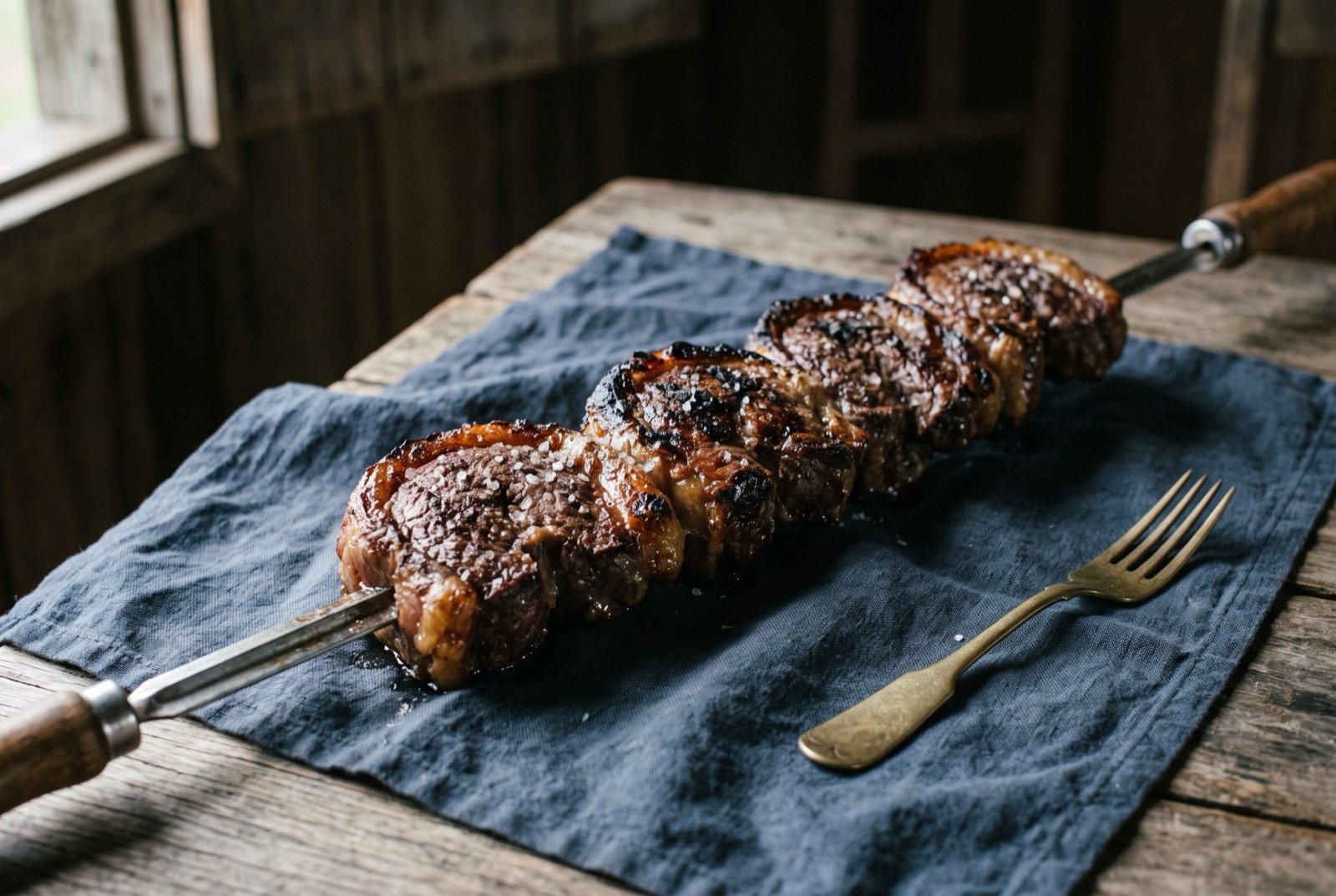
An illustration of the dish, not a photograph of it cooked.
- Time
- Not statedNo source states a time and the atlas has too few comparable dishes to estimate one.
- Reviewed
- Not yet reviewed from inside the tradition
- Cooked
- Not yet cooked and reported
As tradition built it
Churrasco gaúcho
Serves 6 to 8. Timing depends on cut and fire, given below as zones rather than false precision.
Ingredients
- 1 matambre (flank), thin cut, for the direct zone
- 1 paleta (shoulder), boned and cut into portions
- to taste coarse salt (sal grosso), to season, and nothing else
Method
- Build a wood ember fire (charcoal alone will do if wood is not available, though the traditional flavour depends on wood) with a genuine hot zone and a cooler zone further from the coals.
- Salt the meat with coarse salt only as it goes onto the skewer or grate, never in advance and never with any other seasoning: the flavour is meant to come from the fire and the smoke.
- Grill matambre and thinner paleta cuts over the direct zone, turning to render fat evenly, until well charred outside and cooked through; move thicker paleta portions to the cooler zone to finish slowly if they colour before they are cooked through.
- Rest briefly before slicing and serving straight from the fire, in the continuous, unhurried sequence a real rodízio implies rather than a single timed course.
Notes
This chapter has not found a single, precise minute by minute timing for grate churrasco specific to each cut; judge by colour, render and touch, the way a Rio Grandense assador does, rather than by the clock.
What a modern chef changes
Two genuine fire zones, held rather than chased, and sous vide as a precision step before the crust.
Rungs 1 and 2.
Method
- Build the coal bed deliberately banked to one side, with a thermometer in each zone rather than judging by hand alone, so the direct zone runs hot enough for a fast crust and the indirect zone holds low enough for paleta to finish gently without drying.
- Bring the paleta to exact doneness in a sous vide bath first, then finish it hard over the direct zone only for colour and crust, rather than trusting the fire alone to cook it through evenly.
- Salt only at the point of finishing over direct heat, keeping the coarse salt principle intact even where the cooking itself has been split into two stages.