The Americas · Volume 44
The Gaúcho South
Fire, Mate and the Colônia Table
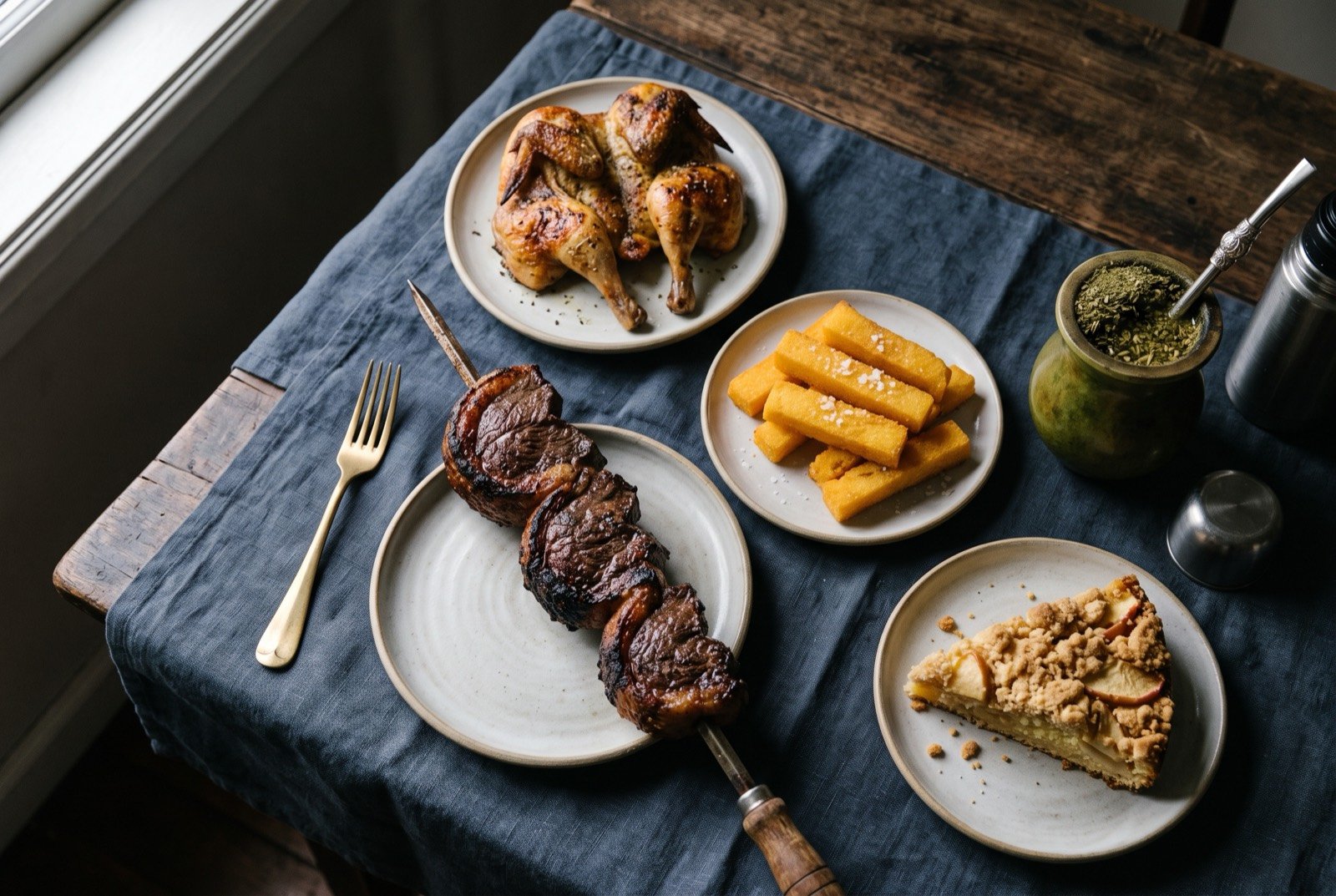
Brazil's three southernmost states sit outside almost every story this atlas has told so far about Brazil, and outside almost every story most British readers have been told about it. There is no dendê palm here, no okra, no Candomblé; the maize and beans of the wider country persist, but the fat is butter and lard, not palm oil, and the defining protein is grass fed beef rather than anything from the sea or the forest. Ecologically this is the northern tip of the pampa, the same rolling grassland that runs south through Uruguay into Argentina, tipping gradually into the araucária pine highlands of the planalto and the cooler, wetter hill country of the Serra Gaúcha before falling to a Atlantic coastline shaped by very different settlers again. Three genuinely distinct food producing landscapes sit inside these three states, and the cuisine follows the land rather than the modern political border.
Sources and review · What this chapter does not assert · How we research · Spotted something wrong?
A Sense of Place
Brazil's three southernmost states sit outside almost every story this atlas has told so far about Brazil, and outside almost every story most British readers have been told about it. There is no dendê palm here, no okra, no Candomblé; the maize and beans of the wider country persist, but the fat is butter and lard, not palm oil, and the defining protein is grass fed beef rather than anything from the sea or the forest. Ecologically this is the northern tip of the pampa, the same rolling grassland that runs south through Uruguay into Argentina, tipping gradually into the araucária pine highlands of the planalto and the cooler, wetter hill country of the Serra Gaúcha before falling to a Atlantic coastline shaped by very different settlers again. Three genuinely distinct food producing landscapes sit inside these three states, and the cuisine follows the land rather than the modern political border.
The first is the campanha and the pampa gaúcho itself, the open cattle country of the Uruguayan and Argentine border, a River Plate world before it is a Brazilian one. The second is the colônia belt, the cooler hill country settled from the 1820s by German and, from 1875, Italian immigrants, running from the Vale do Sinos and Vale do Itajaí through the Serra Gaúcha to the Santa Catarina interior and on into Paraná, where a smaller Polish settlement took root around Curitiba from 1871. The third is the coast, Azorean fishing communities from 1748 in what is now Florianópolis, sitting on top of a much older Sambaqui shell mound culture that had already been eating local oysters for some seven thousand years before any of these settlers arrived.
A fourth layer sits underneath all three, older than any of them and easy to leave out of the story entirely: the Guaraní, who gathered and later cultivated yerba mate and considered it sacred before the Jesuits ever commercialised it; the Charrúa, credited in Brazilian sourcing with the horsemanship and the ground fire barbecue technique that the gaúcho figure later claimed as his own; the Minuano, on the coastal strip between the Atlantic and the Lagoa dos Patos; and the Kaingang and Xokleng, whose roughly four thousand year occupation of the southern plateau is dated to the same age as the araucária forests they depended on for pinhão, still central to Kaingang ritual life today. This chapter tries to keep that sequence visible rather than letting the gaúcho, the colonist and the fisherman stand in for the whole story, because the sourcing gathered for it keeps surfacing the same pattern found across this atlas everywhere else: the settler technique sits on an indigenous base, and the settler credit usually arrives first.
| People or group | Where | What they carry into the kitchen |
|---|---|---|
| Guaraní | Missions belt, wider south | Yerba mate cultivation, considered sacred before Jesuit commercialisation |
| Charrúa | Campanha, the border pampa | Horsemanship, ground fire barbecue technique, physical resistance to enslavement |
| Kaingang and Xokleng | The planalto, the araucária forest | Pinhão, eaten roasted, boiled or pounded to pisé flour; the Kiki ritual |
| Portuguese and Azorean | Coastal Santa Catarina, from 1748 | Fishing technique, tainha na taquara, the base the oyster and sequência tradition sits on |
| German | Vale do Sinos from 1824, Vale do Itajaí from 1850 | Cuca, chimia, marreco recheado, sausage and pork curing |
| Italian | Serra Gaúcha from 1875, Santa Catarina interior | Polenta, salame colonial, galeto al primo canto, Vale dos Vinhedos wine |
| Polish | Curitiba region from 1871 | Pierogi and a smaller, less documented culinary footprint than the German and Italian waves |
| Gaúcho (mixed Iberian, indigenous and African descent) | The campanha and estância country | Churrasco, chimarrão, arroz de carreteiro, the whole pastoral repertoire |
Rio Grande do Sul's own state heritage institute has begun formally recognising two pieces of this table as intangible cultural heritage in the last few years: the erva-mate cultivation and drinking system in June 2023, after a research process that ran from 2019 and produced more than seven hundred pages of documentation, and the artisanal way of making cuca, on a petition from the municipality of Rolante. Both registrations matter for this chapter's argument, because they are the state naming its own food, in its own institutions, as worth protecting, rather than the outside world doing the naming for it.
The History in Layers
Before the cattle: an indigenous base, credited unevenly
The clearest indigenous attribution found in the research behind this chapter comes from Instituto Humanitas Unisinos, a Jesuit university affiliated institute, which credits the Guaraní with cultivating and sanctifying yerba mate, the Charrúa specifically with ground spitted churrasco and the horsemanship the gaúcho figure would later claim as his own, and the Minuano with the coastal strip north of the River Plate. The same source argues that Rio Grande do Sul's landowning elites have historically obscured this foundation, and cites genetic studies showing Charrúa ancestry persisting in the border region's population today. This is worth stating plainly at the outset of a chapter that will spend a great deal of its length on cattle, fire and European immigration: the technique underneath all three came from people the pastoral economy that followed did not treat kindly.
Kaingang and Xokleng occupation of the southern Brazilian plateau is separately dated to roughly four thousand years, matching the age of the araucária forests both peoples depended on. Pinhão was eaten roasted, boiled, or pounded into a flour called pisé, sometimes mixed with hunted meat or fish, and the harvest cycle organised seasonal movement, festivity and exchange; it remains central to the Kiki ritual connecting the Kaingang to the dead and to the natural world. Most Kaingang land today has lost its araucária cover to historic deforestation, a loss to both subsistence and cultural practice that this chapter names rather than glosses over.
On the coast, oysters were already being eaten by the pre colonial Sambaqui shell mound people from at least 5000 BC, noted still standing in the diary of the French traveller Antoine Joseph Pernety in the 1760s. Azorean Portuguese settlers arrived at what is now the Sambaqui neighbourhood of Florianópolis in the mid eighteenth century, and one Brazilian source states the point unusually directly: the Azoreans did not live from fishing in their home islands, and it was in Brazil that they learned to work the water, probably from the indigenous people already living there. The fishing technique that produced tainha na taquara, mullet skewered on bamboo and slow roasted over coals, is credited to Azorean communities, sitting on an indigenous base this chapter cannot pin down more precisely from the sources available.
Jesuit cattle, the estância and the charqueada economy
Jesuits introduced large cattle herds to Rio Grande do Sul from 1634, and the pastoral economy that followed developed through the eighteenth century largely from cattle that had escaped or been taken from the destroyed Jesuit mission herds after the order's expulsion. The cattle ranch, the estância, became a formal private commercial enterprise after 1732 under the Portuguese sesmaria land grant system, and from the late eighteenth century the charqueada, the jerked beef drying works, was installed across the province, built on enslaved labour, to export sun and salt cured beef.
This is the specifically Rio Grandense industrial institution behind the pastoral world, and its scale is documented in hard numbers by a peer reviewed study of Pelotas, the Empire's principal dried meat producing town, covering 1830 to 1885. Charque and leather made up three quarters of Rio Grande do Sul's exports by 1861, with charque alone reaching roughly 85 per cent of the province's exports at its peak; the two charque towns, Pelotas and Rio Grande, grew in population by 754 per cent and 884 per cent respectively between 1814 and 1860, against 286 per cent for the province as a whole, and each charqueada employed on average around 80 enslaved workers. A companion study traces illegal slave trafficking between Rio Grandense charqueadores and Uruguayan saladeristas, the same trade running both ways across the border roughly between 1830 and 1850. Arroz de carreteiro, the drover's dish given below, is the direct culinary descendant of this economy: charque was what an ox cart driver carried because it was what the region produced in industrial quantity, and it is worth remembering that fact sits behind the dish's rustic, campfire charm.
The gaúcho, and a founding myth that does not survive checking cleanly
The word gaúcho is itself contested at the root. Some accounts trace it to Mapuche, meaning a solitary man or bachelor; a competing account runs through the Spanish Canary Island term guanche or guacho, an orphan or vagabond. What is not contested is the chronology. Through the eighteenth century a figure called guasca, later gaudério, developed on both sides of the River Plate frontier, and gaúcho appears as a term probably in the last quarter of that century, originally pejorative, applied to the mestizo cattle rustlers and vagrants of Spanish, Portuguese and indigenous descent who worked the campanha. An official document from the 1790s proposed a mobile patrol to arrest the malefactors, thieves and deserters it called Gauchos or Gauderios.
By the mid nineteenth century a symbolic inversion had taken hold, and a peer reviewed anthropology article locates the specifically Rio Grandense turn precisely: the Farroupilha Revolution, 1835 to 1845, is what crystallised the rehabilitated image of courage and honour, not the Argentine or Uruguayan national stories that did the same work on their own side of the border. This is where the chapter has to name a real contradiction in its own sourcing rather than choose a side. Popular and commercial accounts of the Revolution repeat, almost unanimously, that its principal cause was punitive taxation on Rio Grandense charque, undercut by cheaper Uruguayan and Argentine imports, compounded by a rise in the salt tax that fed the charqueada trade. The one peer reviewed academic source consulted for this chapter, tracing the memory construction of the Farroupilha myth across nearly two centuries, does not cite charqueada economics as a cause at all, framing the conflict instead in terms of provincial autonomy and centre periphery tension with the imperial government. The same study gives a precise, sourced chronology worth keeping: a long period of public silence after the defeat, in which former rebels avoided discussing it; a Republican era reframing from the 1880s, recasting the farrapos as federalist pioneers rather than separatists; formal ritualisation from 1947, when the Movimento Tradicionalista Gaúcho, founded by João Carlos D'Ávila Paixão Côrtes and Luís Carlos Barbosa Lessa, institutionalised the myth through the network of Centros de Tradições Gaúchas; and state law in 1964 fixing the Semana Farroupilha, 14 to 20 September, as an official annual commemoration. Whether charque taxation was a real grievance sitting alongside the political ones this study documents could not be settled here, and this chapter would rather say so than repeat the tidier popular version as fact.
German, Italian and Polish arrival: three waves, three different tables
The first thirty nine German speaking immigrants landed at what became São Leopoldo on 25 July 1824, and by 1830 roughly 5,350 more had followed; the town is now formally recognised in Brazilian federal law as the cradle of German colonisation in the country. German settlement of Santa Catarina followed from 1850, when the Blumenau colony began with seventeen immigrants under the German chemist Hermann Otto Blumenau, and from 1851 at Joinville, which had received 17,000 German speaking Lutheran farmers by 1888. Pomerode, Gaspar, Indaial, Rio do Sul and, further along the Vale do Itajaí, Brusque all grew from this settlement.
Italian immigration began later and further south, the first arrivals reaching Campos dos Bugres, now Caxias do Sul, on 20 May 1875. The imperial government took over existing colonies to house the new arrivals that year, and a further area demarcated in 1877, renamed Colônia Caxias, became the origin of Caxias do Sul, São Marcos, Flores da Cunha, Nova Pádua and Farroupilha; the Quarta Colônia, in the centre of the state, followed the same year. Some 84,000 Italians settled in Rio Grande do Sul in total, drawn mainly from Veneto, Lombardy and Trentino Alto Adige, and the same wave reached the Santa Catarina interior.
Polish settlement of Paraná was smaller and more recent than either: 7,030 people arrived between 1871 and 1889, the first group of thirty two families reaching Pilarzinho, on the edge of Curitiba, in September 1871. Some of these families had passed first through Santa Catarina, and the much larger national wave, more than 64,000 Polish immigrants in the "febre brasileira" years of 1890 to 1894 alone, followed a decade later. Curitiba today holds the second largest Polish diaspora in Brazil and, by some counts, the largest anywhere outside Chicago, though this chapter has found comparatively little quantified culinary detail behind that presence beyond the widespread survival of pierogi across the Polish settlement areas of all three states, a genuine gap named plainly below rather than papered over.
Each wave kept its own kitchen rather than merging into a single colonial cuisine, and this chapter has tried to correct two assumptions that did not survive checking: marreco recheado, stuffed duck with red cabbage, is German, the Brazilian descendant of Ente mit Rotkohl, concentrated in the Vale do Itajaí towns of Blumenau, Joinville, Pomerode and especially Brusque, not an Italian dish of the Serra Gaúcha colônia belt; and chimia, the thick fruit preserve, is likewise German in origin, its name a Brazilianisation of the German Schmier, meaning to spread. Galeto al primo canto and polenta, by contrast, are genuinely Italian, developed on the roughly 25 hectare plots the first Italian settlers were given, land suited to subsistence maize, wheat and grapes but with no room to raise cattle for protein, which is exactly why the young spit roast chicken and the maize porridge became the two dishes that carried Italian identity forward here rather than anything built on beef.
Picanha, espeto corrido and the invention of "Brazilian steakhouse"
This chapter went looking specifically for picanha's supposed origin as a Rio Grandense contribution to Brazilian steakhouse culture, on the reasonable assumption that the cut most associated abroad with Brazilian barbecue must have come from the country's barbecue heartland. It does not check out. Every substantive source traces picanha's rise as a named, marketed cut to São Paulo in the 1950s, not to Rio Grande do Sul, where the traditional rodízio cuts were always costela, paleta and matambre. One Brazilian food history source states the contrast in almost these words: many people imagine picanha arose in the land of churrasco, but there the traditional cuts were always rib, shoulder and flank. Two competing São Paulo legends exist, both mid century and both urban: that the restaurateur Baby Pignatari encountered the cut at the Bambu restaurant, opened 1950, via an Argentine grillmaster who explained that picaña referred to the goad point used on the Pampas; and that the Hungarian butcher Lazlo Wessel, working in São Paulo's Bixiga neighbourhood, sold the cut from the 1950s to German immigrant workers at Volkswagen who wanted it for tafelspitz, the Central European boiled dish. Bambu, Baby Beef Rubaiyat and Dinho's Place, all São Paulo, are the named pioneer steakhouses.
This chapter treats that finding as significant enough to state directly, because it changes what the dishes below actually cook: churrasco gaúcho is built here around costela, paleta and matambre, the cuts Rio Grande do Sul actually traditionally serves, and picanha appears only where it belongs, as the internationally famous cut a different Brazilian city invented and the world since mistook for the whole country's barbecue.
Espeto corrido, the running skewer service behind the international rodízio format, is similarly contested rather than cleanly Rio Grandense. Three separate town level origin stories exist, dated consistently to the 1960s: one in Sapiranga, Rio Grande do Sul, where a churrascaria is said to have run short of pre cut meat and begun carving straight from the skewer at the table; and two in Paraná, at Colombo and at Londrina, the latter credited to a restaurant owner born in Rio Grande do Sul working in a different state. This chapter does not adjudicate between them, and names the contradiction rather than picking the tidiest version.
From the campanha to the world, and back to Porto Alegre
Rodízio moved from rural Rio Grande do Sul properties into Brazil's capital cities through the 1980s and 1990s as gaúcho run establishments expanded, before going international through chains including Fogo de Chão, co-founded in Porto Alegre in 1981 by the Coser family. Arri Coser, born in Encantado in the Vale do Taquari, sold his stake in that chain in 2011 for a reported 230 million US dollars and, in 2012, took over his family's older churrascaria Na Brasa, rebuilding it as NB Steak with a tasting menu replacing roaming skewer service entirely, describing it as the churrascaria of the future. It is a genuine format innovation at real commercial scale, though this chapter's sourcing found more about its sustainability positioning than about any specific ageing protocol or fire technique, and says so rather than inflating the claim.
A newer, smaller movement in Porto Alegre and beyond is doing something closer to what this atlas is actually looking for: cooking that treats the region's own produce and technique as worth researching rather than repeating. Marcelo Schambeck's Capincho, opened 2019, states its method plainly on the menu, mixing technique, research and memory, and sources through named growers and the Feira Agroecologia do Bom Fim market for native pampa produce including butiá, pinhão, guamirim and uvaia. Enio Valli's Guri, in Bento Gonçalves, calls itself a casa gaúcha doing cozinha de origem rather than a churrascaria, built around wood, fire and embers, and was named the region's best regional cuisine and best restaurant three years running from 2020. Marcos Livi, born in São Francisco de Paula and now cooking in São Paulo at Quintana, opened his restaurant in 2013 out of frustration at hearing nobody discuss southern Brazilian food as anything but barbecue, and deliberately excludes churrasco from his own menu to force the point; he now curates the pampa biome section of Instituto ATÁ's stall at São Paulo's Mercado Municipal de Pinheiros, the same institute that documents native ingredients from across Brazil's biomes. None of the three is working in London, and this chapter found no credible UK restaurant or chef cooking Rio Grande do Sul food specifically; what exists in London is generic pan-Brazilian rodízio, and that gap is named honestly in Voices and Sources below rather than filled with a weaker example.
The Flavour Arsenal
The cuts that actually matter here. Costela, the whole rib rack, cooked bone side to the fire in the stake method below or cut and grilled on the bars; paleta, the shoulder; and matambre, a flank cut, are the three traditional Rio Grande do Sul rodízio cuts, seasoned with sal grosso, coarse salt, alone. Picanha, rump cap, belongs to this chapter only as an honest aside: it is São Paulo's invention, not the campanha's, and appears here without pretending otherwise.
Erva-mate. The Guaraní's plant, grown alongside the Jesuit missions and today formally recognised, since June 2023, as Rio Grande do Sul's first item of intangible cultural heritage, following a research process that ran from 2019 and produced more than seven hundred pages of documentation. The state is Brazil's largest producer and exporter of fresh leaf, grown across more than 32,000 hectares mostly by smallholders. Brazilian chimarrão yerba differs from the Rioplatense yerba already covered in Volume AM-25: it is mostly leaf powder with no ageing period, consumed shortly after harvest, giving a greener colour, higher chlorophyll and a fresher, less bitter flavour than the leaf and stem blend used across the border, where Argentine law caps the maximum powder content. The vessel differs too: the Brazilian cuia is more elongated than the rounder Rioplatense mate gourd, and its bomba straw carries more perforations, suited to the finer local yerba.
Pinhão. The araucária pine nut, indigenous to the Kaingang and Xokleng long before any settler arrived, eaten roasted, boiled or pounded into a flour called pisé. Seasonal, autumn to winter, and now genuinely scarce: the Slow Food Foundation's own Ark of Taste listing for the Serra Catarinense araucaria nut states that forest cover is down to under one per cent of its original extent, with protected harvesting areas totalling under 3,000 hectares.
Cornmeal, fubá. The Italian colônia's other staple starch alongside cattle protein it did not have room to raise, and the base of both the everyday polenta and the sweeter, more festive cuca and other colonial baking.
Charque. Sun and salt dried beef, the product of the charqueada economy described above, the ingredient that made arroz de carreteiro possible on a cattle drive with no refrigeration.
Salame colonial and its collective mutirão tradition. Brought by Italian immigrants and made a neighbourhood, cooperative activity, the mutirão, in the absence of home refrigeration; a legally defined family agroindústria product requiring a minimum 60 per cent pork content plus lard, salt and curing salts.
Wine. The Englishman Thomas Messiter introduced American Vitis labrusca and Vitis bourquina vines, more disease resistant than European varieties, to Rio Grande do Sul in 1840, and the Isabel grape quickly became popular before Italian immigrants arrived; from 1870 those immigrants brought the technical winemaking knowledge that turned subsistence production into a real industry. Vale dos Vinhedos, Brazil's first Indicação de Procedência, granted by INPI in 2002 and upgraded to full Denominação de Origem status in 2012, remains the country's only wine DO: Merlot is the flagship red, blended with Cabernet Sauvignon, Cabernet Franc and Tannat; Chardonnay leads the whites, with Riesling Itálico as auxiliary; and Chardonnay or Pinot Noir lead the traditional method sparkling wines the region is increasingly known for.
Oysters and the coast. Farmed at industrial scale only since the 1980s, when research at the Federal University of Santa Catarina under Professor Carlos Rogério Poli brought mariculture knowhow to Florianópolis, which today produces an estimated 97 per cent of all oysters consumed in Brazil, sitting on top of a shellfish eating tradition that runs back through Azorean settlement to the Sambaqui people millennia earlier.
The Technique Ladder
The argument, from inside
### The argument, from inside
Every rung below is documented somewhere in current gaúcho or colônia practice, in a Porto Alegre kitchen or a Serra Gaúcha smokehouse, and every one is directly usable with the kit this atlas assumes: a Big Green Egg, sous vide, a dehydrator, a high power blender, a chinois, a spice grinder.
Rung 1. Build a genuine two-zone ember bed, and match fire duration to the cut
Traditional gaúcho churrasco already separates a direct heat zone for quick cuts such as matambre and thinner paleta from an indirect zone, further from the coals, for costela and other large cuts needing hours rather than minutes. On a kettle or a Big Green Egg this is a coal bed banked to one side, with wood embers rather than charcoal alone wherever possible, and coarse salt as the only seasoning, letting the fat render slowly rather than seizing under a hard sear.
Rung 2. Use sous vide as a precision step before the fire, never as a replacement for it
Documented Brazilian practice already combines the two: a cut is vacuum sealed and brought to exact doneness in the water bath, then finished hard and fast over direct heat for the crust the fire alone is for. The rung applies as well to a small whole bird as to a steak: spatchcock, sous vide the breast and leg separately to their correct temperatures, then finish both together over coals for colour.
Rung 3. Treat forequarter and secondary cuts as a composed, sauced plate, not spit meat
The clearest contemporary example is Capincho's costela de dianteiro, braised sixteen hours until it falls apart, then plated with a proper demi glace and a purée, rather than served straight off a skewer. The principle transfers directly: a long, low braise, reduced and finished separately, turns a cut that would otherwise only ever be rodízio meat into a plate with its own structure.
Rung 4. Work erva-mate into a dry, savoury or bitter register, not only an infusion
Contemporary Porto Alegre practice already treats erva-mate as more than a drink: farofa de erva-mate served alongside roasted meats, an erva-mate ganache, an erva-mate cocktail built on cachaça. A dehydrator and a high power blender make a genuinely fine toasted erva-mate powder at home, usable the same way a good cook uses a matcha or a smoked salt, rather than confined to a gourd.
Rung 5. Make the foundational ingredient properly rather than shortcut it
Neither charque nor a true colônia salame is reliably available in a British kitchen, and the honest fix is not a supermarket substitute but the actual process, scaled down: a dehydrator will cure a genuine charque from good beef in a fraction of the traditional sun drying time, and the same discipline applies to reducing a real chimia from whole fruit pulp and skin over low heat for hours, rather than reaching for jam.
The Ferment and Preserve Bench
1. Salame colonial
Brought by Italian immigrants and made a genuinely collective, neighbourhood activity, the mutirão, in the absence of home refrigeration; a legally defined family agroindústria product today requiring a minimum 60 per cent pork content, plus lard, salt and curing salts. Rest the seasoned meat mixture at least 12 hours before stuffing into casings; hang 2 to 3 days at room temperature to ferment; cold smoke, ideally over oak or chestnut wood, for 4 to 8 hours depending on the intensity wanted, ideally not exceeding around 35°C during smoking; then hang to cure in a dark, lightly ventilated space at roughly 14°C and 80 per cent humidity until the salame has lost around 40 per cent of its original weight, typically 15 days or longer depending on size. No dedicated protected origin status covers salame colonial itself, though the Serra Gaúcha already holds Brazil's only wine denomination of origin, and a separate project seeking one for the region's colonial cheese is in progress.
2. Chimia
A German, not Italian, fruit preserve, its name a Brazilianisation of Schmier, to spread. Thicker than jam, made from the pulp and sometimes the skin of the fruit rather than juice alone, cooked down over many hours over a low fire until it reduces to a dense, spreadable paste. Guava and pineapple, both novel to German settlers encountering a subtropical larder for the first time, are the most commonly named fruits; in Rio Grande do Sul the word usually means this sweet fruit version, while savoury and egg based versions also exist in Santa Catarina.
Sourcing in Britain
Verified 1 September 2026. Where a retailer's current stock could not be confirmed, that is said rather than smoothed over.
1. Costela, paleta and matambre are sold under British names, not Portuguese ones. South American Shop (shop.southamericanshop.co.uk), a real London butcher and importer trading as Atacadao das Carnes, lists Bavette (Fraldinha) at £17.99/kg alongside Beef Ribs with Bone, Boneless Beef Ribs and Jacob's Ladder Beef Ribs, any of which is the right cut for costela. Maminha turned up only as an archived, currently removed listing; treat it as effectively unavailable under that name, and ask a British butcher for a boned out rump instead. 2. Picanha is never actually Brazilian beef in the UK, and that is fine. South American Shop sells the cut, rump cap with the fat left on, under Argentinian, Uruguayan, Irish, Australian and Polish national labels; The Ethical Butcher sells a 28 day dry aged, Pasture for Life version. Ask for "rump cap, fat on, uncut" if picanha is not on the counter. 3. Erva-mate: Barão is the Brazilian brand actually on UK shelves, the same brand this atlas already names for Volume AM-25's tereré. UruShop (urushop.co.uk) and Comércio Brasil (comerciobrasil.co.uk) both stock it in 500g and 1kg, explicitly marketed for chimarrão rather than hot mate. No Baldo brand product was found in the UK. 4. Espeto skewers for espeto corrido are genuinely sold, by the same Brazilian butcher. South American Shop lists single and dual 75cm Grilazer skewers. For a Big Green Egg approximation of costela no fogo de chão, The BBQ Shop UK stocks the genuine Big Green Egg Rib and Roast Rack, which upright holds a full rack at the right angle, though it will not rotate like a stake. 5. Salame colonial is not sold anywhere in the UK, and the honest substitute is Italian, not Brazilian. Delicatezza's Cortebuona Salame Felino or Salame Milano are the closest genuine, coarse, rustic style products currently stocked; say plainly this is a substitution. 6. Fubá is available under its actual Brazilian brand. South American Shop lists Yoki Fubá Mimoso. Standard UK fine polenta, not the coarse bramata or precooked instant kind, is a workable substitute. 7. Pinhão is, honestly, essentially unobtainable in the UK. The Slow Food Foundation's own Ark of Taste page for the Serra Catarinense araucaria nut confirms the whole Presidium's aim is domestic Brazilian recognition, not export. Chestnuts, roasted or vacuum cooked the same way, are the honest substitute, similarly starchy but genuinely different in flavour. 8. Serra Gaúcha wine is genuinely imported, at two tiers. Vinos Latinos and Go Brazil Wines both list real Vale dos Vinhedos producers, including Pizzato, Miolo, Casa Valduga and the Familia Geisse sparkling house; VINVM, a legitimate London retailer, currently stocks a Miolo Chardonnay and a Casa Valduga traditional method Brut. At the everyday end, South American Shop stocks Pérgola, genuinely Vinícola Campestre's Serra Gaúcha smallholder cooperative label rather than a placeholder wine.
South American Shop is the strongest single stop resource found, covering meats, erva-mate, fubá, wine and espeto kit all in one basket, with live UK delivery. Comércio Brasil and Go Brazil Wines are worth a second mention for the yerba mate and wine specifically. Treat this as a snapshot rather than a guarantee: online stock changes fast, and several adjacent listings researched for this chapter showed live "out of stock" flags at the time of checking.
Voices and Sources
From inside the tradition
- Marcelo Schambeck, Capincho, Porto Alegre. Opened 2019, states the kitchen's method plainly: technique, research and memory. Sources native pampa produce, butiá, pinhão, guamirim and uvaia, through named growers and the Feira Agroecologia do Bom Fim market, and treats forequarter cuts as composed, sauced plates rather than rodízio meat. - Enio Valli, Guri Restaurante, Bento Gonçalves. Opened 2018, deliberately calling itself a casa gaúcha doing cozinha de origem rather than a churrascaria, built around wood, fire and embers across the shared Brazilian, Uruguayan and Argentine pastoral repertoire. Named best regional cuisine and best restaurant for the Bento Gonçalves area three years running from 2020. This chapter could not retrieve his own words beyond that framing, a gap named rather than filled with invented quotation. - Marcos Livi, Quintana, São Paulo. Born in São Francisco de Paula, Rio Grande do Sul; opened his restaurant in 2013 specifically to argue that southern Brazilian food is more than barbecue, and excludes churrasco from his own menu to prove the point. Curates the pampa biome section of Instituto ATÁ's stall at São Paulo's Mercado Municipal de Pinheiros. - Arri Coser, NB Steak. Co-founded Fogo de Chão with his family in Porto Alegre in 1981; sold his stake in 2011 and rebuilt his family's older churrascaria as NB Steak in 2012, replacing rodízio service with a tasting menu he calls the churrascaria of the future.
The gaps, named
No credible UK restaurant or chef cooking Rio Grande do Sul or southern Brazilian food specifically was found. London's Brazilian steakhouse landscape, Fogo de Chão itself, Touro, Preto, Rodízio Rico, is generic pan-Brazilian rodízio; only Fogo de Chão's own marketing invokes gaúcho identity at all, and none is documented doing technique-forward, ingredient-researched work of the kind Capincho or Guri do. A restaurant once called Cantina do Gaúcho, in Stamford Hill, has since closed. Jeferson Finger's specific dry ageing protocol, taught at Friboi's Meat Academy, is referenced by several sources but its actual temperature, humidity and duration figures were not retrievable in this chapter's research. A quantified historical recipe for cuca, salame colonial or polenta colonial, distinct from current home and artisanal practice, could not be found from an archival or academic source; the recipes given above are workable, cookable versions built from documented composition and general practice, not claimed originals.
Things this chapter has deliberately not asserted
- That charqueada taxation was the principal cause of the Farroupilha Revolution. Widely repeated popularly, but the one peer reviewed academic source consulted frames the conflict as political rather than fiscal, a genuine contradiction this chapter has not resolved.
- That picanha is a Rio Grandense contribution to Brazilian steakhouse culture. Checked directly and found not to hold: every source traces it to 1950s São Paulo, and this chapter has built its churrasco dish around costela, paleta and matambre instead.
- That espeto corrido, the running skewer rodízio format, originated cleanly in Rio Grande do Sul. Three competing town level origin stories exist, two of them in Paraná, all dated to the 1960s, with no consensus source.
- Any single, precise salt ratio or brine time for costela no fogo de chão. Sources range from coarse salt applied at set up with no marinade at all, to an 18 hour brine documented from one Rio de Janeiro trained chef; both are given above, the second named explicitly as an elevation rather than folk practice.
- The Minas Gerais transmission story for arroz de carreteiro, that gaúcho drovers specifically carried and popularised the dish there. Plausible and repeated across several Brazilian lifestyle sources, but not confirmed academically.
- Precise gourd curing instructions for a new porongo cuia. No specific, credible step by step was found, and none has been invented here.
- That marreco recheado or chimia are Italian-immigrant dishes, an assumption this chapter began with and corrected once the sourcing was checked: both are German, concentrated in the Vale do Itajaí, not the Serra Gaúcha colônia belt.
- A quantified, academically verified colônia-specific ratio for polenta, distinct from generic Italian practice, or for cuca's dough beyond current home recipe sites.
- A single definitive salame colonial curing time standard, or any protected geographical status covering salame colonial specifically. None was found; a separate, still developing project seeks one for the region's cheese instead.
- The precise regional origin, Galicia against Silesia, of the bulk of Polish immigrants to Paraná between 1871 and 1889. Groups from both Upper Silesia and Opole are documented, but the overall split could not be established from a Portuguese-language search pass, and Polish-language sources were out of scope here.
- That modern rodízio churrascarias represent unbroken continuity from rural gaúcho estância practice. The sourcing instead points to urban commercial invention, in São Paulo for picanha and in a contested three-town dispute for the running-skewer format itself.
- Jeferson Finger's specific dry ageing parameters, or that NB Steak's tasting menu format involves any documented ageing protocol or fire-management innovation beyond its own sustainability and freshness positioning.
- That any UK retailer sells costela, paleta or picanha as beef actually imported from Brazil. Everything verified is British, Irish, Argentinian, Uruguayan, Australian or Polish beef, cut and marketed under the Brazilian name.
- That pinhão or genuine Brazilian salame colonial is obtainable anywhere in the UK in any form. Neither is, and this chapter has named the honest substitutes, chestnuts and Italian salame, rather than pretending otherwise. --- Volume AM-44 of Not Just Stew, closing the mainland Brazil culinary region's first written volume. Research briefs: `AM-44-tradition.md` and `AM-44-modernist-sourcing.md`. Sourcing verified 1 September 2026. Churrasco gaúcho and chimarrão are cross-referenced, not re-treated, with Volume AM-25, Argentina and Uruguay: the River Plate cattle-and-fire culture this chapter describes crosses the modern Brazil-Uruguay-Argentina border as one pastoral world, and the fuller asado, parrilla and mate history sits there.
Build a genuine two-zone ember bed, and match fire duration to the cut
Traditional gaúcho churrasco already separates a direct heat zone for quick cuts such as matambre and thinner paleta from an indirect zone, further from the...
Use sous vide as a precision step before the fire, never as a replacement for it
Documented Brazilian practice already combines the two: a cut is vacuum sealed and brought to exact doneness in the water bath, then finished hard and fast...
Treat forequarter and secondary cuts as a composed, sauced plate, not spit meat
The clearest contemporary example is Capincho's costela de dianteiro, braised sixteen hours until it falls apart, then plated with a proper demi glace and a...
Work erva-mate into a dry, savoury or bitter register, not only an infusion
Contemporary Porto Alegre practice already treats erva-mate as more than a drink: farofa de erva-mate served alongside roasted meats, an erva-mate ganache, an...
Make the foundational ingredient properly rather than shortcut it
Neither charque nor a true colônia salame is reliably available in a British kitchen, and the honest fix is not a supermarket substitute but the actual...
The dishes
- Churrasco gaúcho Rio Grande do Sul, Brazil
- Costela no fogo de chão Rio Grande do Sul, Brazil
- Chimarrão Rio Grande do Sul, Brazil
- Arroz de carreteiro Rio Grande do Sul, Brazil
- Cuca Rio Grande do Sul and Santa Catarina, Brazil
- Polenta colonial Serra Gaúcha and Santa Catarina, Brazil
- Galeto al primo canto Serra Gaúcha, Rio Grande do Sul, Brazil
- Marreco recheado Vale do Itajaí, Santa Catarina, Brazil
Sources and review
- Reviewed
- Not yet reviewed from inside the tradition
- Cooked
- Not yet cooked and reported
Where this volume comes from
3 research briefs on file for this volume, researched to the rules on How we research. Published 3 September 2026. Last changed 7 September 2026.
The brief's own account of its sources
Across both parts, roughly 40 web searches and 13 direct page fetches were run, nearly all queries composed in Brazilian Portuguese, with a small number in Spanish for the Rioplatense/cross-border mate comparison. A few searches hit temporary rate limits and were not retried; the topics they covered were substantially covered by adjacent successful searches instead.