The Americas · Volume 39
Bahia and the Dendê Coast
The Fritter and the Fire
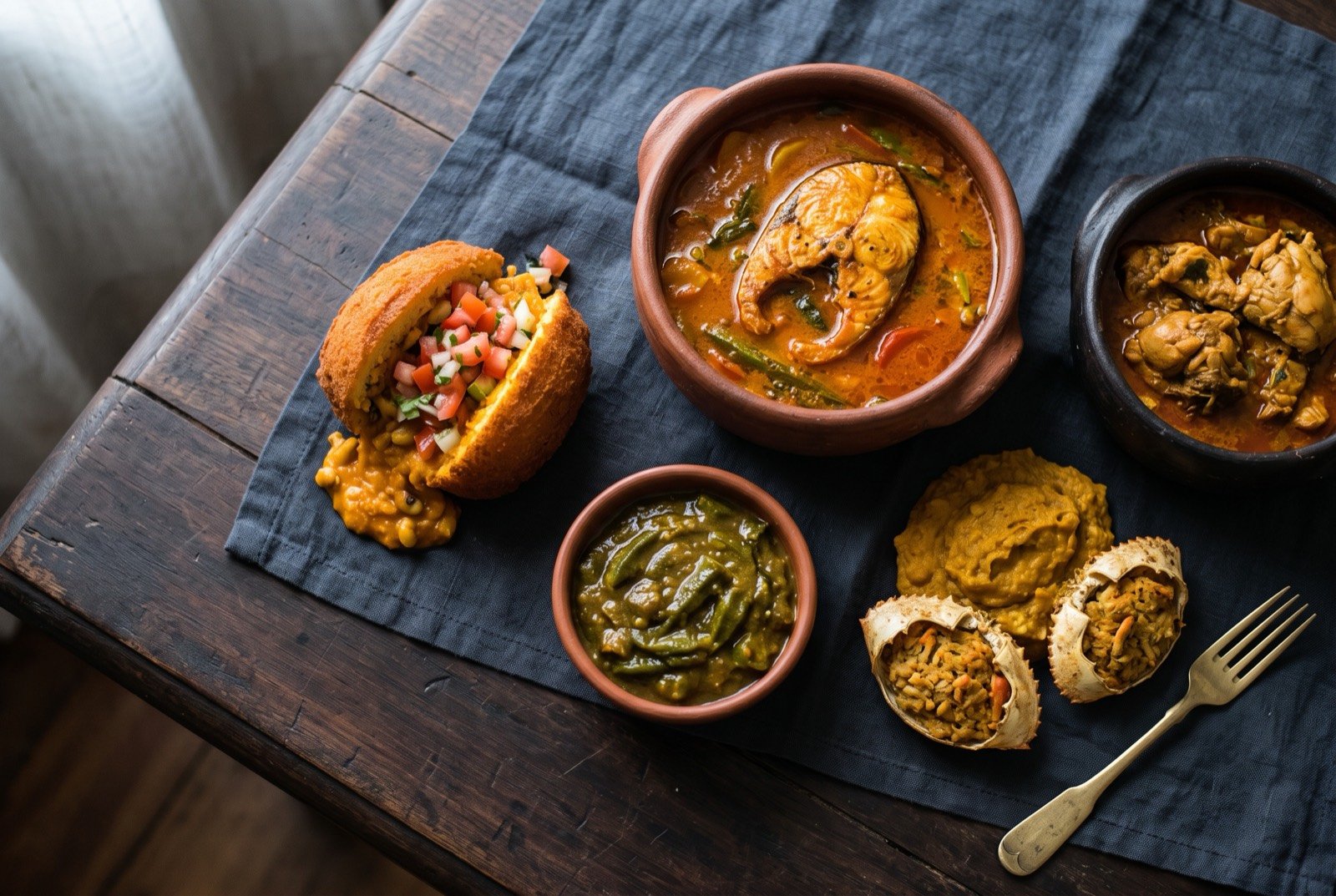
A bay, a fat, and a two-way trade route are what this volume is built on. The Baía de Todos os Santos, the Bay of All Saints, was for close to three centuries the Portuguese Atlantic's principal point of exchange with the Bight of Benin, and the cuisine that resulted is not a diffuse "African influence" laid over Portuguese colonial cooking. It is traceable, unusually precisely for a diaspora cuisine, to two named West African peoples, Yoruba and Fon, carried by ship in one direction and, after abolition, carried back in the other by freed people who founded their own communities on the African coast they had been taken from. Dendê, red palm oil, is the fat the whole repertoire turns on, and it is also, still, a live flashpoint: the dish this chapter opens with, acarajé, is simultaneously Brazil's most famous street food and a consecrated offering to an orixá, and the argument over which of those two things it is allowed to be is not a historical footnote. It was still making the news in January 2025. Every dish as tradition built it, then what a modern chef would change.
Sources and review · What this chapter does not assert · How we research · Spotted something wrong?
A Sense of Place
Salvador and the Recôncavo Baiano, the fertile ring of towns and sugar country around the bay behind it, are the geographic centre of this volume. This is not the whole of Bahia state, and it is deliberately not the sertão, the semi-arid cattle interior a few hundred kilometres inland, which is a different food world entirely, built on sun-dried beef and drought rather than on dendê and the coast, and which belongs to its own volume (AM-40). It is also not Rio and Espírito Santo a few hundred kilometres south, whose Portuguese-court coastal cooking pointedly excludes the two ingredients this volume is named for (AM-42). What this volume covers is narrower and more specific than "Bahian food": the dendê-and-coconut-milk, Yoruba-and-Fon-descended cuisine of Salvador and its bay, built by enslaved cooks and their descendants, and still, in large part, cooked and sold by their descendants today.
The defining logic
| Element | Afro-Bahian dendê coast (this volume) | For contrast: the sertão interior (AM-40) |
|---|---|---|
| Fat | Dendê (red palm oil), coconut milk | Rendered animal fat, minimal |
| Starch | Cassava flour, rice, corn | Corn, cassava |
| Aromatic base | Dendê, dried shrimp, ginger, malagueta | Salt, sun |
| Everyday protein | Fish, shrimp, crab, chicken | Sun-dried and salted beef, goat |
| Religious frame | Candomblé's comida de santo, layered onto syncretised Catholic feast days | Catholic, largely unsyncretised |
The peoples, and the trade that carried them
Bahia's Afro-Brazilian population descends overwhelmingly from two named West African peoples rather than a generalised "African" origin: Yoruba speakers, called Nagô in Bahia, and Fon and Ewe speakers, called Jeje. This precision matters, because it is what lets this chapter trace specific dishes, specific ritual structures and specific words back to a specific place, rather than gesturing at Africa in the abstract the way a great deal of English-language writing about this food still does.
The mechanism was a documented, dedicated shipping corridor between Salvador and the Bight of Benin, what the Portuguese called the Costa da Mina, running from the sixteenth century into the nineteenth. Bahian merchants ran a direct route to the port of Semé at Porto Novo from the 1750s, the first recorded Bahian ship arriving in 1760, trading low-grade Bahian tobacco, unwanted at home in Portugal but prized on the West African coast, for enslaved people at a fixed exchange rate: eight to twelve rolls of tobacco per captive at Porto Novo, thirteen to sixteen at Ouidah, which is the documented reason Bahian traders favoured the Porto Novo route over the more famous Ouidah one. A meaningful share of the people bought this way had walked to the coast from the interior of the Oyo empire, meaning they were specifically Yoruba by origin before they were ever "African" by the ship manifest's shorthand. Yoruba textiles moved the other way along the same route, into Bahia, valued because Afro-Bahians or their parents had themselves been born in the weaving regions.
The whole corridor was reconstructed by the French historian Pierre Verger, whose 1966 doctoral thesis, published in Portuguese as Fluxo e Refluxo do Tráfico de Escravos entre o Golfo do Benim e a Bahia de Todos os Santos, "flow and reflow," is the reason this volume can be this precise. Verger worked from ship manifests and from the papers of a real Bahian trader, José Francisco dos Santos, and he documented the current running the other way too: freed Africans, many of them after the failed 1835 Malê Revolt in Salvador, an uprising led by enslaved and freed Muslims, returned to West Africa and founded what are still called Agudá communities, Brazilian-descended communities, in Lagos, Porto Novo, Ouidah and Accra. Verger could still trace that Brazilian presence on the African coast in the 1950s. The word for this two-way movement, fluxo e refluxo, flow and reflow, is this chapter's own best short description of what Bahian food actually is: not an import that stayed put, but a current that ran both ways and is still, in the form of the Agudá descendants, running.
On the Fon side of the same story, the historian Luis Nicolau Parés's A formação do Candomblé, drawn from seven years of archival and field research in Salvador, Cachoeira and Benin itself, makes the case that it was specifically Fon vodun cults that supplied the organisational template for Bahian Candomblé's structure of "nations," Jeje, Nagô and Angola, the religious houses this whole chapter's sacred food tradition sits inside. Fon religious structure, not only Yoruba practice, underlies the terreiro system.
The History in Layers
Indigenous core. Before dendê, before Yoruba and Fon cooks, the Recôncavo already had a leaf-and-shellfish cooking tradition of its own. The clearest surviving trace is caruru, this chapter's fifth dish below: a comparable indigenous dish, caruru de folhas, made with taioba or bredo-de-santo-antônio leaves, existed before African cooks folded in okra and dendê to make the dish this chapter actually describes. This is worth stating plainly rather than letting caruru read as a purely African invention, because the fuller, honester story is a merger, and a Bahian university nutritionist's own framing of it is the best short version this chapter found: two traditions meeting on the same plate rather than one replacing the other.
The Columbian Exchange, running in an unusual direction. Most of this atlas describes American crops moving east into Africa. Bahia is one of the places where the exchange briefly ran the other way as well as the usual way: dendê, an African palm, crossed the Atlantic and took root nowhere else in Brazil at the same density it did in Bahia, arriving, on the best evidence found, as early as 1539 to 1542 with the very first captives brought to Duarte Coelho's captaincy of Pernambuco, most likely carried as seed by the slave traders' own agents. By the eighteenth century palm wine, vinho de dendê, was an ordinary thing to buy in Salvador. Meanwhile chilli, in the specific form of malagueta pepper, and the New World's tomato and peanut, moved the conventional way, arriving in Bahia from elsewhere in the Americas and folding into a cuisine that was simultaneously absorbing an African fat and an African vegetable, okra, carried the same way as the palm. Very little in this repertoire is purely one thing.
The colonial economy: sugar, slavery, and self-purchase labour. The Recôncavo was sugar country, and the standard brutal arithmetic of the plantation Atlantic applies here as everywhere else this atlas covers it. What is specific to Bahia is the mechanism that turned enslaved and freed cooking into the street food Salvador is now known for. IPHAN's own historical account of how the acarajé trade began states it plainly: freed African women connected to Candomblé communities sold food in the street under what was called "ganho," self-purchase labour, arrangements that let an enslaved or newly freed person earn toward buying their own or a relative's freedom while simultaneously discharging a religious obligation to the orixás through the act of selling their food. Selling and worship were not two separate activities happening to be done by the same women. They were, from the outset, one activity.
The modern moment: heritage recognition and a live religious conflict. On 14 January 2005, revalidated 7 December 2022, Brazil's federal heritage body IPHAN registered the Ofício das Baianas de Acarajé, the craft of the acarajé vendors, as national intangible cultural heritage. The petition was jointly filed by the vendors' own trade association, UFBA's Centro de Estudos Afro-Orientais, and, tellingly, Ilê Axé Opô Afonjá, one of Salvador's most important working Candomblé terreiros. A terreiro co-proposing the registration alongside an academic centre and a trade body is the clearest possible evidence that the state understood, and meant to protect, the dish's religious identity specifically, not a folkloric, de-religionised "traditional food." IPHAN's own text describes the vendors as "guardians of traditional knowledge, marked by resistance, religiosity, and contribution to collective memory," and glosses their turbans and beaded necklaces as symbolising "connection with the orixás and respect for the sacred."
That recognition sits alongside, not instead of, an ongoing and serious conflict. As evangelical, and especially neo-Pentecostal, conversion has grown sharply across north-eastern Brazil, cited growth from roughly 3 per cent to 16 per cent of the population between 1970 and 2010, some baianas themselves converted, and a version of the fritter began appearing rebranded "bolinho de Jesus," deliberately stripped of every visible link to Candomblé: no turban, no reference to Iansã, sometimes a refusal to use the word "acarajé" at all. Some evangelical pastors have preached against Candomblé-linked acarajé from the pulpit as spiritually dangerous. This is not settled history. Brazil's federal human rights hotline recorded 3,853 religious-intolerance complaints in 2024 against 2,128 the year before, an increase of more than 80 per cent in a single year, with Candomblé and Umbanda the two most targeted religions. A named, documented case reaches directly into this chapter's subject: on 15 November 2021, Eliane de Jesus, a baiana and a suspended ekede, a ritual functionary, at a Salvador terreiro, was verbally attacked in the Pelourinho, the city's historic centre, by tourists who called her "preguiçosa," lazy, and "macumbeira," a slur for practitioners of African-descended religion. She filed a formal police complaint the next day. Rita Santos, coordinator of the national vendors' association, put the stakes in the clearest single line this chapter found anywhere in its research: "The host is to the Catholic church what acarajé and abará are to African-matrix religions. All have equal importance." That is the frame this chapter holds throughout: not a curiosity to admire from outside, but a living sacrament for a religious minority currently under real pressure.
The Flavour Arsenal
Dendê, red palm oil, Elaeis guineensis, is the fat this whole cuisine and this volume are named for, and buying and using it correctly is the single largest lever any cook, Bahian or British, has over whether these dishes taste like themselves. Two things are worth knowing that most recipe writing skips. First, dendê separates naturally into two fractions: bambá, a yellowish, waxy solid that gives body and creaminess to a stew without any added thickener, and flor de dendê, the red-orange liquid fraction, more heat-stable and the one to reach for when frying. A serious Bahian cook does not treat one bottle of dendê as a single undifferentiated ingredient; she treats it as two ingredients that happen to share a bottle. Second, the oil's carotenoids, the source of both its colour and much of its aroma, are genuinely fragile under heat: published figures put the loss at up to 59 per cent of beta-carotene after two hours at 200°C, and over 98 per cent after just twenty minutes at 240°C, with storage above roughly 35°C accelerating the same decline. Treat dendê the way you would treat a good finishing olive oil rather than a neutral frying medium wherever the dish's whole point is its colour and aroma, which, in this repertoire, is most of the time.
Malagueta pepper, Capsicum frutescens, is Bahia's defining chilli: small, citrus-bright, 60,000 to 100,000 Scoville units, and worth naming precisely because of a genuine, recurring confusion this atlas is well placed to correct, having already written both sides of it. Brazilian malagueta is essentially the same species as Portuguese and Mozambican piri-piri, small young pods even sharing the name across the two traditions. It has nothing whatsoever to do with West African "malagueta," better known as grains of paradise, Aframomum melegueta, a ginger-family seed spice that is not a chilli at all. The two share a name only because Portuguese traders, already used to buying West African melegueta as a black pepper substitute, applied the familiar word to an unrelated, equally pungent New World pod. Reach for the wrong bottle and the dish's whole character changes, not merely its heat.
Camarão seco, sun-dried shrimp, is the umami backbone of vatapá, caruru and xinxim alike, and its quality is a genuine, live concern even within Brazil: São Paulo's Preto Cozinha, the strongest example of a diaspora kitchen taking this seriously, sources its shrimp specifically from the riverside community of Saubara, harvested only on the new moon, and smoke-cures it over aroeira wood, explicitly as a corrective to the smaller, industrially processed commodity product most kitchens, in Brazil and well beyond it, actually use.
The rest of the pantry, briefly: feijão fradinho, black-eyed peas, carried from West Africa alongside okra and dendê itself; farinha de mandioca, both raw and toasted cassava flour; leite de coco, coconut milk; and amendoim and castanha de caju, peanut and cashew, ground for vatapá's thickening base. Every one of these ingredients is documented as arriving on the same corridor as the people who first cooked with them here.
The Technique Ladder
The argument, from inside
Six rungs, each explained by why it works, not only what it does.
Rung 1. Rung 1, mechanical aeration without water
Acarajé's lightness has nothing to do with a raising agent and everything to do with mechanics. Dried black-eyed peas are soaked, skinned, blended to a paste, and then beaten, traditionally by hand in a stone or wooden pilão, without adding a drop of water, until the mass doubles or triples in volume and takes on a genuine foam. This works because the pea paste's own starch and protein form a matrix strong enough to trap air mechanically, the same principle as a mousseline, and it is also the most commonly skipped step outside Bahia: add water to loosen the paste, as an impatient cook is tempted to, and the foam simply cannot form, which is the single biggest reason most acarajé eaten outside Bahia is heavy and oil-logged rather than light.
Rung 2. Rung 2, fractionate the dendê rather than treating it as one ingredient
Because dendê genuinely separates into a waxy bambá solid and a more liquid flor de dendê, warming a bottle gently and decanting, or simply letting it settle cold in the fridge and skimming, gives a cook two distinct tools: the liquid fraction for frying, where heat stability matters, and the solid fraction stirred into a finished sauce off the heat, where body and colour matter more than stability.
Rung 3. Rung 3, the layered, undisturbed moqueca build
Onion, pepper, tomato, garlic and fish are layered, not stirred together, into a pan already carrying part of the dendê; the remaining dendê and the coconut milk go in; the pan is covered and left largely alone on a low-medium heat, shaken rather than stirred, for fifteen to twenty minutes, so the coconut milk's own steam finishes the dish. This is a controlled, closed-vessel poach dressed as a stew, and disturbing it defeats the point: stirring breaks the fish and lets the emulsion the covered steam is quietly building collapse.
Rung 4. Rung 4, finish with unrefined dendê off the heat
Given how fast dendê's carotenoids and aromatics degrade under sustained heat, the professional move is to cook with the more heat-stable liquid fraction and reserve a spoonful of raw, unrefined dendê to stir through at the very end, off the flame, so the colour and aroma a cook paid for actually survive to the plate rather than cooking away over an hour's simmer.
Rung 5. Rung 5, cure your own dried shrimp for concentrated umami
The Saubara method, sun-drying followed by a cold smoke over an aromatic wood, is a controlled dehydration that concentrates glutamate and inosine monophosphate, the two compounds most responsible for savoury depth, while the smoke adds a genuinely different, resinous top note absent from a plain sun-dried or industrially processed shrimp.
Rung 6. Rung 6, the seasoning discipline that actually distinguishes register
The one clearly documented technical difference between Candomblé's ritual acará, offered to Iansã, and the secular street acarajé sold from every corner in Salvador is not shape or method. It is seasoning restraint: the ritual version carries only salt and grated onion; garlic, tomato and pepper mark the secular version and only the secular version. The transferable lesson for a home cook chasing "elevation" is that precision and restraint in aromatics that are genuinely traditional to a given register of a dish will always read as more considered than importing an unrelated modernist flourish with no documented connection to how this cuisine is actually cooked at its best.
The Ferment and Preserve Bench
Bahia's preservation tradition is thinner in the documentary record than several other volumes in this atlas, and this chapter states that honestly rather than inventing a fuller bench than the sources support.
Camarão seco, sun-and-smoke cured dried shrimp, covered fully above, is the one genuinely load-bearing preservation technology in this repertoire, sun-drying followed, in the best documented modern practice, by a cold smoke over aromatic wood, concentrating umami and extending keeping in a hot, humid coastal climate that would otherwise spoil fresh shrimp within a day.
Vinho de dendê, palm wine, was, on the documentary evidence found, an ordinary commercial drink in eighteenth century Salvador, a genuine fermentation technology built on the same palm this whole chapter is named for. This chapter could not establish how widely, if at all, it survives as a living practice today, and states that gap plainly rather than presenting a historical footnote as a current one.
Sourcing in Britain
Dendê oil, the single decision that matters most. Genuine Brazilian-branded dendê, distinct from West African palm oil brands though both are the same species, is buyable in the UK. Cepêra Azeite de Dendê, 900ml, £7.95, in stock at [Delícias UK](https://www.delicias-uk.com/), is the most widely distributed brand, bottled in glass and marketed on its own copy as filtered without impurities. Arrifana Azeite de Dendê, 200ml, also via Delícias UK, is marketed explicitly for moquecas, acarajés, vatapás and carurus, the Bahian use case by name rather than a generic African palm oil sold under a different flag. Buy small, glass-bottled quantities and store them cool and dark: carotenoid loss under heat and light is fast, and a large bottle degrading slowly on a shelf will cost this cuisine most of what actually distinguishes it.
Malagueta pepper. Fresh pods are not realistically available in the UK. Jarred and bottled versions are, and they are genuinely Brazilian rather than a Portuguese piri-piri substitute: Aroma D'Minas and Cepêra both sell red and green malagueta, whole and as a bottled molho, via Delícias UK. Buy these specifically rather than reaching for a generic bird's-eye chilli or a Portuguese piri-piri sauce, which shares the pepper's lineage but not its Brazilian branding or, reliably, its exact cultivar.
Camarão seco, honestly the weakest link in this chapter's sourcing. No dedicated Brazilian-branded dried shrimp was found for sale in the UK, at Delícias UK, at Produtos Brasileiros, or in general search. What is genuinely buyable is West African dried shrimp, unsmoked where possible, via retailers such as Afrobuy, a real but flavour-shifting substitute, since Bahian dried shrimp is traditionally salt-dried rather than smoked and the commonly stocked West African product often is smoked. State this plainly to the reader rather than implying an easy substitution.
Farinha de mandioca, coconut milk and the rest of the pantry. Genuinely well stocked. Yoki Toasted Cassava Flour, 500g, £2.70, at Delícias UK and at Sous Chef; Sococo coconut milk, the Brazilian brand Bahian recipes are actually calibrated to, also at Delícias UK, 500ml £6.20; black-eyed peas via Amazon UK or any well-stocked South Asian or Caribbean grocer; raw peanuts and cashews from any wholefood supplier, toasted and ground at home.
Named shops. In London, the Brazilian Centre has four branches, Stockwell, Stamford Hill, Hackney and North Finchley, and delivers UK-wide; Casa Brasil trades from Queensway Market in Bayswater, one of two real London clusters of Brazilian retail alongside Willesden Green in Brent; Latin Market trades from Old Kent Road. Online, Delícias UK is the most thoroughly stocked single site for this chapter's dishes specifically, carrying a dedicated acarajé and bobó de camarão product range.
The kit note. A pilão, the traditional stone or wooden mortar, pounds acarajé's paste and vatapá's nut base to a coarser, more aerated texture than a blender gives by default. No UK source for an authentic pilão was pursued, deliberately, since Rung 1's real lesson, mechanical aeration without added water, transfers to a high-power blender and stand mixer used correctly, which every reader of this atlas already owns.
Voices and Sources
On the history and the trade corridor: Pierre Verger's Fluxo e Refluxo do Tráfico de Escravos entre o Golfo do Benim e a Bahia de Todos os Santos, the foundational reconstruction of the Bahia-Bight of Benin corridor, and the Fundação Pierre Verger that carries his archive forward; Luis Nicolau Parés's A formação do Candomblé, on the Fon and Jeje foundation of Bahian Candomblé's nation structure; a dedicated academic study of eighteenth century Salvador-Porto Novo trade published via Redalyc, for the tobacco-for-captives exchange rate and shipping chronology; IPHAN's own registration text for the Ofício das Baianas de Acarajé, the clearest official Brazilian source on both the ganho labour mechanism and the 2005 heritage recognition.
On Candomblé and comida de santo: Fábio Libório Rocha, writing in the Fiocruz public health foundation's journal Revista de Alimentação e Cultura das Américas, on comida de santo as a full cultural complex; Nina Pinheiro Bitar's UFRJ research, reviewed in the peer-reviewed journal Religião & Sociedade, for the documented seasoning distinction between ritual and secular acarajé; and, above every other source in this chapter's research, Angélica Moreira, ekede and traditional cook at Ilê Axé Opô Afonjá, speaking to the Bahian daily Jornal Correio, whose own words on caruru anchor this chapter's ritual section directly rather than through a scholar's paraphrase.
On the modern conflict: Rita Santos, coordinator of the national baianas' association; Maria Leda Marques and Gerlaine Martini, whose 2007 doctoral research first documented the "bolinho de Jesus" phenomenon; Pai Rodney de Oxóssi and Patrício Carneiro Araújo, both naming the flattening of the dish's religious identity as a form of racism; and Eliane de Jesus, whose own 2021 police complaint after a racist attack in the Pelourinho is named here as a documented fact, not an anecdote.
On the technique itself: Carla Soares, a Bahian food writer who sources her own dendê at Salvador's Feira de São Joaquim, the strongest single source on dendê's two fractions and on the real, current problem of adulteration; Raul Lody, on the Nigerian-versus-Bahian comparison for both akará and xinxim; the Slow Food Foundation's Ark of Taste, documenting the artisanal, quilombola-led dendê production of the Iguape Basin and its decline under industrial pressure.
On the modern restaurant scene: chefs Fabrício Lemos and Lisiane Arouca of Restaurante Origem, and Leila Carreiro of Dona Mariquita, both in Salvador; Rodrigo Freire of Preto Cozinha in São Paulo, whose sourcing discipline for dried shrimp and dendê is the clearest documented case in this chapter of a diaspora kitchen taking the tradition seriously rather than caricaturing it.
Things this chapter has deliberately not asserted
- That Bahian dendê technique differs from contemporary West African palm oil technique in any specific, well-evidenced way. The one source found for this, a Bahian newspaper's human-interest story about a Nigerian tourist's reaction to acarajé, is suggestive, not ethnography, and this chapter does not build a firmer claim on it than that.
- That bobó de camarão's cassava base is a settled indigenous-driven substitution for an older, yam-based ipeté. The claim is repeated across several generalist Brazilian food-history sites and nowhere academic; it is named in this chapter's dish entry as reported, not as established fact.
- That vatapá's and xinxim's Yoruba etymologies are linguistically verified. Both are widely repeated in Brazilian food writing; neither was traced to a dictionary or a named linguist in this chapter's research.
- That camarão na moranga's popular origin story, involving Japanese political prisoners and squash that washed into the sea, is history rather than food folklore. No source found treats it as anything more than a repeated legend, and this chapter does not either.
- That quindim's descent from Portuguese convent egg-yolk technique and its Kimbundo name are independently verified rather than a single, widely syndicated origin story repeated across Brazilian lifestyle press. The story is plausible and is named as plausible, not as settled.
- That any UK retailer currently stocks dedicated Brazilian-branded dried shrimp. None was found. West African dried shrimp, honestly flagged as a flavour-shifting substitute, is what this chapter recommends instead.
- That a full recipe for the ritually offered version of acarajé, abará or acaçá belongs in a book aimed at a home cook outside the tradition. This chapter gives the secular versions, which the baianas themselves sell to anyone, and states plainly that the ritual versions are not offered here, because their meaning depends on who prepares them, for whom, and under what religious authority, not on their ingredient list.
- That efó, feijoada baiana, cuscuz de tapioca and peixe frito à baiana are established well enough by this chapter's research to be given a full treatment. Sourcing for all four was thin; they are named in passing rather than given recipes, and a future revision of this chapter, with a dedicated further research pass, is the honest place to add them.
Rung 1, mechanical aeration without water
Acarajé's lightness has nothing to do with a raising agent and everything to do with mechanics.
Rung 2, fractionate the dendê rather than treating it as one ingredient
Because dendê genuinely separates into a waxy bambá solid and a more liquid flor de dendê, warming a bottle gently and decanting, or simply letting it settle...
Rung 3, the layered, undisturbed moqueca build
Onion, pepper, tomato, garlic and fish are layered, not stirred together, into a pan already carrying part of the dendê; the remaining dendê and the coconut...
Rung 4, finish with unrefined dendê off the heat
Given how fast dendê's carotenoids and aromatics degrade under sustained heat, the professional move is to cook with the more heat-stable liquid fraction and...
Rung 5, cure your own dried shrimp for concentrated umami
The Saubara method, sun-drying followed by a cold smoke over an aromatic wood, is a controlled dehydration that concentrates glutamate and inosine...
Rung 6, the seasoning discipline that actually distinguishes register
The one clearly documented technical difference between Candomblé's ritual acará, offered to Iansã, and the secular street acarajé sold from every corner in...
The dishes
- Acarajé Salvador, Bahia
- Abará Salvador, Bahia
- Moqueca baiana Salvador and the Recôncavo Baiano, Bahia
- Vatapá Salvador, Bahia
- Caruru Salvador, Bahia
- Xinxim de galinha Salvador, Bahia
- Bobó de camarão Salvador, Bahia
- Casquinha de siri Salvador, Bahia
Sources and review
- Researched
- No outside sources linked
- Reviewed
- Not yet reviewed from inside the tradition
- Cooked
- Not yet cooked and reported
Where this volume comes from
3 research briefs on file for this volume, researched to the rules on How we research. Published 3 September 2026. Last changed 8 September 2026.
The brief's own account of its sources
Rough split. Across both research passes, roughly 70 to 75 distinct sources were consulted. Of these, roughly 28 to 30 are genuinely local, Brazilian in-tradition or Brazilian academic (IPHAN and IPAC official heritage texts; SciELO, Fiocruz's RACA journal, Redalyc, HALAC academic articles; Geledés and Xapuri as Black Brazilian press; A Tarde, Correio, CNN Brasil's Brazilian edition, Bahia Notícias, Alô Alô Bahia, Metrópoles as Bahian and national press; Pierre Verger's and Luis Nicolau Parés's academic work; Carla Soares's field-sourced writing; named on-the-record practitioners Angélica