The Americas · Volume 42
Rio de Janeiro and Espírito Santo
The Court and the Clay Pot
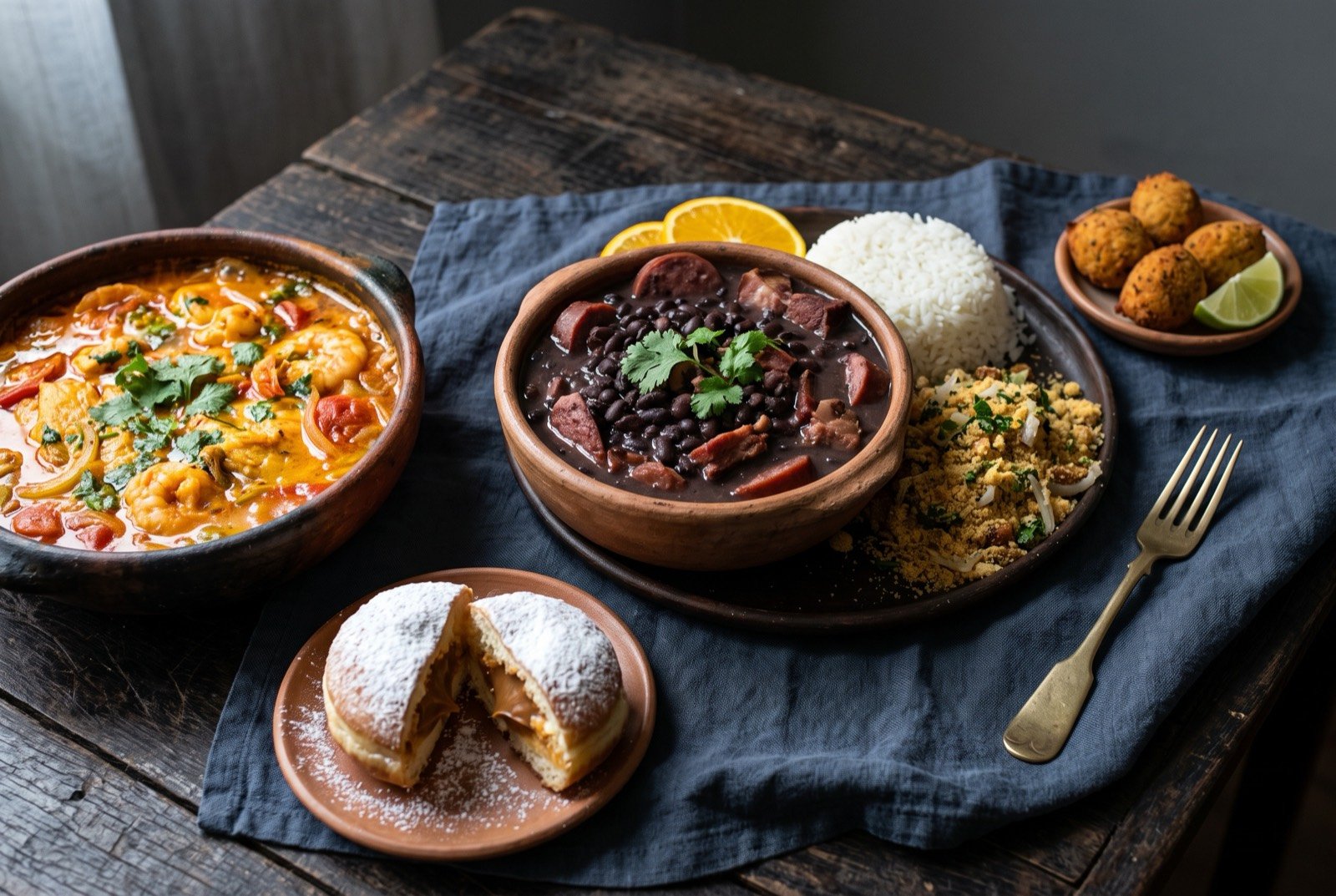
A fleeing royal court and a fired clay pot, arriving by two completely different roads: in 1808 Dom João VI landed at Rio de Janeiro with some fifteen thousand people fleeing Napoleon, and inside a decade the crown's own appetite had reshaped the carioca table from the top down. A few hundred kilometres south in Espírito Santo, an indigenous cooking method older than any of it, fish sealed and slow cooked over embers, survived the same Portuguese arrival by changing its vessel rather than its logic: the moquém became the panela de barro. What holds the two together, and sets both apart from Bahia's dendê coast, is what neither ever adopted: no red palm oil, and in Espírito Santo's case, no coconut milk either. Every dish as tradition built it, then what a modern chef would change.
Sources and review · What this chapter does not assert · How we research · Spotted something wrong?
A Sense of Place
Two coasts, one exclusion. Rio de Janeiro's carioca table and Espírito Santo's capixaba coast are geographically separate, historically distinct in how each was settled, and covered here as one volume because both are Portuguese imperial and ecclesiastical cooking built without the fat and the colouring agent that define Bahia's kitchen a few hundred kilometres north. Neither uses dendê palm oil. Espírito Santo goes further and excludes coconut milk too, using olive oil and urucum, annatto, instead; Rio's own line is a shade softer, dendê is absent without exception, but coconut milk turns up in some carioca moqueca alongside olive oil, tomato and coriander, a genuine complication this chapter states rather than smooths over. This is not the whole of either state's food, and it is deliberately not São Paulo, a few hundred kilometres further south again, whose cooking runs on a nineteenth and twentieth century immigration economy built on coffee wealth rather than on the crown and the church, and which belongs to its own volume (AM-43).
The defining logic
| Element | Carioca (Rio, this volume) | Capixaba (Espírito Santo, this volume) | For contrast: Bahia (AM-39) |
|---|---|---|---|
| Fat | Olive oil, pork fat; coconut milk appears in some carioca moqueca, not structural | Olive oil, historically “azeite doce,” never dendê | Dendê, coconut milk |
| Colouring agent | None fixed; tomato and pimentão common | Urucum | Dendê |
| Starch | Wheat bread, white rice, farinha de mandioca | Farinha de mandioca, pirão | Cassava flour, rice, corn |
| Aromatic base | Garlic, bay leaf, coriander, pimentão | Coriander, garlic, malagueta, urucum | Dendê, dried shrimp, ginger, malagueta |
| Signature vessel | Any pot; no fixed material | Unglazed clay panela de barro, hand built in Goiabeiras | Wide shallow pan, sometimes clay |
| Religious frame | Catholic feast and fast calendar, Lent, Christmas Eve bacalhau | Catholic, especially Holy Week | Candomblé's comida de santo, syncretised onto Catholic feast days |
The court that arrived all at once
Rio's food identity has an unusually precise starting date, which is rare enough in this atlas to be worth stating plainly. Dom João VI, then Prince Regent of Portugal, landed at Rio de Janeiro on 7 March 1808, fleeing Napoleon's invasion of Portugal, at the head of a court of roughly fifteen thousand people carried on thirty four ships under Royal Navy escort. This was not a slow multi-generational trickle of Portuguese settlement, of the kind that shaped most of colonial Brazil; it was an entire royal household, cooks, bakers and all, arriving inside a single decade and reordering the city's food supply by decree. A royal order gave the court first claim on poultry purchases, and estimates put daily court consumption at roughly five hundred and thirteen chickens, capons, pigeons and turkeys, plus ninety dozen eggs, rising to some two hundred thousand birds and thirty three thousand dozen eggs a year, provoking real shortages and real resentment among ordinary cariocas who found themselves competing with the crown for eggs. A dedicated Brazilian academic study exists on this exact period, food culture at the Joanine court between 1808 and 1821, and this chapter could not obtain its full text within the research budget, only its title and abstract; it is named here rather than quietly relied upon, and is worth a future revision's direct pursuit. What can be stated with confidence is the shape of the consequence: salt cod, wheat bread and pastry, olive oil and, above all, convent sweet making entered Rio's repertoire as elite and then civic food, arriving with an installed court rather than accumulating over generations the way most colonial cuisines do.
Why Espírito Santo did not become a second Bahia
The most serious answer this chapter found to why capixaba cooking diverged so completely from Bahian cooking, given both are Portuguese-colonial Atlantic coasts, is demographic, and it comes from a named academic source rather than received wisdom. Patrícia Merlo, a UFES historian with a doctorate in social history from UFRJ, argues that Espírito Santo received comparatively few enslaved Africans across its colonial history, and that those who did arrive came predominantly via the Angola, Benguela and Cabinda axis feeding the port of Luanda, a population whose food habits, per Merlo's own doctoral research and that of Adriana Pereira Campos, were already closer to the Portuguese than to the West African traditions that shaped Bahia. Bahia, by contrast, drew a far larger and more concentrated population from Mina, Jeje and Nagô backgrounds, a community folklorist Câmara Cascudo credits with actively defending its own food, partly through Candomblé's own religious structure (see AM-39). Espírito Santo's low population density and relative isolation until the early nineteenth century, on Merlo's reading, kept its coastal cuisine on an indigenous-plus-Portuguese axis rather than developing Bahia's strong African retention. This is Merlo's own scholarly argument, not settled consensus; she notes an alternative view exists, that moqueca generally descends from a Portuguese peixada to which enslaved cooks later added African ingredients, a framing she herself reserves more for Bahia's variant than for Espírito Santo's.
The History in Layers
The indigenous core, and what actually survived it
Before either Portuguese court or Portuguese peasant settler arrived, the coast that is now Espírito Santo already had a cooking technology of its own: moquém, from Tupi, roughly “drying rack,” the practice of slow roasting fish or meat wrapped in leaves over or beside embers, cooking gently in its own juices rather than over direct flame. The earliest documentary trace is a 1554 letter from Padre Luís de Grã; later Jesuit accounts, Padre Fernão de Cardim in 1584, Padre Monteiro in 1610, describe the technique with real admiration, and from the eighteenth century on increasingly link it specifically to fish. “Moqueca” is derived directly from “moquear,” the verb for this method. Patrícia Merlo's own formulation is the clearest single sentence this chapter found anywhere in its research on Espírito Santo: o moquém capixaba então é a panela de barro, the clay pot is the modern vessel form of the indigenous moquém, because both cook slowly, gently, in the food's own liquid. Archaeologist Celso Perota's 1997 study of the Goiabeiras potters traces the ceramic technique itself to the Tupi-Guarani and, in greater number of identified elements, specifically to the Una people, knowledge later carried forward by a genealogically mixed population of colonists and the descendants of enslaved Africans who came to occupy the same mangrove margins. This is not a clean indigenous-to-Portuguese-descended line; it is messier and more honestly Brazilian than that.
The colonial court economy, and the elite Portuguese repertoire it installed
Covered above in A Sense of Place: the 1808 arrival of the Portuguese court reordered Rio's food supply within a decade rather than a century, and brought with it the fat, starch and sweet-making tradition, olive oil, wheat, egg yolk and sugar, that still marks carioca cooking as Portuguese-imperial rather than Afro-Brazilian. Rio's later concentration of dedicated Portuguese restaurants and bacalhau specialists, Adegão Português, A Marisqueira, Rancho Português among the named survivors, is reported to trace specifically to nineteenth and twentieth century immigration from Minho and Trás-os-Montes in northern Portugal, with Ramos, Visconde de Carvalho and Ilha do Governador named as strongholds; this detail carries only moderate confidence and deserves a firmer migration-history source before being stated as settled.
The nineteenth century codification of feijoada, and a genuine, unresolved disagreement about who made it
The popular story holds that feijoada was invented by enslaved people in the senzala, who took the offal and undesired cuts, ears, tails, trotters, that plantation owners discarded, and stewed them with black beans out of necessity. This does not survive checking, and this chapter states that plainly rather than repeating it. Câmara Cascudo, Brazil's foundational food historian, calls the senzala-invention story outright absurd: Portuguese cooking did not despise offal and trotters, which were standard Iberian ingredients, and what enslaved people actually subsisted on was overwhelmingly beans with cassava flour, not a meat-rich stew. Cascudo instead traces feijoada as currently known, beans and varied cured meats cooked together as a named, served dish, to nineteenth century Rio de Janeiro restaurants and hotels, patronised by the same slaveholding elite the myth imagines it was invented against, with the technique's deeper root in “feijão gordo,” a bean-and-salt-pork stew Portuguese settlers had already brought to colonial Brazil, a case made by Carlos Alberto Dória working from Gilberto Freyre's framework. Raul Lody, the Rio-born anthropologist, agrees the folk mechanism is false, but keeps African culinary agency central rather than displacing it toward the elite restaurant story, arguing Iberian cuisine already used blood and fat sausages and that feijoada's African imprint runs deep through the hands that shaped Brazilian cooking generally. This chapter reports both positions rather than choosing between them, because the disagreement is real and unresolved, not a settled debunking with a single tidy replacement. What every source agrees on is negative: no primary documentary trace of the senzala-invention story exists anywhere, and the earliest concrete references to something recognisable as feijoada point to nineteenth century restaurants, not slave kitchens.
Heritage recognition, precisely stated
It is the pot-making craft that carries federal weight, not the dish. IPHAN registered the Ofício das Paneleiras de Goiabeiras as national heritage on 20 December 2002, revalidated 31 August 2021, described academically as Brazil's first geographic indication in the craft category. The dish itself has only state and municipal recognition: Espírito Santo's State Law 7.567/2003 declared moqueca the state's typical food, State Law 10.463/2015 declared it intangible state heritage, and a separate Vitória municipal bill did the same at city level. A coalition including the Prefeitura de Vitória, UFES and Sebrae-ES was, at the time of the most recent reporting found, still assembling the dossier to pursue federal registration of the dish itself, alongside a proposed “Authentic Moqueca Capixaba” quality seal; this remains unresolved and in progress, not completed, and no specific current year could be confirmed for its status. Separately, Rio's own heritage apparatus has moved in the same period: the city listed fourteen traditional bars as Patrimônio Cultural Carioca by municipal decree, and a 2012 decree made the beach vendors of iced mate, lemonade and Biscoito Globo intangible cultural heritage of the city in their own right, citing the beach itself as Rio's defining democratic social space.
The modern moment: a live argument about which moqueca is the real one
In 1974, the Espírito Santo journalist Cacau Monjardim, freshly returned from a trip to Bahia where he had told Bahians their moqueca was too heavy, coined the line that still organises this whole rivalry: moqueca é capixaba, o resto é peixada, moqueca is capixaba, the rest is fish stew. His birthday, 30 September, is now Vitória's official Dia da Moqueca Capixaba by municipal law. The argument resurfaced nationally in 2026, when former president Lula publicly repeated a version of Monjardim's line to justify wanting to visit Espírito Santo, prompting the Bahian chef Túlio D'Emidio to respond on the record that Bahian moqueca requires dendê to be authentic, without it “it is merely a stew,” while confirming from the Bahian side exactly what the capixaba version leaves out: coconut milk, bell pepper, dendê, replaced with urucum and olive oil. No Espírito Santo figure was found on record rebutting D'Emidio directly in that specific 2026 exchange, which this chapter notes as a real gap rather than filling it with an invented quote; the loudest capixaba voice on record remains Monjardim's own decades-old line. On the Vitória side, Chef Juarez put the underlying philosophy more calmly, after TasteAtlas ranked moqueca baiana above moqueca capixaba on a world seafood list: “menos é mais,” less is more, arguing the shorter capixaba ingredient list is a deliberate choice to foreground the fish, and that ranking the two dishes against each other barely makes sense since they are, at bottom, different dishes sharing one name.
The Flavour Arsenal
Bacalhau, dried salt cod, is this volume's single most important imported ingredient and the clearest direct throughline from the 1808 court to today's carioca and capixaba table. It arrives in Brazil, as it always has, from Norway and from Portugal itself; there is no distinct “Brazilian bacalhau,” only Brazilian ways of buying and using the Portuguese and Norwegian product. Grade and cut are the two decisions that actually matter: Atlantic or Norway cod, sold whole or in loins, commands a clear premium over Pacific cod sold pre-shredded, desfiado, and the two are not interchangeable across dishes. A loin's flake should stay visible, as in bacalhoada; desfiado is correct, and considerably cheaper, wherever the fish is bound into a mash, as in bolinho de bacalhau. Desalting time scales directly with cut thickness, a whole loin needs meaningfully longer under running or repeatedly changed water than a pre-shredded pack, which is a timing decision, not only a shopping one.
Urucum, annatto, Bixa orellana, is Espírito Santo's answer to the colouring job dendê does in Bahia, and it works on a completely different chemical principle: dendê is itself an oil carrying its own pigment and aroma, where urucum is a hard seed whose colour must be actively extracted, traditionally by warming the seeds in oil until the fat runs deep orange, then discarding the spent husks. Brazilian cooks buy this pre-extracted, as colorau, an oil-infused ground annatto seasoning, rather than working from raw seed at home. Urucum is not native to Espírito Santo, its natural range runs through Amazonas, Pará, Maranhão, Ceará and Bahia, but is cultivated there among other states as a secondary crop; this chapter treats it as an adopted colourant tradition rather than claiming a distinctive capixaba growing culture, since no source documents one comparable to Bahia's own dendê groves.
Palmito, heart of palm, appears fresh in Espírito Santo, cut from pupunha palm for torta capixaba, and jarred or tinned everywhere else in Brazil for everyday cooking; fresh pupunha heart has a firmer bite and a faint sweetness that jarred palmito, softened by brine, does not fully replicate.
Feijão preto, couve, laranja. Black beans, sliced collard greens and orange sit together as feijoada's fixed frame: daily black bean eating, not only for feijoada, is described repeatedly in Rio's own popular writing as a specifically carioca habit rather than an occasional-use grain the way it is treated elsewhere in Brazil, a claim worth stating with the hedge it deserves, since it rests on popular-press framing rather than a dietary survey. Couve is sliced into a fine chiffonade and briefly sautéed, never braised soft. Orange, sliced or in segments, is the fixed digestive garnish alongside the stew, a genuinely universal convention across every source this chapter found.
Cachaça, specifically Cachaça de Paraty. Paraty, on the Rio state coast, has produced cachaça since around 1600 and held two hundred and fifty three registered stills by 1799, a hundred and fifty five of them in Paraty itself; by the early nineteenth century the region was producing some eight hundred and forty five thousand litres a year, and the town's own name became, for over a century, a period synonym for cachaça nationally. Only seven stills remain today of the more than a hundred that once operated. In 2007, Paraty's cachaça became the first spirit in Brazil to receive a geographic indication, restricting the name to cachaça genuinely made within the municipality, the same legal instrument that protects Champagne or Parma ham.
Erva-mate gelada, iced mate, is Rio's beach drink, and its own history is a useful corrective against reading it as either purely carioca or purely gaúcho: the plant and the infusion tradition are indigenous Guarani in origin. The commercial product that made it a Rio beach fixture is Matte Leão, founded 1901 in Paraná, whose innovation was toasting the yerba mate for a caramelised flavour rather than serving it green; cold consumption on Rio's sand and at Maracanã became fixed from the 1950s, carried by street vendors calling “Olha o mate!”
The Technique Ladder
Six rungs, each explained by why it works, not only what it does.
Rung 1. Stagger the meats by cut, not one pot simmering
Feijoada's traditional build adds its meats in a specific order determined by how each one behaves under heat: long-soaked salted cuts and bacon go in first because they need the longest time to release their own salt and soften; tougher fresh cuts, tail, ear, trotter, follow once the pot has real body; sausages go in last because they need only enough time to cook through, not to break down. This works because a bean stew's real enemy is uniform overcooking, everything reduced to the same soft texture regardless of what it started as, and staggering by cut is simply respecting how differently pork tail and fresh linguiça actually cook.
Rung 2. Deconstruct into components, each finished separately, then composed
Rio's own two-star kitchen Oro serves a documented “feijoada Oro,” suckling pig, sausage, dried meat and greens presented as distinct, separately finished elements rather than one long-simmered pot. This is the logical extension of Rung 1: if staggered cooking already respects that different cuts need different treatment, cooking each cut fully in its own vessel to its own correct doneness, then plating them together, respects it completely, at the cost of the single unifying pot liquor a home cook usually wants back at the end.
Rung 3. Apply starch chemistry to a rustic snack
Kátia Barbosa's bolinho de feijoada, invented at her boteco Aconchego Carioca, reworks feijoada's own leftover culture, Monday's cold pot repurposed as a fried snack, with real technical precision: raw cassava flour for its starch's binding strength, sour starch, polvilho azedo, added specifically for elasticity, cabbage folded through only barely wilted rather than fully cooked so it keeps crunch inside the fried shell, and tapioca gum standing in for egg as the binder. This is not French method imported onto a Brazilian dish; it is exactly the kind of deliberate, technically precise handling of an indigenous ingredient this atlas's animating idea describes, done here with cassava starch rather than any borrowed technique.
Rung 4. Build moqueca capixaba hot, urucum first and undisturbed
Where Bahian moqueca (AM-39) is built low and slow under a lid, letting coconut milk's steam finish the dish over fifteen to twenty minutes, capixaba moqueca is built fast and hot: urucum oil goes into the base of the clay pot first, then a bed of onion and tomato, then the fish, dressed again with more urucum oil for colour just before it goes over direct heat, and the whole dish is done in twenty to twenty five minutes rather than gently coaxed. This works because there is no coconut milk here to reduce and finish; the dish depends instead on the clay pot's own heat retention doing the work a longer simmer does elsewhere.
Rung 5. Treat the clay pot as a real variable, honestly bounded
No source this chapter reached, including a ceramics industry association's own feature on the Goiabeiras potters, offered a chemical explanation of why the unglazed clay itself changes the finished dish, beyond the historical argument that it is the modern vessel form of an older slow-cooking method. A claim that the clay reduces the acidity of tomato and chilli, offered locally as the reason capixaba moqueca does not cause heartburn the way other versions can, rests on a single source in this chapter's research and is stated here with that caveat rather than as settled chemistry. What can be stated with confidence is that the vessel is not optional folklore: Espírito Santo's own heritage law and its 2002 federal craft registration both treat pot and dish as one continuous tradition, and a British kitchen without access to genuine Goiabeiras ware should reach for the nearest mechanical equivalent, a Spanish cazuela, rather than treat any metal pan as a neutral substitute.
Rung 6. Let live fire organise the dish, not merely finish it
Felipe Bronze's stated principle at Oro treats fire as the primary cooking medium across an entire tasting menu, modern technique built around braising coals and grill flame rather than replacing them with a water bath. Applied to this volume's rustic, boteco-rooted dishes, this means reaching for direct heat, a hard sear over coals, a short blast under a grill, before a sous vide bath, wherever the traditional dish already implies char or crust rather than gentle poaching.
Ferment or Preserve Bench
This volume's preservation tradition is genuinely thinner than several others in this atlas, and this chapter states that honestly rather than inventing a fuller bench than the sources support. What it has is inherited Portuguese salt-curing technology rather than a distinct Brazilian fermentation practice.
1. Bacalhau, salt curing in reverse
The dried, salted cod at the centre of this volume is not cured in Brazil, it arrives already cured from Norway or Portugal, but the home kitchen's own real technique is the reverse process: desalting under repeatedly changed or running water, timed to the thickness of the cut, is the one hands-on preservation skill every carioca and capixaba cook actually practises.
2. Carne seca and the salted pork cuts, Iberian dry-salt curing carried to Brazil
Dried salted beef and the salted tail, ear and trotter that anchor feijoada are cured by the same dry-salt method Portuguese settlers brought with them, packed in coarse salt and air-dried or lightly smoked, a preservation technology built for a hot climate without refrigeration rather than a distinctly Brazilian invention.
3. Cachaça de Paraty, a genuine distillation tradition with real depth
Covered fully above: production dating to around 1600, a peak of over a hundred registered stills, and Brazil's first geographic indication for any spirit, granted in 2007. This is the one part of this volume's preserve bench with real historical weight behind it, and it sits, appropriately, outside the kitchen entirely.
Sourcing in Britain
Verified September 2026. Where a supplier could not be fully confirmed, or where no dedicated UK stockist could be found, that is said plainly rather than smoothed over.
- Bacalhau, the decision that matters most. Genuine bacalhau, Atlantic and Norway loins as well as Pacific cod sold pre-shredded as desfiado, is buyable in the UK from Delícias UK, a Portuguese, Brazilian and Spanish deli with UK-wide delivery. Confirmed brands include Rui Costa & Sousa, sold as “Sr. Bacalhau,” and Lugrade, with Atlantic loins priced roughly two to three times the Pacific desfiado product per kilogram. Buy desfiado specifically for bolinho de bacalhau, where the fish is bound into a mash anyway and a loin's cost is wasted; reserve a whole loin for a dish where the flake stays visible. No dedicated Brazilian bacalhau brand exists as distinct from the Portuguese product; Brazil imports its own cod from the same two sources.
- Urucum, buy colorau rather than raw seed. A UK spice merchant will sell raw annatto seed under the name “achiote” rather than “urucum,” and it needs infusing in warm oil for ten to fifteen minutes before use. The Brazilian Centre's online shop stocks colorau, the pre-extracted, oil-infused seasoning powder Brazilian cooks actually use, which is the closer match for authentic capixaba colour and worth seeking out specifically rather than reaching for a generic South Asian spice shop's achiote seed.
- Palmito. Genuinely well sourced: Emporio Brasil stocks jarred heart of palm directly, and Mercearia Brasil, 773 Harrow Road, Kensal Green, names it among its stock. UK and European palmito is typically jarred in brine rather than tinned, the reverse of the American market.
- Linguiça. Emporio Brasil stocks genuine linguiça calabresa under the Top Brazil brand. Where it is unavailable in time, Portuguese chouriço is the honest fallback over Spanish chorizo, whose heavier cure and different smoking time changes the texture of a long-cooked feijoada.
- Feijão preto, couve, cachaça, erva-mate. Sous Chef UK stocks black beans specifically marketed for feijoada. Couve, collard greens, is a genuine UK gap: not commercially grown here and unreliably stocked even by African and Caribbean grocers, who remain the best chance of finding it, sometimes under East African names like sukuma wiki; spring greens or cavolo nero are the honest default substitute, closer in leaf structure and cooking behaviour than kale. Cachaça is well served at the specialist level, Master of Malt stocks Leblon and Novo Fogo, both genuinely artisanal tiers worth the premium over mass-market Pitu or Velho Barreiro. Erva-mate for chimarrão specifically, rather than the Argentine-style yerba mate most UK health-food shops stock, is available from UruShop under the Barão brand, explicitly marketed for chimarrão.
- Farinha de mandioca. Yoki toasted cassava flour, via Sous Chef UK, is the same reliable route this atlas has already documented for Bahia (AM-39).
- The panela de barro, honestly the weakest link in this chapter's sourcing. No current UK retailer selling genuine hand-built Goiabeiras clay ware was found. A Spanish cazuela, unglazed or interior-glazed, available from Terracotta World and Pure Spain, is the honest substitute: both are low-fired earthenware built for slow, even heat retention over direct flame, the real cooking behaviour moqueca needs, though the tannin-sealed, fully unglazed Goiabeiras finish and the cazuela's usually glazed interior are genuinely different surfaces, a difference this chapter states rather than glosses over. A Big Green Egg cannot substitute for the pot itself, it is the wrong tool for a gentle stovetop simmer, but earns a place smoking fish or charring aromatics before they finish in a cazuela on the hob.
- Named shops. In London, the Brazilian Centre has four branches, Stockwell, Stamford Hill, Hackney and North Finchley, with UK-wide delivery through its online arm, produtosbrasileiros.co.uk; Emporio Brasil trades online with confirmed live stock of palmito and linguiça; Casa Brasil trades from Queensway Market in Bayswater, established 1989, though its grocery stock beyond magazines and general goods was not independently confirmed in this research.
Voices and Sources
On the history and the demographic argument
- Patrícia Merlo, UFES historian. Her peer-reviewed article “Repensando a tradição: a moqueca capixaba e a construção da identidade local,” Interseções (UERJ, 2011), read in full, is the anchor source for this chapter's entire Espírito Santo history section.
- Celso Perota, archaeologist, whose 1997 study of the Goiabeiras potters is cited within Merlo's work.
On feijoada's contested history
- Câmara Cascudo, whose História da Alimentação no Brasil is the ur-text for the senzala-myth debunking, consulted here via secondary citation rather than direct text, worth the chapter's own future revision sourcing directly.
- Carlos Alberto Dória, on the “feijão gordo” Portuguese antecedent.
- Raul Lody, whose column “O mito da criação da feijoada” keeps African culinary agency central even while rejecting the folk mechanism.
On boteco culture
- A genuinely academic UFRJ source, the Revista Minerva piece “Botecos marcam a sociabilidade carioca,” naming four researchers on record, Rafael Haddock-Lobo, Marcos Paulo Ferreira de Góis, Myriam Melchior and Leonardo Monteiro Iório, whose fieldwork on Rio's informal drinking geography and whose named critique of “gourmetização,” the aestheticised, working-class-excluding boteco revival, anchors this chapter's honesty about what is happening to that culture now.
- Ruy Castro, author of Botecos do Rio: Memórias Cariocas, the single best available named-author source on boteco culture, consulted here only via secondary reference.
On the modern restaurant scene
- Rafa Costa e Silva of Lasai, on sourcing discipline as the real modern technique.
- Felipe Bronze of Oro, on fire as the organising principle and the documented “feijoada Oro.”
- Kátia Barbosa of Aconchego Carioca, on the bolinho de feijoada's starch chemistry.
- Rafael Cagali of Da Terra, London, the only Brazilian-identified restaurant with two Michelin stars outside Brazil, whose own explicit refusal to label his cooking “Brazilian” is quoted directly here rather than smoothed into a simpler claim.
- Chef Juarez, Vitória, and chef Túlio D'Emidio, Salvador, both quoted on the moqueca capixaba versus moqueca baiana question.
On UK sourcing
Delícias UK, Emporio Brasil, the Brazilian Centre and produtosbrasileiros.co.uk, Sous Chef UK, UruShop and Master of Malt, all consulted directly for live product listings; portal.iphan.gov.br, Brazil's federal heritage institute, for the Goiabeiras registration; brasileirosemlondres.co.uk, a genuine Portuguese-language London-Brazilian community resource.
Things this chapter has deliberately not asserted
- That feijoada was invented in the senzala. Every source found rejects this, though Cascudo, Dória and Lody disagree with each other about what the truer story is; this chapter reports the disagreement rather than resolving it.
- That petit gateau is a Rio invention. It is not even a Brazilian invention: the underlying molten-centred cake is credited to French chef Michel Bras in 1981, and its documented Brazilian debut, by French chef Érick Jacquin, who is on record saying he only renamed it, was at Le Coq Hardy in São Paulo in October 1994, not in Rio. No source anywhere connects a specific Rio restaurant to its invention.
- That camarão na moranga is a native carioca dish. Multiple independent sources place its actual origin around 1945 on Ilha Anchieta, Ubatuba, on the São Paulo coast, not in Rio de Janeiro, despite its wide popularity in Rio's own botecos and restaurants today.
- That Goiabeiras clay chemically reduces the acidity of tomato and chilli in moqueca capixaba, offered locally as the reason the dish doesn't cause heartburn. This rests on a single source found in this chapter's research and is named here as reported tradition, not verified chemistry.
- That “Friday is feijoada day” in Rio, a claim found in one recipe-adjacent source and directly contradicted by the dominant, better-attested Wednesday-and-Saturday convention.
- That caldinho de feijão descends from a sixteenth century senzala practice. No source supports this beyond unverifiable repetition; the two competing twentieth century boteco origin stories given in this chapter's recipe section are themselves informal tradition, not documented history.
- That bacalhoada, arroz de polvo, bolo de aipim, torta de palmito and petit gateau are established well enough by this chapter's research to be given full recipes. Sourcing for all five was thin, generic, or, for petit gateau, actively misleading about its own origin; they are named in passing rather than treated fully, and a future revision with a dedicated further research pass is the honest place to add proper recipes where the sourcing supports them.
- That Espírito Santo's federal heritage bid for moqueca capixaba the dish, as opposed to the pot-making craft already registered since 2002, has been resolved. It remains an active, undated-as-of-writing proposal, not a completed registration.
- That any current UK retailer sells genuine hand-built Goiabeiras panela de barro. None was found; the cazuela substitute recommended in this chapter is stated plainly as a substitution, not a discovered equivalent.
Stagger the meats by cut, not one pot simmering
Feijoada's traditional build adds its meats in a specific order determined by how each one behaves under heat: long-soaked salted cuts and bacon go in first...
Deconstruct into components, each finished separately, then composed
Rio's own two-star kitchen Oro serves a documented “feijoada Oro,” suckling pig, sausage, dried meat and greens presented as distinct, separately finished...
Apply starch chemistry to a rustic snack
Kátia Barbosa's bolinho de feijoada, invented at her boteco Aconchego Carioca, reworks feijoada's own leftover culture, Monday's cold pot repurposed as a fried...
Build moqueca capixaba hot, urucum first and undisturbed
Where Bahian moqueca (AM-39) is built low and slow under a lid, letting coconut milk's steam finish the dish over fifteen to twenty minutes, capixaba moqueca...
Treat the clay pot as a real variable, honestly bounded
No source this chapter reached, including a ceramics industry association's own feature on the Goiabeiras potters, offered a chemical explanation of why the...
Let live fire organise the dish, not merely finish it
Felipe Bronze's stated principle at Oro treats fire as the primary cooking medium across an entire tasting menu, modern technique built around braising coals...
The dishes
- Feijoada carioca Rio de Janeiro
- Bolinho de bacalhau Rio de Janeiro
- Caldinho de feijão Rio de Janeiro
- Picadinho Rio de Janeiro
- Cozido carioca Rio de Janeiro
- Isca de peixe Rio de Janeiro
- Moqueca capixaba Espírito Santo
- Torta capixaba Espírito Santo
- Sonho Rio de Janeiro
Sources and review
- Researched
- 6 sources cited
- Reviewed
- Not yet reviewed from inside the tradition
- Cooked
- Not yet cooked and reported
Where this volume comes from
3 research briefs on file for this volume, researched to the rules on How we research. Published 3 September 2026. Last changed 7 September 2026.
The brief's own account of its sources
Rough split. Across both passes, roughly 75 distinct sources were consulted. For the modernist pass, roughly 80 to 85 per cent were genuinely Brazilian, national and regional press including Michelin Guide Brasil's own Portuguese-language site, CNN Brasil's Brazilian edition, Folha Vitória, A Gazeta, Prefeitura de Vitória, IPHAN, O Tempo, Correio Braziliense, Forbes Brasil, Exame, Terra, Rioja.com.