The Americas · Volume 43
São Paulo, the Immigrant Metropolis and Coffee Interior
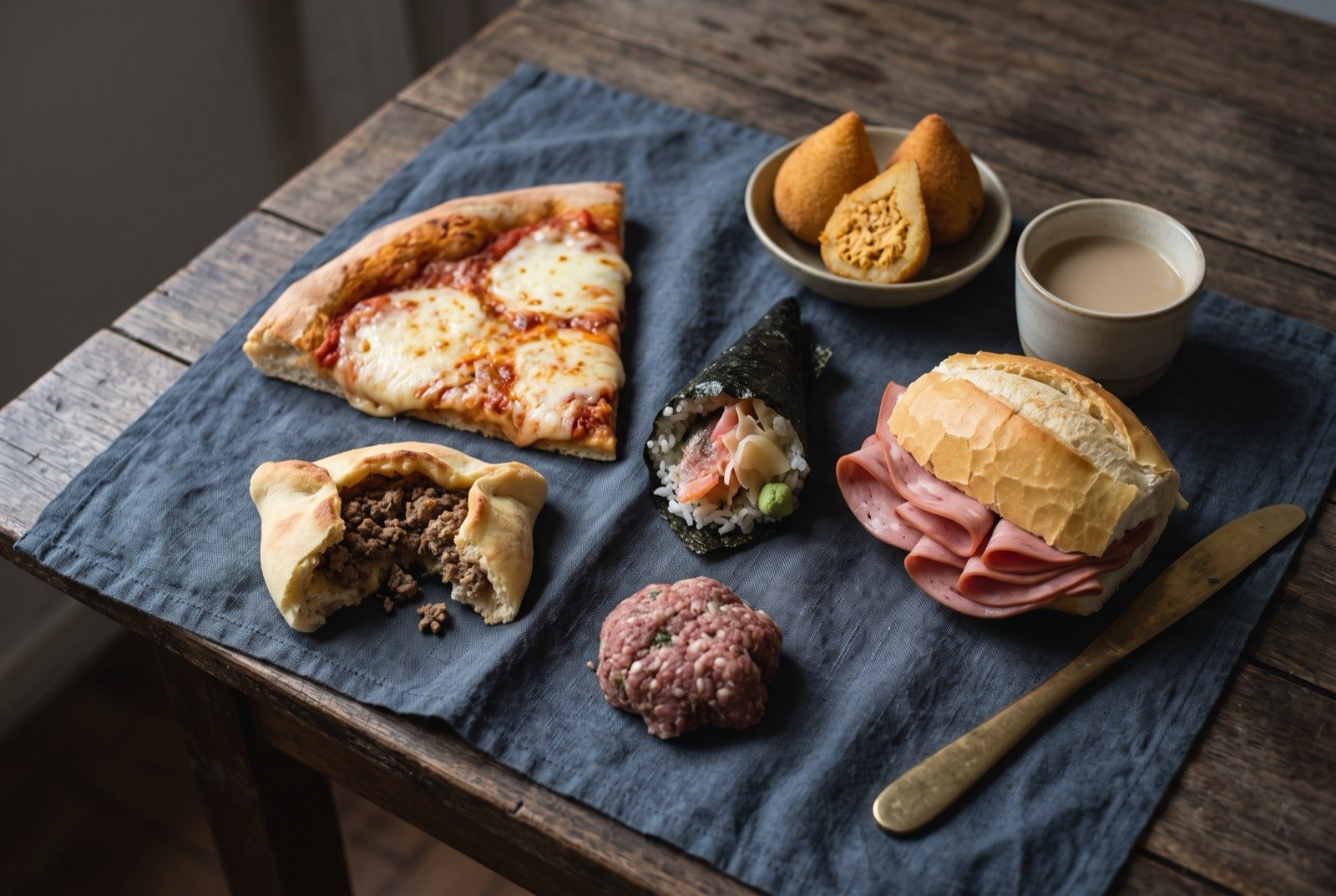
A city with no deep-time cuisine of its own to romanticise, and that absence is the whole story. São Paulo's food is not a single lineage refined over centuries in one place. It is what happens when a bandeirante-Portuguese-Indigenous base, a hard subsistence table of beans, maize flour and pork, gets bought out by coffee money and rebuilt, twice over, by the people that money brought in: Italians fleeing agricultural collapse, Japanese labourers recruited the moment Italy's own pipeline was cut off, and Syrian and Lebanese traders arriving on nobody's subsidy at all. Nowhere else in this atlas is a cuisine's whole identity so directly the fingerprint of one nineteenth-century export crop. Every dish as tradition built it, then what a modern chef would change, in a city that now holds three of Latin America's Michelin three-star kitchens and calls itself, not without evidence, a world capital of Japanese gastronomy.
Sources and review · What this chapter does not assert · How we research · Spotted something wrong?
A Sense of Place
São Paulo is not a coastal cuisine. It sits on an inland plateau, the planalto de Piratininga, and everything about its food follows from the fact that it grew rich from an export crop grown on that plateau's own soil, not from what its own coastline could offer.
The plateau before coffee, and who was on it
The São Paulo plateau was Tupi-Guarani territory: decentralised, semi-nomadic societies combining hunting, fishing and gathering with cultivation of manioc, sweet potato, peanuts and beans, manioc flour the dietary base. Most of the region's original inhabitants were captured by bandeirante slaving expeditions and taken to the villages of São Paulo de Piratininga or São Vicente, or fled south into the forests, and Tupi vocabulary remained dominant in the region's place names, Piratininga, Itaipu, Ubatuba, long after Portuguese became the official language. Because there were very few Portuguese women in the early settlement, Portuguese men had children with Indigenous women, producing a mixed mameluco population that Jesuit accounts of the sixteenth and seventeenth centuries describe as the typical inhabitant of Piratininga, and general Tupi, not Portuguese, remained the region's dominant spoken language across all social classes until the end of the eighteenth century. The colonists lived on maize, cotton, wheat, beans and manioc, plus small-scale livestock and hunting: the direct ancestor plate of what becomes virado à paulista two centuries later.
A table of the defining logic
| Element | The bandeirante-tropeiro base | The coffee-era immigrant layers |
|---|---|---|
| Fat | Pork lard, pigs thriving readily in Brazilian conditions | Olive oil (Italian), tahini and olive oil (Levantine), little historical fat tradition transferred cleanly (Japanese) |
| Starch | Beans with manioc or maize flour, rice | Wheat flour (pizza and esfiha dough), rice seasoned Japanese-style (temaki), noodles (yakisoba) |
| Aromatic base | Garlic, bay, black pepper, comparatively little chile heat | Za'atar, sumac, mint, cumin (Levantine); shoyu, miso, ginger (Japanese); garlic, tomato, basil (Italian) |
| Everyday protein | Pork, egg, dried and fresh beef | Lamb and beef (kibe), chicken (coxinha), raw fish (temaki), pork mortadella (the Italian charcuterie trade) |
| Preservation | Sun-drying, salting | Cured and smoked charcuterie, the Italian deli tradition; pickling, the Levantine table's own accompaniment |
The History in Layers
The bandeirantes, without the marble
This chapter will not repeat the "pioneer hero" version of São Paulo's founding figures, because the version repeats a story the city's own coffee elite manufactured rather than a history the bandeirantes actually lived. Bandeirante expeditions were systematically organised slave raids into the interior, aimed at capturing Indigenous people for forced labour. The University of São Paulo's own teaching laboratory calls bandeirantes "more assassinos do sertões," assassins of the backlands, than noble pioneers, and names figures such as Raposo Tavares and Domingos Jorge Velho as associated with organised violence, including posing as priests to deceive the very communities they intended to capture. The heroic image of the bandeirante as a barefoot nation-builder was substantially built after the fact: from 1903, São Paulo's coffee-wealth political and economic elite funded public art and monuments promoting exactly that image as the state's foundational identity, though the real bandeirantes went largely barefoot, spoke more Guarani than Portuguese, and were mostly mixed-race, considerably darker-skinned than the marble now depicting them. It is worth stating plainly: the same coffee wealth that pulled Italians, Japanese and Levantine migrants into this city also retroactively built the bandeirante myth to give paulista identity a heroic founding story it had not earned on its own terms. Indigenous leaders and activists have protested São Paulo's Monumento às Bandeiras directly, calling it a monument to those who massacred them, and this chapter attributes that protest rather than adjudicating it against the monument's defenders.
Tropeiros and the caipira table
Out of that base grew tropeirismo, mule-train droving that emerged in the seventeenth century to move gold, goods and supplies between economic centres and small settlements, journeys that could run weeks or months on food that had to be dense, portable, resistant to spoiling and quick to prepare on the trail. Feijão tropeiro, beans mixed with manioc flour, pork crackling, sausage, egg and onion, is the direct sibling of virado à paulista rather than a separate invention, and is today claimed as a shared identity dish of Minas Gerais, São Paulo and Goiás alike. Antonio Candido's Os Parceiros do Rio Bonito, the standard academic reference for interior São Paulo caipira culture, based on fieldwork in Bofete in the late 1940s and mid-1950s, identifies beans, maize and manioc as the essential caipira dietary base and treats food exchange, collective labour and folk festival as central to how that society reproduced itself. Candido's own term for the wider cultural-economic zone the bandeirantes' expansion created, "Paulistânia," beyond the modern state's own borders, is the frame the food historian Carlos Alberto Dória still uses for this table.
Coffee, abolition, and a labour system that replaced one coercion with another
From the 1880s São Paulo became Brazil's leading coffee producer, and Brazil the world's largest producer overall from that same year, coffee bringing railways to the state to move the crop to port and, by the 1880s, representing more than 60% of the country's total export earnings, still on the back of enslaved labour at that point. Slavery was abolished in 1888, sharply intensifying a labour need that westward-expanding coffee cultivation had already been growing, and between roughly 1885 and 1902 the state government built a deliberately, heavily state-subsidised immigration policy targeting Italians specifically, who were living through serious economic collapse at home. What followed was the colonato system, the arrangement that replaced slavery on São Paulo's coffee estates: immigrant families, overwhelmingly Italian in this period, contracted to tend an assigned number of coffee trees by household size, whole families including children working from sunrise to sunset, summoned by estate work bells. This should not be told as a simple opportunity story. One studied plantation, Santa Gertrudes, ran up to 1,500 workers and 150 colonist families across eight colonies, with women labouring until childbirth, high infant mortality from poor sanitation, rigid patriarchal family structures enforced by the estate, low wages, and cultural control through mandatory Catholic and Italian-language religious instruction, the first school for colonist children on that estate opening only in 1921. A minority of families did eventually save enough, over a lifetime, to buy their own land, and that possibility is real, but it sat alongside conditions that were harsh, tightly controlled and, in their first years, close to indentured, even though the labour was legally free.
The Hospedaria de Imigrantes opened in the Brás neighbourhood in 1887, designed to house around 3,000 people at a time, and operated for ninety one years until 1978, housing more than 3.5 million people from over seventy nationalities across that span, the overwhelming majority destined for coffee estates. Its recorded annual peak, more than 111,000 people in 1929, remains the twentieth century's record for the site.
The Italian wave, and the exact hinge into the Japanese one
By 1920, 1,078,437 Italian immigrants had entered São Paulo state, roughly 70% of all Italian arrivals to Brazil; the 1920 census recorded 398,797 Italians resident in the state, about 9% of its population, and by 1910 Italians made up 33% of São Paulo city's own urban population. The peak wave was the 1890s, with 210,910 arrivals in the single five year window 1890 to 1894 alone. Regional origin genuinely shifted over the wave's life: parish marriage records from the interior coffee town of São Carlos, 1880 to 1914, show the Veneto as the single best-represented region among Italians who married there, with Calabria and Campania rising through the early twentieth century; within the city, Bixiga and Bela Vista drew mainly Calabrian and Campanian settlers, Brás a strong Neapolitan concentration, Mooca also predominantly southern Italian.
That subsidised flow ended abruptly and specifically. On 26 March 1902 the Italian government issued the Decreto Prinetti, banning subsidised emigration to Brazil after Italian press reports of debt bondage and mistreatment of Italian workers on Brazilian coffee estates. Emigrants now had to fund their own passage, and the flow fell sharply. With that pipeline cut, São Paulo's coffee planters and state government looked elsewhere, and Japan's own emigration policy, a Meiji government pursuing emigration since early in its modernisation drive against genuine rural land scarcity and poverty, plus growing American restriction on Japanese immigration around the same period, made the two states' interests align. This is not two unrelated immigration stories sitting side by side in the same chapter. It is one labour market's demand switching supplier, and the switch has an exact date.
The Kasato Maru departed Kobe on 28 April 1908 and reached the port of Santos on 18 June 1908, carrying 781 contracted immigrants to work coffee fazendas in the São Paulo interior; 18 June is now marked as Japan-Brazil immigration day. More than a third of those 781, 325 people, were from Okinawa prefecture specifically, a detail this chapter found only through Japanese-language sourcing and not through the Portuguese or English material otherwise consulted, a gap worth naming rather than hiding: this chapter's own Japanese-language research was a shallow pass, not a thorough one. Conditions on arrival were harsh: most immigrants intended to work a few years, save and return to Japan, but housing was poor and pay bad enough that debt accumulated rather than savings. Japan's Ministry of Foreign Affairs put the number of people of Japanese descent in Brazil today at roughly two million in 2022, the largest such population outside Japan itself, with São Paulo state holding the largest single share. Liberdade, the neighbourhood now read as the city's Japanese quarter, only began filling with Japanese settlers from 1912, arriving from the interior because many had not adapted to fazenda coffee work; before that, Liberdade's history was a Black one, the site of the old Largo da Forca, a colonial-era execution ground, and its first residents were Black rather than Japanese. The chapter does not want to write Liberdade as empty land waiting for its immigrants.
Syrian and Lebanese São Paulo, arriving on nobody's subsidy
Lebanese and Syrian immigrants began entering Brazil from 1871, with a first documented São Paulo city presence from 1880, and unlike the Italian and Japanese waves above, this migration was not subsidised by the Brazilian state at any point: it happened on its own economic logic. The 1920 census recorded 19,290 Syrians and Lebanese in São Paulo state, nearly 70% of them, 13,302, living in the interior rather than the capital, an important corrective against reading this as a purely city-centre community. By 1907 there were 320 Lebanese and Syrian-owned shops in the city; a study of a 1920s commercial census found more than a fifth of establishments on and around Rua 25 de Março Lebanese or Syrian-owned. The community settled and worked around that street and the district containing the old Mercado Municipal, which before its 1933 rebuild stood at the very corner of Rua 25 de Março and Rua General Carneiro: the Levantine trading quarter and the historic municipal market were, for decades, the same few streets. The economic trajectory ran from peddling on arrival into dry goods, textiles, grain and cattle trading, and by the 1920s in São José do Rio Preto half of all grain buyers there were of Syrian or Lebanese origin.
A crossover this chapter names rather than resolves
Three of this chapter's own dishes belong properly to two food worlds that have no volume of their own yet in this atlas. Esfiha and kibe are as much Levantine dishes as paulistano ones, and their real home, the Levant itself, sits in a Middle East and Anatolia culinary region this atlas has not yet reached. Temaki paulistano is not a Japanese dish at all in the form this chapter treats it, but its ancestor, the hand-rolled temaki of the Edo period, belongs to a Japan and Korea volume equally unwritten here. This is not a gap this chapter can close by itself, and it should not pretend to: the honest move, consistent with how this atlas treats every crossover, is to name the connection plainly and let whichever volume eventually covers the Levant or Japan pick it up properly, rather than either ignoring the debt or trying to write half of someone else's chapter inside this one.
The Flavour Arsenal
Requeijão cremoso, and the genericised Catupiry name. A spun, cultured, unripened cheese curd with a stretchy, mildly tangy, marshmallow-soft melt, closer in structure to a very soft, spreadable mozzarella-family curd than to any Western cream cheese. "Catupiry" is a specific trademarked Brazilian brand that has become genericised in everyday speech the way "Hoover" has in English, and this chapter keeps the two apart: the real product and the word people use for any product like it are not the same claim.
Farinha de mandioca torrada. Toasted cassava flour, the direct descendant of the Tupi dietary base, and the correct product for farofa specifically: raw or uncoloured cassava flour is a different product and will not give the same nutty, crisp result.
Mortadella. The Italian charcuterie trade's clearest single contribution to the paulistano table, at its most visible in the Mercadão's own sandwich culture.
Za'atar, sumac, cumin, mint and tahini. The Levantine aromatic register, carried into esfiha and kibe largely intact, Brazilian pepper substitutions folded into some family recipes rather than replacing the base outright.
Shoyu, miso, nori and ginger. The Japanese aromatic and wrapping register, adapted in Brazil with one addition that has no equivalent in Japan itself: cream cheese, folded directly into the temaki tradition rather than left at its edge.
Palmito. Heart of palm, not an immigrant import but a South American ingredient that became a favoured pizza paulistana topping precisely because it was locally abundant where European toppings were not.
The Technique Ladder
The argument, from inside
Five techniques, each explained by why it works, not only what it does.
Rung 1. Long fermentation, a levain doing the Egyptian flour's own gluten work over time rather than heat
High-end paulistana pizza dough now runs a minimum 24 hours with Brazilian flour blends, up to 48 to 72 hours with imported Italian 00 flour, at hydration as high as 80%. The long, slow ferment lets enzymes and wild yeast build gluten structure gradually, at a strength and evenness a fast commercial-yeast rise cannot match, which is the actual, mechanical reason the resulting crust is lighter, crisper and considerably more digestible than a same-day dough baked hot and fast to compensate for its own weak structure.
Rung 2. Roux, not bread dough, for coxinha's shell
Chicken stock, sometimes with milk, is brought to a simmer and flour worked in and cooked out for roughly ten minutes until the starch is fully gelatinised and the dough pulls together into one mass: functionally a panade, closer kin to choux pastry than to any bread dough, and the reason a well-made coxinha shell holds a clean, dense structure around its filling rather than turning bready or greasy.
Rung 3. Thermal shock for pururuca-style crackling
Dry the skin thoroughly, chill it hard, then hit it with very hot oil or a fierce blast of heat: the sudden temperature differential flashes the skin's remaining surface moisture into steam almost instantly, blistering and crisping it through in seconds rather than the slower, patchier result a steady moderate heat gives.
Rung 4. Ice-cold mincing for kibe cru
Kibe cru's meat is minced the same day it will be eaten and worked with ice in the mixing bowl specifically to keep the hand's own warmth from partially cooking and discolouring the meat grey before it reaches the plate: this is not a chef's flourish, it is the entire reason the dish can be served raw at all.
Rung 5. Buying, not making, the good charcuterie
The Mercadão's own trade logic: a proper mortadella sandwich needs a whole piece cut to order at three to four millimetres by a deli counter that does this work daily, not a pre-sliced supermarket pack, the same logic that made Yucatán's recado a market skill rather than a home one, a trade's daily throughput producing a result a domestic kitchen rarely matches on its own.
The Ferment and Preserve Bench
A comparatively fermentation-light table next to some of this atlas's earlier volumes, and that is itself worth saying plainly rather than inventing a bench where the real cuisine does not particularly have one.
Long-fermented pizza dough. The one genuine, everyday fermentation technology in this chapter, a levain doing gluten-building work across 24 to 72 hours that no fast commercial-yeast rise can replicate.
Cured Italian charcuterie. Mortadella and its cousin salame are not made at home in this tradition any more than recado is ground at home in Yucatán: they are a trade skill, bought from a deli or a market stall that does the work daily, the Mercadão's own logic written into the ingredient itself.
Sourcing in Britain
Requeijão, in place of Catupiry. Real Catupiry-brand cheese is not obtainable in the UK through any credible route found in this research; the honest substitute is a genuine bought Brazilian requeijão, Mabiju or Kaito brand, confirmed in stock at Brazuka Meat, the same product family rather than a Western analogue. A soft, unsalted, high-fat cream cheese without stabilisers gets closer than a standard tub cream cheese, but will never pull into the same elastic strings when hot.
Mortadella. Genuine Italian mortadella, including Bologna IGP, is easy to find in the UK from specialists such as Delicatezza, but only in thin, pre-sliced packs; the thick-cut format the São Paulo sandwich needs is the genuine gap. The honest route is a technique, not a product: buy from an Italian deli counter that slices to order and ask for it cut at three to four millimetres, or order a whole piece in bulk and slice it at home.
Farinha de mandioca torrada. Confirmed, named and in stock: Yoki brand, 500g, from Brazuka Meat, the correct toasted product for farofa specifically.
Palmito. Tinned or jarred only; Kaito and Zaeli brands confirmed in stock at Brazuka Meat, though availability across the wider range of Brazilian brands fluctuates.
Bulgur, tahini, za'atar and Lebanese flatbread. The easiest category in this whole chapter. Al Nakhil tahini and Monalisa za'atar are confirmed in stock at Oasis Market; Duru Koftelik fine-grade bulgur, specifically the grade needed for kibe, is a named and buyable line from MyJam Food. Lebanese flatbread from the genuine London producer Dina is stocked even at Tesco, Asda and Morrisons, not only specialist grocers.
Nori, sushi rice and Kewpie mayonnaise. SushiSushi is the verified, dedicated UK retailer for both, with graded nori worth specifying by name: A or A-plus grade for temaki's structural needs, B grade only good enough for maki that gets cut. Kewpie mayonnaise is stocked widely enough, at Yutaka Shop, Sous Chef, The Wasabi Company and others, to treat as a trivial buy. Cream cheese needs no special sourcing at all, a standard supermarket block.
Brazilian coffee. Café Pilão, the correct brand to name, is confirmed in stock at both Brazuka Meat and RocaBuy, alongside the cloth coador filter that is the genuinely correct piece of kit for how this coffee is actually made.
Pão francês. No dedicated UK product exists; this is a technique gap, not a sourcing one. A strong white bread flour, shaped into small rolls and given a steam-injected bake, gives a closer result than seeking a ready-made equivalent.
The single decision that matters most. A whole piece of proper mortadella, sliced thick to order rather than bought pre-packed, because it underpins the one dish in this chapter, pão com mortadela, whose entire character is a format problem rather than an ingredient one: get the cut wrong and no amount of quality in the meat itself will fix it.
Kit. A pizza stone or steel, run inside the Big Green Egg, is the one genuine addition this chapter makes to the kit already assumed across this atlas: without one, even a kamado run hot will not reproduce a paulistana pizzeria's deck-oven base. Everything else, the sous vide for coxinha's filling and virado's pork, the dehydrator for torresmo-adjacent crisping and bulgur firming, the chinois and high-power blender for smooth sauces and stocks, the spice grinder for kibe and coxinha's aromatics, applies here exactly as it does elsewhere in this atlas.
Voices and Sources
Brazilian academic and institutional sources, prioritised throughout: USP's LEMAD teaching laboratory on the bandeirantes; SciELO Brasil, for the coffee-immigration labour history and the Syrian-Lebanese demographic record; the Museu da Imigração's own history of the Hospedaria; the ALESP state legislature's account of Japanese immigration; Suzano's own municipal government on yakisoba's heritage registration; Antonio Candido's Os Parceiros do Rio Bonito and Carlos Alberto Dória's published work on caipira and Paulistânia cuisine.
On the immigrant communities' own record: Bunkyo, the São Paulo Japanese-Brazilian community organisation, and Discover Nikkei's Portuguese edition, for temaki and the Japanese-Brazilian food record generally; Asharq Al-Awsat, a major pan-Arab newspaper, read directly for the Syrian-Lebanese migration's own account of its origins and numbers.
On the fine-dining scene, verified directly against restaurant and Michelin sources rather than assumed: Jefferson Rueda of A Casa do Porco, whose porcopoca and pork-jowl "sushi" are this chapter's clearest documented examples of a paulistano chef consciously cross-wiring two of the city's own immigrant traditions, and whose earlier tasting-menu treatment of virado à paulista, developed with USP-affiliated researcher Tânia Biazioli, is the strongest documented example found of a São Paulo chef researching a traditional dish's original purpose before restaging it, rather than simply modernising its plating; Rodrigo Oliveira of Mocotó, whose family's Casa do Norte origins and refusal to relocate downtown for prestige is this chapter's clearest counter-example to the idea that elevation requires leaving your own tradition's original setting; Luiz Filipe Souza of Evvai, whose own "Oriundi" language, sometimes Brazilian ingredient with Italian technique, sometimes Brazilian culture with Italian ingredient, is the clearest single articulation found anywhere in this research of this atlas's own founding idea, that every elevated technique has an ancestor; Salvatore Loi and the Fasano family, the "old guard, imported-luxury" pole this chapter reads Rueda and Souza's generation against; Edson Yamashita of Ryo Gastronomia, whose knife precision this chapter treats as the honest model of what elevation actually looks like in the nipo-paulistano lineage, precision over invention. Silvana Azevedo de Almeida, the USP researcher whose decade of work reframes pizza paulistana's own history, deserves particular credit for a finding this chapter leans on directly.
On the traditional dishes: Rita Lobo's Panelinha for coxinha's real ratios and timings; the Prefeitura de São Paulo's own tourism office for its honest debunking of coxinha's popular origin legend; Condephaat for virado à paulista's heritage registration.
Things this chapter has deliberately not asserted
- That São Paulo's bandeirantes were noble pioneers rather than organised slave raiders. The heroic framing is a documented, dated, coffee-era political invention, and this chapter treats it as such rather than as inherited heritage colour.
- That virado à paulista is a single, fixed, unbroken colonial-era recipe. A real source conflict exists over whether its ancestor was a bean dish or a chicken one, and this chapter presents virado as a flexible cooking method rather than one canonical dish.
- That the Princesa Isabel origin story for coxinha is history rather than legend. It fails on its own geographic premise, and the city's own tourism office says plainly that coxinha's true origin will probably never be settled.
- That Silvana Azevedo de Almeida's finding on pizza paulistana predating northern Italian pizza, though specific and credibly attributed, has been checked here against her original doctoral thesis rather than a secondary press report of it.
- That either Bar do Mané or Hocca Bar has the true, prior claim to inventing the Mercadão's mortadella sandwich. The two accounts genuinely disagree and this chapter presents both without choosing.
- That esfiha's point of origin within the Levant, Homs or Baalbek, is settled. A named São Paulo restaurateur's own account admits the dispute runs both ways.
- That the story of an elderly Arab cook teaching Antônio Saraiva the recipe behind Habib's is verified history rather than a widely told, singly sourced anecdote absent from his own published biography.
- That "Nikkei cuisine," the Japanese-Peruvian fusion genre now spreading in Brazil, is the same thing as São Paulo's own century-old nipo-brasileiro sushi and yōshoku tradition. The two share a demographic word and nothing else, and this chapter keeps them apart throughout.
- That São Paulo's Levantine food culture has reached fine-dining or Michelin recognition the way its Italian and Japanese layers have. No Michelin-starred restaurant built specifically around Levantine-paulistano technique was found in this research, and this chapter states that as a genuine gap rather than papering over it with a generic claim.
- That this chapter reached genuine depth in Japanese-language or Arabic-language food history sourcing specifically. What stands here on the Japanese and Levantine immigrant layers rests overwhelmingly on Brazilian Portuguese-language and Brazilian community-press sourcing, with only a shallow Japanese-language pass and a single Arabic-language migration-history article behind it; neither language was searched specifically for temaki's, yakisoba's or esfiha's own food history in the original language, and that gap is named here rather than concealed.
Long fermentation, a levain doing the Egyptian flour's own gluten work over time rather than heat
High-end paulistana pizza dough now runs a minimum 24 hours with Brazilian flour blends, up to 48 to 72 hours with imported Italian 00 flour, at hydration as...
Roux, not bread dough, for coxinha's shell
Chicken stock, sometimes with milk, is brought to a simmer and flour worked in and cooked out for roughly ten minutes until the starch is fully gelatinised and...
Thermal shock for pururuca-style crackling
Dry the skin thoroughly, chill it hard, then hit it with very hot oil or a fierce blast of heat: the sudden temperature differential flashes the skin's...
Ice-cold mincing for kibe cru
Kibe cru's meat is minced the same day it will be eaten and worked with ice in the mixing bowl specifically to keep the hand's own warmth from partially...
Buying, not making, the good charcuterie
The Mercadão's own trade logic: a proper mortadella sandwich needs a whole piece cut to order at three to four millimetres by a deli counter that does this...
The dishes
- Virado à paulista São Paulo interior, bandeirante and tropeiro tradition, Brazil
- Pizza paulistana Brás, São Paulo, Neapolitan immigrant tradition, Brazil
- Coxinha São Paulo, industrial-era street food, Brazil
- Esfiha Syria and Lebanon, Levantine tradition, carried to São Paulo
- Kibe Levant, Syrian and Lebanese tradition, São Paulo
- Temaki paulistano Japan, reinvented in São Paulo, Japanese-Brazilian tradition
- Yakisoba paulistano China (chow mein) via postwar Japan, reinvented in Suzano, São Paulo, Japanese-Brazilian tradition
- Pão com mortadela Mercado Municipal Paulistano (the Mercadão), Italian charcuterie tradition, São Paulo
- Café pingado e pão na chapa São Paulo, Brazil, coffee economy
Sources and review
- Researched
- No outside sources linked
- Reviewed
- Not yet reviewed from inside the tradition
- Cooked
- Not yet cooked and reported
Where this volume comes from
3 research briefs on file for this volume, researched to the rules on How we research. Published 3 September 2026. Last changed 7 September 2026.