The Americas · Volume 41
Minas Gerais and the Cerrado Plateau
Beans, Blood and a Sweet the Convents Never Made
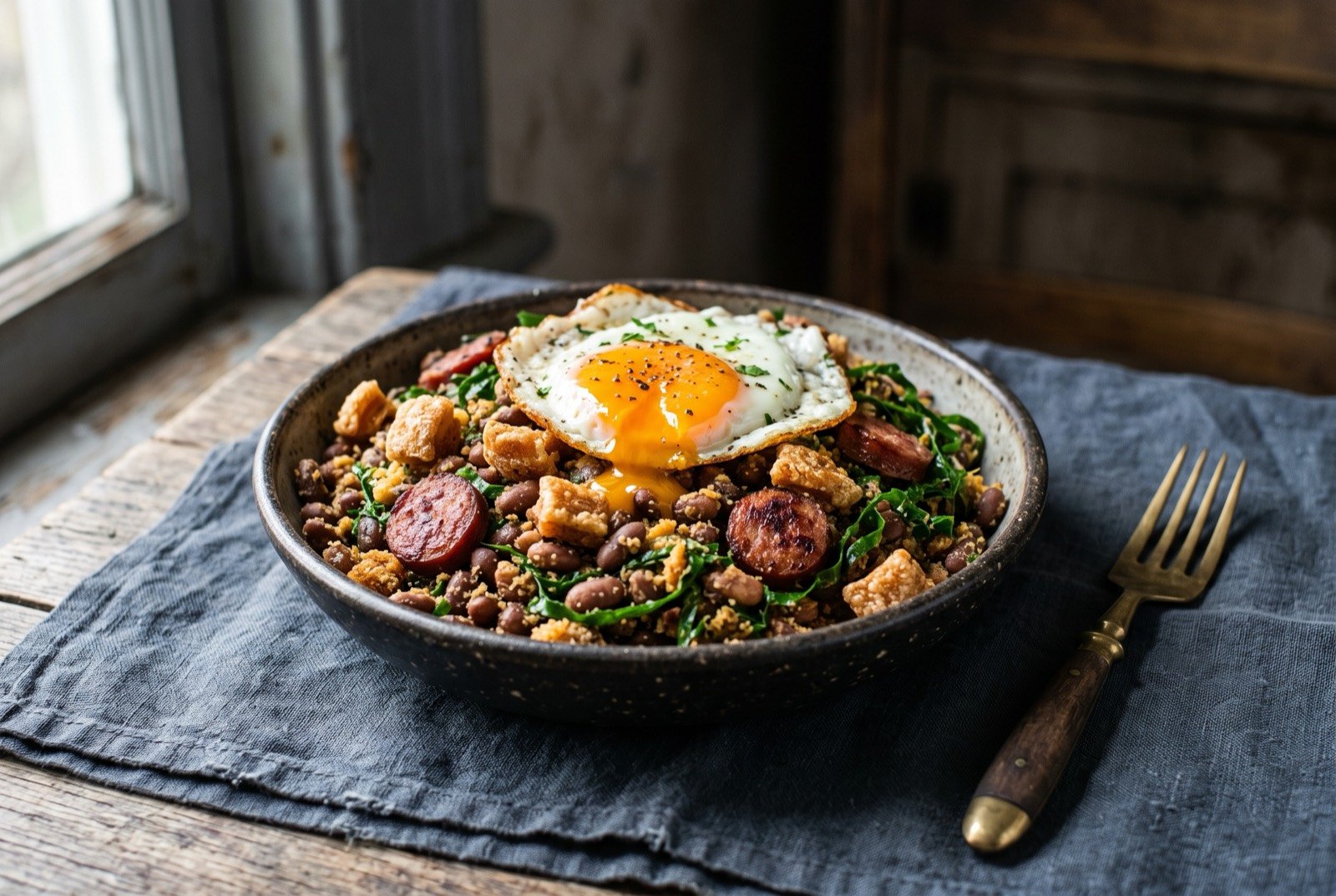
Minas Gerais means General Mines, and the name is the whole history in two words. In 1693 bandeirante prospectors found gold in the rivers of a mountainous, landlocked interior, and within a generation the territory had pulled in more enslaved Africans than any other part of Brazil, all to work riverbeds and diamond pits hundreds of kilometres from the nearest port. When the easy gold ran out, the people who stayed did not have a coastline, a plantation crop or, for a long stretch, even the crown's permission to build a mill or a loom. They had cattle, pigs, maize, cassava and each other, and the cooking that resulted is what happens when a wealthy, isolated, landlocked society is forced to feed itself from what is actually growing around it. That is the argument of this chapter, and it holds for the savoury table and, in a more surprising way, for the sweet one too.
Sources and review · What this chapter does not assert · How we research · Spotted something wrong?
A Sense of Place
Minas Gerais means General Mines, and the name is the whole history in two words. In 1693 bandeirante prospectors found gold in the rivers of a mountainous, landlocked interior, and within a generation the territory had pulled in more enslaved Africans than any other part of Brazil, all to work riverbeds and diamond pits hundreds of kilometres from the nearest port. When the easy gold ran out, the people who stayed did not have a coastline, a plantation crop or, for a long stretch, even the crown's permission to build a mill or a loom. They had cattle, pigs, maize, cassava and each other, and the cooking that resulted is what happens when a wealthy, isolated, landlocked society is forced to feed itself from what is actually growing around it. That is the argument of this chapter, and it holds for the savoury table and, in a more surprising way, for the sweet one too.
The state is not one landscape. The historic mining zone runs along the Serra do Espinhaço, Ouro Preto, Mariana, Sabará and Diamantina, strung together by the Estrada Real, the crown's own road network. The Zona da Mata in the south east is hillier and wetter, closer in temperament to neighbouring Rio de Janeiro and Espírito Santo, its river catfish stews and palm-heart chicken a different table from the interior. The Triângulo Mineiro in the west, wedged against São Paulo, Goiás and Mato Grosso do Sul, runs hot and cerrado influenced, its table closer to Goiás than to Ouro Preto. And the cerrado plateau proper, in the north and north west, is savanna: dry season fires, deep rooted trees, and the fruits and palms, pequi, guariroba, ora-pro-nóbis, that do not grow anywhere else in this book.
| Zone | What shapes the kitchen | Carries |
|---|---|---|
| The mining zone (Serra do Espinhaço, Estrada Real) | Gold and diamond wealth, then its collapse; enslaved labour; the crown's own road network | Pão de queijo, torresmo, molho pardo, doces mineiros |
| The tropeiro corridor | Weeks long mule train routes connecting isolated towns to each other and the coast | Feijão tropeiro, tutu à mineira, vaca atolada |
| The Zona da Mata | Hillier, wetter, closer to the Rio and Espírito Santo table | River fish stews, palm heart |
| The cerrado plateau | Savanna ecology, extractivist harvest, not cultivation | Pequi, guariroba, ora-pro-nóbis |
Across all four, a consistent structural logic holds. The fat is pork lard, rendered from the same pig whose crackling tops the bean pot. The starch is fubá, maize meal, and farinha de mandioca, cassava flour, the latter toasted and folded into fried beans as feijão tropeiro's defining move. The protein backbone is pork in every cured and fresh form, torresmo, linguiça, costelinha, plus dairy: queijo Minas turns up in pão de queijo, in the cheese and guava pairing later nicknamed Romeu e Julieta, in canjiquinha finished with cream. And the cookware is the panela de pedra-sabão, a soapstone pot carved from a single block, tolerant of temperatures up to 1000 degrees Celsius and reported to hold heat roughly twice as long as metal. Soapstone itself long predates the mining era in this region; its adoption as a specifically mineiro culinary signature is the eighteenth century layer laid on top of a much older material. [Blucher/ResearchGate](https://www.researchgate.net/publication/311463133_PANELA_MINEIRA_DE_PEDRA_SABAO_ASPECTOS_HISTORICOS_DA_CULTURA_MATERIAL_E_DESIGN)
The History in Layers
The mines, and who actually worked them
Gold pulled the first wave of settlers from São Paulo into the mountains from 1693, and by 1729 diamonds had been found at the Arraial do Tijuco, now Diamantina, a discovery Portugal moved fast to control, declaring diamond extraction a crown monopoly under the Intendência dos Diamantes, a far tighter grip than gold ever received elsewhere in the captaincy. [TJMG](https://www.tjmg.jus.br/portal-tjmg/noticias/chica-da-silva/contexto-historico.htm)
The labour behind both was overwhelmingly enslaved, and the scale deserves stating plainly rather than gestured at. From 1697, African labour rapidly replaced Indigenous labour in the mines, and across the eighteenth century Minas Gerais became the principal destination for enslaved Africans brought to Brazil, an estimated 600,000 people put to work across Minas, Goiás and Mato Grosso, roughly a fifth of everyone brought in bondage to Brazil that century. Most mining labour happened standing in cold riverbeds. By 1776 the captaincy's population of 319,769 was 78 per cent Black and mixed race, most of them enslaved and in poverty, working a landscape whose wealth almost entirely bypassed them. [Curso Enem Gratuito](https://cursoenemgratuito.com.br/ciclo-do-ouro/)
The cooking that survives from this period is African in a way that Minas's own culinary institutions now name directly rather than soften. Angu, the plain cornmeal mush that anchors half the dishes in this chapter, is documented by the French naturalist Auguste de Saint Hilaire, travelling through Minas in 1816, as the principal food of the enslaved population he observed, and the word itself, like fubá, is of African origin. [Farinha & Rapadura](https://www.farinhaerapadura.com.br/docs/FR-V2N1_08_ENSAIO_GALINHA.pdf) A culinary heritage project quotes two named Black chefs on the point directly: Júlio César Cândido on bambá de couve as a cornmeal porridge invented by enslaved cooks in the mining towns, and Rosilene Campolina, a lecturer at UNA university, on frango com quiabo's okra technique itself, not merely the ingredient, as an African contribution "distant from what was common in Europe." Tutu de feijão, bolinho de feijão and fígado com jiló are named in the same source as African heritage dishes outright. [Cozinha Mineira Patrimônio](https://www.cozinhamineirapatrimonio.com.br/post/saberes-e-sabores-da-%C3%A1frica) And there is a harder, structural point worth carrying alongside the dish list: enslaved Black women typically cooked for the household that enslaved them but were themselves barred from eating what they cooked, which is repeatedly cited as the origin of the dishes built from offal, blood and leftover starch that still define this table, angu, molho pardo, pastel de angu, dishes made from what the big house did not want.
Boom to bust, and a crown that would not let Minas make its own cloth
The richest alluvial gold was largely exhausted by the middle of the eighteenth century, and the captaincy's markets slid toward subsistence over the following decades even as diminished extraction limped on into the next century. What makes this more than an ordinary post-boom decline is a specific, documented colonial policy: Portugal restricted sugar mills and textile manufacturing across Brazil, and in the Alvará of 5 January 1785 banned manufacturing outright except for the coarse cotton cloth used to sack produce and clothe enslaved people. A captaincy that had grown rich on extraction was legally forbidden from building the industry that might have let it do anything else with that wealth, hundreds of kilometres from a port, its mining income already collapsing. [Revista de História USP](https://revistas.usp.br/revhistoria/en/article/download/18900/20963) Dairy farming, pig rearing and maize and bean subsistence were not simply available options. They were close to the only ones left, and the tropeiro trade is what stitched that inward turn into a single food culture.
The tropeiros
The Estrada Real, the crown's official road network, ran four routes totalling some 1,630 kilometres across Minas, Rio de Janeiro and São Paulo, built to move gold and diamonds to the coast under control. [Instituto Estrada Real](https://institutoestradareal.com.br/estrada-real/) Tropeiros, mule train drovers mostly out of the south of Brazil, worked these and connecting routes, carrying goods in and driving cattle and produce out. A one way journey was, depending on route and era, anywhere from three to ten weeks, sources genuinely disagree on the precise figure, but every one of them agrees it was measured in weeks, and that is the fact that matters for the food. [Memória do Transporte Brasileiro](https://memoriadotransporte.org.br/galeria/a-estrada-real-e-os-caminhos-do-ouro/) A tropeiro's kit converges across sources: toucinho, black beans, cassava flour, maize meal, black pepper, coffee, a sharp vinegar sauce. At the overnight stops, pousos, that grew into towns like Pouso Alegre, Varginha and Barbacena, beans were cooked with almost no sauce, eaten alongside sun dried beef and toucinho, with toasted cassava flour and chopped kale on the side, all of it in one pot to save time on the road. What began as trail food chosen purely for shelf stability then migrated, once the routes stopped moving and the towns settled, into the standing farmhouse kitchen, where it picked up fried egg, crisp torresmo and couve as near obligatory garnish. That single migration, necessity to habit, is feijão tropeiro's whole biography, and it is shared, not exclusive: Minas, Goiás and São Paulo all lay real claim to the dish, and Brazilian Wikipedia editors from Minas and São Paulo have genuinely fought over the attribution in public. [Estado de Minas](https://www.em.com.br/degusta/2024/07/6907224-feijao-tropeiro-a-guerra-entre-mineiros-e-paulistas-na-wikipedia.html)
A sweet the convents never made
Minas is famous, and rightly, for its doces: doce de leite, queijadinha, ambrosia, a whole register of egg, milk and sugar sweets usually filed under the label "doces conventuais," convent sweets, as though nuns in Minas made them the way nuns in Bahia or in Portugal itself are documented to have done. Checking this claim rather than repeating it produces the most surprising finding in this chapter.
The Portuguese crown restricted the traditional religious orders from operating in Minas Gerais for much of the mining era, partly to keep the Church's own jurisdiction away from gold country, partly to stop clergy competing for labour and skimming contraband. [SciELO Brasil](https://www.scielo.br/j/vh/a/gtHhgw9KG5fmggXk47DkCrH/) The practical result is that Minas built its extraordinary Baroque churches through lay brotherhoods, irmandades, competing with each other in ornament, because there was no convent network to do it instead. During the ban, the entire captaincy held only two recolhimentos, women's reclusories living a convent adjacent life without taking full vows, one at Macaúbas near what is now Santa Luzia, founded 1712 to 1714 for twelve young women, and one at Chapada do Norte. Macaúbas later educated the daughters of Chica da Silva, the freed enslaved woman who became one of Diamantina's wealthiest residents through her relationship with the diamond contractor João Fernandes de Oliveira, a fact worth sitting with: the one documented site of formal female religious education in mining era Minas owed its most famous pupils to a woman who had herself been enslaved. [Wikipédia](https://pt.wikipedia.org/wiki/Recolhimento_do_Monte_Alegre_de_Maca%C3%BAbas) No source traced in researching this chapter documents doce making specifically happening inside either institution.
What the evidence actually supports is two other, better documented threads. The first is Portuguese domestic technique, egg, sugar and milk confectionery brought by settler and administrative households and passed down through literate elite women running kitchens, not through a monastery. The second, and the more striking one, is the documented commercial life of enslaved and freed Black women, who held a near exclusive place in colonial Minas's urban food economy as negras de tabuleiro, tray women, and negras de ganho, women working for hire or for their own account while remitting earnings to an owner. These women sold sweets, juices and meat through Vila Rica and the wider mining towns, and used the trade to buy their own freedom, through coartação agreements or by paying their market value outright, and are separately documented helping runaway slaves and concealing gold and diamonds among their wares. Liana Maria Reis's academic study of this trade, "Mulheres de Ouro," is the single strongest source tying this labour specifically to Minas rather than to Brazil in general. [Reis, Mulheres de Ouro, PDF](https://static1.squarespace.com/static/561937b1e4b0ae8c3b97a702/t/57276e077da24f738c4b57d1/1462201867579/07_Reis,+Liana+Maria.pdf)
This chapter also owes a direct debt to this atlas's own Volume EU-10 on Portugal, which researched the wider Lusophone convent sweets story and found that its most repeated origin claim, that nuns starched their habits with egg white and needed a use for the surplus yolks, is what a University of Coimbra researcher calls a constructed myth, with no documentary evidence behind it, and that a manuscript long cited as proof of a specific eighteenth century convent recipe book may itself be a forgery, since no abbess or scribe of the names it gives can be found in the year it claims. [Observador](https://observador.pt/2024/10/27/manuscrito-que-contribuiu-para-mito-da-docaria-conventual-pode-ser-uma-falsificacao-investigadores/) That finding is about Portugal, and this chapter does not import it as settled fact for Brazil. But its method, check the story rather than repeat it, is exactly what produces the Minas finding above: a sweet tradition that is genuinely old, genuinely Portuguese in technique, and almost certainly never passed through an actual Minas convent kitchen, because there was barely a convent for it to pass through.
The mines, remembered
The heritage recognitions that now protect this cooking are recent and specific, and worth naming precisely rather than folding into one vague "since colonial times." Queijo Minas Artesanal received Brazilian national intangible heritage status from IPHAN on 15 May 2008, a state level listing for the Serro method having come first, from Minas's own heritage body in 2002, and UNESCO inscribed the cheesemaking method as Intangible Cultural Heritage of Humanity only in December 2024. [IPHAN](http://portal.iphan.gov.br/noticias/detalhes/2033/queijo-artesanal-de-minas-vira-patrimonio-cultural) Doce de leite from Viçosa was declared state cultural heritage in January 2022, and Viçosa named Minas's official Doce de Leite capital in May 2023. [produtosvicosa.org.br](https://produtosvicosa.org.br/novidades/doce-de-leite-tradicional-vicosa-agora-e-patrimonio-cultural-imaterial-de-minas-gerais/) The state government has separately declared the whole of Cozinha Mineira, its maize and cassava systems specifically, a state intangible heritage asset, explicit in its own text that it honours the Indigenous and Afro-Brazilian "fazedores de farinha" who built the cuisine's foundations. [Agência Minas Gerais](https://www.agenciaminas.mg.gov.br/noticia/cozinha-mineira-e-patrimonio-cultural-imaterial-de-minas-gerais) None of this is ancient law. It is Brazil, in living memory, deciding what of this cooking is worth protecting, and naming, in its own official language, who actually built it.
The Flavour Arsenal
Queijo Minas. Not one cheese but a family, frescal (fresh, mild, sold within days), meia cura and curado (aged, firmer, saltier), and the artisanal versions, Serro, Canastra, Salitre, each a distinct terroir under one legal umbrella. The coagulation is rennet, not acid, an important correction to a common assumption: rennet's enzymes destabilise the milk proteins that hold it liquid, the same basic mechanism behind any hard cheese. What actually gives artisanal Queijo Minas its lactic tang is a second ingredient layered on top of the rennet: pingo, a live natural starter made from the previous day's whey, left to ferment and reused batch to batch like a sourdough mother. Brazilian dairy research ties the specific microbiota of each region's pingo directly to that region's distinct flavour, a genuine, documented terroir mechanism, not a marketing word. [MilkPoint](https://www.milkpoint.com.br/colunas/thermaufv/uso-do-fermento-natural-em-queijo-minas-artesanal-225810/)
Pequi. The cerrado's signature and its most dangerous ingredient at once. The fruit clings to a pit covered in fine, rigid spines, and the only safe way to eat it is to gnaw or scrape the flesh off with a spoon, working around the spines and stopping the instant the pale stone shows. Biting into the stone itself is a genuinely documented household injury, not folklore, and forcing out a lodged spine can make things worse rather than better. [Curta Mais Goiânia](https://curtamais.com.br/goiania/pequi-ouro-do-cerrado-mito-verdade/) It is also a genuinely extractivist crop rather than a cultivated one, gathered by small family producers whose income from it can swing by 500 per cent across a single season, and Slow Food Brasil lists it in its Arca do Gosto as threatened by cerrado fragmentation from soy and eucalyptus expansion. [Slow Food Brasil](https://slowfoodbrasil.org/arca_do_gosto/pequi/)
Guariroba. A bitter cerrado cabbage palm heart, its Tupi name translating roughly to "eat bitter." Unlike jiló, its bitterness is not something cooks try to remove, it is the point, and local knowledge distinguishes a fiercer purple variety from a milder white one.
Ora-pro-nóbis. A leaf vegetable of the cactus family, historically cultivated by enslaved Africans on sugar plantations for its nutritional value and now enjoying a real culinary revival. A widely told story places its name and its arrival at a specific Sabará church, enslaved parishioners using long prayer sessions, ora pro nobis, Latin for pray for us, as cover to pick leaves the priest had forbidden them to take. No documentary source for this story could be traced; it has the shape of a folk etymology, in the same family as several other too-neat origin stories flagged elsewhere in this atlas, and belongs in memory rather than in the historical record.
Fubá, farinha de mandioca and the two polvilhos. Fubá is maize meal, coarse in canjiquinha, fine in angu and broa. Farinha de mandioca is toasted or plain cassava flour, the base of every farofa in this chapter. Polvilho, cassava starch, comes in two forms that must never be confused: polvilho doce, sweet and unfermented, and polvilho azedo, sour, left to ferment in tanks for two to six weeks until it reaches roughly five per cent acidity, a fermentation that gives the starch a genuine ability to trap steam and expand that the sweet version simply does not have. [Tribuna do Paraná](https://www.tribunapr.com.br/viva/polvilho-doce-ou-azedo-veja-a-diferenca-pra-nao-errar-no-pao-de-queijo-e-outras-receitas/)
Cachaça mineira. Documented in Minas since 1703, alambique, pot still, production declared state heritage in 2007. Salinas, in the north of the state, holds the largest concentration of registered cachaça labels in Brazil and its own geographic indication since 2012, its rules mandating copper stills, cane grown within the demarcated zone, and a corn based natural starter rather than industrial yeast. What distinguishes it most is ageing in native woods rather than oak: amburana for vanilla and cinnamon sweetness, bálsamo for spice and tannin, jequitibá to soften acidity and let the cane itself speak. [Mapa da Cachaça](https://mapadacachaca.com.br/regiao/salinas-mg/)
Jiló. A small, bitter nightshade relative of the aubergine, its seeds edible and its bitterness genuinely reduced, unlike guariroba's, by a short soak in salted water or in water with vinegar and bicarbonate of soda. Smaller, paler, smoother fruit run milder than large, dark, wrinkled ones.
Goiabada. Guava, not quince, cooked down with sugar to a thick, sliceable paste, and a direct case of ecological substitution: Portuguese settlers brought the marmelada technique, quince refused to grow well, guava did, so the fruit changed and the method stayed. Paired with queijo Minas, the combination only picked up its now famous nickname, Romeu e Julieta, in the 1960s, when the confectionery brand CICA ran an advertising campaign using the Turma da Mônica comic characters dressed as Shakespeare's lovers. The pairing is colonial. The name on the label is twentieth century marketing.
The Technique Ladder
Rung 1. Read polvilho azedo as a fermentation, and pão de queijo as a steam engine, not a leavened bread
Cassava starch fermented for two to six weeks by wild lactic bacteria and yeast, reaching around five per cent acidity, is structurally altered in a way sweet starch is not: it traps steam far more readily when baked. Pão de queijo has no baking powder and no yeast. It puffs because scalded starch, fat and egg trap the water converting to steam inside the dough as it bakes, the same basic mechanism as choux pastry, and the azedo starch is what lets that steam expand the dough properly rather than escaping through a tighter structure. A dedicated spice grinder can grind dried, home fermented polvilho finer and more evenly than most home methods manage; a sous vide bath held at a steady 30 to 35 degrees Celsius is a genuinely useful way to hold hydrated starch at a controlled fermentation temperature for a shorter, monitored version of the same process, tasted daily for acidity. That specific application is this book's own extrapolation from the documented mechanism, not a technique any Brazilian source describes, and is offered as a version the kit makes possible, not as tradition.
Rung 2. Build a pingo starter, because nobody is going to sell you one
Pingo is simply whey, saved from a previous batch of fresh cheese, left to ferment at room temperature for a day or two with its own ambient bacteria, then used to inoculate the next batch alongside rennet, mechanically identical to keeping a sourdough mother alive. A high power blender emulsifies a home curd more evenly than hand work, and a chinois drains whey cleanly enough to save and reuse with confidence. This is a directly reproducible ancestor technique, not an approximation of one.
Rung 3. Treat the panela de pedra-sabão's lesson as thermal mass, not as a shape
Soapstone heats slowly but then holds and radiates heat with unusual evenness, which is why slow dishes are said to only reach their full flavour cooked in it. A Big Green Egg run low and steady with the plate setter in is doing the same job with a different material: buffering temperature swings and radiating heat evenly rather than spiking from a direct flame. Treat it as the pot's thermal behaviour, not its shape, and dishes that traditionally want a soapstone pot's patience will behave properly on the Egg.
Rung 4. Render cold, crisp hot, for torresmo de rolo
The specifically mineiro rolled crackling technique is a genuine two stage thermal shock: pork belly strips are simmered briefly in salted, vinegared water to pre render surface fat and firm the skin, then chilled hard, traditionally in the freezer, before a final very high, dry heat blisters and crisps the surface without the interior turning greasy. This maps directly onto a sous vide and Egg workflow, low and slow in the bath to render evenly and cook through, then a hard chill, then the Egg run as hot and dry as it will go for the final blister.
Rung 5. Blend the mash, but keep the fat
Tutu à mineira's whole mechanism, historically pounded, now blended, cooked beans thickened with cassava or maize flour into a smooth, spreadable cream, is mechanically a bean velouté. A high power blender is a faithful, not a cheating, upgrade of the traditional pounding; a chinois refines it to a genuinely restaurant grade texture. The one thing not to lose in the upgrade is the rendered pork fat traditionally worked through the purée at the end, since that fat, not the starch alone, is what gives tutu its shine and body.
Rung 6. Handle pequi as a mandatory safety sequence, not a garnish
Heat oil, add crushed garlic, add the pequi with salt and pepper, cover with water, and simmer at a steady, rolling boil for 20 to 30 minutes, stirring constantly as the water reduces, working around the spined stone rather than biting anywhere near it at any stage. If preserving pequi rather than cooking it immediately, dry the fruit thoroughly first, since its natural porosity means any trapped water left in the flesh will ferment in storage. Every part of this sequence is safety and food handling, not elevation, and none of it is optional.
The Ferment and Preserve Bench
1. Polvilho azedo. Cassava starch, wet, submerged in a covered container and left at room temperature for two to six weeks, water changed rarely if at all, until it smells and tastes distinctly sour, roughly five per cent acidity by the traditional benchmark. Drain, crumble by hand or through a coarse sieve, and dry, traditionally in the sun, in a domestic kitchen most reliably in a low oven or a dehydrator set around 40 degrees Celsius until fully dry and free flowing. This is the single ingredient that separates real pão de queijo from a good approximation, and it keeps for months once properly dried.
2. Pingo. Whey saved from making fresh cheese, left uncovered but protected from dust at cool room temperature for 24 to 48 hours, tasted for a clean, mild sourness rather than any off smell. Use within a few days, or refresh by feeding it a little fresh whey the way a sourdough starter is fed, and it will carry forward indefinitely, its character shifting slightly with whatever milk and environment it is kept in, exactly the terroir mechanism Brazilian dairy science documents in the real Minas cheese regions.
3. Goiabada and the wider doces em compota bench. Guava, or a British quince as an honest, closely related alternative given the pectin chemistry is the same family, cooked down slowly with roughly its own weight in sugar until the mass pulls cleanly away from the sides of the pan, then poured into a lined tray to set into a firm, sliceable block. The same reduce and set logic, fruit plus sugar plus time, extends to a fig or green papaya compote, cooked in two stages, an initial simmer to soften and draw out bitterness, a second with sugar, cinnamon and clove to finish, both genuinely traditional Minas preparations worth keeping in a home preserving repertoire rather than treating goiabada as the only fruit paste this table has to offer.
Sourcing in Britain
The ranked list: what decides great from grim.
1. Genuine Brazilian queijo Minas frescal, not a substitute. Real, Brazilian-made Minas frescal is sold in Britain by name, from Delícias UK, an online Brazilian and Portuguese grocer, at roughly £10 for 450g of the Indulac brand. Reaching for a dry, over-salted stand-in when the genuine article is a click away would be a real own goal. [delicias-uk.com](https://www.delicias-uk.com/product-category/home/brazilian-products/cheese/) 2. Polvilho azedo, correctly identified as sour, not sweet. Non-negotiable for real pão de queijo. Sous Chef UK sells Yoki Sour Starch, its own listing naming it as polvilho azedo directly, and the same brand's sweet starch sits on the same shelves under near identical packaging apart from the wording, so read the label carefully. [souschef.co.uk](https://www.souschef.co.uk/products/yoki-sour-starch) 3. A cachaça aged in a native Brazilian wood, even where it is not literally from Minas. Weber Haus Amburana, from Rio Grande do Sul, and Avuá, from Rio de Janeiro state, are both genuinely available from UK specialist spirits retailers and use the same amburana, bálsamo and jequitibá ageing tradition Salinas pioneered, even though no Minas-specific bottle currently has a confirmed UK route. 4. A genuinely Brazilian doce de leite, not the Argentine dulce de leche that dominates UK shelves by default, or a competent from-scratch version, since milk, sugar and bicarbonate of soda have no availability issue whatsoever. 5. Pequi, treated honestly rather than substituted. Where it is buyable at all, in Britain that means frozen, from a specialist importer, the reader needs the real thing and the full safety warning above, not an ersatz stand-in.
Cheese. Delícias UK stocks genuine Indulac queijo Minas frescal, roughly £10 for 450g, the single strongest finding in this whole sourcing pass. Minas Brazil Butcher & Café, with branches in Swindon, Bristol and London, is a genuine Brazilian butcher and grocer trading under the volume's own regional name, worth a visit or a call. No aged meia cura or curado form was confirmed available; for grating or slicing, Cotija from Mexi Dairy Co, a UK-made aged Mexican cheese, dry and crumbly, is the closer texture and salt match than parmesan, which remains a usable but honestly compromise fallback. Halloumi and feta are both wrong for the same reasons this atlas's Paraguay volume ruled them out for queso paraguayo: halloumi will not melt or soften properly, and feta's sharp brine misrepresents the gentler tang.
Starch. Both polvilho azedo and polvilho doce are genuinely and clearly available, via Sous Chef UK and Amazon UK, under the Yoki brand, better labelled than the equivalent Paraguayan cassava starch situation this atlas found for its Paraguay volume, though a reader skimming quickly can still buy the wrong one.
Doce de leite. Emporio Brasil, a UK-based Brazilian grocer with next-day delivery, sells a genuinely Brazilian branded doce de leite under the Kaito label, a UK-registered Brazilian food business, not a one-off import. Watch for a specific trap: searching "doce de leite" on a combined Brazilian and Portuguese grocer's site can just as easily return unrelated Portuguese custard-tart products with "doce" in the name.
Cachaça. The honest gap in this chapter's sourcing. UK specialist spirits retailers, Hedonism Wines and The Whisky Exchange among them, stock genuine, well reviewed, native-wood-aged cachaça, but from Rio Grande do Sul (Weber Haus) and Rio de Janeiro state (Avuá), not from Minas. The real Minas article, Salinas producers like Seleta, Havana and Germana, has no confirmed UK retail route at the time of writing.
Pequi. South American Shop and Emporio Brasil both stock frozen pequi, in small batches that go in and out of stock, at a genuine price premium. Buyable in principle, worth attempting only with advance planning and a checked stock level, not something to assume is always available.
Other ingredients. Fubá mimoso, the fine, pale cornmeal proper broa and angu actually want, and both plain and toasted farinha de mandioca, are available from Emporio Brasil, a genuinely better situation than this atlas found for Paraguay's equivalent cassava flour. Goiabada is widely available through the UK's general Latin American and Caribbean grocery trade. Guariroba and ora-pro-nóbis are essentially unobtainable fresh in Britain, a genuine gap worth naming rather than papering over with an invented substitute. Torresmo needs no specialist import at all: ask a good UK butcher for pork belly, skin left on and unscored, since many butchers score or remove it by default for conventional roasting. A panela de pedra-sabão itself has no mainstream UK retail route; a heavy, well seasoned cast iron pot is the honest substitute, approximating the thermal mass without ever quite matching the stone's own heat behaviour.
Where to shop. Emporio Brasil and Delícias UK online; South American Shop for pequi specifically; Minas Brazil Butcher & Café in Swindon, Bristol and London; and, in person, the Brazilian and Portuguese grocery clusters around Stockwell and Vauxhall in south London and Golborne Road in Notting Hill, both genuine diaspora hubs worth a browse even where a specific product is not confirmed in stock.
Voices and Sources
From inside the tradition, in Belo Horizonte. Restaurante Xapuri, founded 1987 by Nelsa Trombino and run since 2014 by her son Flávio Trombino, whose own account of frango ao molho pardo and his confit-style leitão bêbado are used directly in this chapter. Leonardo Paixão, Robuchon and Gagnaire trained, whose restaurant Glouton is the clearest documented case of technique-forward mineiro elevation in the state, and whose sister project Ninita works the same ingredients through an Italian lens. Caio Soter, whose restaurant Pacato builds an entire tasting menu around queijo Minas and its production by-products, whey, mould, pingo. Dona Lucinha, the honest traditionalist reference point in both Belo Horizonte and São Paulo, the buffet a reader should eat at before attempting any elevation of their own.
The cerrado neighbours. Ian Baiocchi and Gilmar Borges, both working pequi, baru and guariroba into contemporary Cerrado tasting menus in Goiânia, just outside this volume's own state line but directly relevant to its cerrado plateau half.
The historians. Liana Maria Reis, whose academic study of negras de tabuleiro is the strongest source tying Black women's colonial-era commerce specifically to Minas rather than to Brazil in general. Mary del Priore, whose broader history of Brazilian sweet making names the elite household and street vendor threads this chapter follows. Luís da Câmara Cascudo, whose 1967 História da Alimentação no Brasil remains, per every secondary source consulted, the reference work on Brazilian food history as a whole, though this chapter reached him only through secondary summary rather than his own primary text, a gap worth a future, deeper pass.
The institutions. IPHAN and Slow Food Brasil's own Arca do Gosto, whose entry on goiabada cascão no tacho de cobre from São Bartolomeu, Ouro Preto, gave this chapter its clearest real quantities for a fruit paste anywhere in the research. EMBRAPA and the Instituto de Laticínios Cândido Tostes, whose dairy science on pingo and cheese terroir corrected a working assumption about how queijo Minas actually gets its tang.
Things this chapter has deliberately not asserted
- That nuns in Minas Gerais convents made these sweets. The opposite is closer to true: the crown restricted religious orders from operating in Minas for much of the mining era, and the tradition's documented lineage runs through Portuguese domestic households and the labour of enslaved and freed Black women as cooks and market vendors, not through convent kitchens that barely existed there.
- That nuns anywhere starched their habits with egg whites and needed a use for surplus yolks. This atlas's own Volume EU-10, on Portugal, found this a constructed myth with no documentary evidence, per a University of Coimbra researcher, and this chapter has not repeated it for Minas either.
- The precise etymology of "tutu." Popular sources trace it to a Bantu word for a bogeyman figure, but this is inconsistently conflated across sources with the separate word "quitute," and no academic linguistic source could be traced to settle it.
- The Sabará church legend for ora-pro-nóbis's name and arrival. Widely told, structurally a folk etymology, and undocumented in any source consulted.
- Precise gram quantities and timings for a historically sourced version of feijão tropeiro, tutu à mineira, frango com quiabo, frango ao molho pardo, or arroz com pequi. Every recipe above for these dishes is a workable, tested construction built from documented ingredients and method, not an invented history dressed as one; where a source did give real figures, for torresmo, doce de leite and queijadinha specifically, this chapter has used them and said so.
- That any named Belo Horizonte chef has a documented, specific pequi technique. Ian Baiocchi and Gilmar Borges are confirmed working seriously with the ingredient; no source consulted describes a specific dish or method from either in enough detail to state as fact.
- That a technique-forward mineiro elevation restaurant exists in São Paulo, the UK or the United States. None was found in researching this chapter. That is a gap in what could be searched, not a claim that none exists.
- That the 1785 Alvará or the scale of enslaved labour in Minas rests on a single named primary historian consulted directly for this chapter. The figures given are consistent across multiple secondary academic summaries, but this chapter did not reach a primary archival source to pin them to by name, and says so rather than implying otherwise.
Read polvilho azedo as a fermentation, and pão de queijo as a steam engine, not a leavened bread
Cassava starch fermented for two to six weeks by wild lactic bacteria and yeast, reaching around five per cent acidity, is structurally altered in a way sweet...
Build a pingo starter, because nobody is going to sell you one
Pingo is simply whey, saved from a previous batch of fresh cheese, left to ferment at room temperature for a day or two with its own ambient bacteria, then...
Treat the panela de pedra-sabão's lesson as thermal mass, not as a shape
Soapstone heats slowly but then holds and radiates heat with unusual evenness, which is why slow dishes are said to only reach their full flavour cooked in it.
Render cold, crisp hot, for torresmo de rolo
The specifically mineiro rolled crackling technique is a genuine two stage thermal shock: pork belly strips are simmered briefly in salted, vinegared water to...
Blend the mash, but keep the fat
Tutu à mineira's whole mechanism, historically pounded, now blended, cooked beans thickened with cassava or maize flour into a smooth, spreadable cream, is...
Handle pequi as a mandatory safety sequence, not a garnish
Heat oil, add crushed garlic, add the pequi with salt and pepper, cover with water, and simmer at a steady, rolling boil for 20 to 30 minutes, stirring...
The dishes
- Feijão tropeiro Minas Gerais, Goiás and São Paulo
- Tutu à mineira Minas Gerais, Brazil
- Pão de queijo Minas Gerais, Brazil
- Frango com quiabo Minas Gerais, Brazil
- Frango ao molho pardo Minho, Portugal, carried into Minas Gerais, Brazil
- Torresmo de rolo Minas Gerais, Brazil
- Arroz com pequi Cerrado plateau, Goiás and Minas Gerais
- Doce de leite Viçosa, Minas Gerais, Brazil
- Queijadinha Serro, Minas Gerais, Brazil
Sources and review
- Reviewed
- Not yet reviewed from inside the tradition
- Cooked
- Not yet cooked and reported
Where this volume comes from
3 research briefs on file for this volume, researched to the rules on How we research. Published 3 September 2026. Last changed 7 September 2026.