The Americas · Volume 40
The Sertão and the Cattle Interior
Caatinga, Vaqueiro and the Salt-Cured Table
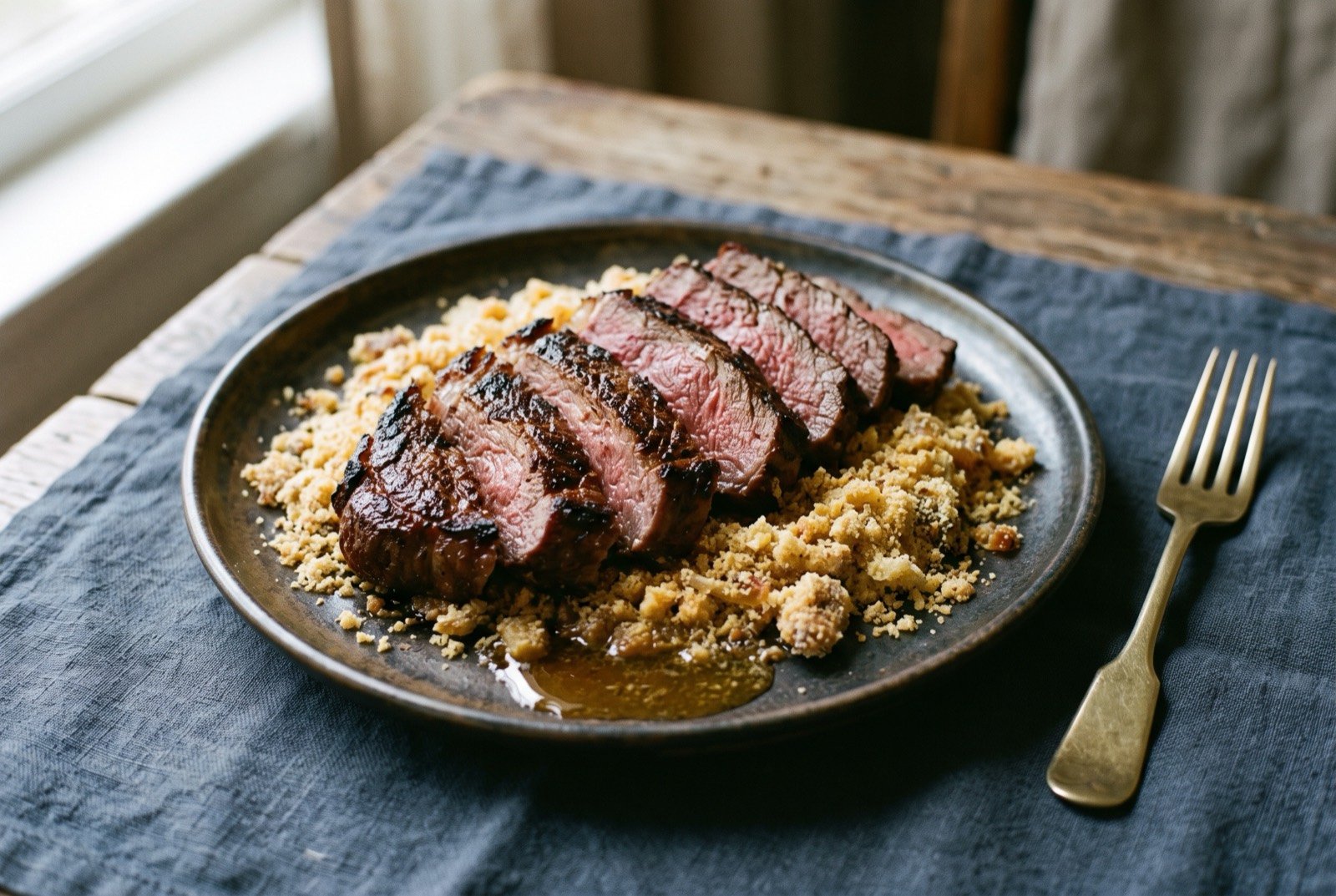
The semi-arid caatinga of Brazil's Northeastern interior, Pernambuco, Ceará, Paraíba, Rio Grande do Norte, Piauí and the interior of Bahia: a cattle economy built on thorn scrub and eight-month droughts, not on the Atlantic humidity of Bahia's dendê coast next door. Not a kitchen of feijoada and caipirinha with a folkloric footnote about cowherds attached, but a food world shaped by three forces holding tightly together: salt and sun where there was never refrigeration, corn and cane where the rains actually fall, and a leather-clad, quarter-paid vaqueiro culture that drove cattle a thousand miles along the São Francisco to feed a gold rush that had nothing to do with them. Every dish as tradition built it, then what a modern chef would change.
Sources and review · What this chapter does not assert · How we research · Spotted something wrong?
A Sense of Place
The caatinga is Brazil's only biome found nowhere else on earth, and it covers just over a tenth of the national territory, across the semi-arid interior of Pernambuco, Ceará, Paraíba, Rio Grande do Norte, Piauí and the dry back-country of Bahia. The name is Tupi, roughly "white forest", and it describes exactly what the land looks like in drought: trees shed their leaves, the pale bark and dry scrub are all that is left standing, and for months at a stretch the whole interior reads as bleached rather than green. Rainfall is irregular and concentrated into a short window; dry spells regularly run to eight months a year, and in the worst years to nine. Soils are shallow, stony and poorly permeable, so most of what rain does fall evaporates rather than soaking in. Vegetation has adapted accordingly: low, thorny, deciduous scrub, trees branching heavily near the base into an inverted-pyramid shape, many species carrying tiny leaves or none at all through the dry months. This is not marginal desert with nothing living in it. Something like 1,500 plant species have been catalogued in the biome, roughly a quarter of them found nowhere else, but it is a hard, spare, thorn-armed landscape, and every dish in this chapter is downstream of that fact.
It is this ecology, thin unreliable rain, poor soils, scrub rather than grassland, that explains why cattle ranching rather than settled cropping became the interior's defining economy. Cattle can be walked to water and forage across huge extensive ranges in a way fixed-plot farming in this soil and rainfall regime never could. Cattle first reached the Northeast coast in the early colonial period, landing in Pernambuco around 1535 and Bahia around 1549, brought to supply the sugar mills with draught power and hides. As herds grew they competed directly with cane for the fertile coastal strip, and colonial authorities pushed cattle raising inland into the caatinga, where cane could not grow anyway and nobody minded what grazed. The interior, in other words, was given to cattle because the coast had already been given to sugar, and everything else in this chapter follows from that division of the land.
The figure who worked that land was the vaqueiro, and his clothing is the clearest single object this chapter can point to as evidence of a genuinely indigenous technology, not an imported Iberian costume. The full outfit, recorded in outside description as early as 1816 and again in Euclides da Cunha's 1902 Os Sertões, is built entirely from leather: the gibão, a decorated jacket forming the outer layer; the guarda-peito, a leather waistcoat worn beneath it for extra protection; perneiras, loose leg coverings tied from hip to foot; a leather hat secured under the chin by a cord specifically so it could not be lost mid-work; and shaped gloves guarding the backs of the hands. This is armour against caatinga thorn scrub, nothing more mysterious than that, made originally from deer hide and later from sheep and goat as deer came under pressure, left in its natural rust colour and kept supple against the heat. Vaqueiros were paid not in wages but through the quarteação system, one quarter of the calves born under their care each year, on land organised into vast latifúndios and worked by tenant families with, by most surviving accounts, very little leverage over the man who owned the herd.
A table of the defining logic, read as fat, starch, aromatic and protein rather than as a shelf of regional specialities:
| Element | The caatinga interior |
|---|---|
| Fat | Manteiga de garrafa, a clarified Northeastern butter; pork lard where pigs are kept |
| Starch | Maize, above all, as cuscuz, canjica and pamonha; cassava flour and its granulated relatives; rapadura as both sugar and staple calorie |
| Aromatic base | Colorau (annatto-tinted oil), cumin, garlic, coriander; the smoke of an open fire more than any single spice |
| Everyday protein | Beef and goat, overwhelmingly preserved by sun and salt rather than eaten fresh; queijo coalho and queijo de manteiga as the dairy equivalent, made to survive without refrigeration |
The History in Layers
The cattle cycle, and a trade route that ran on somebody else's gold
Once pushed inland, the cattle economy did not stay small or local for long. The Rio São Francisco, sometimes called the Rio dos Currais, the River of Corrals, became the spine of its expansion: herds moved north from Bahia's Recôncavo from around 1590 and spread out along the river system into Piauí, Maranhão, Ceará, Paraíba and Pernambuco. The economy intensified sharply from the late seventeenth century for a reason that had nothing to do with the sertão itself: gold was found in Minas Gerais. The mining boom created an unprecedented internal market for food, pack animals and leather, and the northern sertões supplied live cattle, hide, and salted, dried meat historically known as "carne do Ceará" along a route linking the Bahian Recôncavo to the Rio das Velhas valley in Minas, the Caminho da Bahia, established from the late seventeenth century specifically to feed the mining interior. Herds of a hundred to three hundred head were driven along it in search of buyers. Within the Northeast itself a further droving network, the estrada das boiadas, connected Rio Grande do Norte through Paraíba into Ceará and as far as Piauí, its seasonal gatherings timed to November, when the rains reached Piauí. Stopping points along both routes grew, in the ordinary way of these things, from venda posts into fairs into chapels into villages, many of them now municipal seats. The sertão, in short, was never a food-producing region cooking only for itself: from the moment gold turned up somewhere else, it was provisioning an economy a thousand miles away, and the salt-cured, shelf-stable food this chapter documents is exactly what that kind of long-distance provisioning demands.
Drought, and the food it forced into being
Droughts in the sertão are documented from the sixteenth century, the earliest recorded episode placed between 1580 and 1583, and the region has always lived with a routine seven to eight month dry season it is genuinely adapted to. What the chapter cannot soften is the periodic severe, multi-year drought on top of that routine one. The Grande Seca of 1877 to 1879 was the worst in Brazilian history, with death toll estimates running to four or five hundred thousand people. Of roughly 800,000 people in the affected region, around 120,000 migrated to the Amazon and 68,000 elsewhere in Brazil; Fortaleza, a city of only 19,000 to 21,000 before the drought, received more than 80,000 refugees by 1878, briefly swelling past 130,000 residents, most of them with nothing. A second major drought in 1915, some 30,000 deaths, is the one that inspired Rachel de Queiroz's novel O Quinze, and it led directly to the Campo do Alagadiço in Fortaleza, a camp built not to shelter drought refugees generously but to contain and control them, a genuinely dark piece of state response this chapter names plainly rather than smooths into background colour.
Against that history, the sertão's shelf-stable foodways read less as folk tradition and more as engineering under duress. Rapadura, unrefined block cane sugar, traces to the Canary Islands and arrived in Brazil around 1532 as a way of turning small household-scale cane mills into a portable, storable product rather than something only large export plantations could make. The historian Luís da Câmara Cascudo is quoted repeatedly calling it the sweet "of poor children, of simple men, a treat for enslaved people, cangaceiros, cattle-drovers and soldiers", which is the plainest possible statement of who this food was actually for. Cassava flour, dried meat and rapadura recur together, again and again, as the three staples a sertão household could produce and store through a dry year, and this chapter treats that clustering as the organising fact of the whole tradition, not as three unrelated ingredients that happen to share a shelf.
Cangaço, and what a bandit actually ate
Cangaço, the banditry movement most closely associated with Virgulino Ferreira da Silva, Lampião, ran roughly from the 1830s to 1940, and it grew directly out of this same drought, near-feudal rule by coronéis, and a largely absent state. Brazilian historians treat it, correctly, as genuinely contested ground, neither simple criminal predation nor simple popular resistance, and this chapter does not adjudicate that argument. What is worth carrying into a food chapter is a fourfold typology of cangaceiro eating recorded by one regional historian of the Cariri, offered here with the caution due a single, non-academic source: everyday road food, dried meat, roasted goat, game, cassava flour, carried in leather saddlebags; refuge meals, more elaborate cooking possible at a safe hideout provisioned by sympathiser coiteiros, fresh goat and beef, beans, rice, sugar, coffee; food demanded outright from households along the road; and, when a coronel chose to host a band rather than fear it, genuinely refined hospitality, buchada, sarapatel, chicken in a dark pan sauce, roasted meats. Whatever else cangaço was, its food ran the entire range from subsistence to feast, and that range maps neatly onto the sertão's own economic extremes.
Corn's layered arrival
The sertão's other great staple, corn, arrived by a genuinely African route, though not directly. Cuscuz reached Brazil carried by Portuguese colonisers who had themselves absorbed it from the Amazigh, Berber, peoples of the Maghreb, where the earliest known couscous dates to somewhere between the eleventh and thirteenth centuries; a Brazilian heritage source traces the word itself to the Amazigh seksu, "well formed, well rolled, rounded". What travelled from North Africa was the method, steam cooking, and the cuscuzeira itself, not the grain: maize replaced wheat, sorghum or millet because it was already the staple of indigenous diets before the Portuguese ever arrived, a Brazilian adaptation the sources describe as driven by the cereal's abundance and, very probably, indigenous influence on top. The Jesuit José de Anchieta recorded in Bahia in December 1585 that indigenous people "made a flour that resembles wheat cuscuz", the earliest written trace of that substitution already under way. It should not be softened into a pleasant fusion story: in colonial Brazil, cuscuz was "seen as a second class food, reserved for enslaved people", and maize itself carried real spiritual weight in enslaved communities as an offering to the orixá Oxóssi. Enslaved and African-descended cooks kept cuscuz alive as everyday food for the poor precisely while it carried that low status, sold by street vendors and reportedly eaten inside the Quilombo dos Palmares, and are separately credited with introducing coconut milk enrichment in some regional forms. Its rise to the region's defining daily bread is a later story on top of that harder one.
The Flavour Arsenal
Carne de sol, charque and carne seca: three different products, not three names for one
Brazilian technical sources are precise about this, and this chapter follows them precisely rather than treating the English word "jerky" as covering all three. Carne de sol uses the lightest salting of the family, around five per cent of the meat's weight, rubbed over the surface rather than deeply cured, then dried quickly, traditionally finished not under blazing sun at all but overnight in the sereno, the cool night dew and air. A serious Brazilian technique source is explicit that real carne de sol today is typically dried in shade rather than direct sun to avoid over-drying, and, crucially, uses no curing salt of the nitrite kind that charque relies on, which is exactly what gives true carne de sol its pale colour and its short shelf life. Charque and carne seca both use heavy salting, up to thirty per cent of the meat's weight, on large butterflied sheets, resting salted for several days before proper sun-drying; charque stays in the sun longer again, producing a harder, firmer result than carne seca's more pliable one. This difference is not academic. A 2023 peer-reviewed food-safety study from the Universidade Federal do Ceará, sampling carne de sol sold in the Sertão de Crateús, found staph counts running four to sixty times over Brazil's legal limit across every sample tested, because the light salting that gives carne de sol its character also leaves enough water in the meat for spoilage organisms to establish. This is not a reason to distrust the dish. It is the honest reason a British kitchen with a fridge and a dehydrator can do this technique more safely than the tradition ever could, while keeping the exact same shallow-salt, partial-dry profile that makes carne de sol carne de sol rather than charque.
Queijo coalho and queijo de manteiga, dairy solving the same problem as salted beef
Queijo coalho grew out of the same off-grid necessity: milk naturally curdling in leather skin containers, matulões, carried by travellers and tropeiros with no refrigeration and days of road ahead of them, an accident that became a deliberate technique. The name refers to coalho, rennet, historically taken from a young ruminant's stomach lining. Its defining culinary property, and the reason it turns up skewered over charcoal at every roadside stall in the Northeast, is heat resistance: a comparatively high milk pH keeps calcium bound tightly to the cheese's protein structure, so it chars and softens on a grill rather than melting and running the way a lower-pH cheese would. Well over half of all Northeastern milk production is estimated to go into queijo coalho today. Queijo de manteiga solves the same storage problem by a genuinely different route, and no other Brazilian or European cheese shares its defining step: skimmed milk is curdled without rennet and cooked for around five hours over a wood fire, and manteiga de garrafa, a clarified, bottled Northeastern butter, is worked directly into the curd along with salt, giving it a yellow colour and a fat content high enough that it needs no ageing and no refrigeration at all.
Cajuína, protected by law because it is genuinely worth protecting
Cajuína is a clarified, non-alcoholic cashew apple juice specific to Piauí, and it carries formal Brazilian heritage protection, registered by IPHAN, the national heritage institute, in its Book of Knowledge in 2014, and separately by Piauí's own state cultural agency in 2012. The production method is worth knowing in full because it is a real, distinct preservation chemistry, not a curiosity: cashew apple juice, naturally astringent with tannin, is repeatedly strained through cloth in a clarification process that removes the tannin entirely, historically precipitated out using cashew-tree resin or, for decades, a cobbler's glue, today powdered gelatine; the clarified juice is then bottled in glass and slow-cooked in a water bath until its own sugars caramelise, which is what gives cajuína its amber colour and lets it keep, unrefrigerated, for up to two years. Production remains traditionally artisanal women's work, passed down within families, the tasting of a finished bottle, its colour, sweetness, clarity and body, itself part of the registered cultural practice.
The caatinga's own fruit and cowpea
Umbu, the fruit of the umbuzeiro tree, Euclides da Cunha called the "sacred tree of the sertão" for good reason: it stores water in tuberous roots that act as underground reservoirs, letting individual trees live around a century in a landscape that kills most things slowly. The fruit itself, small, round, sweet with a sour edge, is roughly ninety per cent water. Buriti, from the Cerrado's moist palm-lined veredas rather than the caatinga proper but reaching into sertão areas with that microclimate, gives a deep red oil and a fruit eaten scraped from its own husk or worked into juice, ice cream and jam. Castanha de caju, the cashew nut, is overwhelmingly a Northeastern crop, the region supplying 99.6 per cent of Brazil's production, and it was already central to indigenous diet and fermented drink before colonisation. Feijão verde, fresh cowpea harvested immature, matters more to food security here than its modest reputation suggests: some varieties are ready in as little as forty days, meaning a family gets a guaranteed meal well before a full drying cycle completes, a real margin of safety in a region where the growing window itself is short and unreliable.
Three dishes called "cuscuz" that have almost nothing to do with each other
This is worth stating as plainly as the atlas's own house rule demands, because the shared name genuinely misleads. Cuscuz nordestino is the plain, savoury, steamed maize staple this chapter treats as its own dish below, eaten daily, usually hot, at breakfast. Cuscuz baiano, the coastal Bahian dish, is a different thing again, coconut-forward, softer, served cold as a dessert with condensed milk. Cuscuz paulista, from São Paulo's bandeirante and tropeiro interior, is unrelated in lineage as well as construction: maize flour hydrated with savoury stock rather than plain salted water, mixed directly with sardines or prawns, hearts of palm, olives and egg, set in a ring mould and served cold as a shared centrepiece, with records reaching back to 1728. All three share only a name and a distant North African root, and this chapter does not merge them.
The Technique Ladder
The argument, from inside
Five techniques, each explained by why it works, not only what it does.
Rung 1. Carne de sol's light salt and sereno finish
A shallow salting, around five per cent of the meat's weight, does not fully arrest microbial activity the way charque's thirty per cent does; what actually preserves the meat over its short life is the combination of that light salt with rapid surface drying, traditionally finished overnight in the sereno's cool, moving air rather than blazing sun, which the tradition itself seems to have understood would over-dry and toughen a cut meant to stay tender.
Rung 2. Cuscuz nordestino's aerated steam
The cornmeal used is already gelatinised by industrial pre-cooking into flakes, so what actually determines the result is not the cooking time but whether the packed flour in the cuscuzeira's upper chamber is left loose enough for steam to move through the whole mass rather than only penetrating from the outside in; pack it tight and the outside overcooks long before the centre is done.
Rung 3. Bolo de rolo's hot roll
The dough is deliberately not a fat-free rocambole sponge: butter or margarine worked into the batter gives a denser, more pliable crumb that can be rolled tight immediately after baking, while still hot, without the structural spring a leaner sponge would fight back with and crack under.
Rung 4. Paçoca's mortar-pounding
A wooden pilão shears dried meat along the grain of the muscle fibre rather than cutting across it, which is what gives paçoca its characteristic loose, fibrous, almost fluffy texture rather than a paste; the technique, and the word itself, from Tupi pa'soka, predates the dried beef it is now used on, originally applied to other pounded foods entirely.
Rung 5. Queijo coalho's heat-stable curd
Milk with a comparatively high pH keeps calcium phosphate bound tightly within the cheese's casein structure, which is the chemical reason the cheese chars and softens on a grill rather than collapsing into a melted pool the way a lower-pH cheese does.
The Ferment and Preserve Bench
This is a chapter built almost entirely on preservation, so it earns its own bench rather than a paragraph.
Carne de sol, the light cure. Roughly five per cent salt by weight, twenty four hours, finished fast in shade or the night sereno rather than baked in sun. A two to three day product, eaten soon after curing, not stored for months.
Charque and carne seca, the heavy cure. Up to thirty per cent salt by weight on large, butterflied sheets, salted several days, then genuinely sun-dried, charque longer than carne seca, for a harder, more shelf-stable result that then needs proper desalting, a cold soak of several hours with the water changed repeatedly, before it can be cooked.
Manta de bode, the goat's own charque. A deboned carcass opened flat like a sheet, salted and sun-dried by the same logic as charque, historically a specialised skill passed down within a family rather than common household knowledge, and, per the field research behind this chapter, a skill now genuinely at risk of being lost as younger sertanejos leave for the cities.
Cajuína, a completely different preservation chemistry. Not salt and sun at all, but repeated straining to remove tannin followed by a slow water-bath cook that caramelises the juice's own sugar, giving a bottled drink that keeps two years unrefrigerated. It sits, appropriately, in Slow Food's Ark of Taste and carries formal Brazilian federal heritage protection.
Rapadura, the sertão's own sugar. Cane juice boiled down through successive pans to setting point, then moulded into blocks, historically made on small household-scale mills specifically because the interior's engenhos were too small to compete with the coast's export plantations. It is not a dessert ingredient here so much as the region's own stored calorie, carried on the road exactly as dried meat and cassava flour were.
Sourcing in Britain
Three ingredients in this chapter are genuine gaps in the UK, and this chapter says so rather than dressing up a compromise as the real thing. Queijo coalho has no UK-made equivalent; halloumi is the honest working substitute, comparable in squeak and melting point though saltier and more mineral, since it is traditionally a brined preservation cheese where queijo coalho is a fresh, low-salt curd made not to need refrigeration in a hot climate. One specialist London Brazilian grocer, Emporio Brasil, does stock an actual imported chilled queijo coalho, worth seeking out specifically before defaulting to halloumi. Queijo de manteiga could not be found anywhere in the UK, imported or made, and this chapter states that plainly rather than inventing a stand-in with no basis. True carne de sol cannot be bought at all, fresh or preserved, since raw salted beef cannot legally be imported and would not survive the journey in any case; the honest route is a home cure on British silverside, a light dry salt for twenty four to forty eight hours under refrigeration, then a hard sear, treating bresaola and biltong as useful reference points for texture and method rather than as substitutes themselves.
Rapadura sold in the UK is almost never the real Brazilian block: what most retailers stock under that name is granulated Ecuadorian panela, chemically close and correct in cooking but pre-crumbled rather than a grateable block; for the authentic solid form, Colombian panela or South Asian jaggery, both genuinely equivalent unrefined cane sugars, are the honest substitute, openly presented as a different country's cane doing the same job. Cajuína is unobtainable bottled in Britain; frozen cashew apple pulp and concentrated juice exist through specialist importers, but neither is the clarified, caramelised finished drink, and this chapter does not pretend otherwise.
The cassava starch aisle is a genuine trap worth naming precisely: tapioca pearls sold for bubble tea are a different, pre-cooked product entirely and will not form a crepe; polvilho azedo, soured cassava starch, is the one Brazilian starch most UK specialist retailers already stock, but it gives a chewier, more elastic result suited to cheese bread, not a crepe; the correct product, polvilho doce or ready-granulated tapioca goma, is stocked, so far as this research found, only by Emporio Brasil, and is worth ordering by that exact name. Fresh mandioca itself, by contrast, is one of the easiest ingredients in this whole book, sold fresh and frozen through African and Caribbean grocers across the country, not only in London.
For cuscuz nordestino, the corn itself is a naming trap of its own: the dish wants flocão, a coarser, pre-steamed corn flake, not fubá or British polenta, both of which are closer to fubá in character and will give the wrong texture entirely. Emporio Brasil stocks genuine flocão by name, and getting this one substitution right matters more to the finished dish than almost any technique in the chapter. Canjica corn, dried white hominy, is correctly stocked by the same retailer. Goiabada is genuinely easy to find, through both Brazilian and Portuguese delis, guava paste being equally loved in Portugal, with a real cluster of Portuguese and Brazilian shops around Vauxhall and Stockwell in London worth knowing by name.
For kit, a real Brazilian two-chamber aluminium cuscuzeira is available by mail order from the same specialist grocer, and is worth the modest cost over improvising with a couscoussier or bamboo steamer, both of which work but give a wetter, less separated grain than the flat, wide steaming plate of the genuine article. For the chapa, no UK retailer sells anything actually branded for the job, but a Big Green Egg cast-iron plancha griddle, or failing that any standard flat cast-iron griddle pan, gives the flat, dry, high, even heat both the crepe and the grilled cheese depend on.
Voices and Sources
The chapter this treatment could not have been written without a São Paulo restaurant whose whole project is making the case that sertanejo cooking deserves to be taken seriously on its own terms: Rodrigo Oliveira's Mocotó, built from his father's own migration story out of interior Pernambuco, and his own stated aim to show that this cuisine is neither "heavy" nor "technically lesser" than anything served on the coast. Cafira Foz, raised in Teresina and now leading Fitó, is the second reference point this chapter leans on directly, not least for her own published paçoca method. Lorena Dayse's Piancó Gastronomia, Teresina's first tasting-menu restaurant, closed in February 2025 after fewer than four years, and this chapter treats that closure honestly rather than skating past it: it is, on the evidence gathered for this book, the clearest single fact available about how hard it is to sustain elevated sertão cooking anywhere but São Paulo. Slow Food Brasil's own field documentation, on manta de bode among Fundo de Pasto communities and on the endangered corn cake manuê, is the strongest single institutional source behind this chapter's tradition sections, alongside a peer-reviewed conference paper on bolo de rolo by Sandra Simone Moraes de Araújo of the Universidade de Pernambuco, and a genuinely in-tradition literary source, Rachel de Queiroz's own writing on cuscuz as the sertanejo's bread. The historian Luís da Câmara Cascudo's História da Alimentação no Brasil sits behind more of this chapter's etymology and social history than any single other source, quoted throughout at second hand via named Brazilian writers rather than reached directly in this research, a limitation stated here rather than concealed. IPHAN's formal registration of cajuína, and a 2023 peer-reviewed University of Ceará food-safety study on carne de sol, both did real work in shaping how this chapter presents preservation as something worth respecting and worth improving rather than either romanticising or discarding.
Things this chapter has deliberately not asserted
- That bolo de rolo has a single named inventor, or that it was served to Dom Pedro II in 1859; the research behind this chapter treats the imperial-visit claim as a likely confusion with the separately documented Bolo Souza Leão legend.
- That "canjica" carries one correct national meaning; its Northeastern sense genuinely differs from its use everywhere else in Brazil, and this chapter has tried to represent that split rather than flatten it.
- A settled etymology for either canjica or mungunzá; competing African-root claims exist for both and this chapter presents them without resolving which is correct.
- Precise, laboratory-verified salt ratios and timings for charque and carne seca desalting; the figures given rest on consistent Brazilian household recipe consensus, not on an academic or agricultural-research source, and are offered as workable rather than as definitively correct.
- A fully timed, quantified traditional recipe for panelada, rabada or bode assado; the sourcing behind these three specifically did not rise to the standard this book otherwise holds itself to, and this chapter's treatment of them is accordingly plainer than the others.
- That cartola, the fried banana and cheese dessert, belongs to the sertão by origin; the research behind this chapter places it firmly in the sugar-engenho world of the Zona da Mata coast, and it is named here only in passing rather than given full treatment, precisely so it is not quietly annexed to the cattle interior on the strength of its cheese alone.
- That Lampião's cangaceiros ate any specific dish on any specific occasion beyond the general typology given above; the single source for that typology is a regional local-history blog, not an academic or archival one, and this chapter treats it as illustrative rather than as documented fact.
- Any claim about a UK Brazilian restaurant, in London or elsewhere, treating sertão cooking as its specific subject; none was found, and the honest reading of that absence is set out above rather than papered over.
Carne de sol's light salt and sereno finish
A shallow salting, around five per cent of the meat's weight, does not fully arrest microbial activity the way charque's thirty per cent does; what actually...
Cuscuz nordestino's aerated steam
The cornmeal used is already gelatinised by industrial pre-cooking into flakes, so what actually determines the result is not the cooking time but whether the...
Bolo de rolo's hot roll
The dough is deliberately not a fat-free rocambole sponge: butter or margarine worked into the batter gives a denser, more pliable crumb that can be rolled...
Paçoca's mortar-pounding
A wooden pilão shears dried meat along the grain of the muscle fibre rather than cutting across it, which is what gives paçoca its characteristic loose...
Queijo coalho's heat-stable curd
Milk with a comparatively high pH keeps calcium phosphate bound tightly within the cheese's casein structure, which is the chemical reason the cheese chars and...
The dishes
- Carne de sol Sertão, Brazil
- Paçoca de carne seca Sertão, Brazil
- Buchada de bode Sertão, Brazil
- Bode assado, in the manta de bode tradition São Francisco Sertão, Brazil
- Galinha de cabidela Pernambuco, Paraíba and Rio Grande do Norte, Brazil
- Rabada Sertão, Brazil
- Cuscuz nordestino Northeast Brazil, Brazil
- Bolo de rolo Pernambuco, Brazil
- Canjica, in its sertão sense of mungunzá Northeast Brazil, Brazil
- Tapioca com queijo coalho Northeast Brazil, Brazil
Sources and review
- Reviewed
- Not yet reviewed from inside the tradition
- Cooked
- Not yet cooked and reported
Where this volume comes from
3 research briefs on file for this volume, researched to the rules on How we research. Published 3 September 2026. Last changed 8 September 2026.
The brief's own account of its sources
Roughly two thirds of the sourcing behind the cattle-economy and preservation material is Brazilian and either academic, heritage-institutional or specialist trade press: EMBRAPA, IPHAN and FUNDAC, Slow Food Brasil and the Ark of Taste, an ANPUH conference paper on cangaço as social banditry, a peer-reviewed UFC/FATENE food-science paper on carne de sol's real microbiological risk, MilkPoint's dairy-trade history, SciELO, and named regional press (Diário do Nordeste, O Povo, Correio Braziliense, Folha PE).