Mainland Brazil · Volume 42, The Court and the Clay Pot
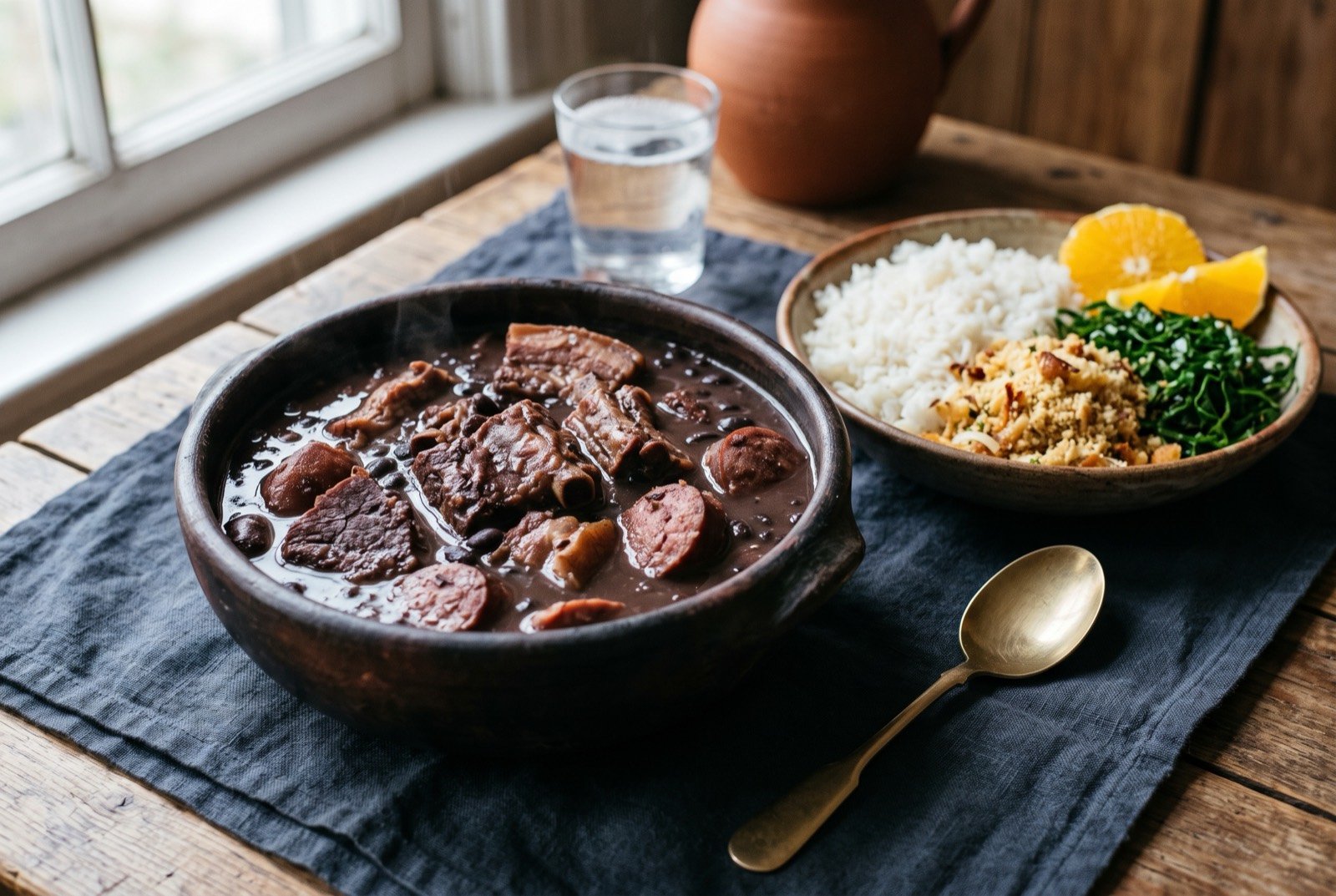
Feijoada carioca
Rio de Janeiro
Illustration
- Time
- 2 hours 30
- Researched
- 6 sources cited
Rio's best known dish, and the one this chapter is most careful about. The popular story that it was invented in the senzala from an owner's discarded offal does not survive checking: Câmara Cascudo traces feijoada instead to nineteenth century Rio restaurants and hotels, built on an older Portuguese bean and salt pork stew, feijão gordo, though Raul Lody keeps African culinary agency central even while rejecting the same folk mechanism. This chapter reports that disagreement rather than resolving it.
As tradition built it
Serves about 12. Roughly 2½ hours' active cooking, beyond a 24 hour soak.
Ingredients
- 1 kg black beans
- 250 g carne seca, dried salted beef
- 1 salted pig's tail
- 1 salted pig's ear
- 2 salted pig's trotters
- 250 g salted pork loin
- 4 bay leaves
- 200 g smoked bacon, diced
- 400g fresh linguiça sausages, added last
To serve
- to serve white rice
- to serve couve, thinly sliced and briefly sautéed
- to serve farofa
- to serve orange, sliced or in segments
Method
- Soak the salted meats, tail, ear and dried beef, for 24 hours, changing the water roughly six times to draw out excess salt.
- Drain, boil 30 minutes, cool and cut into pieces.
- Put the beans, bay leaf, bacon and dried beef into the pot first and cook 1 hour from boiling.
- Add the tail, ear, trotter and salted loin and cook a further hour.
- Add the sausages last and cook until the meats and beans are fully tender and the broth has thickened on its own, roughly 2½ hours' total active cooking beyond the soak.
- Serve with white rice, thinly sliced sautéed couve, farofa and orange.
Notes
Traditionally served on a Wednesday or a Saturday, a custom a Brazilian food historian attributes to an older Portuguese habit of pairing dishes with days of the week, though no Portuguese record actually confirms Saturday specifically, which suggests the day itself may be a Brazilian rationalisation rather than an imported rule.
What a modern chef changes
Each protein finished separately, then reduced into one shared jus
Rungs 2, 3 and 6
Ingredients
For the bolinho de feijoada, from the trim
- as available cooked beans, from a previous batch
- a little meat fat
- as needed raw cassava flour, for binding
- a spoonful sour starch, polvilho azedo, for elasticity
- as available shredded cabbage, barely wilted
Method
- Cook each protein to its own correct texture in its own vessel rather than in one shared pot, Rung 2: braise the tail and ear long and slow until the collagen fully renders and the meat pulls apart.
- Poach the pork loin gently to stay pink at the centre.
- Simmer the dried beef separately until tender but not stringy.
- Sear the sausages hard over live coals on the Big Green Egg, Rung 6, for a crust the pot never gives them.
- Reduce the combined braising liquors from all three pots together into one dark, gelatinous jus, passed through a chinois, and plate the components separately over it rather than serving from a single stew pot.
- Alongside, make Kátia Barbosa's bolinho de feijoada from the trim and any beans left from a previous batch, Rung 3: purée cooked beans with a little of the meat fat, bind with raw cassava flour and a spoonful of sour starch for elasticity, fold through barely wilted shredded cabbage rather than cooked, and fry until the shell is crisp and the centre stays dense and creamy.