Mesoamerica · Volume 08, Pupusas, Gallo Pinto and the Pacific Volcanic Belt
Casado
San José, Costa Rica
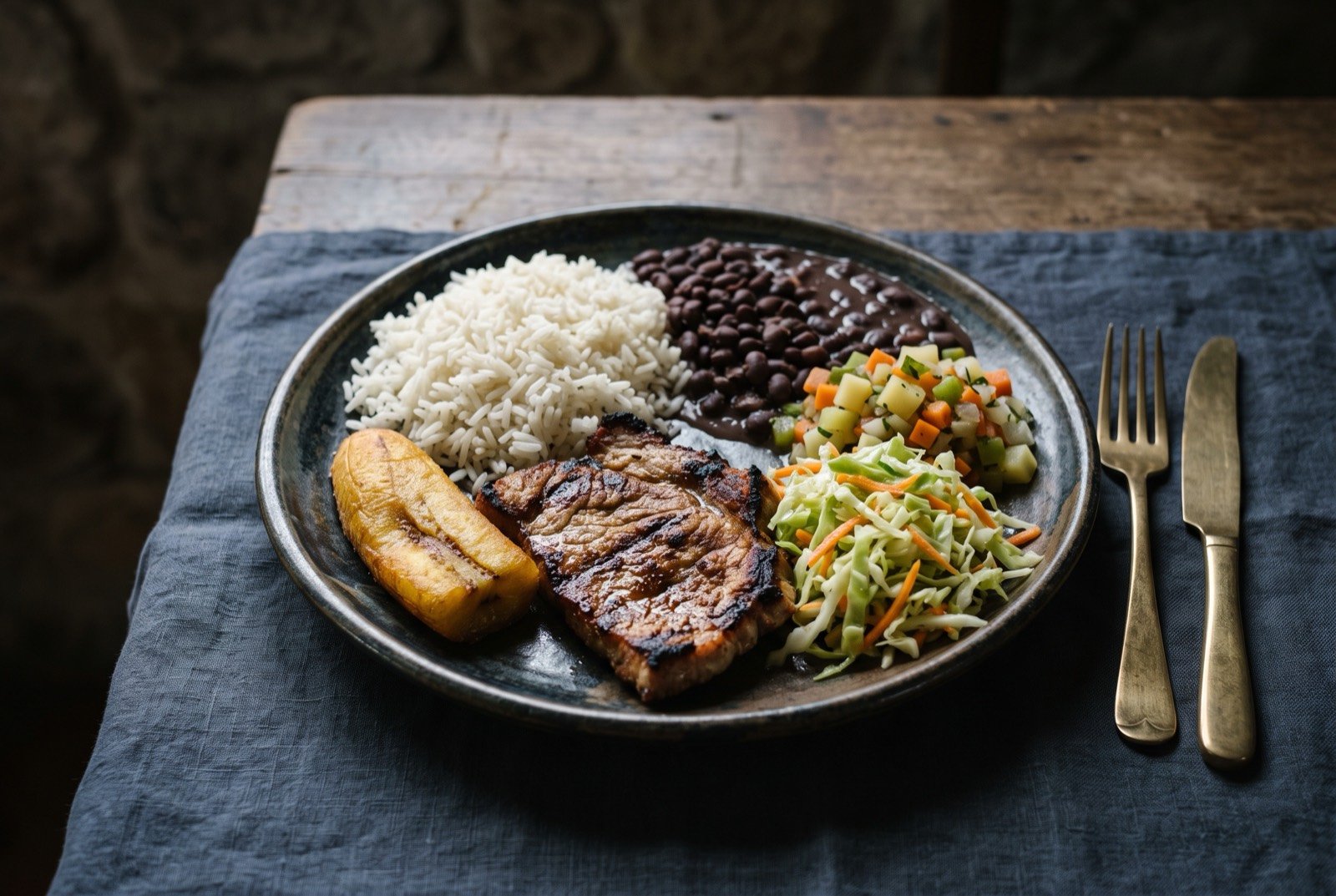
An illustration of the dish, not a photograph of it cooked.
- Time
- Not statedNo source states a time and the atlas has too few comparable dishes to estimate one.
- Reviewed
- Not yet reviewed from inside the tradition
- Cooked
- Not yet cooked and reported
As tradition built it
Casado
Consolidated as a single format in 1960s San José sodas
Ingredients
- as available rice
- as available black beans
- as available ripe plantain, fried (maduro)
- as available picadillo
- as available protein, chosen
- as available cabbage or salad
- as available pasta, often
- as available tortillas or bread
Method
- Cook rice and black beans.
- Fry ripe plantain until soft.
- Make a picadillo rooted in Andalusian technique.
- Cook a chosen protein.
- Add cabbage or salad, and often pasta.
- Serve everything on one plate, with tortillas or bread.
Notes
No verified single "authentic" recipe with fixed quantities exists in in-tradition sources, and this chapter does not force one: the casado is explicitly a customisable, composed plate.
Consolidated as a single format specifically in the 1960s, when San José's expanding workforce needed a fast, complete, home-style lunch and the sodas responded by putting everything on one plate.
What a modern chef changes
Elevate each component on its own terms
Method
- Sous vide the chosen protein, whether chicken, pork or fish, to a precise doneness before a final hard sear, well beyond what a soda's quick pan-fry can hold consistently.
- Dehydrate a portion of ripe plantain into thin, concentrated chips for textural contrast against the soft fried maduro.
- Blend the picadillo's vegetables to a fine, even dice-adjacent purée in a high-power blender, pulsed rather than smoothed.
- Pass a portion of the picadillo through a chinois for a silkier hash than knife work alone gives, while keeping enough texture that it still reads as picadillo rather than a purée.
Notes
Since the dish is a composed plate rather than a fixed recipe, this elevation reworks each component on its own terms rather than the format itself.