The Americas · Volume 08
El Salvador, Pacific Nicaragua and Costa Rica
Pupusas, Gallo Pinto and the Pacific Volcanic Belt
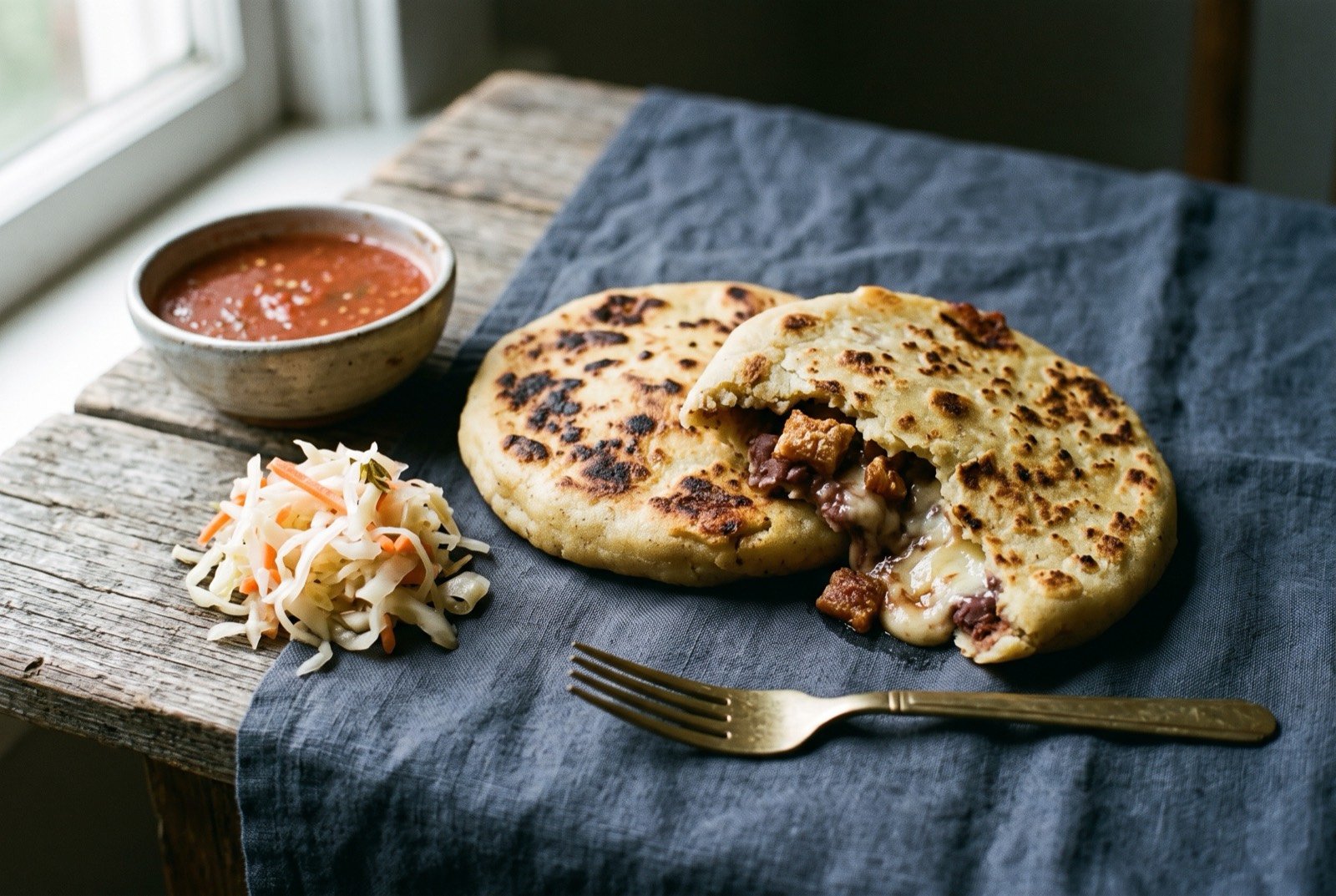
The southernmost extension of the Mesoamerican maize world, three countries answering to genuinely different forces rather than one shared story. El Salvador and the Pacific side of Nicaragua carry a real, if thinly documented, pre-Hispanic inheritance, the Pipil and the Lenca in one, the Chorotega and the Nicarao in the other, overlaid by Spanish colonial technique and, in El Salvador's case, a civil war that scattered one of the largest diasporas in Central America. Costa Rica answers to something else entirely: not a deep surviving court cuisine, since the documentary and archaeological record for one simply is not there, but a nineteenth and twentieth century coffee economy that built a genuinely distinctive smallholder food culture, and did so in a way Costa Rican historians have spent decades correcting the flattering version of. Every dish as tradition built it, then what a modern chef would change.
Sources and review · What this chapter does not assert · How we research · Spotted something wrong?
A Sense of Place
El Salvador, Pacific Nicaragua and Costa Rica sit on the same volcanic Pacific belt and grow the same maize, beans and squash, but they are not one food world wearing three flags. El Salvador and Pacific Nicaragua carry real indigenous strata, distinct from each other and from Costa Rica's much thinner pre-Columbian record. Costa Rica's own defining force is not indigenous survival but a specific, documented economic history: coffee, and the smallholder culture it produced.
El Salvador: the Pipil west, the Lenca east
Two indigenous peoples, ethnically and linguistically unrelated, divide the country. The Pipil, a Nahua people who migrated south from central Mexico, arrived around 1000 AD and by 900 to 1200 AD had built an organised society centred on Cuscatlán, in the country's centre and west. The Lenca are older and belong to a different branch entirely, the Potón, settled in the east, Usulután, San Miguel, Morazán, La Unión, between roughly 400 BC and 1000 AD. Lenca gastronomy runs on maize, beans and yuca, with güirila, a thick, soft corn griddle cake, and chicha, a fermented maize drink central to ceremony, as its own signature preparations, genuinely distinct from Pipil pupusa culture further west.
Pacific Nicaragua: the Chorotega and the Nicarao, and a coast this chapter deliberately does not cover
The Chorotega, a Mangue-language people, arrived from the Valley of Mexico around 800 AD and settled the Isthmus of Rivas and much of what is now Guanacaste, including the Nicoya Peninsula. The Nicarao, a Nahua people culturally and linguistically closer to the Pipil, arrived later and pushed the Chorotega toward the islands and eastern shore of the Gulf of Nicoya, the two peoples in recurring conflict. This chapter treats "Pacific Nicaragua" as this Chorotega and Nicarao zone, León, Managua, Granada, Masaya, Rivas, Chinandega. Nicaragua's Caribbean coast, coconut milk and oil, Afro-Caribbean technique, root vegetables, is a genuinely different food world and does not appear here.
Costa Rica: three linked worlds, and a food identity coffee actually built
Not one country but at least three. The Valle Central, a tectonic depression of roughly 3,250 square kilometres at an average 1,400 metres, ringed by the volcanoes Irazú, Barva and Poás, whose ash produced the mildly acidic, moisture-retentive soils that made it Central America's most productive coffee belt from the final decade of the eighteenth century. Guanacaste, inside the corredor seco centroamericano, the arid Pacific strip running the length of the isthmus, historically cattle ranching and corn agriculture rather than coffee, its households consuming an estimated 500 kilos of corn a month in traditional preparation for rosquillas, tortillas palmeadas, chorreadas and tamales de elote. The Pacific littoral around the Gulf of Nicoya, Puntarenas above all, supplying the shrimp, octopus, clams and lobster that feed Costa Rican ceviches and seafood casados. Costa Rica's Caribbean coast around Limón, with its own Afro-Caribbean cuisine, rondón and a Caribbean-style rice and beans genuinely distinct from gallo pinto, sits outside this Pacific-facing volume for exactly the same reason Nicaragua's Caribbean coast does, and belongs to a future volume covering the Caribbean region proper.
A table of the defining logic, read as fat, starch, aromatic and protein rather than a shelf of regional dishes:
| Element | El Salvador | Pacific Nicaragua | Costa Rica |
|---|---|---|---|
| Fat | Lard, some vegetable oil | Lard, especially in nacatamal masa and rosquillas | Historically lard, now increasingly vegetable oil |
| Starch | Maize, nixtamalised masa; rice, from the 1980s in pupusas; yuca | Maize, masa and whole kernel; rice; yuca | Rice; maize dominant in Guanacaste; yuca and plantain elsewhere |
| Aromatic base | Onion, garlic, tomato, loroco | Achiote, chiltoma, onion, garlic, naranja agria, hierbabuena | Onion, chile dulce, garlic, culantro coyote, Salsa Lizano since 1920 |
| Souring or acid | Vinegar and fermentation (curtido), naranja agria | Naranja agria, vinegar | Vinegar, culantro coyote |
| Everyday protein | Cheese (quesillo, queso duro), beans, pork | Pork, beef, chicken, cheese and cream | Black beans, modest pork and chicken, coastal fish and shellfish |
The History in Layers
Joya de Cerén, and a maize world older than the Pipil themselves
The clearest physical evidence anywhere in this zone is Joya de Cerén, a Maya-affiliated farming village in El Salvador buried essentially in place by the Loma Caldera eruption around 650 AD, a UNESCO World Heritage Site. Excavation found maize and bean storage, cooking hearths, kitchen tools, cultivated fields of maize, yuca and probably common and lima beans, a temazcal, and a shaman's house surrounded by medicinal plants. This predates the Pipil migration by a full generation and belongs to an earlier Maya-linked population, meaning the maize, beans and squash triad was established in Salvadoran territory well before the Pipil arrived, not brought by them. Academic archaeological work traces from these sites nixtamalisation, tamales, tortillas, an early vegetarian form of pupusa filled only with vegetables, beans or squash blossom, since cheese and meat did not exist locally before the Spanish, totopostes, atoles and shuco.
A contested word, and a dish the region will not let one country own
Salvadoran anthropologist Ramón Rivas argues the pupusa, in a primitive maize, bean and meat form, is pre-Hispanic, citing Bernardino de Sahagún's colonial documentation of natives eating a mixture of masa, meat and beans, while being explicit himself that the dish does not have its origin in one country with exactitude, but in the Mesoamerican region as a whole. A second Salvadoran anthropologist, Jorge Ávalos, disputes that the word "pupusa" itself has demonstrable Pipil or Nahuat linguistic origin at all, suggesting some Salvadoran scholars reach for a Pipil etymology to justify the dish's Salvadoran identity without solid linguistic evidence, and holds that corn masa filled with beans was simply a typical dish of all Central America. The earliest known written reference to something resembling a pupusa dates to 1837, in a letter by the Guatemalan poet José Batres Montúfar describing eating the dish while travelling in Nicaragua, not El Salvador. This chapter states the dispute rather than settling it: whether the pupusa is specifically Pipil, or a general Mesoamerican form El Salvador later claimed as a national symbol, is genuinely unresolved. The colonial period is not in dispute: cheese, pork, beef, chicken, wheat, dairy and citrus entered the diet after conquest, converting the vegetarian pre-Hispanic pupusa into the cheese and meat filled dish known today, particularly from the 1570s.
The civil war, and the diaspora that carried the pupusa around the world
El Salvador's civil war, 1979 to 1992, killed or disappeared more than 75,000 people and drove one of the largest Central American migrations to the United States. A specific, repeatedly cited claim holds that wartime maize scarcity in the early 1980s prompted the invention of the pupusa de arroz, the rice pupusa, pioneered around Olocuilta, now known as the capital of rice pupusas. This is consistently reported in Salvadoran press, though no agricultural or archival source confirming an actual maize supply shock was found in the research behind this chapter, so the causal claim is presented as plausible rather than independently corroborated. The United States is home to an estimated 2.9 million people of Salvadoran origin as of 2025 projections, roughly 1.4 million Salvadoran-born, the community having grown over 225 per cent since 2000, migration intensifying sharply through the 1980s. This diaspora carried the pupusa worldwide and gave it its present pupusería character outside El Salvador, and it is the same diaspora that, four decades later, produced this chapter's single strongest example of Salvadoran food writing, Karla Tatiana Vásquez's SalviSoul project, covered in full below.
The Kingdom of Nicoya, and Nicaragua's own Sandinista-era food history
Chorotega and Nicarao territory on Nicaragua's Pacific side ran its own pre-Hispanic agricultural economy, maize, beans, cotton, chilli, tobacco and other legumes, supplemented by deer, fish and fruit trees including cacao. Much later, and far better documented, is what the 1979 revolution did to how Nicaraguans ate. The new Sandinista government nationalised Somoza-family assets and pursued food policy built on basic-grain cultivation, agrarian reform, subsidies on staple prices, and an alternative distribution network. This ran into a genuine supply crisis during the Contra war, scarcity and rationing forcing households to improvise recipes around whatever donated or rationed goods actually reached the shops, a real parallel to the Salvadoran civil war's own effect on the rice pupusa, though it resolved differently.
Costa Rica's pre-Columbian record, stated as thinly as it deserves
This is the section where honesty about sparse documentation matters most. Unlike Mexico or Guatemala, pre-Hispanic Costa Rica had no single dominant imperial state and no correspondingly rich documentary or archaeological food record. It sat at the southern edge of Mesoamerica and the northern edge of the Chibchan Intermediate Area, its peoples small, dispersed chiefdoms rather than a unified court culture. The Chorotega, concentrated in the Nicoya peninsula, are documented with subsistence agriculture based on maize, beans, cotton, chilli, tobacco and other legumes; surviving maize foods attributed to this heritage include chicha, chorreadas, cosposas, atoles and tortillas. The Huetar, described as the Central Valley's most numerous pre-Columbian people, are credited with a surviving maize festival and chicha preparation, though on weaker, general sourcing than the Chorotega material. The Boruca, in the southern zone adjacent to but outside this chapter's core scope, are documented with maize, beans, rice, palm hearts, yuca and other tubers. What this section does not claim is any equivalent to the depth of documentation available for Aztec or Maya court cuisine, and colonial Costa Rica compounds the gap: a poor, marginal, thinly populated province of the Captaincy General of Guatemala, without a large indigenous tribute-labour base or a wealthy colonial elite, the usual explanation offered for why it did not develop toward a large hacienda system before coffee changed everything.
Coffee: the actual force, told with the correction it needs
Coffee reached the Americas via Martinique in 1720 and was planted in Costa Rica by the late eighteenth century. The first recorded export was 12 October 1820. Direct shipments to the United Kingdom began in 1843, via the English ship captain William Le Lacheur, after initial exports were routed through Chile for re-bagging. Coffee concentrated around San José between 1830 and 1850 and by 1850 had spread to Alajuela, Cartago and Heredia, the belt that still defines the coffee Central Valley today. Costa Ricans call coffee the grano de oro, the golden grain, and the term reflects a genuine historical judgement, not boosterism: coffee wealth funded San José becoming one of the first cities in the world with public electric street lighting, switched on 9 August 1884, after only Paris, London and New York.
Was Costa Rican coffee genuinely smallholder, or is that a national myth? Both things are true at once, and this chapter says so rather than picking the flattering half. An Irish traveller in 1858 reported roughly two thirds of the population were landowners, almost every man owning his farm, animals and a plantation of sugar or coffee. Carolyn Hall's 1976 study of coffee's historical geography, the first scientific treatment of the subject and described by later Costa Rican scholarship as particularly revolutionary for its method, found materially better social conditions among peasant proprietors in Costa Rica than among workers on large Guatemalan or Salvadoran estates, a genuinely different, less latifundio-dominated pattern than much of the rest of Central America. But Lowell Gudmundson, the leading historian of this specific question, is explicit that the popular Costa Rican self-image of a nation of contented, more or less equal small coffee farmers, folded into the wider leyenda blanca, the white legend, of national mythology, is a flawed historical model. His own research traces how a subsistence-oriented peasantry was transformed, across exactly this coffee century, into a genuinely class-stratified society of owners and non-owners, employers and workers, land and wealth concentrating over time even as widespread small proprietorship persisted at the base. Both are true: Costa Rica's coffee economy really did produce a far larger base of small independent growing households than the classic Central American pattern, and this really did shape a national food culture built around the modest family table rather than a plantation big house. And the popular equality version is a documented national myth that Costa Rican historians have spent decades correcting.
The physical link between highland smallholding and Pacific export before railways was the ox-cart, the carreta, and the tradition of boyeo, ox-cart driving, moving coffee from the Central Valley to the port of Puntarenas from the mid-nineteenth century. UNESCO proclaimed the boyeo and carreta tradition a Masterpiece of the Oral and Intangible Heritage of Humanity in 2005, formally inscribed in 2008; the painted, hubless-wheel carretas, a genuine hybrid of Aztec disc wheel and Spanish spoked wheel designed to cope with mud, remain a national symbol directly tied to the coffee economy rather than a tourist invention. Historian Patricia Vega Jiménez has written directly on coffee's domestic consumption history, not only its export history, coffee becoming a genuine social institution inside Costa Rica itself, the tertulia, the coffee-drinking gathering, with advertising and consumption patterns being actively shaped domestically from at least 1900.
The soda, the casado, and a food identity built for the modest table
Costa Rican sodas were modelled on the American soda-fountain format of the 1940s and 50s, arriving in San José in the early 1950s, and by the 1970s had become genuinely Costa Rican, small, family-run restaurants serving traditional local food across the country. One especially well documented example, the Soda Palace in San José, founded by the Spanish immigrant José María Calvo Reventós, operated for more than 70 years as a genuine centre of San José conversational life, famous for its paella, coffee and arroz con pollo, before its closure. The casado itself, rice, black beans, ripe fried plantain, a picadillo rooted in Andalusian technique, a protein, cabbage or salad, often pasta, tortillas or bread, consolidated as a single composed plate specifically in the 1960s, when San José's expanding commercial and institutional workforce needed fast, complete, home-style lunches and sodas responded by assembling everything onto one plate. No single theory for the name, "married man," is verified, and this chapter treats all of them as folk etymology rather than choosing one: that workers asked cooks to repeat their plate as if they were married men wanting a full second helping; that mid-century sodas served complete plates meant to make a worker feel at home the way a wife's cooking would; that the name reflects ingredients "married" together with the rice; that it evokes the first meal of a marriage.
The Flavour Arsenal
Loroco, El Salvador and Nicaragua's own signature. A vine with edible flower buds, native to and still mainly grown in El Salvador, oblong-elliptical to broadly ovate leaves, white inner petals with greenish outer colouring. It naturally flowers May to October, though irrigated cultivation now allows near year-round harvest. Buds are harvested at maximum development, just before opening, while still light green, the stems discarded, and overuse of the flower itself can turn a dish bitter. Used in soups, tamales, cream sauces for chicken and, above all, pupusas, alone or with quesillo cheese.
Curtido. A lightly fermented or quick-pickled cabbage relish, cabbage, carrot, onion, sometimes oregano and chile, dressed in vinegar with salt, sometimes called Salvadoran sauerkraut because it can be genuinely fermented rather than merely pickled. Sources disagree sharply on real timing, a genuine finding this chapter states rather than smoothing over: some describe fermentation over many weeks, others a valid quick version ready in as little as two hours refrigerated, or twenty four hours for a naturally fermented version with fuller development. No single credible in-tradition source gives one definitive timing.
Quesillo, two genuinely different things sharing one name. In El Salvador, quesillo is a cheese, soft, stretchy and mild, comparable in style to Oaxacan string cheese, used as a pupusa filling. In Nicaragua, quesillo is a completely different, fully composed dish, a warm corn tortilla wrapped around soft melted cheese, topped with cream and vinegar-pickled onion, attributed to the towns of Nagarote and La Paz Centro in León department, dating to around the 1930s, when locals began preserving surplus milk, lost to a lack of refrigeration, by turning it into cheese, first sold commercially at the old railway stations of those towns. Both towns claim the invention, a genuine small local dispute this chapter names rather than adjudicates.
Naranja agria, achiote and chiltoma. Sour Seville orange marinates meat across the whole zone, most notably Nicaraguan nacatamal pork. Achiote gives Nicaraguan and Costa Rican dishes their characteristic red-orange colour. Chiltoma, a mild, sweet pepper distinct from hot chile, is standard in Nicaraguan nacatamal filling and reappears in Costa Rica as chile dulce.
Culantro coyote, Costa Rica's own distinct herb, not the same plant as coriander despite the overlapping common name. A stronger, more intense aromatic, used fresh in beans, soups, meats, stews and rice, its flavour intensifying when used raw or lightly cooked. The name "coyote" is popularly explained by the plant's serrated, spiny leaves once it flowers, which can irritate skin on contact, coyote being colloquial Costa Rican Spanish for something that causes harm.
Salsa Lizano, Costa Rica's defining bottled condiment. A tangy, mildly sweet, vegetable-based brown sauce, created in Alajuela in 1920 by Próspero Jiménez and Próspero Lizano, who ran a cantina; a pickled snack they served alongside an accompanying vegetable sauce grew popular enough that customers began buying the sauce alone, sold first in small glasses, then bottled commercially under the Lizano name and its recognisable green label. Now owned by Unilever, the brand deliberately targets the Costa Rican and wider Central American diaspora as a nostalgia market, and holds an estimated 85 per cent share of its category inside Costa Rica. Stirred into gallo pinto and arroz con pollo, and poured directly onto food, including tamales, at the table.
Pejibaye, Costa Rica's most distinctive and best-documented ingredient. This peach palm fruit is boiled whole, sometimes with a smoked bone or panela added to the cooking water, traditionally processed into flour and mixed with maize masa for tortillas and tamales, or used in olla de carne and picadillos. Pre-Columbian populations fermented it into drinks for its high starch content. Recognised by the Slow Food Foundation's Ark of Taste, with a specific feature on the pejibaye of Tucurrique as a pioneer of Costa Rica's gastronomic heritage recognition programme.
Rice and black beans, and Costa Rican bean breeding as active agricultural science. The University of Costa Rica's Fabio Baudrit Moreno Experimental Station has released named black-bean cultivars including "UCR 55," bred for phosphorus-poor high-altitude soils above 1,000 metres and resistant to anthracnose, and the red-bean cultivar "Diquís" for Alajuela, Pérez Zeledón and Upala. Black beans are the default for Costa Rican gallo pinto specifically, against Nicaragua's characteristic red beans, the one concrete, checkable difference in a rivalry otherwise built on legend.
Chicha, two unrelated ferments sharing a name. Lenca chicha in eastern El Salvador is corn cooked for at least four hours, strained, and left to rest and ferment to the desired strength, described as central and indispensable to Lenca ceremony and festivity. Chorotega and Huetar chicha in Costa Rica is a related but separately documented maize ferment tied to festival and ritual use.
The Technique Ladder
The argument, from inside
Six techniques, each explained by why it works, not only what it does.
Rung 1. Nixtamalisation
Dried maize is cooked and steeped in an alkaline solution, traditionally cal, food-grade lime, which loosens and removes the tough outer pericarp, releases bound niacin, preventing pellagra, and structurally changes the starch to allow it to be ground into a pliable, cohesive masa unlike raw ground cornmeal. This is the base technique beneath pupusas, tamal pisque, nacatamal and Guanacastecan corn cookery alike, and it is not folklore, it is a genuine chemical transformation of the grain.
Rung 2. Curtido's fermentation and quick-pickle spectrum
Where genuinely fermented, the mechanism is lactic-acid fermentation: salt draws liquid from the cabbage, creating an anaerobic brine in which bacteria convert sugars to lactic acid, lowering pH and both preserving and souring the vegetable, the same mechanism as sauerkraut. Where curtido is instead a quick vinegar pickle, the mechanism is simple acid pickling, not fermentation, genuinely different processes sharing one name.
Rung 3. Nacatamal's leaf-parcel long-simmer
Banana leaf works both as a moisture barrier and a flavour vector; tightly bound parcels are boiled, not steamed in the strict sense, for four to five hours, long enough for a fibrous cut of pork and dense masa to become tender while the leaf imparts a grassy, faintly sweet aroma to the masa's exterior, the parcel keeping the filling moist and self-basting in its own fat over a long, low, wet cook.
Rung 4. Gallo pinto's rice-and-bean co-frying, and why day-old rice matters
Freshly cooked rice carries excess surface starch and moisture; resting it overnight allows moisture to evaporate and the starch to firm, so when the grains hit hot oil and a bean-and-sofrito base they separate and lightly crisp rather than clumping, and the drier grain surface absorbs seasoning and bean liquid more evenly. This is the single most teachable technical entry point in this cuisine's home repertoire.
Rung 5. Olla de carne's staged long-simmer
Meat and tough aromatics go in first and simmer long enough to render collagen and tenderise, then vegetables are added in a staggered sequence timed to each vegetable's own cook time, so nothing overcooks into mush while the meat finishes, a genuine staged braise rather than a dump-everything-in stew.
Rung 6. Coffee processing, worth understanding even where a home cook will not perform it
Costa Rica's coffee sector runs on wet processing, same-day depulping after selective, ripe-only manual picking, and the honey process, retaining some or all of the sticky mucilage layer during sun-drying, roughly six to seven days at lower temperature for red honey, six to twelve days at higher temperature for black honey, sits deliberately between full-washed and full-natural processing, trading off water use, fermentation risk and final cup sweetness, acidity and fruit character. Costa Rica turned to the honey process partly for water-conservation reasons, wet-processing uses a great deal of water and the country has tightened its own effluent rules.
The Ferment and Preserve Bench
Curtido. Covered in full above: salted cabbage, carrot and onion, left to develop real lactic-acid fermentation over days to weeks rather than a quick vinegar pickle, a genuine preservation technology as much as a table relish, made in batches large enough to outlast a single meal.
Chicha. Corn cooked for at least four hours, strained, and left to rest and ferment to the desired strength, Lenca in eastern El Salvador and, separately but by the same underlying logic, Chorotega and Huetar in Costa Rica, a way of turning a maize surplus into something that keeps, and that carries real ceremonial weight in both traditions.
Quesillo-making. Nicaragua's cheese was born as a preservation technology, not a delicacy: surplus milk, with no refrigeration to hold it, turned into a fresh curd cheese that would keep and travel, first sold at railway stations in Nagarote and La Paz Centro in the 1930s. The dish it became, the tortilla-wrapped quesillo covered above, is the modern, composed descendant of what began as a simple answer to a spoilage problem.
Sourcing in Britain
Loroco. Stated plainly rather than papered over: not available in the UK in any form, fresh, frozen, dried, jarred or pickled, from any retailer this chapter's research could find. MexGrocer UK's own site search for the word returns zero results despite an otherwise broad Central American range; the Goya-branded jar sold online is a US-only listing that does not ship to Britain. The honest approximation, drawn from how the flower is itself described, chard, artichoke and asparagus, a tangy, faintly floral, slightly bitter green note, is finely chopped asparagus tips and a little artichoke heart cooked down with the pupusa cheese, offered as an approximation and never as the real thing. A genuine, if slow, option for a reader with a garden or a greenhouse: loroco seeds are sold on Amazon UK for home cultivation.
Yuca. Widely and reliably available fresh, at Niyis African Supermarket, Green Oranges, Evergreen Foods and multiple stalls at Brixton Market. Buy roots heavy for their size, firm along the whole length, with no soft spots; fresh yuca is often sold waxed to slow moisture loss, normal rather than a fault, but the wax must be peeled off with the skin. Every root carries a woody, fibrous central core that must be cut out after peeling and never softens on cooking, universal to the crop rather than a sign of spoilage.
Masa harina. MexGrocer UK stocks standard Maseca White Corn Flour and, more usefully for this chapter's dishes, Maseca Corn Flour for Tamales, a distinct, coarser grind meant for tamale-style masa that comes closer to what pupusa dough needs than the standard tortilla grind. No source makes a pupusa-specific claim for this exact product, it is marketed for tamales, so this is this chapter's own texture-based inference rather than a lifted in-tradition citation. Sous Chef UK stocks further alternatives; Harina PAN Masarepa, a precooked Venezuelan product, is not interchangeable.
Quesillo. No UK retailer sells the real thing, and this chapter says so rather than overselling a substitute. Mexican-style queso fresco, crumbly and non-melting, is a different animal from Salvadoran and Nicaraguan quesillo, a stretched-curd cheese closer to a young, low-moisture mozzarella. A mild block mozzarella, not fresh ball mozzarella, too wet, or worked, salted paneer, is more honest than calling any queso fresco product equivalent. Felthams Farm makes a genuinely good UK organic cheese explicitly inspired by Spanish and Latin American fresh cheeses, worth naming as exactly that, a British artisan interpretation, not an import standing in for the original.
Costa Rican coffee. Genuinely available, and one source is worth naming over a generic blend: Adams & Russell Coffee Roasters sources specifically from Coope Dota, a named, real farming cooperative established in 1960, roughly 1,100 growers in Tarrazú, the first coffee processor worldwide certified carbon-neutral, in 2011. Real Deal Roasters in Deal, Kent, also sells a confirmed, in-stock Costa Rican Tarrazú.
Salsa Lizano. Genuinely importable, confirmed on Amazon UK as a proper 625ml bottle rather than a smaller novelty size. There is no honest substitute; reaching for Worcestershire or HP sauce changes the dish more than most readers would expect from a condiment swap.
Beans, plantain and rice. The single decision most likely to be got wrong through simple inattention rather than unavailability: match the bean to the country and region, black beans for Costa Rica's Central Valley, red beans for Guanacaste and for Nicaragua, since both are trivially available in any UK supermarket and the difference is entirely a matter of knowing to reach for the right one. Plantain and rice present no sourcing problem anywhere in Britain.
Banana leaves. Standard frozen banana leaf, the Buenas and Chang brands both widely stocked by UK Asian and Caribbean grocers, the same Musa leaf used for Mexican tamales. Nacatamales are considerably larger than a standard tamale, so buy whole sheets rather than pre-cut squares and trim to size yourself, a technique matter rather than a sourcing one.
Kit. A well-seasoned flat cast-iron griddle or carbon steel plancha does the job of a traditional comal, though a genuine Mexican-import comal is sold by Melbury & Appleton. No dedicated equipment is needed for nacatamal steaming beyond a large stockpot with a rack.
The single decision that matters most. Real Salsa Lizano over a Worcestershire substitute, and a correctly matched bean over a default one. Both cost nothing beyond knowing to look, and both change more about whether a dish tastes properly of this region than any piece of kit in this chapter's kitchen.
Voices and Sources
Salvadoran national and academic sources: Katherine Sánchez-Alemán's 2023 archaeological survey in Revista de Museología Kóot for the pre-Hispanic material; elsalvador.com, elmundo.sv and divergentes.com for the civil war, the diaspora, and the pupusa origin debate; anthropologists Ramón Rivas and Jorge Ávalos for the contested pupusa etymology; UNESCO's own Joya de Cerén documentation.
Nicaraguan sources: nicaraguainvestiga.com and vostv.com.ni for the nacatamal and indio viejo material; a peer-reviewed Scielo Costa Rica article on Nicaraguan food policy 1965 to 1995; the writer and Cervantes Prize laureate Sergio Ramírez, whose Lo que sabe el paladar is the country's most credentialed food-history text, reached in this research only at second hand; María Esther López Guzmán, "La Reina del Sabor Nicaragüense," for the Nicaraguan side of the gallo pinto dispute.
Costa Rican national, academic and heritage sources: La Nación, CRHoy and Diario Extra for the coffee history, the gallo pinto debate and the soda and casado material; the Revista de Historia of the Universidad Nacional and Scielo Costa Rica for Carolyn Hall's and Lowell Gudmundson's scholarship on the coffee economy; the University of Costa Rica's Museo UCR and its Fabio Baudrit Moreno Experimental Station; UNESCO's Intangible Cultural Heritage listing for the boyeo and carreta tradition; the Slow Food Foundation for pejibaye. Culinary historians Patricia Vega Jiménez and Marjorie Ross anchor the two most important contested claims in this chapter, gallo pinto's Afro-Caribbean origin and coffee's domestic consumption history, though both were reached through secondary academic listings and press coverage rather than their primary texts directly, a real gap this chapter states rather than hides.
Modern chefs: Gracia Navarro and Alexander Herrera of El Xolo, San Salvador; Anthony Salguero of Popoca, Oakland, whose own Salvadoran and Costa Rican parentage threads directly through this volume; Karla Tatiana Vásquez, whose SalviSoul Cookbook is the strongest single piece of Salvadoran diaspora food writing found in this research; Santiago Fernández Benedetto of Silvestre, San José; Pablo Bonilla of Sikwa, San José, whose deliberate fidelity to indigenous community method rather than French reinvention is treated in this chapter as the clearest working example of the atlas's own animating idea; Byron Gómez, the first Costa Rican chef to hold a Michelin star, at BRUTØ in Denver; Eliseo Vargas of NM Culinary, Granada, described in Nicaraguan press as probably the country's only restaurant doing contemporary Nicaraguan gastronomy at this level.
Things this chapter has deliberately not asserted
- That the pupusa is definitively of Pipil or Nahuat linguistic origin. A named Salvadoran anthropologist disputes it directly, and the earliest written reference places the dish in Nicaragua, not El Salvador.
- That the pupusa originated specifically in El Salvador rather than the wider Mesoamerican region. Ramón Rivas himself declines to claim a single country of origin.
- That El Salvador's civil war-era maize shortage is confirmed, as a supply-chain fact, to have caused the invention of the rice pupusa. The claim is consistently repeated in Salvadoran press but not independently corroborated by an agricultural or archival source.
- That curtido has one definitive fermentation timing. Sources genuinely range from a two-hour quick pickle to a multi-week ferment, and this chapter gives the range rather than a false single figure.
- That El Salvador has its own independent quesillo wrap dish parallel to Nicaragua's. The evidence points to the wrap being a Nicaraguan invention later adopted regionally.
- That precise modern quantities or timings exist for indio viejo, vigorón's yuca-boiling time, or tamal pisque's steaming time. They are described and sourced as dishes, but no credible source gave real numbers, and this chapter says so rather than inventing plausible ones.
- That the San Sebastián, "don Bernabé," 1930 gallo pinto origin story is documented history. La Nación's own reporting calls it an unproven urban legend, and this chapter follows that caution.
- That the Costa Rica versus Nicaragua gallo pinto dispute is resolved, or that this chapter has adjudicated it. It has not, and does not attempt to.
- That Costa Rica's coffee smallholder economy was ever genuinely egalitarian in the way its own popular mythology claims. Lowell Gudmundson's scholarship documents real, growing class stratification across exactly the period that produced this identity, and this chapter states both halves rather than the flattering one alone.
- That Byron Gómez remains at BRUTØ in Denver as this chapter goes to print. Reporting available at the time of research describes his final tasting menu there in mid-2026, and his current position should be treated as unconfirmed rather than assumed.
- That sopa de mondongo, in either its Central Valley or Limón form, or rondón, or Nicaragua's own Caribbean-coast cooking, belongs in this volume. All are real and part of these countries' food cultures, but ecologically, historically and culturally they belong to a Caribbean-region volume this atlas has not yet written, and this chapter names that gap rather than filling it badly.
Nixtamalisation
Dried maize is cooked and steeped in an alkaline solution, traditionally cal, food-grade lime, which loosens and removes the tough outer pericarp, releases...
Curtido's fermentation and quick-pickle spectrum
Where genuinely fermented, the mechanism is lactic-acid fermentation: salt draws liquid from the cabbage, creating an anaerobic brine in which bacteria convert...
Nacatamal's leaf-parcel long-simmer
Banana leaf works both as a moisture barrier and a flavour vector; tightly bound parcels are boiled, not steamed in the strict sense, for four to five hours...
Gallo pinto's rice-and-bean co-frying, and why day-old rice matters
Freshly cooked rice carries excess surface starch and moisture; resting it overnight allows moisture to evaporate and the starch to firm, so when the grains...
Olla de carne's staged long-simmer
Meat and tough aromatics go in first and simmer long enough to render collagen and tenderise, then vegetables are added in a staggered sequence timed to each...
Coffee processing, worth understanding even where a home cook will not perform it
Costa Rica's coffee sector runs on wet processing, same-day depulping after selective, ripe-only manual picking, and the honey process, retaining some or all...
The dishes
- Pupusas revueltas El Salvador
- Tamal pisque El Salvador
- Nacatamal Nicaragua
- Vigorón Granada, Nicaragua
- Quesillo nicaragüense Nagarote and La Paz Centro, León department, Nicaragua
- Indio viejo Ometepe Island, Nicaragua
- Gallo pinto Costa Rica, contested with Nicaragua
- Casado San José, Costa Rica
- Olla de carne Costa Rica
- Arroz con pollo San José, Costa Rica
Sources and review
- Reviewed
- Not yet reviewed from inside the tradition
- Cooked
- Not yet cooked and reported
Where this volume comes from
3 research briefs on file for this volume, researched to the rules on How we research. Published 3 September 2026. Last changed 8 September 2026.
The brief's own account of its sources
El Salvador and Pacific Nicaragua pass. Roughly 60 to 65% of the substantive claims rest on Central American sources: genuine Salvadoran and Nicaraguan national press (elsalvador.com, laprensagrafica.com, elmundo.sv, divergentes.com, nicaraguainvestiga.com, vostv.com.ni), one directly fetched peer-reviewed-adjacent Salvadoran academic article (Sánchez-Alemán, *Revista de Museología Kóot*, 2023, via the established open-access Latin American scholarly platform amelica.