The Americas · Volume 03
Veracruz, Tabasco and the Gulf Coast
The Port, the Delta and Vanilla's Own Country
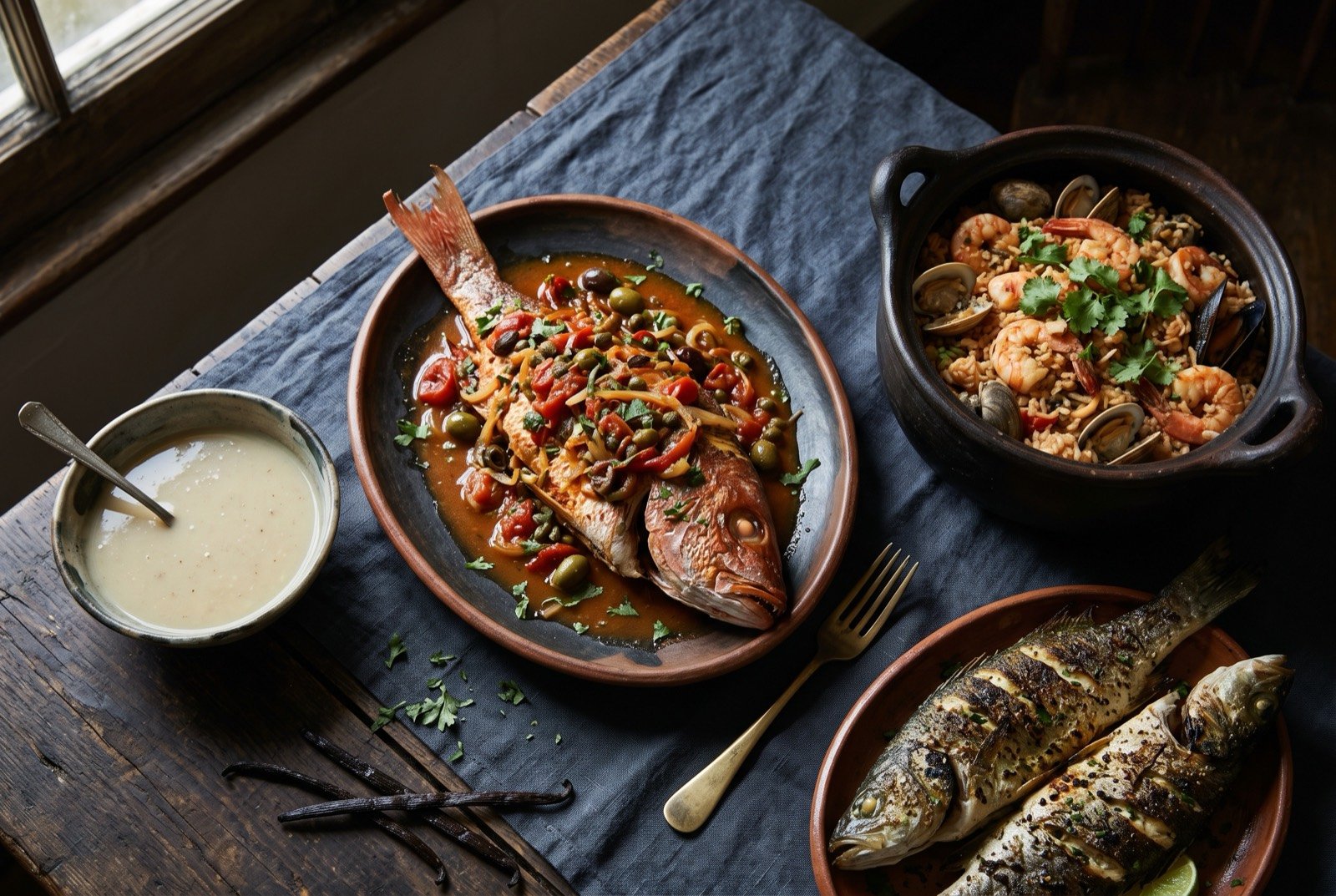
A tropical maritime world, Totonac and Chontal Maya at its root, Afro-Mexican from the port outward, shaped by centuries of Caribbean and African trade through Veracruz and by a river delta that has always fed Tabasco on its own terms. Not the highland Mexico of mole and mezcal, and not the desert north of wheat and beef, but a coast and a delta that run on fish, cacao, achiote and a flower that grows nowhere else on earth quite the way it grows in Totonacapan. Every dish as tradition built it, then what a modern chef would change.
Sources and review · What this chapter does not assert · How we research · Know this better? Tell us
A Sense of Place
Veracruz and Tabasco share a coastline and a climate, tropical, humid, fed by the same Gulf, but they are not one kitchen wearing two names. Veracruz is a port state with a highland spine behind it: the coastal plain rises through Xalapa, Coatepec, Córdoba and Orizaba into cool, volcanic-soil country that grows coffee and hosts a different aromatic register entirely from the coast below it. Tabasco has almost no highland at all. It is a delta, built by two rivers, the Grijalva and the Usumacinta, carrying more fresh water than almost anywhere else in the country, and its cooking answers to that fact before it answers to anything else.
Both states run through the same broad historical layers, indigenous, colonial Spanish, African, and a modern moment shaped by oil and cattle rather than tourism, but the indigenous layer itself is not the same people. Veracruz's coastal north is Totonac country, home to El Tajín and to vanilla, and its Sotavento south carries the state's most concentrated Afro-Mexican history. Tabasco's lowlands are Chontal Maya, Yokot'an speakers whose language and food both answer to the river rather than the sea.
A table of the defining logic, read as fat, starch, aromatic and protein rather than as a shelf of regional specialities:
| Element | Veracruz | Tabasco |
|---|---|---|
| Fat | Olive oil in the port kitchen, a genuine Spanish-Mediterranean import; lard inland | Lard, pork fat from the state's own 20th century cattle-and-pig economy |
| Starch | Maize as tortilla and tamal; rice, a Spanish-era import, worked into the coast's own rice-and-seafood dishes | Maize, but also plantain, yuca, macal and camote as true staples, not garnishes, suited to flood-plain agriculture |
| Aromatic base | Onion, garlic, tomato and olive-caper sofrito on the coast; achiote, epazote and mole spice inland | Achiote, chile amashito, chaya, chipilín, hoja santa, called momo locally |
| Everyday protein, sea and river | Huachinango, jaiba, camarón, the Gulf's own catch, landed daily at the port | Robalo, mojarra, and above all pejelagarto, the delta's own freshwater gar |
| The one ingredient that names the region abroad | Vanilla, native to Totonacapan specifically, nowhere else | Cacao, grown at real scale around Comalcalco today, and claimed, with more civic pride than hard archaeology, back to the Olmec |
The History in Layers
Totonacapan and El Tajín, before either state existed
El Tajín, whose name in Totonac means something close to great smoke or house of thunder, began its monumental building in the first century of the common era and reached its height between roughly 800 and 1150 CE, the most important political centre of northeastern Mesoamerica after Teotihuacán's own fall. The Pyramid of the Niches carries 365 niches, one for each day of the solar year, a working calendar in stone. The site holds seventeen ball courts, more than any other Mesoamerican city, spread across roughly sixty hectares and a hundred and sixty eight structures. UNESCO listed it a World Heritage Site in 1992. This was, and Totonacapan remains, the home region of a plant that would go on to flavour more of the world's food than almost anything else grown in the Americas: vanilla, covered in full below.
The Olmec, and a claim this chapter is careful to get right
Tabasco's own great Olmec city is La Venta, in Huimanguillo municipality, and Tabasco's tourist and cultural material repeats, constantly and with real civic pride, that La Venta is where cacao was first drunk. The archaeology tells a more specific and, as it happens, more interesting story. The chemically confirmed evidence, theobromine residue detected directly in ceramic vessels and published in the peer-reviewed literature, comes from San Lorenzo, the premier early Olmec capital, and from the ritual site of El Manatí: 27 vessels at San Lorenzo alone, spanning roughly 1800 to 1000 BCE, cacao residue found alongside a mortuary ritual involving sacrificial victims at the height of the city's power. Both San Lorenzo and El Manatí are in the state of Veracruz, not Tabasco. No published residue study naming La Venta's own ceramics could be found for this chapter, only tourism and cultural-board copy repeating the claim without a citation behind it. This does not mean Tabasco's Olmec cacao heritage is invented: the region's own historians, at the Universidad Juárez Autónoma de Tabasco, have written a serious academic history of Tabascan cacao running from the Olmec to the present, and Olmec cacao use in the wider Gulf Coast heartland, of which La Venta was unquestionably a part, is not in serious doubt. What is not settled is the specific claim that La Venta's own pots have been shown, by the same chemical method used at San Lorenzo, to have held cacao. This chapter states the stronger claim, Gulf Coast Olmec cacao use by 1800 to 1000 BCE, and the weaker one, La Venta's own residue evidence, separately, rather than letting civic pride stand in for archaeology.
The Chontal Maya, the delta's own people
The Chontal of Tabasco call their own language Yokot'an, the true language, part of the Ch'ol-Chontal branch of the Mayan family, spoken today mainly in the municipalities of Nacajuca and Centro, where roughly three quarters of Tabasco's Chontal population lives. Chontal culture has historically centred on agriculture, fishing and the direct exploitation of the delta's own resources, which is the plain ecological basis of everything this chapter treats as Tabasco's own cooking, as distinct from cooking merely done in Tabasco. A named, place-based food route promoted by the state, Biji Yokot'an, runs through the Chontal towns of Nacajuca and names uliche, roasted pejelagarto and butifarras as its signature dishes, exactly the three this chapter treats as Tabasco's own spine. A genuine gap, honestly stated: no dedicated Chontal-authored or Chontal-community-published culinary source, as distinct from material written about the Chontal by outside academics or by the state tourism board, turned up in the research behind this chapter.
Veracruz as the one authorised door
For most of the colonial period Veracruz was the only authorised port for the legal entry of enslaved Africans into New Spain, receiving both direct shipments from Africa and re-exports from Caribbean holding points, Jamaica, Barbados, later Havana. The scale is genuinely disputed among historians and this chapter reports the range rather than inventing a false single figure: the Mexican anthropologist Gonzalo Aguirre Beltrán's classic 1984 estimate gives roughly 30,000 people officially landed at the port between 1590 and 1640; other historians, working from wider Atlantic trade data, give figures for New Spain as a whole running from 100,000 to 200,000. Trade intensity peaked between 1580 and 1640 and declined sharply after 1650 as mestizaje generalised and the free Black and mulatto population came to outnumber the enslaved. By 1681 the port city itself held roughly 1,000 people, at least half of them Black; a century later, of the city's 4,000 residents, a quarter were classified in the 1791 census as negros, pardos, morenos, mulatos y chinos.
The geographer Odile Hoffmann, writing for the Veracruz state government's own Patrimonio Cultural series, is exact and useful on method here in a way this chapter tries to follow rather than smooth over. She warns directly against hunting for huellas de africanía, traces of Africanness, as an exoticising exercise; states plainly that no archaeological evidence places African people in Mexico before the Spanish conquest, against some claims that circulate in English-language and some Mexican popular writing; and insists there is no hay un modelo, no single plantation-and-slavery model, that explains Afro-Veracruzano history on its own, which was as often urban and free as rural and enslaved. The dense concentration of Afro-descendant communities sits in the south, the Sotavento and Papaloapan region, named towns including Yanga, Amapa, Coyolillo, Mandinga and Mocambo, though Hoffmann also documents Black and pardo populations historically around Xalapa, Coatepec and into the Huasteca, further north than the popular geography usually allows.
San Lorenzo de los Negros, renamed Yanga in 1932, was founded on 10 August 1609, the settlement that followed the negotiated end of Gaspar Yanga's cimarrón rebellion, and is described, including in Hoffmann's own academic text, as the first free town in the Americas. A second, smaller maroon settlement, Amapa, followed a 1735 revolt and was formally founded in 1769. Sugarcane, brought by Hernán Cortés from Cuba in 1519 and planted at Santiago Tuxtla from 1524, with the first mill installed in 1526, is the economic system these settlements sit against: enslaved women and children as young as five worked cane-cutting and stacking alongside adults into their sixties, and slave sales in the sugar-hacienda enclaves around Córdoba and Orizaba are recorded as late as 1810.
Against this, a 2023 academic study of food and structural power among Afro-Mexicans of the Costa Chica and Veracruz offers a useful counterweight this chapter takes seriously rather than dismisses as pedantry: it documents dishes with names suggesting African origin, mondongo, moronga, gandinga, while stressing that it was indigenous women who provided the fundamental food knowledge and labour, and frames Afro-Mexican cuisine as a genuine product of mestizaje under colonial hacienda power rather than of unbroken African retention. Both things can be true at once, and this chapter tries to hold them together: African-diaspora technique is real and documented, plantain worked directly into tamal masa, filled with seafood and seasoned with coconut milk, is one specific, sourced example, and it did not arrive or survive untouched by everything else the coast was doing at the same time. The anthropologist and cook Raquel Torres Cerdán, Xalapa-born, has spent a career working from inside this exact question, co-authoring Recetario afromestizo de Veracruz with Dora Elena Careaga Gutiérrez in 2003, an ethnographic recipe collection compiled from Afro-mestiza cooks in their own voice, and reviving the use of agachilo, a nearly lost Afro-Caribbean root, in atoles, breads and horchatas. She is, by a real distance, the strongest named in-tradition voice this chapter found for this part of its own subject.
Coffee, coming down from the hills
Coffee reached Coatepec in 1808: the priest José Santiago Contreras, granted land at Tecoxolco, imported six thousand plants from Havana via his associate José Arias, the shipment landing at Veracruz port on 16 May that year. Through the nineteenth century Coatepec became known across the country as the capital of coffee, its beans traded well enough to be quoted on the New York exchange, the altitude and volcanic soil of its 1,000 to 1,250 metre elevation credited for the quality. This is a genuinely separate aromatic world from the coast fifty kilometres away, and it belongs in the same chapter as huachinango only because the same state grows both.
Jalapeño, a branding story rather than an agricultural one
The chile that carries Xalapa's name is not, and this surprises most people who assume otherwise, grown in any quantity around the city itself. What actually happened: on 31 January 1922 the federal Secretaría de Industria, Comercio y Trabajo granted a patent to Narciso Jiménez Guerra for La Jalapeña, a method of pickling and preserving headless chiles, and a Xalapa packing business built its trade on preserving cuaresmeño and serrano chiles offloaded from passing trains in barrels of vinegar and salt for bulk sale. The chile's name is a hundred-year-old commercial success story, not an ecological fact about where the plant grows.
Tabasco's own twentieth century: cattle before it was cacao
It is worth stating plainly, because it complicates a comfortable story, that Tabasco's beef-heavy dishes, puchero above all, rest on a much more recent foundation than the state's Olmec and Chontal history suggests. Cattle ranching in Tabasco accelerated sharply only from the 1950s, and by the 1960s and 1970s the state was supplying a substantial share of Mexico City's beef demand, a figure repeated widely but not independently traced here to a primary government statistic, so held at that level of confidence rather than quoted as settled fact. More than one Mexican source makes the honest point directly: beef was scarce in the traditional Tabascan diet before this postwar boom. The delta's older diet, the one uliche and mone still carry, was built from fish, game, maize and wild plant food, and cattle-country Tabasco sits on top of that older cuisine rather than growing out of it.
The Flavour Arsenal
Seeds and pods
Cacao, grown at real scale today around Comalcalco, which produces an estimated two thirds to four fifths of Mexico's national cacao. Twenty seven cacao-focused peasant associations were documented across eight Tabasco municipalities in a 1999 to 2000 harvest study, most concentrated in Comalcalco and Cunduacán, formed under a 1932 federal agricultural-associations law and, at the time of that study, averaging nearly thirty years in operation. A field study by researchers at the Colegio de Postgraduados, Campus Tabasco, working directly in Miahuatlán, Cunduacán, documented twenty four distinct maize-and-cacao beverages still made in the region, thirteen of them ceremonial, used in rites called perdón al cacao and fiestas del cacao, eleven everyday: chocolate, pozol blanco, chorote, chicha de cacao, polvillo and more, a genuinely wider cacao repertoire than the chocolate-drink cliché usually allows.
Pumpkin seed, pepita, ground on a metate or, at home, a spice grinder, the thickening base beneath tlatonile and folded into pejelagarto en chilmole and uliche's own garnish.
Vanilla, native to Totonacapan and nowhere else with the same intensity, xanath in Totonac, recondite or hidden flower. Covered in full in the technique ladder below, since its curing is itself the region's single most distinctive piece of craft.
Leaves
Hoja santa, called momo or mumu locally, an aniseed-and-sassafras-scented leaf used both as a wrap, in mone, and as a flavouring agent in its own right, agua de acuyo, hoja santa water, appears on Múcara's own Xalapa menu.
Chipilín, Crotalaria longirostrata, a bitter legume leaf used across Chiapas, Oaxaca and Tabasco alike, not a Tabasco exclusive, worked into corn masa for tamales, especially associated with Tabasco's own Chontalpa sub-region.
Epazote, the pungent, near-universal bean-pot and mole herb, present in salsa veracruzana's household variants and in chilpachole de jaiba's finish alike.
Banana leaf, the delta's standard wrap for tamales and for mone, alongside hoja de tó, a local name for the same broad function.
Ferments and preserved things
Vanilla, cured rather than fermented in the strict sense, but a genuine preservation technology. Covered below.
Pozol and its cousins, chorote, polvillo, tascalate, fermented and toasted maize-and-cacao drinks, historically portable, shelf-stable travel food for river and forest journeys, still made across Tabasco's Chontal communities and, honestly, claimed by both Tabasco and Chiapas as native rather than belonging cleanly to either.
Chillies
Chile amashito, Capsicum annuum var. glabriusculum, a small, pungent, largely wild-harvested chile, dispersed by birds under tree shade up to 1,300 metres, the base of Tabasco's own table sauce and the sauce served over pejelagarto asado. A Chontal or Mayan-derived word, most plausibly describing the chile's wild quality.
Guajillo, ancho and mulato, the dried chile backbone of mole de Xico and, in different proportion, of chilpachole de jaiba and camarones a la diabla.
Jalapeño, covered above, a Xalapa business rather than a Xalapa crop.
Starches and staples
Maize, nixtamalized, the base of every tortilla, tamal and garnacha in this chapter, and, ground with cumin, the thickener that gives uliche its own body in place of a nut or seed paste.
Plantain, yuca, macal and camote, Tabasco's own flood-plain staples, plantain worked whole into puchero and, in the documented Afro-Veracruzano tamal tradition above, into the masa itself.
Rice, a Spanish-era arrival worked into arroz a la tumbada, the coast's own rice-and-seafood stew, seasoned throughout with the region's own epazote rather than treated as a foreign grain doing a foreign job.
The Technique Ladder
The argument, from inside
Five techniques, each explained by why it works, not only what it does.
Rung 1. Sangrado, bleeding the fish at the point of capture
Two currently operating Veracruz kitchens, Namik and Mardel, both treat this as their real point of difference from an ordinary catch: the fish's cheek and gills are cut, or the fish bled by the method Namik calls, borrowing the Japanese term directly, shukketsu, then the fish is chilled fast. Bleeding stops the build-up of lactic acid and stress hormones in the muscle that a slowly dying fish otherwise produces, which is the actual, physiological reason a properly bled fish tastes cleaner and holds a firmer texture, not a matter of ritual or romance. Both kitchens present this as continuous with, not a departure from, an ordinary fisherman's own practice.
Rung 2. The salsa veracruzana sofrito, built slowly rather than rushed
Onion and garlic sautéed until truly golden, olives and capers added and given their own two minutes in the fat before the tomato goes in, then a genuine twenty five minute simmer before the pickled chile and fresh herbs join at the end. The reason this takes as long as it does: a sofrito this size needs real time for the tomato's water to cook off and its sugars to concentrate, which is what turns a raw-tasting jarred sauce into a properly reduced one, and it is the single biggest reason a bad veracruzana sauce tastes bland while a properly made one does not.
Rung 3. Vanilla's beneficiado, curing rather than harvesting
A green vanilla pod is flavourless. Curing it, matado, a brief killing heat shock, then repeated cycles of sun-drying and sweating in wrapped blankets over roughly a hundred and twenty days, is what triggers the enzymatic breakdown that converts glucovanillin into vanillin and the pod's several hundred other aromatic compounds. This is not a drying process in the ordinary sense: it is a controlled, slow fermentation of the pod's own chemistry, and it is why a properly cured Papantla pod and a bottle of synthetic vanillin extract are not the same substance describing the same flavour at different strengths, but genuinely different things.
Rung 4. Comal-toasting before grinding, for chile and seed pastes alike
Mole de Xico's nuts, seeds and dried chile, and tlatonile's sesame and pumpkin seed, are toasted separately, each to its own point, before they are ever ground together. Toasting develops real Maillard flavour in each ingredient on its own terms, chile toasted with chile's own aromatics, seed with seed's own oil-soluble ones, in a way that grinding them raw and cooking the finished paste afterward cannot reproduce, since by then the ingredients can no longer develop flavour independently of one another.
Rung 5. Leaf-wrapping for steam, hoja santa and banana leaf together
Mone's fish, or pork, is seasoned and wrapped first in hoja santa, then in banana leaf, tied, and traditionally roasted directly over coals. The inner leaf's own aromatic oils infuse the food directly against its surface, while the outer leaf's real job is structural, sealing in the food's own moisture as steam under direct heat, the same basic mechanism a curanto or a barbacoa pit uses at a larger scale.
The Ferment and Preserve Bench
Vanilla's beneficiado. Covered in full in the technique ladder above: a green pod is killed with a brief heat shock, then cycled through repeated sun-drying and blanket-wrapped sweating over roughly a hundred and twenty days, the process that converts the pod's own glucovanillin into vanillin and develops several hundred further aromatic compounds. A genuine curing technology, not simply drying, and the reason a real Papantla pod and a bottle of synthetic extract are different substances rather than the same flavour at different strengths.
Pozol, chorote and their cousins. Fermented and toasted maize-and-cacao drinks, historically portable, shelf-stable travel food for river and forest journeys through the delta, still made across Tabasco's own Chontal communities. Pozol blanco is plain, pozol agrio fermented longer to a genuinely sour result, pozol de cacao and chorote both fold ground cacao through the fermented or fresh nixtamal dough; polvillo, by contrast, toasts rather than ferments its maize and cacao on a comal before beating them into water. Genuinely claimed by both Tabasco and Chiapas as native, and this chapter does not adjudicate that claim, only reports it.
Sourcing in Britain
Vanilla. Real Papantla-origin cured vanilla pod is buyable in the UK, from Fine & Wild, whose "Mexican Vanilla Pods, Papantla Original Variety" names the region and the Totonac cultivation history directly, roughly £5 a pod, several times a standard Madagascar bourbon pod's price from an ordinary spice merchant. This is the single decision that matters most in this whole chapter: real Totonac vanilla carries a dark, woody, almost tobacco-and-dried-fruit complexity with a chocolate-adjacent note that Madagascar's own creamier, more purely sweet Bourbon vanilla does not have, and a reader who substitutes should know plainly what they have traded away, not simply assume the two are interchangeable.
Achiote. Well served. Cool Chile Co, a genuine London manufacturer, makes an achiote paste from Yucatán-imported annatto seed at its own factory, roughly £4.70 for 190g, also via Sous Chef. El Yucateco, a real Mexican brand, sells achiote paste in 100g and 1kg through MexGrocer.co.uk. Whole annatto seed, for building a recado from scratch, is available from Spice Mountain and The Spiceworks. Three physical London Mexican grocers, Mestizo Mexican Market, La Marketa in Camden Market and LaTiendita, are confirmed operating and likely, though not verified item by item, to carry achiote paste on the shelf.
Gulf seafood, and the one fish this chapter cannot honestly promise. Genuine red snapper, the same Lutjanus genus huachinango refers to, is sold fresh in the UK, roughly £22/kg from Adam Seafood, and frozen from Seafresh. True Atlantic blue crab is not established in UK retail; the closest real product is Passionate About Fish's blue swimming crab meat, a related but distinct Indo-Pacific species, closer to jaiba in texture and sweetness than UK brown crab, the honest fallback if blue swimmer cannot be found. Gulf shrimp itself has no UK import; farmed tropical king or tiger prawns are the workable, honestly-stated substitute. Pejelagarto cannot be bought as food in Britain at all: the only pejelagarto for sale in the UK is live aquarium stock through hobbyist sites, pet-trade fish, not food fish, and this chapter does not pretend a real substitute closes that gap, only that a firm, bony whole fish cooked the same way over coals can gesture at the technique.
Chipilín. Confirmed unavailable in the UK in any form, fresh, dried or frozen; every chipilín retailer found in this research is US-based. Fresh fenugreek leaf, methi, from any UK South Asian grocer, is the closer of two realistic substitutes for its genuinely bitter, hay-like character, over the leafier but less bitter alternative of dandelion or amaranth greens; state plainly, when using it, that the specific flavour of chipilín itself cannot be replicated in a British kitchen.
Hoja santa. This chapter did not confirm a UK stockist for hoja santa in the research behind it, and states that gap directly rather than assuming the leaf is available because other Mexican specialist ingredients are. Where it cannot be found, wrap mone in banana leaf alone and accept the loss of the inner leaf's own aniseed character, rather than reaching for an aggressive herbal substitute that would misrepresent the flavour.
Chiles. Genuinely well served. Fresh, British-grown jalapeños and pickled La Costeña jalapeños both via Cool Chile and MexGrocer; dried ancho and guajillo from Cool Chile and Mextrade, both explicitly marketed for mole and adobo use, exactly what mole de Xico and camarones a la diabla need.
Coatepec coffee. No currently operating, verifiable UK retailer of Coatepec or wider Veracruz-origin coffee was confirmed. One Newcastle-based importer lead, surfaced through a UK Mexican community directory rather than a working retail site, could not be verified as currently trading; treat it as worth a direct enquiry rather than a citable source. Failing that, several UK specialty roasters carry Oaxaca or Chiapas lots, a real but geographically different substitute worth naming as such.
Tabasco cacao and chocolate. Genuine single-origin Tabasco chocolate makers exist, Casa Bosques, Pinwheel, CUNADEPIEDRA among them, but none is confirmed to ship to or stock in the UK. No UK bean-to-bar maker, including the well-regarded Solkiki and Dormouse, was confirmed to use single-origin Tabasco cacao specifically. The honest substitute is a criollo or Trinitario-variety single-origin Mexican bar from a UK stockist of imported craft chocolate, or, failing that, a criollo bar from a neighbouring Central American origin, with the clear understanding that this trades geographic precision for varietal character rather than replacing it exactly.
Masa. Maseca-brand masa harina is widely available, Sous Chef, MexGrocer, Mextrade, Melbury & Appleton all stock it. More significantly, real nixtamalized fresh masa, not reconstituted flour, is made in London by Masafina, a genuine tortillería stone-grinding heirloom Mexican corn on site, order direct. This is worth seeking out specifically for the garnachas, uliche and tamales above, all three built on the ladder's own nixtamalization principle.
Plantain and banana leaf. No sourcing problem at all: fresh plantain from Tesco and any African or Caribbean grocer, frozen banana leaf from Oriental Mart, Tradewinds and most South Asian grocers.
Kit. A molcajete, a genuine equivalent to the Mexican volcanic-stone mortar this cuisine has always used, is sold by Sous Chef and MexGrocer, and produces a coarser, more textured salsa or adobo than a high-power blender alone, a real technique point rather than an authenticity flourish. A dedicated comal is available through specialist sellers, but a cast-iron griddle pan, or the Big Green Egg's own plancha, does the same job honestly.
The single decision that matters most. Real Papantla vanilla over a Madagascar substitute, stated above, but worth repeating here: it is the one ingredient in this chapter whose absence changes what the reader is actually cooking, not merely how well they cook it.
Voices and Sources
Mexican and local academic sources: Odile Hoffmann's chapter "De 'negros' y 'afros' en Veracruz," published by the Veracruz state government's own Patrimonio Cultural series; Giobanna Buenahora's peer-reviewed INAH article "Experiencias silenciadas: breves apuntes sobre la cocina afromexicana" (Diario de Campo, 2018); the Colegio de Postgraduados, Campus Tabasco, field study of maize-and-cacao beverages in Miahuatlán, Cunduacán; Universidad Juárez Autónoma de Tabasco's own published cacao history, El Cacao tabasqueño: de los olmecas a nuestro tiempo, and its pejelagarto aquaculture monograph; Scielo-indexed papers on vanilla-curing economics in Totonacapan, Coatepec's coffee culture, Usumacinta fisheries, Afro-Mexican food and structural power, and Tabasco's cacao-cooperative history; the PNAS residue study identifying Olmec cacao use at San Lorenzo; INAH and INPI institutional material on El Tajín and the Yokot'an language; and Larousse Cocina Mexicana, the standard in-country recipe reference, for every quantified dish above.
Named in-tradition cooks and food writers: Raquel Torres Cerdán, the Xalapa-born anthropologist and cook whose Recetario afromestizo de Veracruz, with Dora Elena Careaga Gutiérrez, is the strongest single named source for Afro-Veracruzano cooking in its own voice; Lupita Vidal of Villahermosa, double Chef del Año 2025 and author, with photographer Jesús David, of Agua y Humo: Cocinas de Tabasco, whose own framing, no somos una salsa, we are not a hot sauce, is the honest thesis this chapter's Tabasco half has tried to earn; Lesterloon Sánchez Trinidad of Múcara in Xalapa, who opened his restaurant specifically because the city, unlike Puebla, Oaxaca or Mérida, had nowhere serving its own home cooking, and whose recipes come from his own mother's and grandmother's kitchens; Carmen "Titita" Degollado Ramírez of El Bajío in Mexico City, a national institution built on championing her native Veracruz; and Zarela Martínez, whose 2001 cookbook and PBS series remain, despite her New York restaurant's closure, the strongest in-tradition print source in English for Veracruz cooking, and whose own published recipe for mole de Xico anchors that dish above.
Fishing and technique: Namik and Mardel, both in the port of Veracruz, whose independently arrived-at practice of bleeding the fish at capture, sangrado, is the strongest single piece of transferable modern technique this chapter found; Hugo Ortega of Caracol in Houston, whose pan-coastal Mexican menu is the strongest documented diaspora kitchen taking Gulf technique seriously at a nationally recognised level; and Cometa in London, whose crab chilpachole rice is an honest modern reworking of a correctly built traditional base rather than a substitution for it.
Things this chapter has deliberately not asserted
- That La Venta's own ceramics carry the same chemically confirmed cacao residue evidence San Lorenzo and El Manatí do. The chemistry behind Gulf Coast Olmec cacao use is real and well documented, but the two sites where it has actually been measured are both in Veracruz, not Tabasco, and no residue study naming La Venta specifically could be found.
- That chorote was literally one of the first drinks the Olmecs prepared. This is repeated by Mexican press without a citation and is treated here as regional folklore, not fact.
- That the Tzacopontziza and Zkatan-Oxga vanilla origin story is a documented pre-Hispanic Totonac oral tradition. It is a twentieth century literary retelling by a named Mexican poet, and this chapter treats it as exactly that.
- That chilpachole de jaiba is traditionally masa-thickened, despite that being a natural assumption for a dish carrying an atole-adjacent name. The sourced recipes describe a chile-tomato broth base, and this chapter follows them rather than the assumption.
- That Tabasco's postwar beef supply reached a specific, verified share of Mexico City's demand, or that the state's cacao output reaches a specific, verified share of the national total. Both figures recur constantly across Mexican press and tourism material but were not traced to a primary government statistic in the research behind this chapter.
- That tamales de chipilín, in its specific wrapped tamal form, is a confirmed pre-Hispanic dish. The underlying use of the leaf as food is old and regionally consistent; the exact tamal recipe's antiquity is asserted by only one source, without citation.
- That Namik's head chef can be named with confidence. Sources conflict between two names, and this chapter names the restaurant's technique rather than adjudicating its kitchen's own org chart.
- That Múcara or Mardel hold a Michelin star. Both are recognised by the separate Guía México Gastronómico and Culinaria Mexicana rankings, not by the Michelin Guide Mexico, and this chapter keeps the two distinct.
- That "jarocho" definitely derives from a Black militiaman's lance, or that "mone" definitely derives from monear, to tie. Both are plausible, widely repeated folk etymologies, and neither has been traced to a named academic linguist.
- That real Coatepec coffee or single-origin Tabasco chocolate can currently be bought from a UK retailer. Neither could be confirmed as available in this research, and this chapter says so rather than assuming a specialist market this size must exist somewhere.
- That hoja santa is available from a UK retailer. This chapter did not confirm it either way and treats the gap as open rather than assumed closed.
Sangrado, bleeding the fish at the point of capture
Two currently operating Veracruz kitchens, Namik and Mardel, both treat this as their real point of difference from an ordinary catch: the fish's cheek and...
The salsa veracruzana sofrito, built slowly rather than rushed
Onion and garlic sautéed until truly golden, olives and capers added and given their own two minutes in the fat before the tomato goes in, then a genuine...
Vanilla's beneficiado, curing rather than harvesting
A green vanilla pod is flavourless. Curing it, matado, a brief killing heat shock, then repeated cycles of sun-drying and sweating in wrapped blankets over...
Comal-toasting before grinding, for chile and seed pastes alike
Mole de Xico's nuts, seeds and dried chile, and tlatonile's sesame and pumpkin seed, are toasted separately, each to its own point, before they are ever ground...
Leaf-wrapping for steam, hoja santa and banana leaf together
Mone's fish, or pork, is seasoned and wrapped first in hoja santa, then in banana leaf, tied, and traditionally roasted directly over coals.
The dishes
- Huachinango a la veracruzana Veracruz, Mexico
- Arroz a la tumbada Sotavento, Veracruz, Mexico
- Chilpachole de jaiba Los Tuxtlas, Veracruz, Mexico
- Mole de Xico Xico, Veracruz, Mexico
- Camarones a la diabla Veracruz, Mexico
- Garnachas veracruzanas Highland Veracruz (Orizaba, Córdoba, Coatepec and Xalapa), Mexico
- Pejelagarto asado Tabasco, Mexico
- Uliche Chontal Tabasco (Nacajuca, Centro, Jalpa de Méndez, Macuspana and Centla), Mexico
- Puchero tabasqueño Tabasco, Mexico
- Mone de pescado Tabasco, Mexico
- Tamales de chipilín Chontalpa, Tabasco, Mexico
Sources and review
- Researched
- Researched from 65 sources in the brief
Where this volume comes from
4 research briefs on file for this volume, researched to the rules on How we research. Published 3 September 2026. Last changed 15 September 2026.
The brief's own account of its sources
Roughly two-thirds of substantive claims across both passes rest on Mexican, largely local or academic sources: two full-text academic works read directly (Giobanna Buenahora's INAH Diario de Campo article on Afro-Mexican cuisine; Odile Hoffmann's chapter in the Veracruz state government's own Patrimonio Cultural series), the Colegio de Postgraduados Campus Tabasco field ethnobotany on cacao-and-maize beverages (the single strongest source in the Tabasco pass), Universidad Juárez Autónoma de Tabasco publications on cacao history and pejelagarto aquaculture, Scielo-indexed papers on vanilla