The Americas · Volume 05
Jalisco, Michoacán and the Pacific West
Agave, Birria and the Manila Galleon Coast
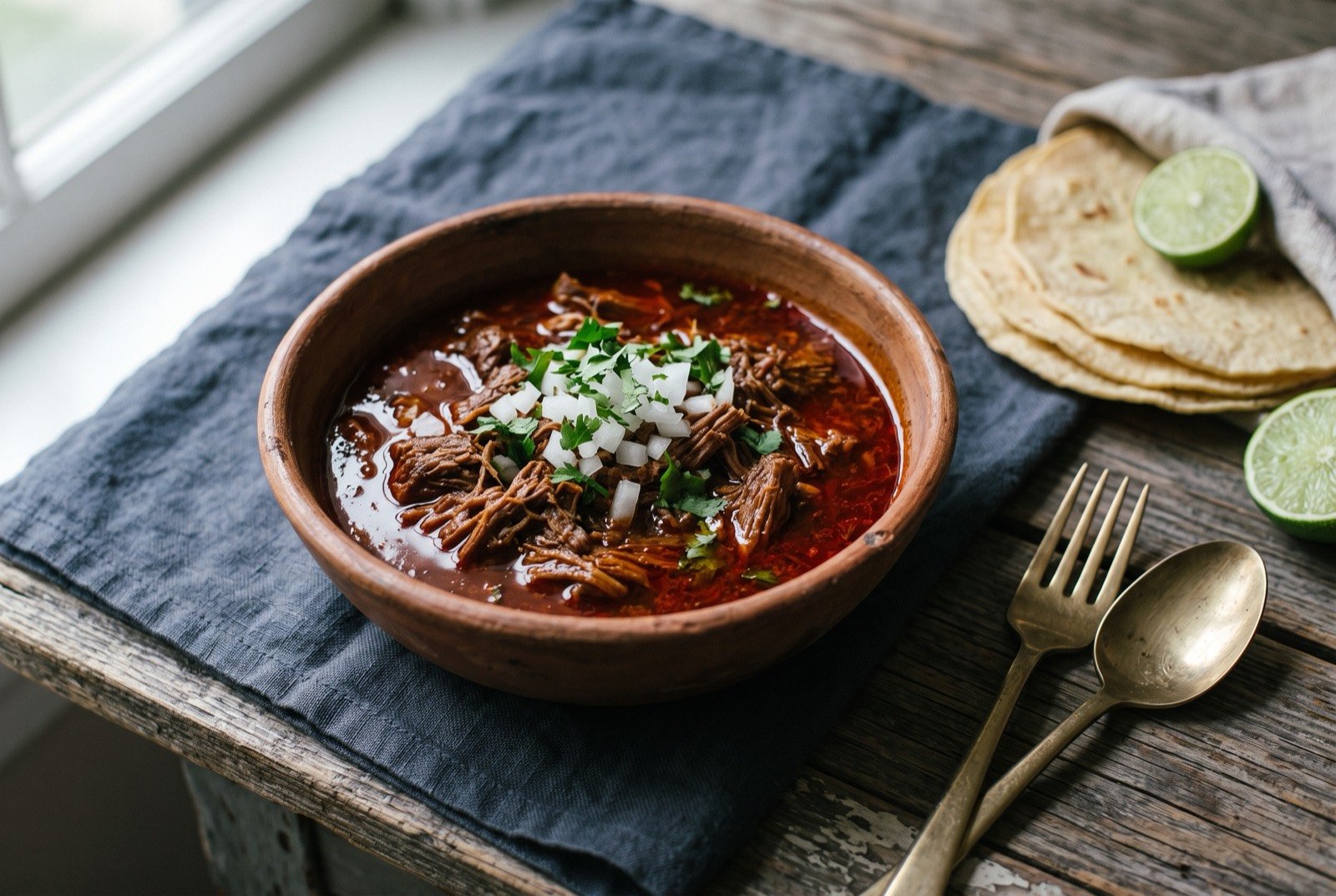
West central Mexico's agave highlands and lake-district south: Jalisco's ranching valleys and tequila country, Michoacán's Purépecha lake world at Pátzcuaro, and the Pacific strip below both, where a seventeenth century wave of Filipino settlement still shows up in a glass of coconut wine on the Colima coast. Not birria tacos and a tequila shot with a wedge of lime, but two food worlds joined by trade, ranching and a genuinely distinct pre-Hispanic state that the Aztecs never conquered. Every dish as tradition built it, then what a modern chef would change.
Sources and review · What this chapter does not assert · How we research · Spotted something wrong?
A Sense of Place
This volume is not one Mexican region with a tequila shot poured over it. It is three food worlds, joined by a shared colonial and pre-Hispanic history but built on genuinely different ecology, and the chapter treats them as three rather than flattening them into "west Mexico."
Jalisco: ranching valleys and the agave highlands
Jalisco's core is a cattle-and-wheat ranching economy laid over a Nahua and mestizo base, with Guadalajara as its urban centre and Los Altos, the highlands to the east, and the lower Valle around the town of Tequila itself, as its two defining agricultural zones. The highlands, roughly 1,700 to 2,100 metres, red clay soil, cooler, slower agave growth, sit against the lowlands under 1,200 metres, darker volcanic soil, warmer and faster. This split runs through the whole state's food logic, not only its spirits: charrería, Mexico's own ranching sport and a genuine UNESCO-recognised piece of intangible heritage specific to Jalisco, sits on the same land as the agave.
Michoacán: the Purépecha lake world
South and west, Michoacán is a different ecology entirely, centred on the Meseta Purépecha and Lake Pátzcuaro rather than on cattle range. This is the territory of the historic Tarascan state, one of the very few Mesoamerican polities the Aztec empire never conquered, and its food culture still runs on the lake, the milpa and a copper-working tradition, Santa Clara del Cobre, that gives the region's most famous dish its defining pot.
The Pacific strip: Colima and the coast
Below both, a narrow coastal shelf, Colima and coastal Jalisco and Nayarit, carries an entirely separate historical layer: the Manila galleon trade, which for two and a half centuries put Filipino settlers ashore at this coast and left a fermented coconut drink still made in Colima today, alongside a butterflied, grill-racked fish technique shared the length of the coast.
A table of the defining logic, read as fat, starch, aromatic and protein rather than as a shelf of regional specialities:
| Element | Jalisco | Michoacán | The Pacific strip |
|---|---|---|---|
| Fat | Lard, from ranching and pig-keeping | Lard, rendered in the copper cazo | Coconut, and lard inland |
| Starch | Maize, nixtamalised, plus wheat for the birote roll | Maize, both nixtamalised for corundas and fresh-ground for uchepos | Maize and rice, with coconut worked through both |
| Aromatic base | Ancho, guajillo, pasilla and chile de Yahualica adobo, cumin, cinnamon, oregano | The same chile family, plus epazote in bean and tortilla soups | Achiote-leaning marinades north toward Nayarit, salt, lime and chile close to the water |
| Everyday protein | Goat for birria, pork for tortas ahogadas | Pork for carnitas, beef for churipo, lake whitefish where it survives | Pargo and robalo, grilled whole |
The History in Layers
The Purépecha, the empire the Aztecs never took
The Tarascan state, Iréchekua Ts'intsúntsani in Purépecha, the Reino de Michoacán to the Spanish, occupied most of present-day Michoacán and reached into Guanajuato and Jalisco, its capital at Tzintzuntzan on Lake Pátzcuaro. Michoacán's own regional pride still rests on one specific, named battle: an Aztec invasion force was stopped at the frontier city of Taximaroa, where the Tarascan army won, one of the Mexica empire's most bitter defeats, and the frontier held. This is not folklore dressed up as history, it is the reason Purépecha technique reads today as its own thing rather than a regional variant of Aztec cooking, and this chapter treats it that way throughout.
Spanish contact: goats, pigs, and two dishes born from the mismatch
The Spanish introduced goats and pigs into a landscape that had neither, and both introductions misfired at first in ways that produced this volume's two anchor dishes. Goats, bred without the predators or management that would have controlled them in Spain, overran the Jalisco countryside and devastated crops; the meat itself was considered tough and strong smelling. What tamed it was an indigenous cooking method applied to a new animal: a chile adobo and a covered earth pit, barbacoa logic, turned an unwanted animal into birria. Pigs, similarly new, met the same logic in Michoacán: cooking meat slowly in its own rendered fat was not a Spanish import either, it was an existing indigenous technique redirected at pork once pork existed to redirect it at. Carnitas is, mechanically, confit, arrived at independently in Michoacán, not a French idea that travelled.
Both origin stories carry a civic legend attached that this chapter treats as legend rather than settled fact. Birria is claimed by two towns, Cocula and La Barca, and the region's own restaurant chamber says plainly that which town got there first cannot be determined with precision; Cocula's version is goat, wrapped in maguey and pit-cooked, La Barca's is birria tatemada, beef, with an added roasting finish. Carnitas is popularly credited to Bishop Vasco de Quiroga personally teaching the technique to Quiroga's Purépecha residents in the sixteenth century, a story repeated everywhere in tourism and food press with no primary document behind it anywhere this chapter's research found, and one that in any case cannot predate the pigs the Spanish themselves brought.
The Manila galleon and Colima's Filipino settlers
Between the sixteenth and seventeenth centuries the Manila galleon route put a documented roughly 7,200 people ashore on this coast, with around 5,000 settling between the 1560s and the early eighteenth century, most of Philippine origin, contemporary records calling them "indios chinos," arriving both enslaved and free. What they carried with them was a drink, not just a labour force: lambanog, coconut-palm-sap spirit, reproduced in New Spain under the new name vino de cocos, coconut wine, concentrated specifically in the provinces of Colima, Motines, Zacatula and Acapulco. The tuba, the unfermented sap itself, was distilled in wooden stills of Philippine tradition, distinct from the metal Arab-derived alembic used elsewhere in New Spain, and because bamboo, used for sap collection in the Philippines, was not available here, settlers substituted tecomates, calabash gourds of pre-Hispanic Mesoamerican tradition, a genuine fusion of an imported technique and an indigenous vessel rather than a straight transplant of either. Tuba and its vinegar are still made in Colima today, a direct living line back to that seventeenth century settlement.
Tequila's industrial century, and what it replaced
The Denominación de Origen Tequila zone, registered with the World Intellectual Property Organization in 1978 and regulated since 1994 by the Consejo Regulador del Tequila, now covers 181 municipalities across five states, Jalisco entire plus parts of Michoacán, Guanajuato, Nayarit and Tamaulipas, and Jalisco alone accounts for over four fifths of the category's market value. The Paisaje Agavero, the agave landscape around the town of Tequila itself, Amatitán, Arenal, Magdalena and Teuchitlán, became a UNESCO World Heritage Site in 2006, recognised for a continuous cultural link to agave cultivation running back at least to the sixteenth century.
What that industrial scale replaced, rather than what it grew from, is the more useful story for a home cook. Traditional production roasted agave piñas slowly in stone or masonry ovens, commonly upward of 48 hours, and crushed them by tahona, a mule or ox-drawn stone wheel, fermenting the juice together with the fibre itself. Industrial production largely replaced both steps: the autoclave, a pressurised steel cylinder, cooks agave in a fraction of the time, and the diffuser dispenses with cooking almost entirely, extracting sugar from raw or barely treated agave with hot water, built to extract volume rather than character. Both steps are still practised commercially, not only remembered: Siete Leguas, in Atotonilco el Alto since 1952, still grinds entirely by tahona and cooks in small stone ovens over roughly three continuous days, a working demonstration that the older method never actually disappeared, it was simply outcompeted at scale.
Raicilla is the spirit that industrial tequila did not absorb. Made from agave species other than the blue Weber variety tequila requires, produced in the Costa and Sierra west of Guadalajara for over 400 years, it spent the colonial period under the name "vino de mezcal" and only took its current name to dodge prohibition and taxation on agave spirits, a history of deliberate clandestinity rather than romantic rediscovery. It kept being made regardless of its legal status, and only gained its own Denominación de Origen in 2019.
The twentieth century's own inventions, honestly dated
Not everything in this chapter is old, and the chapter says so plainly rather than borrowing pre-Hispanic weight it has not earned. Sopa tarasca, the bean and tortilla soup named for the Purépecha, was created in 1966 in Pátzcuaro by Felipe Oseguera Iturbide for the opening of his restaurant, La Hostería de San Felipe, his wife Pamela choosing the name in the Purépecha people's honour, the state's then-governor reportedly at the opening. It draws on genuinely ancestral staple ingredients, beans, tomato, dried chile, tortilla, milpa food in origin, but the dish itself, in this form, is sixty years old, not five hundred.
2010 to 2026: UNESCO's paradigm, and Michelin's late, uneven arrival
UNESCO inscribed traditional Mexican cuisine as Intangible Cultural Heritage on 16 November 2010, and named Michoacán specifically as "el paradigma," the paradigm case. It is worth being precise about what that inscription actually documents, because the honorific is often over-read: the nomination text itself names no specific Purépecha community or dish, containing only general statements about cooks across Michoacán and the rest of Mexico working to sustain traditional crops and cuisine. Michoacán appears to have been chosen as a concrete case study specifically because UNESCO's rejection of an earlier, broader Mexican bid in 2004 had criticised the absence of one, an administrative fix as much as an ethnographic survey.
The Michelin Guide reached Mexico only in 2024, and only for Mexico City, Oaxaca, Nuevo León, Baja California and Los Cabos; Jalisco was added in the 2026 expansion, when Guadalajara's Alcalde and Xokol received the city's first-ever stars, alongside eight Bib Gourmand entries including two dedicated birrierías. Michoacán, the state UNESCO named as the paradigm, carries no Michelin recognition at all as of that same 2026 guide. This chapter states that gap rather than smoothing it into a single tidy "Mexican cuisine is now globally recognised" narrative, because it is not one story, it is two, moving at very different speeds.
The Flavour Arsenal
The chile family that carries this whole volume
Guajillo, ancho and pasilla form the base of birria's adobo, tortas ahogadas' two sauces, pozole rojo's colour and churipo's broth alike, and chile de árbol supplies the sharper, hotter register in the tortas' second sauce. Chile de Yahualica, a guajillo-type chile grown specifically in the Yahualica and Los Altos area of Jalisco, is favoured by many birrieros and is described as determining much of birria's own character, worth naming precisely rather than folding into "guajillo" generically. Pasilla itself needs a careful distinction this chapter states once here so it does not need restating in every recipe: pasilla negro, the dark, raisin-toned chile used in adobo, is a different thing from pasilla de Oaxaca, a smoked chile with its own separate use, and the two are not interchangeable however similar the names look on a UK spice shelf.
Maize, the same plant doing two different jobs
Corundas and uchepos sit either side of a single technical line, and the line is nixtamalisation, not the fold. Corundas use nixtamalised maize, cooked with lime, then washed and ground, some households still using wood ash rather than lime for a purer masa. Uchepos use fresh, tender field corn, ground raw, never nixtamalised, which is the entire reason for the dish's softer, spongier, sweeter character. Cacahuazintle, the wide-kernelled maize variety specific to pozole, is a third, separate maize identity again, chosen for how its kernels burst and "flower" once cooked rather than for its use in masa at all.
Wraps: the leaf a dish is cooked in is not interchangeable
Corundas are wrapped in the leaves of the maize plant itself, hoja de milpa or caña, cut from the standing stalk, not the ear husk. Uchepos are wrapped in the fresh husk of the ear, hoja de elote. No evidence turned up in this chapter's research for banana leaf as a traditional wrapper for either dish, or for any tamale cookery specific to this volume's Pacific coast strip, and the chapter states that plainly rather than reaching for banana leaf as a generic tropical stand-in the way some Gulf coast or southern Mexican tamales genuinely do use it. Birria, separately again, is traditionally wrapped in maguey, agave, leaves during its pit cook, a third leaf again, doing a heat-retention job rather than a flavour-transfer one.
Fat, and the vessel that decides carnitas
Lard is the operative fat throughout Michoacán's cooking, and the copper cazo it is cooked in is not decoration, it is the reason carnitas works: copper conducts heat exceptionally evenly, avoiding the hot spots that would scorch meat sitting in fat for four hours. The Michoacán state's own carnitas cuts go well beyond "pork shoulder": maciza, the lean leg meat, goes in first with costilla and espaldilla, then the thicker cuero, pork skin, after roughly twenty minutes, then buche and nana, stomach and uterus, offal cuts specific to the full traditional repertoire and largely absent from any version made outside the region.
Agave, doing three different jobs depending on the species
Tequila requires Agave tequilana Weber, blue variety, exclusively. Raicilla is made from any of five other agave species depending on the taberna, the term for a raicilla distillery, distinct from tequila's "destilería." Mezcal, made elsewhere in Mexico from still other species, is a related but genuinely separate spirit again. Treating "agave spirit" as one undifferentiated category is the single most common flattening this chapter is trying to avoid.
Dairy that has arrived in Britain properly, for once
Cotija, queso fresco and queso Oaxaca are this volume's defining cheeses, cotija's firm, salty, aged character finishing pozole and sopa tarasca, queso fresco crumbled fresh through corundas' own masa. Full sourcing detail sits in Part Three, but it is worth flagging here in the arsenal itself: these are, unusually for this atlas, genuinely UK-made now, not import-dependent, a real and recent change.
The Technique Ladder
The argument, from inside
Five techniques, each explained by why it works, not only what it does.
Rung 1. Carnitas' copper confit
Meat submerged and slow-cooked in its own rendered fat, at a temperature the fat itself regulates, cooks evenly to a crisp exterior and tender interior without ever drying out, because the fat, not direct heat, is doing the work of moisture retention; copper's even heat conduction, versus a heavy pot's hot spots, is what lets four hours of continuous fat-cooking happen without scorching any single point in the pan.
Rung 2. Birria's chile adobo as tenderiser, not only flavour
The ancho, guajillo and pasilla adobo does two jobs at once on tough, strong-smelling goat: its acidity and enzymatic action begin breaking down muscle fibre before heat ever touches the meat, while its own strong flavour masks what the meat's own smell would otherwise carry through the finished dish, the reason a milder or later-added chile sauce cannot substitute for a proper marinade time.
Rung 3. Nixtamalisation's chemistry, and why uchepos skip it on purpose
Cooking maize with lime frees niacin that is otherwise bound and nutritionally unavailable in raw corn, and breaks down the kernel's pericarp so it grinds into a cohesive, elastic masa rather than a grainy paste; uchepos deliberately skip this step because the dish wants fresh corn's own sweetness and soft texture, not the firmer, more savoury character nixtamalisation produces, a genuine choice rather than an omission.
Rung 4. Tahona crushing and slow roasting, versus autoclave and diffuser
A stone oven run for 48 or more hours caramelises agave sugars slowly and develops complex, roasted aromatics that a seven-hour pressurised autoclave simply does not have time to build; a tahona crushing roasted piñas together with their own fibre, rather than a diffuser washing sugar out of barely-treated agave with hot water, carries that same roasted character into the mosto rather than diluting it into something cleaner but flatter.
Rung 5. Pescado zarandeado's double rack
Holding a butterflied fish between two grates and turning it constantly over coals cooks both faces by even, direct radiant heat while the fish's own moisture is retained rather than dripped away, the "zarandear," shaking or sifting, motion the dish is named for existing specifically to stop it sticking or scorching in one spot the way a single fixed grate would.
The Ferment and Preserve Bench
Two preparations, genuine fermentation technologies from two different parts of this volume rather than a modern flourish.
Tuba and vino de cocos. Coconut palm sap, tapped and left to ferment, distilled in a wooden still of Philippine tradition, using tecomate gourds where bamboo was unavailable, a direct seventeenth century Filipino settlement technology still practised on the Colima coast today under its Spanish name. A genuine, working example of the atlas's own argument that trade and migration are as load-bearing to a cuisine as ecology.
Agave's roasted, fermented mosto. Piñas slow-roasted in stone ovens, crushed by tahona together with their own fibre, and fermented on that fibre with native yeast over three to five days, the process both tequila and raicilla still share at their artisanal end even as industrial production has largely moved to faster, cleaner alternatives. Worth keeping in view as a preservation and transformation technology in its own right, turning a plant that stores badly into a spirit that keeps indefinitely, not only as the first step toward a bottle.
Sourcing in Britain
Dried chiles. Cool Chile Co is the strongest single UK stockist for this volume's core chile list, guajillo, ancho, chile de árbol and pasilla negro, all confirmed in stock. One naming trap worth flagging directly: pasilla negro, the dark, raisin-toned chile birria and churipo's adobo actually need, is not the same product as the smoked pasilla de Oaxaca some retailers also stock, and the two are not interchangeable however similar the names look on a shelf. MexGrocer.co.uk and Mextrade both carry the same core range as a fallback.
Tequila and raicilla. The Whisky Exchange and Master of Malt both carry a genuine range of 100% agave tequila across blanco, reposado and añejo, including Ocho, Fortaleza, Herradura and Don Julio; the one buying rule worth stating plainly is to check the label says 100% agave and not mixto, since supermarket own-brand tequila in the UK is very often the latter. Raicilla is genuinely available, better than expected: Casa Agave, a Nottingham-based specialist agave importer, stocks several expressions, Balam Costa Raicilla among them, correctly identified as Jalisco-specific and distinct from mezcal or tequila, though stock across their range shifts and a reader should expect to substitute between whichever expression is currently available rather than hunting for one specific bottle.
Corn products. Masa harina, Maseca or Cool Chile Co's own brand, and dried corn husks for uchepos are both easily bought from the same specialist retailers as the chiles. Hominy for pozole is available tinned or dried, but genuine raw cacahuazintle for home nixtamalisation is not currently stockable in Britain; the honest route is ready hominy, not a promise of doing the whole process from scratch. Fresh corn for uchepos is this volume's real seasonal gap: British sweetcorn in August and September, bought from a farm shop rather than a supermarket, gives a workable approximation of the milky, tender field corn the dish actually wants, but supermarket sweetcorn, bred for sugar retention and shelf life, will not.
Pork and the copper cazo. UK pork shoulder, bone-in and skin-on, from a specialist butcher such as HG Walter or The Ginger Pig, is the honest substitute for Michoacán's own cazo cuts. A genuine hand-hammered copper cazo in the Santa Clara del Cobre style has no confirmed UK stockist at all; a heavy stainless steel stockpot is the realistic home substitute, and this chapter says so rather than implying the real vessel is an easy purchase.
Fresh ingredients. Seville oranges are a genuine UK seasonal strength, December to February, sold in bulk at major supermarkets during season and freezing well for year-round use, a rare case in this atlas of Britain actually having strong access to the real thing. Epazote has no fresh UK source at all, only seed for growing as a half-hardy annual, or dried; a UK cook either grows it over a season or accepts the dried substitute. Mexican crema has no UK-made bottled equivalent, though LaTiendita, a London-based Mexican importer shipping nationwide, carries an imported one; crème fraîche is the standard, genuinely workable substitute otherwise. Cotija, queso fresco and queso Oaxaca are, unusually, now genuinely UK-made rather than import-only, by Mexi Dairy Co and Yorkshire Dama Cheese, both currently trading, a real and recent change worth stating plainly rather than as a hopeful maybe.
Kit. Molcajetes, tortilla presses and comal griddles are all stocked by MexGrocer.co.uk and Mextrade, genuine, straightforward UK purchases.
The single decision that matters most. Real 100% agave tequila or raicilla over anything labelled simply "tequila" without that qualification. It underpins the drink this volume's food is actually eaten alongside, and mixto tequila is close enough in appearance to mislead a reader who has not been told specifically to check the label.
Voices and Sources
Mexican national and regional press, the backbone of this chapter's factual claims: El Universal, Excélsior, Infobae's Mexico desk, El Informador and NTR Guadalajara for birria, tortas ahogadas, pozole rojo and jericalla's history; La Voz de Michoacán and Quadratín Michoacán for Lake Pátzcuaro's fish and the achoque; Milenio for the birote's competing origin stories and raicilla's own history. Larousse Cocina México, a Mexican culinary reference rather than a Western food site, for corundas' technique and churipo's etymology.
Academic and institutional sources: a SciELO review of Paulina Machuca's El vino de cocos en la Nueva España, the strongest single source behind this chapter's Manila galleon section; a Redalyc ethnographic journal article on Día de Muertos nakatamales in Angahuan; UNESCO's own inscription text for the 2010 Michoacán paradigm listing; the Consejo Regulador del Tequila and Mexico's Diario Oficial de la Federación for tequila and raicilla's respective Denominaciones de Origen; IMPI and INPI for the carnitas michoacanas collective mark and Purépecha territorial detail.
Named cooks, chefs and restaurants: Francisco "Paco" Ruano at Alcalde and Xrysw Ruelas Díaz and Óscar Segundo at Xokol, Guadalajara's first Michelin-starred kitchens, the latter's own nixtamalisation and criollo-maize programme treated in this chapter as the clearest working example of a restaurant elevating an indigenous technique rather than replacing it; Antonio Rivera, of a multi-generation Quiroga carnitas family, for the copper-cazo method given above; Felipe and Pamela Oseguera Iturbide, for sopa tarasca's own 1966 invention; Joel Ornelas at Tintoque, Puerto Vallarta, for a documented contemporary pescado zarandeado. In the diaspora, Juan and Norma Zaragoza of Birrieria Zaragoza, Chicago, and Inocencio Carbajal of Carnitas Uruapan, Chicago, both treated here as evidence that a faithfully carried technique, not only an adapted one, is a real and documented part of this volume's story abroad.
Things this chapter has deliberately not asserted
- That birria's town of origin is settled. Cocula and La Barca both claim it, the region's own restaurant chamber says the question cannot be resolved with precision, and this chapter names both rather than choosing.
- That Vasco de Quiroga personally taught carnitas technique to Quiroga's Purépecha residents. The story is repeated everywhere in tourism and food press and documented nowhere, and in any case cannot predate the pigs the Spanish themselves introduced.
- That pescado zarandeado's popularly claimed pre-Hispanic Totorame origin, tied to Mexcaltitán and San Blas, is documented history rather than a widely copied tourism narrative. No primary source for it turned up anywhere in this chapter's research.
- That pre-Hispanic pozole used human flesh, later substituted with pork after conquest. This claim is widely repeated in Mexican popular sources but was not traced to a primary ethnohistoric citation, and this chapter states the repetition rather than the claim itself.
- That churipo's origin is settled. One story ties it to a meal served to Morelos during the independence era, another to pre-Hispanic times; the two are contradictory and neither is documented, and this chapter names both without choosing.
- That the tortas ahogadas "accidental drowning" anecdote, or any of the birote's three competing naming legends, is documented history rather than oral tradition. All are treated as folklore in this chapter.
- That any named chef currently serves a documented, restaurant-grade elevation of corundas, uchepos, churipo or sopa tarasca. Extensive research found strong provenance for the traditional technique behind all four dishes and no specific, citable fine-dining version of any of them; this chapter's own elevations are offered as this chapter's proposals, not as documented existing restaurant practice.
- That tequila's highland-versus-lowland flavour distinction, sweeter and fruitier from Los Altos, earthier and spicier from the lowland Valle, rests on rigorous agronomic sourcing. It is commonly stated across trade and enthusiast sources but was not independently verified against an academic or CRT technical source in this chapter's research.
- That charrería, Jalisco's ranching sport, has a documented causal influence on the region's specific cooking technique. The connection is asserted by tourism and lifestyle sources rather than evidenced academically, and this chapter treats it as a plausible cultural throughline rather than a proven one.
- That Bill Esparza, the writer credited with first documenting quesabirria in Tijuana, is on record criticising the dish's later American diaspora version. His role in documenting the dish's emergence is well sourced; no citation for a stated critique of what followed was found.
- That Michoacán's contemporary fine-dining scene is as thoroughly documented as Guadalajara's. The named Morelia restaurants and chefs in this chapter rest on comparatively thin, lifestyle-tier sourcing next to Alcalde and Xokol's own press coverage, and that imbalance is itself part of the honest picture this chapter is trying to give: the state UNESCO named as the paradigm carries no Michelin recognition at all, and its own high end of cooking is correspondingly less written about.
Carnitas' copper confit
Meat submerged and slow-cooked in its own rendered fat, at a temperature the fat itself regulates, cooks evenly to a crisp exterior and tender interior without...
Birria's chile adobo as tenderiser, not only flavour
The ancho, guajillo and pasilla adobo does two jobs at once on tough, strong-smelling goat: its acidity and enzymatic action begin breaking down muscle fibre...
Nixtamalisation's chemistry, and why uchepos skip it on purpose
Cooking maize with lime frees niacin that is otherwise bound and nutritionally unavailable in raw corn, and breaks down the kernel's pericarp so it grinds into...
Tahona crushing and slow roasting, versus autoclave and diffuser
A stone oven run for 48 or more hours caramelises agave sugars slowly and develops complex, roasted aromatics that a seven-hour pressurised autoclave simply...
Pescado zarandeado's double rack
Holding a butterflied fish between two grates and turning it constantly over coals cooks both faces by even, direct radiant heat while the fish's own moisture...
The dishes
- Birria Jalisco, Mexico
- Tortas ahogadas Guadalajara, Jalisco, Mexico
- Pozole rojo Jalisco and the Bajío, Mexico
- Jericalla Guadalajara, Jalisco, Mexico
- Carnitas Quiroga, Michoacán, Mexico
- Corundas Pátzcuaro lake region, Michoacán, Mexico
- Uchepos Michoacán, Mexico
- Churipo Pátzcuaro lacustrine zone, Michoacán, Mexico
- Sopa tarasca Pátzcuaro, Michoacán, Mexico
- Pescado zarandeado Pacific coast, Nayarit to Sinaloa, Mexico
Sources and review
- Reviewed
- Not yet reviewed from inside the tradition
- Cooked
- Not yet cooked and reported
Where this volume comes from
4 research briefs on file for this volume, researched to the rules on How we research. Published 3 September 2026. Last changed 12 September 2026.
The brief's own account of its sources
Roughly two-thirds of citations across both halves of this brief are Mexican national or regional press (El Universal, Excélsior, Infobae's Mexico desk, NTR Guadalajara, Zona Guadalajara, El Informador, Milenio, La Voz de Michoacán, Quadratín Michoacán) or Mexican culinary-reference sources (Larousse Cocina México), meeting the local-sources-first bar but sitting at journalistic and reference tier rather than academic tier.