The Americas · Volume 07
The Garifuna and Caribbean Coast
Belize, Honduras and the Mosquito Shore
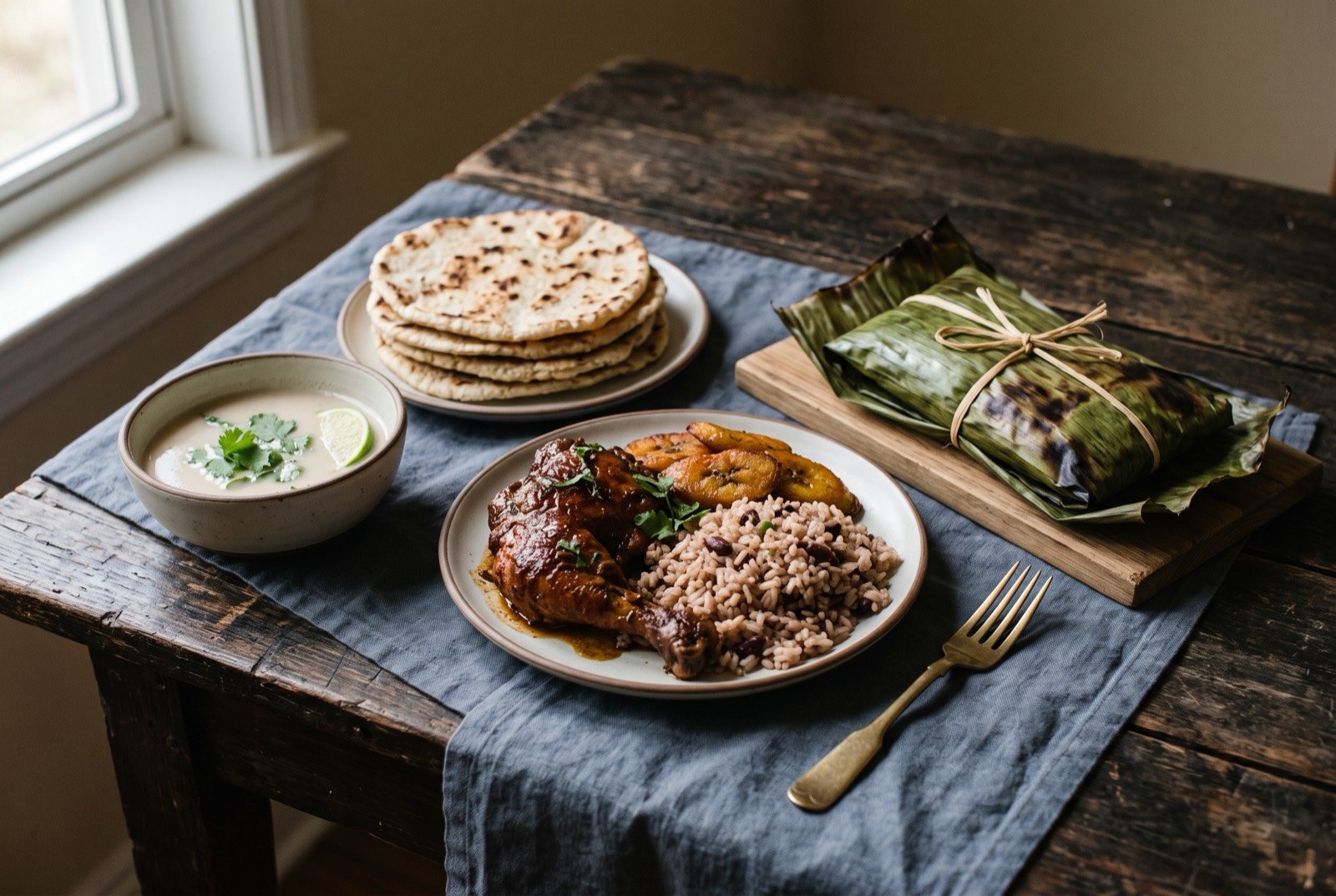
Cassava, coconut and plantain rather than maize, and Garifuna and Belizean Kriol technique rather than Spanish colonial technique. This is the one volume in the Mesoamerican run that the volume map itself flags as belonging as much to the Caribbean as to Central America, because the Garifuna, one of the two peoples this chapter follows, did not arrive on this coast from inland. They arrived by ship, exiled in 1797 from the island of Saint Vincent, carrying a Kalinago and West African kitchen that has more in common with Jamaica or Trinidad than with the maize world two hundred miles inland. The Belizean Kriol, the second people this chapter follows, share the same coastline and the same country as the Garifuna but descend from an entirely different economy: not sugar, but timber. Two traditions, one coast, kept honestly apart rather than blurred into one smooth "Belizean and Honduran" story. Every dish as tradition built it, then what a modern chef would change, where a real technique ladder actually supports that.
Sources and review · What this chapter does not assert · How we research · Spotted something wrong?
A Sense of Place
Belize and Honduras's Caribbean coast is not a single cuisine wearing two flags. It is two peoples who share a shoreline, a climate and, in places, a plate, and who arrived at that shoreline by two entirely different routes.
The Garifuna coast: four countries, one people
The Garifuna live along the Caribbean-facing edge of four countries rather than inside one. In Belize, six villages in the south: Dangriga, the largest, formerly called Stann Creek; Hopkins; Georgetown; Seine Bight; Punta Gorda; Barranco. In Honduras, a longer run of coast, from Punta Gorda on Roatán, the first Garifuna landing point in the Americas, through the La Ceiba area, with Corozal and Sambo Creek nearby, Sambo Creek itself named as one of the largest Garifuna populations in the country and a real centre of cultural preservation, to Trujillo, with Santa Fe, Guadalupe and Cristales, and further named communities including Masca, Travesía and Bajamar strung along the same shore. In Guatemala, Livingston, on Amatique Bay, the country's one substantial Garifuna town. In Nicaragua, a smaller presence that this chapter has not been able to research with any depth, a real gap named honestly rather than smoothed over. Hopkins and Seine Bight are each described as fishing villages of roughly a thousand people, their economies still substantially built on fishing, hunting and homegrown vegetables, though these are approximate, undated figures rather than a recent census.
The Kriol world: a timber colony, not a sugar island
Belizean Kriol food comes from a narrower geography, Belize City and the country's centre and north, and a genuinely different founding economy from almost everywhere else this atlas has covered in the Americas so far. British Honduras was built on logwood, then mahogany, not sugar. From 1724, British "Baymen" bought enslaved Africans, chiefly from Ghana, the Bight of Benin and Biafra, Congo and Angola, to cut timber in the bush; by the second half of the eighteenth century the enslaved population "hovered around 3,000, making up about three-quarters of the total population." This is not a footnote. Because mahogany-camp labour meant small gangs working the forest alongside their owners rather than large field gangs on a plantation, enslaved Belizeans had none of the access to their own provision grounds that shaped the root-crop and stew traditions of the sugar islands. The standard diet of mahogany cutters and working-class urban dwellers was, instead, imported flour and salt meat, a documented weekly ration of four pounds of pork and seven of flour, eaten as dishes such as "pork and doughboys." Fry jack and boil dumplings both descend directly from this ration logic: cheap, shippable, non-perishable staples, worked into fried or boiled dough because that is what a bush camp's stores actually held.
A table of the defining logic, held honestly apart rather than merged
| Element | The Garifuna coast | Belizean Kriol |
|---|---|---|
| Starch | Bitter cassava, worked into ereba; plantain, mashed into hudut or steamed into darasa; maize genuinely marginal | Rice; imported wheat flour, fried into fry jack and boiled into dumplings; cassava and other roots inside boil-up |
| Fat and liquid base | Coconut milk, described by one Garifuna source as the undisputed king of the whole cuisine | Coconut milk in rice and beans; pork fat and lard, a direct inheritance of the ration economy |
| Aromatic base | Basil, cilantro, black pepper, kept spare rather than heavily built up | Thyme, garlic, red recado, vinegar or lime, the marinade base for stew chicken |
| Everyday protein, land | Historically marginal; land animals secondary to fish | Salt pork historically, chicken and pig tail now, the everyday meat of stew chicken and boil-up |
| Everyday protein, sea | Fish, above all, plus conch, crab and shrimp: structurally central, not occasional | Present in boil-up but not the organising principle of the cuisine the way it is for the Garifuna |
One dish genuinely crosses the line rather than sitting on either side of it: rice and beans, cooked together in coconut milk, claimed by the Kriol as their everyday staple and by the Garifuna, under the name resanbinsi, as their own. This chapter treats it as shared rather than picking a side.
The History in Layers
Ethnogenesis on Saint Vincent, before there was an exile to survive
The Garifuna, called "Black Caribs" in colonial English and French usage, formed on Saint Vincent through unions between shipwrecked and escaped enslaved Africans, many from ships bound for Barbados, and the Kalinago, the Island Carib people already resident there, a process generally dated from the mid to late seventeenth century. The standard academic ethnohistory is Nancie Gonzalez's Sojourners of the Caribbean: Ethnogenesis and Ethnohistory of the Garifuna (1988), which gives the culture's food its own dedicated chapter, a genuine signal of how seriously the discipline has taken Garifuna cooking as evidence of identity, even where this chapter has not been able to read that chapter's content directly. Christopher Taylor's The Black Carib Wars traces the resistance through the eighteenth century and names Joseph Chatoyer, killed in the Second Carib War of 1795 to 1797, as the figure most commonly remembered on Saint Vincent as the Garifuna's own national hero.
1797: the exile, reported honestly as a chain of figures rather than settled archival fact
Between 26 July 1796 and 2 February 1797, roughly 4,776 people were sent from Saint Vincent to the small island of Balliceaux, a staging and detention point, not the final destination. Of these, some 4,633 were recorded as Garifuna, a further 102 as Kalinago, and 41 as enslaved Africans. Around 2,445 died on Balliceaux itself, from disease, before onward transport, a mortality rate high enough that Niall Finneran and Christina Welch, archaeologists at the University of Winchester, describe the island in their own published work as "the scene of a genocide orchestrated by the British colonial authorities on the Garifuna." Of the survivors, 2,248 boarded ships on 11 March 1797 for the crossing to Roatán; 2,026 landed on 12 April 1797, reported as 664 men and 1,362 women and children, the gap of 222 attributed to deaths during the voyage. This chapter states this whole sequence as a reported, broadly consistent chain, not as independently verified archival fact: no primary document behind these figures was read directly in the research for this chapter, only their consistent repetition across secondary sources, and the definitive account almost certainly sits inside Gonzalez's own book rather than in what could be found through general search.
Roatán was the first landing and the first Garifuna settlement anywhere in Central America, at Punta Gorda. From there, communities spread along Honduras's mainland coast, and later into Belize, Guatemala and Nicaragua. When Garifuna settlement in Belize itself actually began is genuinely contested, and this chapter does not pick a side. One account, hedged in its own source as legend, gives 19 November 1802 as the first landing in what was then British Honduras, the date now marked as Belize's Garifuna Settlement Day; the same source separately describes that holiday as commemorating "the biggest assembly of Garinagu in Belize, who arrived in 1823." A Guatemalan account gives 26 November 1802 for the Amatique Bay arrival that founded Livingston, and Guatemala marks its own Día Nacional del Pueblo Garífuna on that date. Two figures, two countries, not reconciled in any source this chapter could find.
Belize's Garifuna Settlement Day was established as a civic holiday by Thomas Vincent Ramos, a Belizean Garifuna civil rights activist, in 1941, recognised in Belize's southern districts in 1943, and made a full national holiday in 1977. "Yurumein," the Garifuna word for Saint Vincent itself, names the day's central re-enactment: drummers and dancers paddling dories to shore at dawn, re-enacting the 1797 landing, followed by parades of punta and paranda music.
After 1797: dispossession as an ongoing story, not a closed one
Sarah England's Afro-Central Americans in New York City (2006), built on fieldwork in a Honduran coastal village and in the South Bronx and Harlem, documents Garifuna transnational family life alongside grassroots organising against tourism and agro-export expropriation of coastal village land in Honduras, land the Garifuna have lived on since the early nineteenth century now under renewed pressure from resort and plantation development. A 2025 article by the same scholar names contemporary land dispossession and asylum-seeking explicitly as a "third exile," an argument this chapter has not read in full but whose framing is worth carrying as a structural point: 1797 is not a closed chapter for the Garifuna, it is the first of at least three. Migration to the United States, above all New York, New Orleans and Los Angeles, is generally dated from the 1940s onward, and New York now holds the largest Garifuna population outside Central America, concentrated in the South Bronx.
The Kriol economy: emancipation, self-government, and the moment eating local stopped being shameful
Britain abolished slavery in the colony with emancipation in 1838. Limited local self-government arrived only in 1963, won by the anticolonial People's United Party under George Price, who changed the colony's popular name from British Honduras to Belize as a first, symbolic act of decolonisation; full independence followed in 1981. One precisely dateable episode belongs in this chapter because it says something the rest of the history only implies: in a 1963 to 1964 speech, Price urged Belizeans to stop treating British food standards as the aspiration and eat "traditional" local food instead, naming pupsi and crana, small local river fish, as an alternative to imported sardines. It provoked open mockery. A letter published in the Belize Billboard on 5 January 1964 asked what the PUP would tell people to eat once they got full independence, having already told them, in the writer's words, to "boil fever grass and eat pupsi and other river fishes," after once promising "ham and eggs." Within living memory, eating Belizean food was a mark of poverty in Belize itself, not pride, and the reversal this chapter's own existence assumes, that this cooking is worth taking seriously on its own terms, is recent rather than ancient.
A second episode, better known and worth telling precisely: on Queen Elizabeth II's 1985 state visit to the new capital, Belmopan, a state banquet served roast gibnut, a large rainforest rodent, as the honoured main course, on the advice of Belizean cooks and officials. British tabloids, The Sun foremost among them, ran headlines mocking the choice in openly racist terms. Belizeans reacted with real anger, not at the dish but at the coverage, and in the backlash gibnut was reclaimed as a national delicacy, still marketed today as "Royal Rat." This is shared game meat across Garifuna, Kriol and Maya kitchens rather than a Kriol dish specifically, but it belongs here as the clearest single instance of Belizean food functioning as an assertion of nationhood against outside contempt.
"Belizean cuisine" as an invented category, and why this chapter keeps the two traditions apart
The single most useful source found for this chapter is not a cookbook or a heritage body but a peer-reviewed anthropology paper: Richard Wilk's "'Real Belizean Food': Building Local Identity in the Transnational Caribbean" (American Anthropologist, 1999), the product of fieldwork in Belize going back to 1973. Wilk's argument, stated in his own words, is the reason this chapter refuses to write "the cuisine of Belize and Honduras" as one smooth thing: "Belizean restaurants appeared first in New York, then Los Angeles; Belizean cuisine is a concept invented almost entirely outside of Belize. Under a national label it submerges ethnic distinctions between what Belizeans call 'Spanish' food (tamales, garnachas, chirmole), Garifuna dishes like cassava bread and fish stew (sere), and Creole foods like boil-up and rice-and-beans." He quotes, verbatim, what was likely the first restaurant to brand itself explicitly "Belizean," a radio advertisement placed by a Belize-born couple returning after twenty years in the United States: "Treat yourself to a Belizean Feast. Authentic Belizean dishes, Garnachas, Tamales, Rice and Beans, Stew Chicken, Fried Chicken." Every dish on that list was already being cooked, separately, by its own ethnic tradition, all over Belize. What was new was the label, and the label was invented in a diaspora restaurant, not at home. Wilk's own 1990 door-to-door survey of 389 Belizeans found only eight dishes, out of twenty one rated, that respondents clearly agreed were "Belizean Creole food." Even Belizeans do not agree on a single bounded national cuisine. This chapter follows Wilk's own distinction rather than inventing a tidier one: Garifuna dishes are Garifuna, Kriol dishes are Kriol, and where the two genuinely meet, as with cassava's crossing between them, this chapter says so rather than blurring it.
The Flavour Arsenal
Bitter cassava is the Garifuna staple, distinct from the sweet cassava sold as a vegetable across the Caribbean and West Africa: it contains genuinely toxic levels of cyanogenic glycosides raw, and its whole processing technology, grating, pressing, drying, exists to remove that toxin before the flour ever reaches a griddle. Coconut, milked rather than eaten whole, is the Garifuna kitchen's dominant fat and liquid, described by one Garifuna source, without much exaggeration, as "the undisputed king of Garifuna gastronomy." Plantain, green for mashing and frying, ripe for sweetness, carries the same structural role for the Garifuna that fufu's own starches carry across West Africa, a genuine, direct technique inheritance rather than a coincidence: hudut's mashed plantain is routinely and explicitly compared, by Garifuna and Honduran sources alike, to fufu.
Culantro, Eryngium foetidum, sharper, more resinous and more sulphurous than ordinary coriander, runs through both traditions' seasoning, alongside sweet basil, which appears in hudutu's broth in a way that would be unusual in most other Caribbean or Central American kitchens. Achiote, annatto seed ground to a paste, colours and seasons some coastal dishes, though it belongs more properly to the Mestizo, Yucatec-descended kitchen further north than to Garifuna or Kriol cooking specifically, and this chapter uses it only where a dish genuinely calls for it rather than treating it as a pan-cuisine staple.
Red recado, the annatto-based marinade paste, and thyme anchor the Kriol side of the larder, alongside the smaller red bean Belizean sources gesture at as the traditional choice for rice and beans, without any source naming a specific cultivar precisely enough for this chapter to do more than note the gap. Conch, cut into rough squares and cooked only briefly, and snapper, the preferred fish for hudut and tapado alike, are the coast's two defining proteins from the sea, standing against pig tail and salt pork as the Kriol camp-ration inheritance from the land.
Gifiti's own arsenal is a category apart: palo de hombre, contrigo, jicaco negro and a shifting, family-guarded list of further roots, barks and leaves, some of them wild-foraged Central American forest species with no standardised trade name at all, stood alongside the more everyday allspice, cloves, cinnamon, chamomile and anise that also go into the tonic. Recipes genuinely vary from a base of seven ingredients to as many as thirty eight, by family, and this chapter treats that variation as the real tradition rather than smoothing it into one fixed recipe.
The Technique Ladder
The argument, from inside
Five techniques, each explained by why it works, not only what it does.
Rung 1. Cassava detoxification and pressing
Bitter cassava is grated on an egi, a wooden board studded with small stones, producing a wet mash called sibiba; packed into a ruguma, called wowla in Belizean Kriol, a long woven tube that constricts as it is stretched, physically squeezing out the toxic, cyanogenic liquid, called yare, that raw bitter cassava carries. The pressed, tube-shaped mass is then dried outdoors overnight, which both finishes the moisture loss and allows a slight fermentation to begin, before being sifted through a woven híbise into a true flour. This is not a stylistic choice, it is the only reason bitter cassava is safe to eat at all, and the whole technology, three named, purpose-built tools working in sequence, deserves to be understood as genuine food science rather than folk custom.
Rung 2. Hudut's fufu-adjacent pounding
Boiled plantain, green and ripe together, is mashed to a smooth, elastic paste, structurally the same technique as West African fufu and explicitly recognised as such by the Garifuna and Honduran sources that describe it. The point of the pounding or mashing is not simply to soften the plantain but to develop a cohesive, stretchable texture from its starch, the same mechanism that makes fufu, ugali or foutou work, applied here to a fruit rather than a grain.
Rung 3. Coconut milk as the broth's whole structure, not a flavouring added to it
Sere, the broth that carries hudut's fish, is built almost entirely from coconut milk rather than a separate stock, meaning the milk itself has to carry both the fat and the savoury depth of the dish. This is why the coconut has to be genuinely good, and why a thin, over-diluted tinned milk flattens the whole dish in a way that a weak stock in a Western fish soup would not.
Rung 4. Stew chicken's burnt-sugar browning
Brown sugar is melted in hot oil until it turns a dark, near-burnt caramel, timed deliberately just short of scorching, and the seasoned chicken is seared directly in that caramelised sugar-oil rather than in plain fat. The result is a genuinely different colour and flavour compound, caramel maltol, from ordinary browning, a deep mahogany crust with a bittersweet depth that flour-dredging or plain searing cannot produce. The same mechanism, under different names, runs through Trinidadian brown stew, Guyanese pepperpot and Jamaican brown stew chicken, a real shared Caribbean technique lineage that happens to be the standard method for Belizean stew chicken specifically.
Rung 5. Gifiti's long infusion
Roots, barks and herbs are left to steep in high-proof rum or aguardiente for one to two weeks, sometimes longer, the mixture's colour darkening as the alcohol slowly draws out both the bitter compounds and whatever medicinal property the recipe is built around. This is functionally the same extraction principle that underpins any serious bitters-making, given a long enough, high enough-proof soak to actually work, only here practised as folk pharmacy for generations before any cocktail bar treated bitters-making as a serious technique in its own right.
The Ferment and Preserve Bench
Gifiti. The Garifuna's own herbal rum tonic, and the one genuine preservation and infusion technology this chapter found no evidence anyone has yet taken into a modern bar's own bitters-making practice, itself a real and stated finding rather than an oversight. Roots, barks and herbs, palo de hombre, contrigo, jicaco negro, manzanilla, anise, allspice, cloves, cinnamon, nutmeg and more, in family recipes running from a base of seven ingredients to as many as thirty eight, are steeped in high-proof rum or aguardiente for one to two weeks, sometimes longer, until the mixture darkens to the point a family recipe judges ready. Framed consistently as medicine as much as drink, taken in small daily doses for fever, stress and pain, and often family-guarded rather than freely shared. A genuinely old extraction technology, functionally identical to any serious modern bitters-making, practised as folk pharmacy for generations before any cocktail bar treated the same long, high-proof steep as a serious technique in its own right. A British cook cannot currently source the named forest botanicals that define a true gifiti, and any UK version, built instead from mainstream spice-shop stock, allspice, cloves, cinnamon, star anise, chamomile, plus a bittering agent such as gentian root, should be understood and presented honestly as an adaptation of the principle, not a recreation of the Garifuna original.
Sourcing in Britain
The easy wins, genuinely so. Plantain is mainstream stock at Tesco and at African and Caribbean greengrocers generally, sourced from Ecuador at the supermarket level, no specialist hunting required. Scotch bonnet peppers are equally mainstream, confirmed live at Sainsbury's, Tesco, Ocado, Asda, Waitrose and Aldi, priced well under a pound for a fifty to sixty gram pack. Tinned coconut milk from Grace, the Caribbean brand under Grace Foods, is the right style note for this cuisine's coconut cookery, thicker and more savoury than a typical Thai-style tin, and is stocked across multiple UK Caribbean grocers as well as Grace's own UK site. Genuine red snapper, not a vague "similar white fish" gesture, is buyable fresh or frozen from several specialist UK fishmongers, Adam Seafood and Ocean Catch Fishmongers among them, at prices in the low to mid twenties per kilogram, better served than this chapter expected going in. Overproof rum for gifiti is equally solid: Wray & Nephew, Jamaican rather than Belizean or Honduran but the standard, easily available, honest choice as a high-proof base for extraction, widely stocked across UK spirits retailers.
Where this chapter has to be honest that the real ingredient is not currently buyable. True bitter cassava root cannot be sourced in Britain. Fresh cassava is easy to find, but no UK retailer distinguishes cultivar or attaches the safety information a genuinely bitter root would need, and this chapter does not pretend otherwise: build ereba from sweet cassava or a commercial cassava flour instead, with the process and safety difference stated plainly rather than glossed over. Conch is not sourceable in Britain at all, very likely a real effect of CITES trade regulation on the queen conch species specifically; whelk, UK-caught and widely available from specialist fishmongers, is a genuine, honestly different substitute, a cold-water animal of a different genus sharing only a broadly similar dense, sweet texture, and this chapter names it as a substitute rather than dressing it up as the real thing. Fresh culantro cannot currently be bought anywhere in Britain either, only seeds and small nursery plants for growing your own, a genuinely simple thing to do with this tropical perennial and the honest recommendation over silently reaching for ordinary coriander, which is markedly milder, less sulphurous and less resinous than the real thing.
Gifiti's own botanicals sit in the same honest category. The specific named Garifuna forest roots have no UK retail presence under any name this chapter could find; a London herbalist stocks adjacent tonic and bittering herbs, damiana, cat's claw, a sarsaparilla-type root, none of them the specific Garifuna ingredients but genuine relatives in the same register, worth knowing about for a serious attempt at the adaptation given above.
Diaspora-specific shopping is genuinely thin. No UK Belizean, Honduran or Garifuna restaurant, shop, pop-up or supper club of any kind was found anywhere in Britain in the research behind this chapter, a real, searched-for absence rather than a gap this chapter has simply failed to fill. One online retailer, My Belize Box, lists UK delivery among its options but was not confirmed through an actual completed order; Seven Sisters Market in Tottenham, a genuine general Latin American market, is worth a visit and a conversation in person rather than an online order for anything this specific.
The single decision that matters most. Real red snapper, not a generic firm white fish, and genuine Grace coconut milk, not a thin, generic tin. Between them they carry hudut, tapado and sopa de caracol, the three dishes this chapter treats most fully, and getting those two right does more for the finished plate than any amount of effort spent chasing the ingredients this chapter has had to say, honestly, cannot currently be bought in Britain at all.
Voices and Sources
Academic and historical: Richard R. Wilk, an American anthropologist who has worked in Belize since 1973, whose 1999 American Anthropologist paper, "'Real Belizean Food': Building Local Identity in the Transnational Caribbean," is the single most rigorously sourced document behind this chapter, thanking named Belizean informants Inez Sanchez and Gloria Crawford directly and citing the Belizean newspaper Amandala as a primary source in its own right; Nancie Gonzalez, Sojourners of the Caribbean (1988), the standard Garifuna ethnohistory, including a dedicated chapter on food this chapter was not able to read directly and recommends strongly to any future researcher of this volume; Christopher Taylor, The Black Carib Wars; Sarah England, Afro-Central Americans in New York City (2006) and later work on Garifuna land dispossession as a "third exile"; Niall Finneran and Christina Welch, University of Winchester, on Balliceaux as a site of genocide and of contemporary Garifuna memory.
Honduran, Guatemalan and Belizean press and institutions: La Prensa and El Heraldo, Honduran national press, for sopa de caracol's correct-versus-commercial distinction and for Reny Gutiérrez's four-star Garifuna restaurant in San Pedro Sula; Buen Provecho, GO TV Honduras, for Chef Carlos Espinal's named hudutu recipe and for ereba's process detail; Prensa Libre and Guatemala's own Ministry of Culture site, sicultura.gob.gt, for Livingston's darasa and tapado; Breaking Belize News for fry jacks; the Belize Tourism Board and Belize's own National Kriol Council, the latter reached only at second hand in the research behind this chapter, a real gap this chapter states rather than hides.
Garifuna-authored and in-community voices: SoyGarifuna.com; Warasa Garifuna Drum School, Hopkins, Belize; the National Garifuna Council of Belize, founded 1981, with affiliate branches in Guatemala, Honduras and Nicaragua; ODECO, a Honduran Afro-descendant rights organisation founded in 1992 by Celeo Álvarez Casildo; Isha Gutierrez-Sumner, born in Tela, Honduras, now New York-based, whose Weiga catering company and long-worked-on cookbook, reported by several US outlets as the first Garifuna cookbook in history, this chapter treats as a genuinely promising but not yet independently confirmed candidate, its actual publication status unclear from what could be found.
Diaspora chefs and the honest state of elevated cooking: Melissa Araujo of Alma Café, New Orleans, born and raised in La Ceiba, Honduras, a 2024 James Beard Award semifinalist described by US food press as delivering "elevated Honduran cooking," though this chapter could not independently confirm what, technically, that elevation actually consists of; Winston Miranda of Saraba, Los Angeles, son of a Honduran and Belizean Garifuna family from Dangriga, whose food truck and later restaurant served hudutu, sere, darasa and tapado in a faithful, home-style register.
Belizean cookbook authors: Tanya McNab, publisher of Flavors of Belize, launched in Belize City on 3 July 2012, more than 120 recipes spanning Maya, Mestizo, Creole, East Indian, Garifuna, Lebanese, Chinese, Mennonite, Caribbean and British influences together, itself a real piece of evidence for Wilk's own argument about "Belizean cuisine" as a constructed national category rather than an ancient, bounded one.
Things this chapter has deliberately not asserted
- That "hudut" and "machuca" name the same thing, or two clearly distinct things. Sources use the terms inconsistently, and this chapter states the confusion rather than inventing a tidy resolution no source actually supports.
- That the precise 1797 exile numbers, from the 4,776 sent to Balliceaux through to the 2,026 who landed at Roatán, are independently verified against a primary archival source. They are a consistent, repeated chain of figures across secondary sources, not a fact this chapter has checked against the archive itself.
- That Garifuna settlement in Belize began in either 1802 or 1823. Both dates appear in the sources found, unreconciled, and this chapter reports the contradiction rather than resolving it.
- That any restaurant or chef, anywhere, has taken sous-vide, fermentation science or modern plating to hudut, tapado, sopa de caracol, ereba, darasa or gifiti. No such example was found in either English or Spanish-language research, and this chapter treats that absence as a real finding rather than a search failure to paper over.
- That Isha Gutierrez-Sumner's cookbook, Weiga, Let's Eat, is confirmed published, or that its content has been independently checked. "First Garifuna cookbook in history" is a claim repeated across several US secondary sources, not one this chapter has verified against the book itself.
- That a 2024 UNESCO listing specifically inscribes ereba preparation as its own recognised piece of intangible heritage, distinct from the existing 2001 and 2008 "Language, dance and music of the Garifuna" inscription. Honduran press reports such a listing; this chapter could not independently confirm it against UNESCO's own register and states the claim as reported rather than settled.
- That true bitter cassava, conch, or the specific named Garifuna gifiti botanicals can currently be bought in the United Kingdom. None of the three can, and this chapter's sourcing section says so directly rather than gesturing vaguely at "specialist suppliers" that do not, on the evidence gathered, actually exist.
- That panades, garnaches and escabeche belong to this chapter's own Kriol or Garifuna tradition. They are eaten constantly across Belize and considered thoroughly Belizean by nearly everyone there, but every source consulted for this chapter is explicit that they descend from the Mestizo, Yucatec Maya-rooted kitchen of northern Belize, and this chapter has deliberately not given them the full tradition-and-elevation treatment reserved for this volume's own two named traditions.
- That any organised Garifuna, Belizean or Honduran-coast restaurant, supper club or shop currently operates in the United Kingdom, beyond one social and cultural charity in London. This was searched for directly and repeatedly, in this research and found nowhere, and this chapter reports that absence plainly rather than working around it with a vaguer claim about "Caribbean food in Britain" standing in for something more specific that does not, on the evidence available, exist.
Cassava detoxification and pressing
Bitter cassava is grated on an egi, a wooden board studded with small stones, producing a wet mash called sibiba; packed into a ruguma, called wowla in...
Hudut's fufu-adjacent pounding
Boiled plantain, green and ripe together, is mashed to a smooth, elastic paste, structurally the same technique as West African fufu and explicitly recognised...
Coconut milk as the broth's whole structure, not a flavouring added to it
Sere, the broth that carries hudut's fish, is built almost entirely from coconut milk rather than a separate stock, meaning the milk itself has to carry both...
Stew chicken's burnt-sugar browning
Brown sugar is melted in hot oil until it turns a dark, near-burnt caramel, timed deliberately just short of scorching, and the seasoned chicken is seared...
Gifiti's long infusion
Roots, barks and herbs are left to steep in high-proof rum or aguardiente for one to two weeks, sometimes longer, the mixture's colour darkening as the alcohol...
The dishes
- Ereba Garifuna coast, Belize, Honduras, Guatemala
- Hudut Garifuna coast, Belize, Honduras, Guatemala
- Darasa Livingston, Guatemala
- Tapado Honduras, Guatemala (Livingston); tapou in Belize
- Sopa de caracol Garifuna coast, Honduras
- Rice and beans Belize (Kriol); also Garifuna, as resanbinsi
- Stew chicken Belize (Kriol)
- Fry jacks Belize (Kriol)
- Boil-up Belize (Kriol)
- Coconut bread Belize (Kriol)
Sources and review
- Researched
- No outside sources linked
- Reviewed
- Not yet reviewed from inside the tradition
- Cooked
- Not yet cooked and reported
Where this volume comes from
3 research briefs on file for this volume, researched to the rules on How we research. Published 3 September 2026. Last changed 8 September 2026.
The brief's own account of its sources
The Garifuna-slice research pass ran genuine Spanish-language search (Honduran and Guatemalan press, SoyGarifuna, an unread Academia.edu paper on cassava toxicity) and attempted direct Garifuna-language search, which returned thin results, mostly unindexed Facebook material rather than substantial standalone Garifuna-language content, reported honestly rather than treated as equivalent to the Spanish-language yield.