The Americas · Volume 06
Chiapas and the Guatemalan Highlands
The Maya Highland Corn World
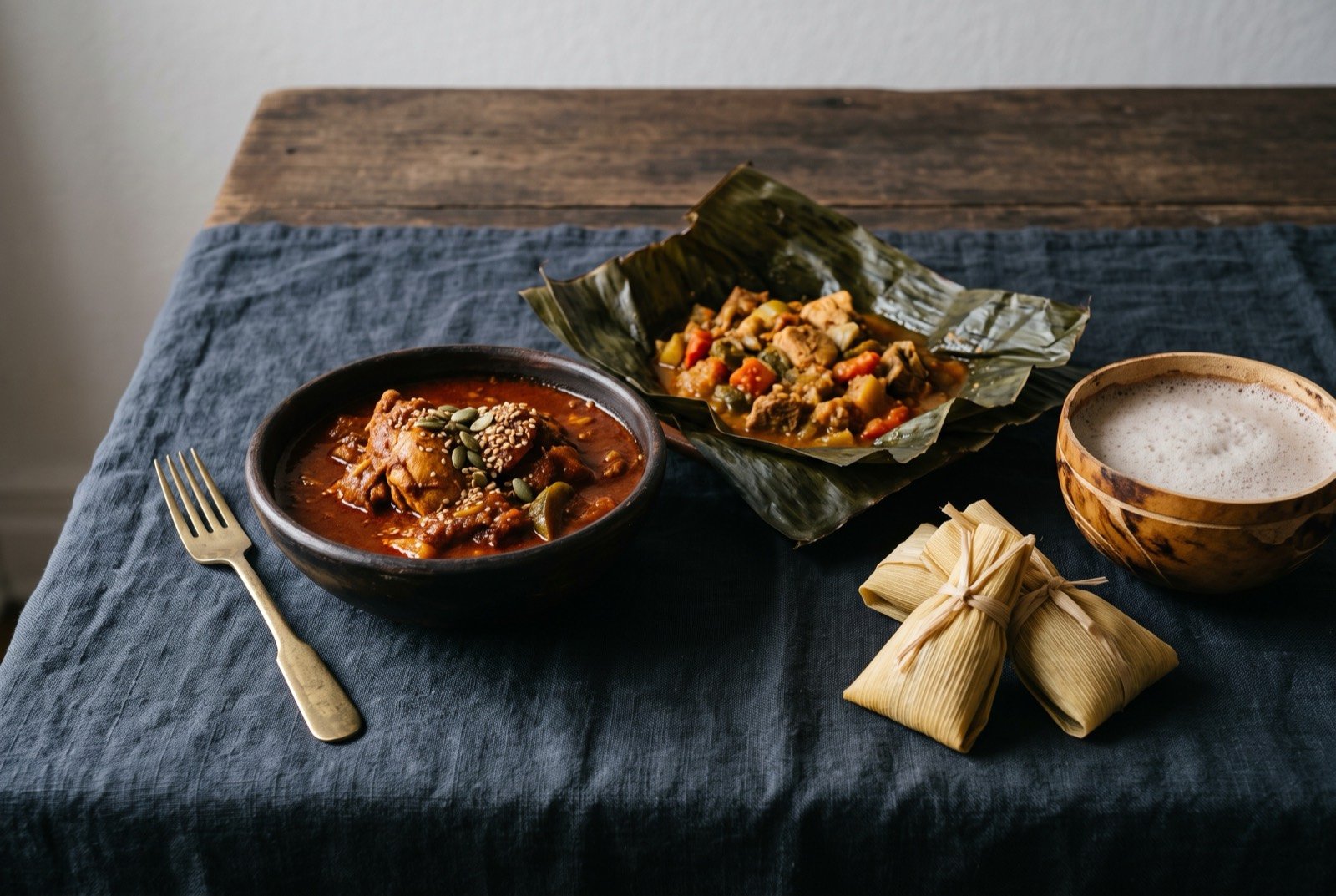
Cool-altitude Maya corn country either side of a modern border that cuts straight through one older world. Chiapas belongs on paper to Mexico, and this atlas keeps that formal link visible: its own political home is Volume AM-01, the Valley of Mexico, Puebla and Oaxaca, and a reader who wants that side of Mexican cooking, mole, nixtamalized maize at industrial scale, the convent kitchens of Puebla, should go there. But the San Cristóbal highlands run on maize, altitude and Maya technique that have far more in common with the K'iche' and Kaqchikel towns around Lake Atitlán than with the Valley of Mexico two thousand metres below and six hundred kilometres northwest. This volume follows the ecology and the people rather than the border. It is also, honestly, a thinner volume than its neighbours in this atlas: the fine-dining and diaspora thread that runs richly through the Mexican volumes runs here in a trickle, two Guatemalan chefs, three Chiapas kitchens, and a UK sourcing picture with real gaps this chapter states rather than papers over.
Sources and review · What this chapter does not assert · How we research · Spotted something wrong?
A Sense of Place
Two highland worlds, joined by altitude and maize rather than by any modern flag.
Two highland worlds, one older corn country
San Cristóbal de las Casas sits at 1,940 metres, temperate and sub-humid, rain falling from May or June through October. The wider Chiapas Altos runs from roughly 800 to over 1,500 metres, 12 to 20 degrees Celsius depending on elevation. Chamula, San Cristóbal itself and Zinacantán are the largest Tzotzil municipalities; Tenejapa and Oxchuc the largest Tzeltal ones. Across the modern border, Lake Atitlán sits at 1,556 metres in Sololá department, a volcanic caldera ringed by three volcanoes over 3,000 metres, Central America's deepest lake. Both worlds run on the same underlying technology: nixtamalized maize, terraced or milpa-rotated fields, and a cool, wet-summer climate that grows a different plant calendar to the hot lowlands either coast.
The ethnic map, given honestly rather than flattened
This volume's own early planning called its Guatemalan half simply "K'iche' and Kaqchikel," and that turns out to flatten something worth naming properly. K'iche' territory runs through El Quiché, Huehuetenango, Quetzaltenango, Retalhuleu, Sololá, Suchitepéquez, Totonicapán, San Marcos and Chimaltenango. Kaqchikel runs through Chimaltenango, Guatemala department, Baja Verapaz, Sacatepéquez, Sololá and Suchitepéquez, over a million people self-identifying as Kaqchikel in the 2018 census. Mam holds Huehuetenango, Quetzaltenango, San Marcos and Retalhuleu. Tz'utujil holds Atitlán's south shore towns. And Q'eqchi' holds Alta Verapaz, Petén, El Quiché and Izabal, a different highland bloc to the north entirely, not part of the K'iche'/Kaqchikel core, a distinction that matters directly once this chapter reaches kak'ik. Totonicapán, formerly the K'iche' empire's second city, Chuimekená, is 98.2 per cent Maya; Chichicastenango, 98.5 per cent K'iche', holds Central America's largest and best known market.
Fat, thickener, aromatic, starch
The strongest single source behind this whole chapter is a piece of genuine fieldwork: Celia Angélica Ajú Patal's study of K'iche', Kaqchikel and Tz'utujil eating patterns, built on interviews across Sololá, Chimaltenango and Quiché for Guatemala's Universidad Rafael Landívar. It gives the K'iche' concept of Qaway Quk'uya', the complete material food that gives life and energy, and the phrase informants used directly: k'o qik qatz'am, there is nothing missing, there is food, there is everything. Maize is, in the FAO figures the study cites, eaten daily by effectively the whole highland population. Pepitoria, ground pumpkin seed, is the thickener; seed-and-herb dishes are traditionally cooked without added fat at all. Achiote and stone-ground tomato and chile, chirmol or recado de tomate, supply the aromatic base that everything else is built against.
A genuinely useful, specific contrast the same study surfaced: the Kaqchikel communities interviewed ate tortillas at all three daily meals and tamalitos only occasionally; the K'iche' communities showed the opposite pattern, tamalitos daily. That is this whole chapter's argument in miniature, that this is not one flattened highland Maya table but several distinct, named ones sitting close together.
Across the border in Chiapas, maize carries the same cultural weight: "the conceptions and values of the Tzotzil man revolve around maíz," in the words of Mexico's own indigenous-peoples institute, a source of social prestige as much as sustenance. Pork lard is the standard fat, worked into tamal masa and used to fry insects such as zats, whose Tzotzil-derived name survives on the plate. Chipilín leaf, worked into masa for both colour and flavour, and hoja santa, the dominant wrapping and flavouring aromatic, do the work achiote and chirmol do on the Guatemalan side.
| Element | Chiapas, Tzotzil and Tzeltal | Guatemalan highlands, K'iche' and Kaqchikel |
|---|---|---|
| Starch | Maize above all; wheat entering through colonial mestizaje | Maize, eaten daily by the whole highland population |
| Thickener | Masa itself; chipilín leaf worked directly into the dough | Ground pepitoria, toasted and ground seeds generally |
| Aromatic base | Hoja santa and momo; achiote in the adobo family | Chirmol, stone-ground tomato and chile; achiote in the recado rojo family |
| Fat | Pork lard, standard | Pork lard where used; seed-and-herb dishes traditionally fat-free |
| Everyday protein | Pork from the colonial layer, chicken, wild-gathered protein including insects | Chicken, creole hen for preference, turkey, pork; game historically |
| A named daily contrast | Tortilla and tamalito use vary genuinely by community, not by nation | Pixtun, thick and soft, against lej, thin and hand-made; tayuyo valued for keeping two days |
The History in Layers
Maize, the Popol Vuh, and a corn agriculture older than either state
The Popol Vuh, the K'iche' foundational text, tells of humanity's fourth and finally successful creation, made from maize after failed attempts from animals, mud and wood. The Ajú Patal study treats this as more than literary colour: its own K'iche', Kaqchikel and Tz'utujil informants still reach for the Qaway Quk'uya' concept directly, a living value system rather than a museum text. Across the border, milpa agriculture, maize, beans and squash on rotation, with fallow periods running up to fifteen years in documented Tzeltal practice, remains the working agroecosystem in Tenejapa today, alongside the huerto familiar, the home garden, and the acahual, managed secondary forest. "The maize absorbs the work of almost the entire year," as Mexico's indigenous-peoples institute puts it of Tzotzil practice, "fields cultivated using slash-and-burn technique."
The Spanish layer
Pork, beef, chicken, wheat, rice, dairy and European spices arrived with the Spanish on both sides of the border. Cochito and longaniza are Chiapas's direct expressions of that fusion. On the Guatemalan side, colonial mestizaje layered carrot, potato and peas onto pulique as regional variants, and achiote technique carried forward through the whole recado family rather than being displaced by it.
Guatemala's thirty six year war, and land as the thread that reaches the table
The armed conflict formally ended on 29 December 1996. Over two hundred thousand people were killed, eighty three per cent of them indigenous Maya. Between 1981 and 1983 the army carried out systematic scorched earth destruction against indigenous communities in Huehuetenango, Quiché and Baja Verapaz, over six hundred villages attacked as counterinsurgency strategy; Q'eqchi' leaders seeking legal land rights were specifically targeted for forced disappearance and killing, most documented in the Sepur Zarco case.
The connecting thread to food today is properly sourced rather than assumed. Citing the UNDP's own 2015 to 2016 national human development report, the Ajú Patal study states that most of Guatemala's indigenous population lives in the highlands and the east, while the country's best agricultural land sits on the south coast, where over forty per cent of the highest-capacity land grows sugarcane, coffee, palm oil, rubber and pasture, not food, and that land is not in indigenous hands. Informants in Sololá, Chimaltenango and Quiché described hunger as a direct function of landlessness rather than an abstraction: "mi problema es que no tengo donde sembrar," my problem is I have nowhere to plant.
Coffee, migration, and the recolonisation of the Chiapas Altos
Land fragmentation forced seasonal Tzotzil and Tzeltal migration to Soconusco coffee fincas and Central Depression cattle ranches; engancheros, labour contractors, historically obligated Tzotzil and Tzeltal workers into coffee fincas and logging camps. Coffee became, in the words of a Chiapas regional research centre's own history of the period, "a motor of the region's economy" from the 1890s. Today the Unión Majomut fair-trade cooperative, running since 1983, groups a thousand small Tzeltal and Tzotzil coffee producers, a genuine, ongoing counterweight to that history rather than only its legacy.
The modern moment, named honestly
In Chiapas, "sin maíz no hay país," without maize there is no country, is a real national campaign running since 2008, and the EZLN and organisations such as OCEZ-CNPA connect their own work to it directly; peer-reviewed research on the Zapatista movement's impact on agrobiodiversity and seed sovereignty in Chiapas exists and corroborates the framing, even where the strongest single paper on it sits behind a paywall this chapter could only read the abstract of. A 2020 study interviewing Tzotzil and Tzeltal diabetics documents the shift from subsistence milpa to industrial food, soda, refined tortillas, processed chicken, as directly implicated, one elder quoted plainly: "fertilizer came bringing poor quality of life, now we eat pure chemicals." This is not a comfortable footnote. It belongs in the chapter because it is where the maize story this chapter opened with actually lands today.
In Guatemala, the most current fact available at the time of writing: in August 2026, the Ministry of Culture and Sports formally submitted the country's recados, pepián, kak'ik, jocón, subanik, revolcado, hilachas, pinol, alongside the Garífuna dish tapado, to UNESCO for evaluation as Intangible Cultural Heritage of Humanity. As it stands these are Guatemala's own national heritage designations, most dating to 2007, and an active international bid, not yet a result.
The Flavour Arsenal
Pepitoria, hulled and toasted pumpkin seed, is the single best documented ingredient in this whole chapter. The Slow Food Foundation's Ark of Taste carries a dedicated entry: grown in Petén, Chimaltenango, Quiché, Huehuetenango and Quetzaltenango, ayote squashes harvested in August, seeds dried and ground, the defining thickener of pepián, whose own name derives from it. The Foundation flags its use declining among younger Guatemalans, a fact worth carrying alongside the ingredient rather than after it.
Achiote underpins the whole recado rojo family, pepián rojo, subanik, kak'ik, revolcado, soaked seed ground with garlic, oregano, cumin, salt, black pepper, allspice and cloves. Guatemalan sources describe it as carrying spiritual as well as flavour significance; that claim is asserted rather than sourced to a named ethnography, and this chapter repeats it as a claim, not a settled fact.
Native chiles worth knowing individually rather than lumped as "Guatemalan chile." Chile cobanero, native to the Verapaces, globular and light red, smoked in preparation. Chile guaque, grown mainly in the central highlands and parts of Sololá department, squarely K'iche'/Kaqchikel territory, the symbolic chile of San Andrés Itzapa and its local dish cherepe. Chile pasa, the third named component of the pepián and kak'ik base, less individually documented but consistently present.
Cardamom is the chapter's honest irony. Guatemala is the world's leading cardamom exporter, having overtaken India, cardamom's own country of origin, over four hundred and fifty million US dollars exported in 2022 from over three hundred and fifty thousand smallholder producers, in some municipalities representing seventy per cent of the local economy. It arrived in 1914, planted at Finca Chinasayub in Alta Verapaz by the German planter Oscar Majus Kloeffer, and almost all of it leaves for Middle Eastern tea and coffee markets. It is not, and never became, a highland Maya cooking spice. Alta Verapaz is Q'eqchi' territory, not this chapter's K'iche'/Kaqchikel core, and no source found ties cardamom to any named highland kitchen at all. It earns its place here as an honest fact about the region, not as an ingredient this chapter's dishes actually use.
Wild greens, quilete or macuy, are given real, specific treatment in the Ajú Patal fieldwork: valued nutritionally, a 1984 study finding them higher in protein than many vegetables and rich in iron, calcium, phosphorus and vitamin A, cooked with ground pepita as kichon pa sakil, or with chile as kichon pa ik, real Kaqchikel names for a real, still-living preparation.
Chipilín and hoja santa do for Chiapas what achiote and chirmol do for the Guatemalan highlands, leaves used fresh, dried or worked directly into masa. No Tzotzil or Tzeltal name for chipilín survived this chapter's research despite direct searching in both languages, a genuine gap stated rather than guessed at.
Pox, sometimes written posh, is Chiapas's own ceremonial spirit, the word meaning medicine, cane liquor, cure, in Tzotzil. Originally fermented maize alone, now typically corn, wheat and sugarcane distilled together, used by Maya healers combined with garlic and honey, central to San Juan Chamula's religious festivals even as soft drinks increasingly displace it there, while it experiences a genuine bar and mixology revival outside that ceremonial context.
Queso Bola de Ocosingo, a raw cow's milk cheese with a distinctive two-part construction, a hardened outer shell around a soft, creamy interior, eaten by cutting the top and spooning out what's inside. Ocosingo itself is Tzeltal-majority territory near Toniná. Its own origin is contested, some tracing it to Porfiriato-era Dutch Edam influence via Yucatán trade, others crediting Franciscan-taught technique directly; the cheese itself, whichever account is right, is a colonial dairy introduction laid onto a Maya highland town, not a pre-Hispanic food.
The Technique Ladder
The argument, from inside
Five techniques, each explained by why it works, not only what it does.
Rung 1. Recado toasting and grinding
Pepitoria, guaque and pasa chiles, tortilla, tomato, garlic and cilantro toasted over hot coals or a comal, then ground to a fine paste and cooked slowly to a creamy consistency. The mechanism is Maillard toasting followed by fine emulsification, and a Big Green Egg's direct-heat zone reproduces the comal's dry, fierce heat more faithfully than a domestic frying pan, while a dedicated spice grinder followed by a high-power blender gets closer to a genuinely fine, even paste than hand-grinding alone.
Rung 2. Pozol's nixtamalisation and hand-beating
Lime-cooked maize, ground with toasted cacao and cinnamon, then hand-beaten with water for roughly ninety minutes to a proper drinking consistency. A high-power blender used briefly, not to purée but to emulsify, followed by straining through a chinois, reproduces the hand-beaten texture's fineness without the ninety minutes, though a serious cook should try the real method at least once to understand what the blender is actually standing in for.
Rung 3. Pozol's sour fermentation
An ambient, uncontrolled window running anywhere from twenty four hours for a mild sour pozol to two weeks for a fully fermented agrio version, genuinely the most distinctive fermentation technique this whole volume surfaced. A temperature-controlled fermentation chamber, or a sous vide bath run warm as a holding box rather than for the corn itself, gives a Chiapas kitchen's unheated ambient window a reliability it never actually had, an honest, mechanism-faithful modernisation rather than an imported technique.
Rung 4. Chile cobanero's toast and grind
Dried seeds toasted low and slow on a griddle, then ground on a stone mortar, releasing the chile's oils into a fine reddish powder. No dehydrator step is needed, the chile arrives already dried, but a spice grinder held to a controlled, low, steady heat reproduces the toasting stage with real precision.
Rung 5. Cochito's two-stage roast
Adobo-marinated pork baked covered in a clay pot for two to three hours, the juices then extracted and reduced, the meat returned uncovered to brown with constant turning. A Big Green Egg run indirect and low for the first stage, then opened to direct heat for the second, matches this two-stage logic closely, low and enclosed, then hot and open, rather than compromising on one setting throughout.
The Ferment and Preserve Bench
Pozol. Covered in full above: nixtamalised maize ground with toasted cacao and cinnamon, fermented at ambient temperature from a day to a fortnight depending on the sourness sought, a genuine, still-living fermentation technology rather than a modern flourish, and the single most distinctive preservation technique either side of this chapter's border surfaced.
Pox. Chiapas's own ceremonial distillate, corn, wheat and sugarcane fermented and distilled, a preservation and concentration technology for a maize surplus turned into something that keeps indefinitely and carries real ceremonial weight, worth a place on this bench alongside the drink pozol rather than filed separately as a curiosity.
Queso Bola de Ocosingo. A raw milk cheese whose two-part construction, a hardened shell around a soft, ageing interior, is itself a preservation strategy as much as a texture, keeping considerably longer than a simple fresh cheese would in a highland climate without reliable refrigeration.
Sourcing in Britain
Genuinely thin, and unevenly so. Where this cuisine overlaps the general Mexican pantry, masa harina, achiote paste, standard dried chiles, hulled pumpkin seed, banana leaf, UK sourcing rides for free on two decades of Cool Chile Co, Mextrade and MexGrocer building supply chains for Oaxacan and Yucatecan cooking. Everything specifically Guatemalan highland or Chiapas falls away fast.
Chile cobanero is this chapter's one genuine, correctly labelled UK win: Spice Mountain's neighbour in the specialist trade, BoTree Farm, sells cobanero chilli flakes, explicitly sourced from the mountains around Cobán, dried whole and lightly smoked, a Great Taste Award winner in 2021. Chile guaque, chile pasa and chile chocolate have no confirmed UK specialist stockist at all; guajillo and ancho, both well stocked, are the honest substitutes, not hidden equivalents, and guaque's own smokiness is structurally part of pepián and kak'ik's flavour, a real, not cosmetic, loss.
Achiote is well solved, though only in Yucatecan-branded Mexican paste form, a genuine provenance mismatch worth naming rather than smoothing over. Pepitoria is genuinely sourceable as plain hulled pumpkin seed kernels from UK bulk seed retailers, distinct from the roasted, unhulled seed in shell that is the wrong product entirely for pepián. Masa harina is no gap at all, white and blue both, from Cool Chile Co; fresh masa dough for home tamale-making has no confirmed UK retail source, only B2B supply to restaurants.
Cacao and coffee are this chapter's other genuine bright spots, though not evenly. Soconusco cacao, Chiapas rather than Guatemalan, is real and buyable, a UK bean-to-bar producer processing it in house, alongside a named single-estate bar; no equivalent named Guatemalan cacao brand reaches the UK. Guatemalan coffee is genuinely well served: a London roaster sources directly and traceably from their own family farm in Antigua, operating since 1870, supplemented by named growers in Huehuetenango and Acatenango, about as good as single-origin traceability gets. No equivalent Chiapas-specific UK roaster was found.
Chipilín and hoja santa are honestly thin, essentially marketplace-only, individual sellers rather than named specialist retailers, and fresh leaf of either is effectively unsourceable in Britain. Banana leaf, needed for several dishes in this chapter, is genuinely and widely available frozen from UK Asian and Caribbean grocers. Cardamom, despite Guatemala's world-leading production, reaches the UK almost entirely without provenance; one small London spice company sources explicitly from Alta Verapaz, though stock was unavailable at the time of this research, itself telling about how thin that particular supply chain runs.
No dedicated Guatemalan or Chiapas grocer, market stall or community shop exists in the UK as far as this chapter's research could establish. The Guatemalan community in Britain is small enough that it does not appear separately in the Office for National Statistics' own small-populations census bulletin.
Kit. A molcajete, widely sold in the UK as the Mexican mortar and pestle, is a fair, traditionally correct stand-in for the wet-grinding stage of a pepián or kak'ik base. It is not a substitute for a metate's dry-grinding function, which a dedicated spice grinder or high-power blender already does better and more consistently at home scale, and a metate itself, large, heavy and hard to source, is not worth buying for this.
The single decision that matters most. Real chile guaque or, failing that, an honest acknowledgement that guajillo is standing in for it. It underpins pepián, kak'ik and pulique's whole flavour architecture, and no UK retailer stocks the real thing at the time of this research, the one gap in this chapter's sourcing that a reader simply has to accept rather than solve.
Voices and Sources
Guatemalan government and heritage sources: the Ministry of Culture and Sports' own Sistema de Información Cultural directory, the single most authoritative source behind this chapter's dish detail; the Agencia Guatemalteca de Noticias for the ethnic and linguistic map; MAGA and Agexport for cardamom's economic history. Guatemalan academic sources: Celia Angélica Ajú Patal's fieldwork-based study for Universidad Rafael Landívar's Revista Eutopía, the strongest single source in this chapter; Universidad de San Carlos's Revista Ciencia, Tecnología y Salud for native chile cultivation. Guatemalan national press: Prensa Libre, twice, for Diego Telles and Debora Fadul; La Hora and the Guatemalan edition of Infobae for the 2026 UNESCO submission.
Mexican government and academic sources: Mexico's own indigenous-peoples institute, INPI, for Tzotzil and Tzeltal ethnography; INEGI for municipal geography; SciELO-published peer-reviewed studies for Tenejapa's Tseltal food knowledge, the Zoque carnival's pozol de cacao, and Tzotzil and Tzeltal dietary change and diabetes; a Chiapas regional research centre, CESMECA, for the coffee economy's history. In-tradition food heritage bodies: the Slow Food Foundation's Ark of Taste, for pepitoria, and its Chiapas Milpa System Presidium; Larousse Cocina as a serious Mexican culinary reference.
Modern chefs: Diego Telles of Flor de Lis and Debora Fadul of Diacá in Guatemala City, the clearest names cooking this food seriously at restaurant level today, though this chapter notes plainly that no Mayan-owned kitchen at that same register was found; Jorge Gordillo of Tarumba and Marta Zepeda and Kievf Rueda of Tierra y Cielo in San Cristóbal de las Casas, a genuinely richer scene than Guatemala City's own.
Things this chapter has deliberately not asserted
- That pepián's regional home is settled. Guatemala's own Ministry of Culture calls it Huehuetenango's; other Guatemalan sources credit Chimaltenango. Both are stated, neither is chosen.
- That the exact date of the 2007 heritage decree is settled. Sources give both 26 and 7 November; this chapter states the discrepancy rather than picking one.
- That "chuchito" derives from a K'iche' word meaning small. The Real Academia Española's own historical dictionary treats the word's origin as unresolved, and this chapter follows the dictionary over a diaspora recipe blog's confident claim.
- That boxbol, rolled chayote-leaf tamales, is a Chiapas dish. Every substantive source found instead documents it as specifically Guatemalan, tied to the Ixil Triangle, Baja Verapaz and Quiché. It does not appear in this chapter's dish list because it does not belong to Chiapas, and this volume's own initial scoping had that wrong.
- That chirmol is a well documented Chiapas condiment. It is documented primarily as Guatemalan; the one source naming it alongside chilevinagre, pebre, tiste and zaquil as also present in Chiapas gives no technique detail for any of the four, and this chapter does not invent any.
- That cardamom is, or ever became, a highland Maya cooking spice. Guatemala grows more of it than anywhere on earth, and almost none of that fact touches this chapter's own kitchen.
- That any named Guatemalan or Chiapas-rooted chef, writer or academic has publicly criticised how pepián or kak'ik get flattened commercially abroad. No such critique was found, only the constructive, definitional material this chapter has used instead.
- That a dedicated Guatemalan or Chiapas restaurant, grocer or community shop exists anywhere in the UK. None was found. Debora Fadul's five day residency at Carousel London in May 2025 is named because it is real, dated and specific, not because it amounts to a UK footprint.
- That real quantities and timings survive for pulique, subanik or the tamal de azafrán. They do not, in any source this chapter could reach, and each of those three dishes is given here with that gap stated plainly rather than filled with invented figures.
Recado toasting and grinding
Pepitoria, guaque and pasa chiles, tortilla, tomato, garlic and cilantro toasted over hot coals or a comal, then ground to a fine paste and cooked slowly to a...
Pozol's nixtamalisation and hand-beating
Lime-cooked maize, ground with toasted cacao and cinnamon, then hand-beaten with water for roughly ninety minutes to a proper drinking consistency.
Pozol's sour fermentation
An ambient, uncontrolled window running anywhere from twenty four hours for a mild sour pozol to two weeks for a fully fermented agrio version, genuinely the...
Chile cobanero's toast and grind
Dried seeds toasted low and slow on a griddle, then ground on a stone mortar, releasing the chile's oils into a fine reddish powder.
Cochito's two-stage roast
Adobo-marinated pork baked covered in a clay pot for two to three hours, the juices then extracted and reduced, the meat returned uncovered to brown with...
The dishes
- Pepián Huehuetenango or Chimaltenango, Guatemala
- Jocón Huehuetenango, Guatemala
- Pulique Sololá, Chimaltenango and Quiché, Guatemala
- Subanik San Martín Jilotepeque, Chimaltenango, Guatemala
- Kak'ik Cobán, Alta Verapaz, Guatemala
- Chuchitos Guatemala
- Pozol de cacao San Fernando (Zoque carnival), Chiapas, Mexico
- Cochito horneado Chiapa de Corzo / San Cristóbal, Chiapas, Mexico
- Tamal de azafrán San Cristóbal de las Casas, Chiapas, Mexico
Sources and review
- Reviewed
- Not yet reviewed from inside the tradition
- Cooked
- Not yet cooked and reported
Where this volume comes from
3 research briefs on file for this volume, researched to the rules on How we research. Published 3 September 2026. Last changed 8 September 2026.
The brief's own account of its sources
Roughly half of the sourcing behind this brief is genuinely local or in-tradition: Guatemala's own Ministry of Culture and Sports (SIC directory, cited repeatedly and treated as the single most authoritative source in this brief), the Agencia Guatemalteca de Noticias, MAGA and Agexport on the Guatemalan side; INPI and INEGI, Mexico's own indigenous-peoples institute and statistics agency, on the Chiapas side; and, most valuably, three genuine academic sources built on direct fieldwork inside the communities this volume covers: Celia Angélica Ajú Patal's Revista Eutopía study (Sololá