The Americas · Volume 04
The Arid North and Baja
Cattle, Wheat and the Border World
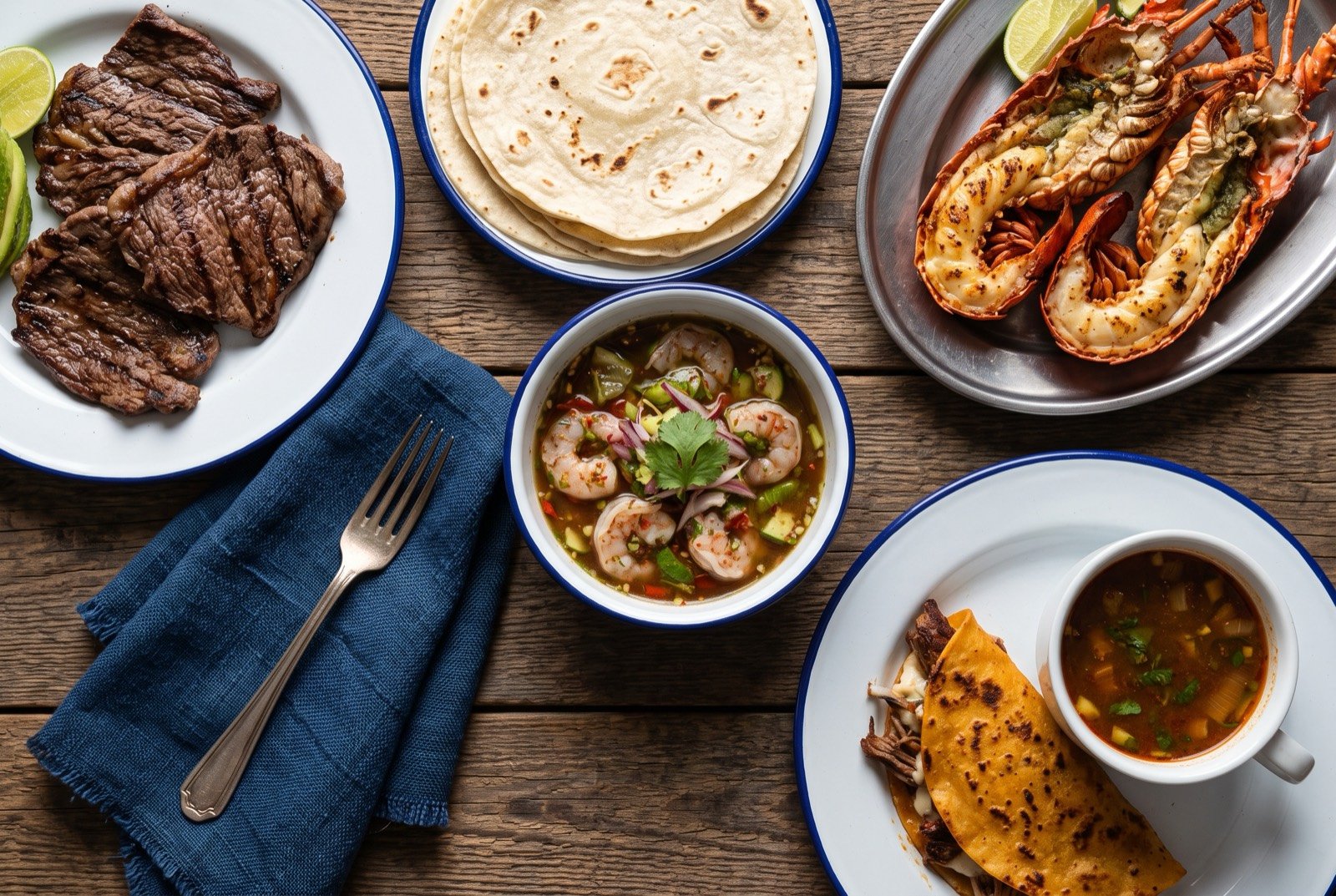
Sonora and Chihuahua run on wheat, beef and dairy where the rest of Mexico runs on maize, a desert ranching world built by Jesuit missions and their cattle rather than by milpa farming, and a twentieth century wheat economy the colonial story alone does not explain. Baja California is not a southern extension of that same table. It is a separate strand entirely: a Pacific fishing coast, a Mediterranean-climate wine valley, and a modern border cuisine invented in living memory rather than inherited from empire. Every dish as tradition built it, then what a modern chef would change.
Sources and review · What this chapter does not assert · How we research · Spotted something wrong?
A Sense of Place
This volume covers two food worlds that share a border and a climate zone but almost nothing else. Sonora and Chihuahua are a wheat-and-cattle interior, arid, ranch-organised, structurally closer to Texas or northern Spain than to central Mexico. Baja California is a Pacific peninsula with its own separate Mediterranean valley and its own separate coastline, and its defining dishes were mostly invented within living memory rather than carried down from the colonial period.
The desert interior: wheat and beef where maize is not king
The Sonoran and Chihuahuan Deserts share dominant plant families, scarce trees confined to watercourses, and mesquite as the defining woody presence across both. What actually organised the food culture on top of that ecology was land use, not climate alone: cattle grazing rangeland and irrigated river-valley agriculture, not the milpa maize-bean-squash system that shaped the rest of the country. Wheat needs a temperate climate and does not thrive in Mexico's tropical regions, which is the basic reason maize stayed dominant in the centre and south while wheat took hold in this more temperate, arid north, missions and haciendas the institutional vehicle that planted it. The single most important thing to say about this region's wheat identity, though, is that it is not only a colonial-era story. The Yaqui Valley around Ciudad Obregón, Sonora, became known as "El Granero de México," the granary of Mexico, after the American agronomist Norman Borlaug arrived in 1943 to fight stem rust and developed the rust-resistant, high-yield wheat varieties that triggered the Green Revolution. Yields rose from 1.4 tonnes per hectare in 1950 to 5 by 1980 and 7.2 by 2011 to 2012, and Borlaug's 1970 Nobel Peace Prize rests substantially on this work. Sonora's wheat table is a twentieth century irrigation-and-agronomy achievement layered on top of a colonial one, and this chapter treats it as both rather than collapsing it into a single origin story.
Baja California: a Pacific coast, a Mediterranean valley, a border
South of the Sonoran interior geographically but a different world entirely, Baja California runs on Pacific seafood, a Mediterranean-climate wine valley genuinely comparable in growing conditions to the south of France, and a modern culinary identity forged at the US border, in Tijuana and Ensenada specifically, largely since the 1960s. Where the desert interior's food logic is centuries deep, Baja's signature dishes, the Ensenada fish taco, aguachile's arrival on the peninsula, quesabirria, the Baja Med restaurant movement, all trace to the twentieth and twenty first centuries. This chapter treats that recency as a fact worth stating plainly, not a weakness to disguise with borrowed antiquity.
A table of the defining logic, read as fat, starch, aromatic and protein rather than as a shelf of specialities:
| Element | The desert interior | Baja California |
|---|---|---|
| Fat | Lard, from mission-descended pig and cattle husbandry | Olive oil, genuinely local to the Valle de Guadalupe's Mediterranean climate; also lard and butter |
| Starch | Wheat flour above all, the sobaquera tortilla its purest form | Corn tortilla for the fish taco; wheat bread and pastry in the Valle de Guadalupe's restaurant scene |
| Aromatic base | Chiltepín, wild-harvested and fiery; mesquite smoke itself as a flavour, not only a fuel | Lime and fresh chile for aguachile and ceviche-adjacent dishes; Mediterranean herbs in the wine valley |
| Everyday protein, land | Beef and goat, from a cattle-and-mission economy predating refrigeration | Beef and pork as everywhere, but less the defining note than the coast below |
| Everyday protein, coast/dairy | Queso Chihuahua and queso menonita, a genuine Mormon-then-Mennonite dairy tradition | Shrimp, abalone, lobster and Pacific white fish, under a real and actively managed cooperative fishery |
The History in Layers
Missions, cattle and the vaquero the desert did not invent alone
Jesuit missions were the colonising institution of Sonora, and they needed to self-finance, which is why livestock raising became a principal economic activity alongside introducing wheat cultivation from the outset. A documented case makes the scale of this concrete: the Jesuit mission college of San José de Mátape organised a cattle drive that took roughly a year to reach Puebla, by 1681, evidence of a commercial ranching network radiating from Sonoran missions well before independence. The defensive presidio system that protected this economy was formalised later, with the 1776 creation of the Comandancia de las Provincias Internas. Nueva Vizcaya, colonial Chihuahua and Durango together with eastern Sonora and Sinaloa, was the first northern province the Spanish settled at all, and cattle became so abundant there by 1580 that the viceroy Martín Enríquez de Almanza remarked they were worth no more than the effort of killing them.
It matters to say precisely where the vaquero tradition itself came from, because the desert missions did not invent it independently. The herding and roping skills that became charrería are traced by the historian José María Murià Rouret to Jalisco's Los Altos region from the sixteenth century, spreading north via haciendas established by families including Oñate, Urdiñola and Ibarra, several of them Basque. The Sonora and Chihuahua vaquero is a northward extension of a Jalisco-originated practice, not a separate desert invention, and this chapter states that rather than letting the more romantic, self-contained version stand.
The Mennonite dairy colonies, and a genuinely unresolved commercial history
Mennonites arrived from Canada from 1 March 1922, the first trains bringing roughly 3,000 settlers to what was then San Antonio de los Arenales, now Cuauhtémoc, Chihuahua, numbers reaching near 10,000 by 1927. A separate strand traces queso Chihuahua's technical ancestry further back, to English Chester and Cheddar cheeses brought by Mormon colonists from around 1885, aged only about seven days against sixty for its English ancestor, giving the cheese its golden colour and semi-firm, buttery, low-porosity texture, with Mennonite settlers from 1921 industrialising what the Mormons had begun.
Who actually commercialised it is genuinely disputed and this chapter keeps the dispute open rather than picking a side. One journalistic account credits industrialisation in 1936 to Abraham Dickey, combining Dutch Mennonite and Mormon technique. A peer-reviewed Mexican academic source instead names Luis Lara Leos, a merchant, working with a Mormon associate named Cole, in the same year, 1936, with "Quesos Las Pampas," under Enrique Wall around 1950, as the first solidly documented commercial operation. Both accounts agree on the year and on a Mennonite-Mormon technical hybrid; they disagree on the individual. The academic source carries the stronger evidence base: it surveys eleven queserías today across Janos, Ascensión and Nuevo Casas Grandes, roughly 82,000 litres of milk processed daily, and a 256-consumer survey in which 77 per cent preferred menonita for flavour and 63 per cent named it Chihuahua's most representative cheese, most product wholesaling into Ciudad Juárez.
Missions again, further south and later: the Dominicans, Baja's wine, and the Molokans
Baja California's own mission history runs later and differently. Between 1780 and 1840 Dominican missionaries built nine missions in Baja California specifically to plant sacramental vineyards, three of which anchor today's wine route: San Vicente Ferrer, Santo Tomás de Aquino and Nuestra Señora de Guadalupe. The mission at Santo Tomás was abandoned in 1849 and recovered in 1888 by the Basque Francisco Andonaegui and the Italian Miguel Ormart, who founded Bodegas de Santo Tomás, widely credited as the oldest continuously producing winery in Latin America.
A second, separate settlement layered onto the same valley from 1904: Russian Molokan colonists, a larger wave from 1912, organising as the "Empresa Rusa Colonizadora de la Baja California" under named leaders, Basiley G. Pivavaroff, Basiley Tomalsoff and Simeón Babichoff, acquiring roughly 5,600 hectares. Molokan religious practice forbade alcohol, yet by the mid-1920s the community was growing grapes and making wine, initially in partnership with Bodegas de Santo Tomás, the first Russian-planted vineyard dated to 1917 by Jorge Afonin. Land reform under Lázaro Cárdenas, creating the Francisco Zarco ejido, hurt Molokan landholding, and from 1957 many Russian families left for the United States. The valley's Mediterranean climate is real, not marketing language, which is the ecological fact that later let the region's twentieth century wine industry, L.A. Cetto from 1963, Monte Xanic from 1987, and its restaurant scene grow the produce a genuinely Mediterranean table needs: olives, olive oil, stone fruit, wine grapes.
Ensenada's Mercado Negro, and the fish taco's real, contested birth
The best-documented origin story in this whole chapter, drawn from Ensenada's own local press and oral history, places the fish taco's birth at Ensenada's Mercado Negro, an unofficial seafood trading hub operating roughly 1957 to 1969. Around 1960, a Sinaloan migrant nicknamed "El Bachigualato" was frying fish for himself in a 200-litre oil drum when fishermen with unsellable catch, chiefly the shark-like ray called angelito, asked him to fry it for them in tortillas. Pedro Alvarado and his wife opened the first roofed stall in 1961. The now-signature battered coating is credited, in the fullest account, to Don Zeferino Mancillas Fortuna, who arrived at the market around 1963 to 1964 with 35 pesos, the batter recipe itself credited to his wife, Evelia Abas; a shorter account gives the innovation to 1962 without her name attached. This chapter keeps both accounts rather than harmonising them into one clean date. The widely repeated claim that Japanese tempura batter inspired the coating does not appear in either Spanish-language local source and should be read as a later embellishment rather than fact.
Aguachile's arrival, and a modern moment invented at the border
Aguachile is Sinaloan, not Baja, in every source this chapter drew on, and its presence on this peninsula's plates is a modern adoption, not a native dish; the honest account of it belongs here for that reason, not to claim it as Baja's own. The dish moved from Sinaloa's mountainous interior, where its earliest form used rehydrated dried beef rather than seafood at all, to the coastal fishing ports from around the mid-twentieth century, where raw shrimp replaced dried meat, its now-standard cilantro-and-serrano version consolidating through the 1970s and 1980s and becoming nationally known in the 1990s. No source traces a specific date or individual for its arrival in Baja California specifically, and this chapter states that gap rather than inventing an arrival story.
Quesabirria is the clearest example of a dish this chapter can date almost to the year. Birria itself is Jalisco's, and its full tradition belongs to the sibling volume AM-05. What happened in Tijuana was different: street vendors took birria's meat, dipped the tortilla in the stew's own fat and consommé before griddling it, added melted cheese, and served the taco alongside a cup of consommé for dipping. The American food writer Bill Esparza documented this happening at a truck called Tacos Aaron in Tijuana around 2009, the format spreading through other Tijuana trucks and then to Los Angeles across the 2010s. Baja Med, the fine-dining movement that runs alongside this street-level border creativity, has its own recent and genuinely disputed origin: chef Miguel Ángel Guerrero is credited with coining and trademarking the term around 2005, after opening La Querencia in Rosarito in 2001, framing it as Mexican, Mediterranean and Asian influence converging on one Pacific-facing, Mediterranean-climate peninsula. An earlier root is usually traced to Benito Molina and Solange Muris, whose Ensenada restaurant Manzanilla, and Molina's cooking through the 1980s and 90s before that, is described in Mexican food writing as pioneering a genuine locavorism in Mexico before the word existed in Spanish. No source ties the two claims into a single timeline, and this chapter presents both rather than adjudicating.
The Flavour Arsenal
Chiltepín, wild and unforgiving
A wild, perennial shrub bearing a tiny, 3 to 6 millimetre, round-to-oblong berry, growing only under the canopy of nurse plants in canyon and arroyo margins, never in direct open sun. Harvest is entirely by hand, berry by berry, traditionally late September into early October, by pickers, chiltepineros, who travel considerable distances into difficult terrain for it. It carries real conservation pressure from habitat loss and careless over-harvesting, and the Consejo Regulador del Chile Chiltepín has petitioned Mexico's industrial property institute for denominación de origen-style recognition as a Sonoran product. Slow Food's international Ark of Taste lists it, naming it historically present on the table of Sonoran, Opata, O'odham and Yaqui rural households. It seasons machaca, caldo de queso, menudo and carne asada, eaten fresh and green at harvest, dried or preserved in vinegar or brine the rest of the year.
Queso Chihuahua and queso menonita
A genuine, single-region cheese with a traceable Mormon-then-Mennonite lineage, not a generic stand-in for "Mexican melting cheese." Its short ageing, roughly seven days against sixty for the English Cheddar it descends from, is what gives it its golden colour, buttery texture and low porosity. Almost all commercially sold "queso Chihuahua" is made in the Mennonite colonies of Chihuahua and Durango, or made elsewhere to the same technical formula.
Carne seca and machaca
Beef, historically also venison, pork, fish, ray, turtle, donkey or horse, cut into thin sheets, salted to draw out moisture, and sun-dried until hard, then pounded and shredded on a metate or in a molcajete until it separates into fine threads. No source consulted for this chapter gave an exact drying time in hours or days, and this chapter states that as a real gap rather than inventing false precision.
Mesquite, fuel and flavour at once
The wood that actually distinguishes northern Mexican grilling from grilling done anywhere else, named repeatedly across Mexican sources as giving carne asada its characteristic aroma, treated in this chapter as an ingredient, not only a heat source.
Baja's Pacific complex, and the conservation story behind it
Shrimp, corvina, cabrilla, cazón, robalo and the shark-like ray angelito make up the fish taco and aguachile larder. Abalone and lobster, fished along Isla Cedros, Isla Natividad, Bahía Tortugas, Bahía Asunción and Punta Abreojos, have been managed for over sixty years by FEDECOOP, a federation of eight fishing cooperatives founded in 1940 holding territorial concessions, a genuine community-based conservation model rather than a marketing claim, though abalone productivity is now reported declining under climate pressure. Almeja generosa, geoduck, is a young fishery, commercial capture only beginning around 2005 in Bahía Magdalena, Baja California Sur. Callo de hacha, called "the king of the seafood of the Sea of Cortés," commands roughly double the price of shrimp, and in La Paz bay a group of fishermen ended illegal fishing of it and began sustainable management from 2021.
Valle de Guadalupe's wine and Mediterranean produce
Bodegas de Santo Tomás, founded 1888, is Latin America's oldest continuously producing winery. L.A. Cetto, whose founder Luis Angelo Cetto emigrated from Italy in 1924, made a decisive investment from 1963 in grape varieties and French oak and steel technology considered unsuited to Baja's heat at the time, and remains the region's largest producer. Monte Xanic, founded 1987 by five partners, is described as Mexico's first boutique winery, pioneering night harvests and low-temperature white fermentation. Olives, olive oil and stone fruit grow here because the valley's climate is genuinely Mediterranean, the same ecological fact that underwrites the Baja Med kitchen's Mediterranean half. Separately, and further south, San Ignacio's Jesuit-planted date palms, from around 1765, still produce fruit from one of the peninsula's genuine desert oases, a distinct tradition this chapter keeps apart from the wine valley rather than blurring the two.
The Technique Ladder
The argument, from inside
Five techniques, each explained by why it works, not only what it does.
Rung 1. Mesquite live-fire grilling
Mesquite burns hotter and produces a different, more resinous set of aromatic compounds than oak or generic charcoal, which is what actually gives carne asada its specific smell rather than a generic barbecue one; cleaning the grate with a raw white onion and greasing it with a piece of beef fat before cooking prevents sticking without adding a fat flavour that competes with the meat itself.
Rung 2. Sun-drying and salting for machaca
Salt draws moisture out of thin-sliced beef by osmosis, lowering water activity enough to prevent spoilage, while the desert's dry air and heat complete the drying; the meat is then pounded to physically break the dried muscle fibre into shreds, a mechanical step, not just a textural flourish, that is what lets it rehydrate quickly and evenly when fried with egg.
Rung 3. Sobaquera dough, hand-stretched not pressed
A dough enriched with lard and rested under cloth for around 30 minutes lets its gluten relax fully, which is what allows the tortilla to be stretched by hand to near translucency without tearing; a pressed tortilla, by contrast, is compressed rather than stretched, and cannot achieve the same thinness without the dough fighting back.
Rung 4. Aguachile's short acid cure
A shrimp's proteins begin to denature and firm the moment citric acid touches them, the same chemistry as a longer ceviche cure, but at 10 to 30 minutes the process only reaches the surface, leaving the centre of the shrimp raw and translucent rather than fully "cooked" through, which is the entire point of the dish and the reason it is dressed at the point of serving rather than left to sit.
Rung 5. Desflemado, taming a dried chile before it is blended
Steeping a dried chile briefly in hot water or acid draws out some of its harsher, more bitter compounds before it goes into a paste, which is why a properly desflemado chile paste tastes rounder and less aggressive than one made from chile rehydrated and blended straight.
The Ferment and Preserve Bench
Three preparations, each a genuine preservation technology this desert and coastal world actually needed, not a modern flourish.
Machaca and carne seca. Thin-sliced beef, salted and sun-dried until fully leathery, historically hung on mesquite branches, then pounded to shred. A pre-refrigeration technology for holding meat through the year in a climate too hot and dry for anything else to work, and the direct ancestor of machaca con huevo above.
Chiltepín, preserved in vinegar or brine. The wild harvest happens in a short window, late September into early October, and the year-round supply that lets chiltepín season food across the rest of the calendar depends on preserving a portion of that harvest in vinegar or brine rather than relying on the fresh, green chile alone.
Queso Chihuahua's short cure. Aged only around seven days against the sixty of the English Cheddar it descends from, this short cure is itself the preservation technique that gives the cheese its specific character, a deliberately truncated version of a European process adapted to local conditions and local taste rather than a lesser one.
Sourcing in Britain
Flour tortillas. No UK retailer sells anything close to a genuine Sonoran sobaquera; Cool Chile Co's and MexGrocer's flour tortillas are the wrong size and thickness for this dish. The honest route is to make them: UK plain flour, not strong bread flour, is the closer match to Sonoran dough's lower protein content, and real lard, either supermarket block lard or, for genuine flavour, rendered pork back fat from a good butcher, since much shop lard is hydrogenated and bleached.
Carne seca and machaca. No UK supplier stocks anything close, and importing dried meat products from outside the UK is subject to restrictions that make it an unreliable route in any case. A home dehydrator on well-trimmed flank or skirt steak, widely available from any UK butcher, is the honest and genuinely workable alternative, with the caveat that true sun-dried desert-air beef is not fully reproducible indoors.
Queso Chihuahua. No UK stockist of the genuine article was confirmed. Mexi Dairy Co, a small UK producer based in Sowerby Bridge, West Yorkshire, makes real Mexican-style cheeses domestically, Queso Oaxaca, Queso Fresco, Queso Blanco, Queso Cotija among them, though queso Chihuahua itself is not currently in their range. For the melting behaviour that matters most in queso fundido or a quesadilla, a mild Gouda-style or young Monterey Jack-style cheese is the closer match; a supermarket "Mexican style" shredded blend is a poor flavour match though a reasonable melt match, and this chapter is plain about that rather than pretending the substitute is equivalent.
Chiltepín. No reliable UK stockist was confirmed. Dried Thai bird's eye chilli, sold at any UK Chinese, Thai or South Asian grocer, is the closest heat match though sharper and greener in flavour; chile de árbol from Cool Chile Co is the better flavour-family match if the heat is dialled back with fewer chiles.
Dried chiles generally. Cool Chile Co is a genuinely strong, confirmed UK source for ancho, cascabel, guajillo, de árbol, chipotle and habanero. Chile colorado is not a distinct variety but a regional name for dried guajillo or a guajillo-ancho blend, so guajillo from the same supplier covers it.
Cabrito. UK goat sourcing is a real strength, mostly through halal channels: Tariq Halal and HDS Foods for whole kid, Cabrito Goat Meat Ltd for British-reared, non-halal kid shipped nationwide. True cabrito is milk-fed, 4 to 8 weeks old; most UK kid sold is somewhat older, 3 to 6 months, but still far closer to the tradition than lamb, whose extra fat renders faster and can turn the dish greasy if cooking times are not shortened to compensate.
Baja seafood. For aguachile, a reputable UK fishmonger's sashimi or ceviche-grade raw king prawns are the honest standard, since nothing genuinely Pacific or Sea of Cortez is importable fresh, and freshness matters more here than exact species matching. For fish tacos, cod, haddock, hake and pollock are all workable substitutes for Baja's traditional corvina and rock cod, hake's texture being the closest match. No UK stockist of genuine Mexican dried shrimp, camarón seco, was confirmed; Chinese or Southeast Asian dried shrimp from any UK Chinese or Vietnamese grocer is the realistic, if different, alternative.
Valle de Guadalupe wine, a genuinely good answer. L.A. Cetto is confirmed in stock at three UK merchants, Vinello, Tanners Wines and House of Townend, at ordinary prices generally under £13 a bottle, a real and slightly surprising win worth stating plainly rather than assuming Mexican wine is simply unobtainable in Britain.
Masa harina and Mexican grocers. Cool Chile Co and MexGrocer both stock masa harina reliably; Mexican Mama offers UK-wide delivery. Two corrections worth making rather than repeating: R Garcia & Sons on Portobello Road is a Spanish, not Mexican, delicatessen, and Casa Morita in Brixton is a restaurant, not a shop.
The single decision that matters most. Real mesquite lump charcoal, not mesquite-flavoured briquettes, for the Big Green Egg. It is genuinely available in the UK, and it is the one ingredient in this entire chapter whose absence would make carne asada, cabrito and the fish taco all taste approximately, rather than actually, northern Mexican.
Voices and Sources
Mexican academic and institutional sources: Dr Guillermo Núñez Noriega of CIAD, the Centro de Investigación en Alimentación y Desarrollo in Hermosillo, for carne asada's real, unmarinated tradition and its Jesuit-ranch origin; the peer-reviewed Amelica journal article on queso menonita production in northwestern Chihuahua; SciELO and Redalyc for desert ecology, wheat history and colonial ranching; CIMMYT for the Yaqui Valley Green Revolution; the Chihuahua state government's own gastronomy pages; DataMares and Scielo fisheries research for the FEDECOOP cooperative system, geoduck and callo de hacha.
Mexican regional press: El Imparcial (Sonora) on carne asada as identity ritual; El Vigía (Ensenada) and the culinary magazine Molcajete on the fish taco's Mercado Negro origin; El Financiero, El Siglo de Durango and El Siglo de Torreón on Mennonite cheese and discada's Comarca Lagunera origin; El Universal San Luis and a Torreón outlet on the cabrito al pastor dispute.
Mexican and in-tradition cookbook and literary sources: Ernesto Camou Healy and Alicia Hinojosa's Cocina Sonorense, the strongest in-tradition cookbook found for Sonora; Omar Millán González's El marciano y la langosta, nearly three years spent travelling Baja California's fishing and farming communities and tracing its food history from the Kumiai, Pai Pai, Kiliwa and Cochimí through Spanish, Asian and European layers to Baja Med, the strongest literary source found for Baja California specifically.
Baja Med chefs and restaurants: Benito Molina and Solange Muris of Manzanilla, credited with a genuine pre-Baja Med locavorism; Miguel Ángel Guerrero of La Querencia, credited with coining and trademarking the term itself; Diego Hernández of Corazón de Tierra; Javier Plascencia of Finca Altozano and Animalón; Drew Deckman of Deckman's en el Mogor; Jair Téllez, formerly of Laja.
Things this chapter has deliberately not asserted
- That cabrito al pastor or discada norteña originate in Chihuahua or Sonora. The strongest sourced claims for both point to Monterrey, Nuevo León, Coahuila and San Luis Potosí; this chapter presents both dishes as shared northern staples, adopted and widely cooked here, not invented here.
- That aguachile is a Baja or Sonoran dish. Every source consulted places its origin in Sinaloa's mountainous interior; its presence on this peninsula is a modern, undated diffusion, and this chapter states that rather than inventing a Baja arrival story.
- That the fish taco batter derives from Japanese tempura technique. This widely repeated claim does not appear in either of the two Spanish-language local sources this chapter drew on for the dish's actual documented history, and it is treated here as an unverified later embellishment.
- That the commercial origin of queso Chihuahua and queso menonita is settled. Two credible source types disagree on whether Abraham Dickey or Luis Lara Leos and a Mormon partner named Cole industrialised it first, both agreeing only on the year, 1936; this chapter presents the dispute rather than resolving it.
- That any named Baja Med chef documents sous vide use on cabrito, machaca or any dish in this chapter with real, published parameters. No such source was found; where this chapter suggests sous vide, it is offered as the writer's own reasonable extrapolation from general technique, not as reportage of established practice.
- That the Puerto Nuevo lobster tradition's 1950s, fishermen's-wives origin story is archivally confirmed. It rests mainly on Baja tourism-board and lifestyle-magazine sources rather than academic or hard press, and this chapter holds it as the commonly told local story on that basis.
- That a specific named tortillería or family keeps the definitive sobaquera technique. No such lineage was found in the research behind this chapter.
- That San Ignacio's date palms carry a settled UNESCO-linked heritage status. This claim appeared in only one source and could not be cross-verified, so it is not asserted here.
- That the Molina-versus-Guerrero question of who really started Baja Med has a single correct answer. No source ties the two claims into one reconciled timeline, and this chapter presents both without adjudicating.
- That "Teodoro González" has any documented connection to quesabirria or to Tacos El Gordo. This name could not be verified in the research behind this chapter and is not used.
Mesquite live-fire grilling
Mesquite burns hotter and produces a different, more resinous set of aromatic compounds than oak or generic charcoal, which is what actually gives carne asada...
Sun-drying and salting for machaca
Salt draws moisture out of thin-sliced beef by osmosis, lowering water activity enough to prevent spoilage, while the desert's dry air and heat complete the...
Sobaquera dough, hand-stretched not pressed
A dough enriched with lard and rested under cloth for around 30 minutes lets its gluten relax fully, which is what allows the tortilla to be stretched by hand...
Aguachile's short acid cure
A shrimp's proteins begin to denature and firm the moment citric acid touches them, the same chemistry as a longer ceviche cure, but at 10 to 30 minutes the...
Desflemado, taming a dried chile before it is blended
Steeping a dried chile briefly in hot water or acid draws out some of its harsher, more bitter compounds before it goes into a paste, which is why a properly...
The dishes
- Carne asada sonorense Sonora, Mexico
- Machaca con huevo Sonora, Mexico
- Caldo de queso sonorense Sonora, Mexico
- Menudo norteño Chihuahua and Sonora, Mexico
- Cabrito al pastor Northern Mexico (Monterrey and Nuevo León, shared regional dish)
- Discada norteña Comarca Lagunera, Coahuila/Durango border (adopted regional staple in Chihuahua and Sonora)
- Tortillas de harina sobaqueras Sonora, Mexico
- Aguachile de camarón Sinaloa, Mexico (widely eaten across the Mexican northwest, including Baja California)
- Tacos de pescado estilo Ensenada Ensenada, Baja California, Mexico
- Langosta estilo Puerto Nuevo Puerto Nuevo, Baja California, Mexico
- Quesabirria estilo Tijuana Tijuana, Mexico
Sources and review
- Reviewed
- Not yet reviewed from inside the tradition
- Cooked
- Not yet cooked and reported
Where this volume comes from
3 research briefs on file for this volume, researched to the rules on How we research. Published 3 September 2026. Last changed 8 September 2026.
The brief's own account of its sources
Sonora and Chihuahua pass, roughly 20 search queries and 4 direct fetches: the large majority of substantive claims are sourced to Mexican regional and national press (El Imparcial, several Organización Editorial Mexicana network regional papers, El Universal San Luis, El Siglo de Torreón, El Financiero), Mexican government bodies (chihuahua.gob.mx, gob.mx/agricultura, CONAFOR, CIMMYT), and Mexican or Latin American academic outlets (SciELO, Redalyc, Amelica, UNISON, UACJ).