The Americas · Volume 01
Valley of Mexico, Puebla and Oaxaca
The Highland Mole and Maize World
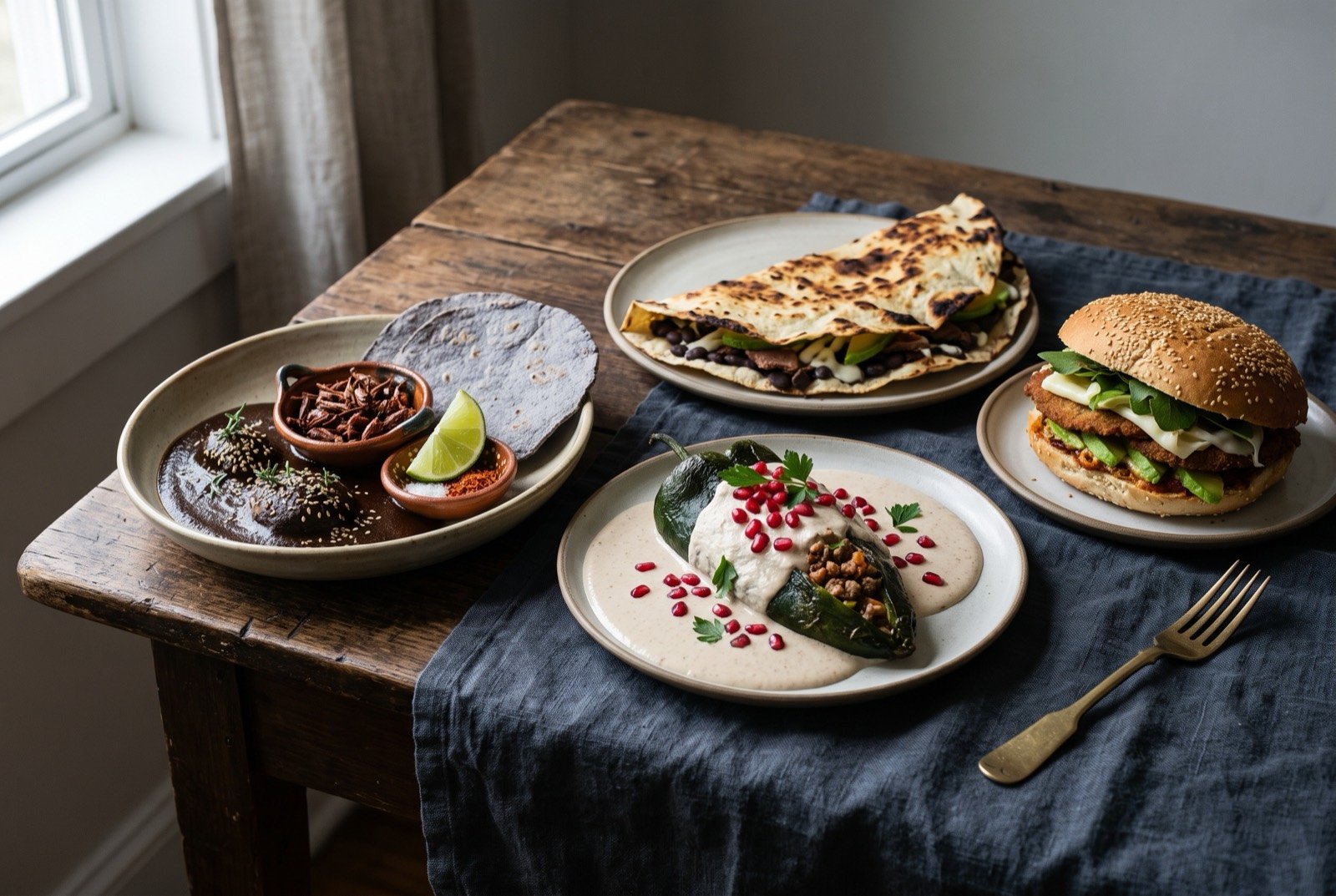
The volcanic highland heartland of Mexico, where nixtamalized maize and pre-Hispanic Nahua, Zapotec and Mixtec technique concentrate most densely, and where market and convent cooking alike produced mole as a cuisine in its own right rather than a single dish. Not the Mexico of a taco van and a bottle of hot sauce, and not a flag-coloured stuffed pepper served once a year for its story. Every dish as tradition built it, then what a modern chef would change.
Sources and review · What this chapter does not assert · How we research · Spotted something wrong?
A Sense of Place
Three highland worlds sit inside this one volume, joined by altitude, volcanic soil and maize, and separated by three different histories.
The Valley of Mexico: a lake system, not a valley
Until colonial-era desiccation, the Valley of Mexico was an interconnected system of shallow lakes, Texcoco, Xochimilco, Chalco, Xaltocan and Zumpango, not a valley in the ordinary sense. The Mexica built raised agricultural plots directly into the water: chinampas, from Nahuatl chinamitl, "place enclosed by reeds." At its productive peak under the Aztec empire, some chinampa plots produced up to seven harvests a year of maize, beans, squash, chile and flowers, giving Tenochtitlan effective food self-sufficiency at a population density most of the pre-industrial world could not match. Lake Xochimilco's surviving chinampas were declared a UNESCO World Heritage Site in 1987, and this is one of the last places on earth where the system still functions, worked by families whose ancestors worked the same plots under the Mexica.
Puebla: a colonial creation, not a Nahua city
Puebla, roughly 100 km east and somewhat lower and drier, is by contrast a wholly colonial invention: founded in 1531 as Ciudad de los Ángeles, deliberately sited between the port of Veracruz and Mexico City so that Spaniards without an encomienda could settle land not already claimed by an indigenous polity. This matters more than it looks like it should. Unlike Mexico City, Puebla was never built over a functioning pre-Hispanic capital, and this absence is the material reason the city's culinary identity is disproportionately colonial and conventual rather than indigenous-urban. By the eighteenth century Puebla held an extraordinary density of women's convents, San Jerónimo, Santa Teresa, Santa Clara, La Santísima Trinidad, Santa Inés, Santa Mónica, Capuchinas, Santa Rosa and La Soledad among them, several wealthy through elite criolla and peninsular dowries, staffed by literate women with pantry access to imported spice. That concentration of resourced, literate kitchens is the actual precondition for the elaborate sauce cuisine covered below. It is not incidental, and it is not romantic scene-setting: it is the reason Puebla, rather than a poorer or less connected town, is where mole poblano and chiles en nogada were formalised.
Oaxaca: the most ethnically complex state in Mexico
Oaxaca is unlike anywhere else in the country by simple weight of numbers: 16 to 18 indigenous languages are spoken there depending on the count used, across eight socio-cultural regions, the Central Valleys, the Sierra Norte and Sur, the Isthmus of Tehuantepec, La Cañada, the Mixteca, the Cuenca del Papaloapan and the Costa. Of the state's 2020 census population aged three and over, 1,221,555 people speak an indigenous language. This chapter is scoped to the Central Valleys, the Zapotec heartland, and the Mixteca, matching the volume's highland spine, and it states the wider diversity honestly rather than letting Central Valleys Zapotec food stand in for "Oaxacan food" as a whole. The Isthmus has its own Zapotec-Huave-Zoque culinary world built on totopo and shrimp tamales, and the Sierra Mazateca its own again; neither gets the twice-given treatment here, and both deserve their own volume eventually.
A table of the defining logic
| Element | Valley of Mexico and Puebla | Oaxaca, Central Valleys and Mixteca |
|---|---|---|
| Fat | Lard, a colonial Spanish import structural to mole poblano; before contact, none | Lard, used in every mole examined for this chapter, for frying spice pastes and finishing |
| Starch | Maize as masa, tortilla and corn-husk tamal; cacahuazintle for pozole, centred on the Valle de Toluca | Maize as the large, dry, comal-toasted tlayuda, and banana-leaf tamales, both genuinely distinct from the Valley of Mexico's forms |
| Thickener | Ground seed and nut, pepita, almond, peanut, pecan, standing in for a roux in a cuisine with no dairy-fat tradition of its own | Nixtamalised masa dissolved into broth, plus toasted bread, plantain and ground nuts fried into a paste for the black moles |
| Aromatic | Chile in fresh and dried multiplicity; after contact, cinnamon, clove and sesame via the Manila Galleon | Hoja santa and avocado leaf, the latter toasted and added only at the very end of chichilo or it turns bitter, a profile largely absent further north |
| Everyday protein | Turkey, before contact; pork and lamb, after, especially in Puebla's barbacoa and mixiotes | Goat, in the Mixtec mole de caderas, a Spanish-introduced husbandry practice; chicken, pork, and, genuinely everyday rather than novelty, chapulines |
Underneath all three sits one logic. Maize is starch and often thickener. Chile, fresh and dried, is the aromatic and heat register. Toasted seed and nut is the second thickening agent, doing the work a dairy-fat roux does elsewhere. And before contact, no rendered animal fat touches any of it. Lard only becomes structural once pigs arrive: the mole poblano recipe examined below uses a cup and a half as its primary cooking fat, a quantity no pre-Hispanic kitchen could have used.
The History in Layers
Pre-Hispanic Nahua foodways, seen by an eyewitness
The richest single account of the pre-conquest Valley of Mexico's food economy is Bernal Díaz del Castillo's description of the Tlatelolco market, adjoining Tenochtitlan, which he says overwhelmed the Spanish on first sight: "Cuando llegamos a la gran plaza que se dice de Tlatelulco, como no habíamos visto tal cosa, quedamos admirados de la multitud de gente y mercadería que en ella había." Díaz records maize and cacao atole, roasted and boiled fish, tortillas, tamales of every filling, tlacoyos, and ahuauhtli, small cakes made from an insect-egg foam skimmed off the lake surface, which he says tasted rather like cheese. It is worth sitting with that image for a moment: a market so large and so various that a conquistador who had seen Seville reached for the only comparison he had, and found it wanting.
Zapotec and Mixtec domestication, ten thousand years before either word existed
Long before Tenochtitlan, Guilá Naquitz cave in Oaxaca's Valle de Tlacolula, roughly 5 km northwest of Mitla, was already doing the work that would define this whole cuisine. Ten-thousand-year-old squash seeds recovered there are considered the earliest known evidence of domesticated plants anywhere in the Americas, and corn cob fragments from the same cave are cited as early evidence for maize domestication itself, from a period of hunter-gatherer occupation between roughly 8000 and 6500 BCE. The site is jointly recognised by UNESCO and Mexico's own National Institute of Anthropology and History, INAH, which still runs guided visits there; this chapter states the site's importance without overclaiming the precision of its dating, since the exact radiocarbon chronology has been contested in the wider archaeological literature. What is not contested is the geography: this cuisine's two most defining ingredients, maize and squash, were first coaxed into cultivated form in the same highland country this chapter covers, not somewhere else and later imported in.
Zapotec agriculture at Monte Albán cultivated chile, beans, squash, cacao and maize, supplemented by deer, turkey and produce from the lakes; Zapotec funerary urns depicting maize cobs worked into the headdress of Pitao Cozobi, the maize deity, are read as material evidence of maize's religious centrality well before the Mexica ever reached the valley further north.
Nixtamalization: the technique the whole cuisine stands on
If this chapter has a single most important fact, it is this one. Nixtamalization is pre-Hispanic, and its name is itself Nahuatl: nextli, lime or ash, plus tamalli, unformed corn dough, gives nextamalli. Dried maize is simmered in water with food-grade lime at close to 80 degrees Celsius for around 30 minutes, then steeped, drained and rinsed repeatedly before grinding. Before lime was identified specifically, Mesoamerican cooks used wood-ash lye for the same purpose, with calcium oxide established later as the first deliberately used chemical reagent in the whole tradition.
The payoff is not simply textural. Nixtamalization rebalances the isoleucine-to-leucine ratio in maize protein, improving the body's ability to convert dietary tryptophan into niacin, and its absence is the documented cause of pellagra in maize-dependent diets that never adopted the step. It also increases available calcium and reduces phytic acid, which otherwise blocks mineral absorption. Separately, and this is worth knowing on its own terms, the maize-and-bean pairing that structures the whole diet supplies complete protein, beans carrying the lysine maize lacks. A civilisation that ate maize without this step would have been malnourished by its own staple crop. A civilisation that discovered the step, evidently by accident and then never let it go, built an empire on top of it. No traditional lime-to-maize-to-water ratio survives in the sources this chapter could reach; that is a real gap, not a smoothed-over one, and closing it would need agronomic literature rather than a recipe site.
Mole itself, as a category, is older than any convent. "Mole" comes from Nahuatl molli or mulli, meaning stew, potage or food broadly, and pre-Hispanic cooks already made thick chile sauces thickened with ground pumpkin seed or toasted tortilla, seasoned with epazote, hierba santa or avocado leaf, served over hunted meat, fish or vegetables. What the colonial period adds is not the idea of a ground chile sauce. It is a specific set of new ingredients, and, in Puebla specifically, an institutional setting wealthy and literate enough to formalise that idea into something as elaborate as what follows.
The colonial layer and the Manila Galleon
Spanish colonisation brought pork and rendered pork fat, dairy and wheat directly. It also, by a much longer and stranger route, brought Asia. The Manila Galleon trade ran from 1565 to 1815, sailing from Manila to Acapulco, and carried cinnamon, black pepper, clove, nutmeg, sesame, coconut, mango and tamarind into the Mexican pantry alongside silk and porcelain. Mole poblano's cinnamon, clove, sesame and almond sit directly on this route: a sauce that reads today as the essence of Mexican cooking carries, in its own spice rack, the residue of a trade line that ran through Manila.
The convent kitchen and mole poblano's disputed origin, told straight
Two convent-origin legends circulate for mole poblano, and this chapter states both by name and adjudicates neither, because the Mexican historians who have actually examined them do the same.
The most repeated version holds that Sor Andrea de la Asunción, a Dominican nun at the Convento de Santa Rosa, created the dish, dated inconsistently to 1681 or 1685, for a viceregal visit, grinding pantry chiles, spices, stale bread, nuts and a little chocolate into a dark sauce. In one telling of the anecdote, the mother superior broke her vow of silence on smelling it, crying "Hermana, ¡qué buen mole!", only for the other nuns to correct her, laughing, that what she meant was "muele", grind. The convent kitchen, tiled in some eighteen thousand pieces of Talavera, still stands as a museum and is treated by Puebla's own tourism bodies as the dish's literal birthplace.
A rival story sets a Franciscan lay brother, Fray Pascual, as chief cook for a banquet honouring Bishop Juan de Palafox, tripping near the pot in which a turkey was already cooking and spilling a tray of chiles, spices and nuts into it by accident.
Neither survives scrutiny as documented history, and Mexican sources that examine the legends say so plainly: mole is a complete dish whose sophistication was not improvised in an afternoon, whichever version you prefer. No primary seventeenth-century convent document naming either the nun or the friar as inventor exists; what exists is oral tradition, recorded much later, repeated by tourism boards and journalism alike. The honest account is less tidy than either story: mole poblano is the gradual elaboration, inside wealthy Puebla convent kitchens with pantry access to imported Asian spice, of a much older Nahua molli tradition that already combined chile, ground seed and aromatic herb before a single Spaniard set foot in the valley.
Chiles en nogada, and a patriotic myth that does not survive checking
The popular story holds that Agustinian nuns at the Convento de Santa Mónica invented chiles en nogada on 28 August 1821 specifically to honour Agustín de Iturbide, the walnut sauce, parsley and pomegranate deliberately evoking the new Mexican flag's green, white and red. This is the kind of story every cuisine eventually grows around its most patriotic dish, and this one does not hold up under its own country's scrutiny. Historians cited by Mexican outlets that have actually investigated it note a date discrepancy, Iturbide is placed passing through Puebla on 2 August in some accounts, not the 28th. More substantially, the archaeologist Eduardo Merlo found records of a very similar fruit-stuffed, battered chile in walnut sauce dating to 1741, eighty years before the supposed banquet, meaning the dish was already an existing convent recipe, adapted for the occasion rather than invented for it. What documentary evidence suggests was actually served to Iturbide was a modest refresco, refreshments, not a formal banquet built around a signature dish. El Universal's own Puebla desk states the conclusion its historians reached without hedging: the chiles en nogada were not created for Agustín de Iturbide. What is real and needs no invented story to carry it: walnuts and pomegranate are both genuinely in season only in August and September in central Mexico, which is why the dish keeps its narrow annual window regardless of who did or didn't invent it for whom.
The mole negro complex, and a disagreement Oaxaca has never settled
Oaxaca is popularly said to have seven moles, and this chapter treats that claim exactly as carefully as it deserves, because Oaxacans themselves do not agree on the list. One common version gives negro, amarillo, coloradito, verde, chichilo, manchamanteles and mole rojo. Mexico's own federal Instituto Nacional de los Pueblos Indígenas, in its 2021 recipe collection La tierra de los moles, states explicitly that the seven are negro, rojo, amarillo, verde, coloradito, estofado and chichilo, then separately lists manchamanteles as an eighth item alongside further, non-canonical moles: mole de caderas, mole de chicatana and mole de camarón. This is a genuine, documented disagreement, not a puzzle with a correct answer waiting to be found, and this chapter will not pretend otherwise. It gets stranger still: the same government source sites mole rojo specifically in the Isthmus of Tehuantepec and the Sierra Mazateca, not the Central Valleys at all, which means "the seven moles of Oaxaca" is not even one tradition's own coherent repertoire. It is a state-level folk category that spans several distinct ethnic regions, retrofitted into a tidy number for the sake of the number.
Markets as a living institution, not a backdrop
Oaxaca's Mercado 20 de Noviembre traces its construction to between 1862 and 1882, built on the site of the former Convento de San Juan de Dios, first opened as the Mercado de la Industria before being renamed for the date the Mexican Revolution began. Its pasillo de humo, smoke passage, is named for the tasajo, cecina and chorizo grilled directly at the stalls over anafre braziers, a wall of charcoal smoke a visitor walks through rather than around. Traditional cooks across Oaxaca's markets, the 20 de Noviembre, the Central de Abastos, the Mercado Benito Juárez, learned their technique in market comedores, generation to generation, and community organisations of cocineras tradicionales now exist across Oaxacan municipalities specifically to protect and strengthen that transmission.
The mezcal and tourism boom, and who actually benefits
This belongs in the history of the cuisine, not filed away as a modern footnote, because it is actively reshaping the market culture described above while this chapter is being written. Two named, in-country, critical sources anchor this section, and they should carry real weight. Isabel Ortega, writing for the Mexican investigative outlet Avispa Mídia, documents that Oaxaca's culinary fame, twenty-one Michelin-listed restaurants, a Netflix series built around its street food, coexists with acute structural inequality: a traditional market meal costs roughly 90 pesos against 700 to 3,000 pesos at a Michelin-listed restaurant, and a street memela sells for around 20 pesos against 200-plus pesos for the identical dish once it has been "elevated." She quotes the critic Luis Hernández, that a dish "can seem dirty in poor contexts but acquire gourmet status when presented by someone deemed superior," and documents chefs extracting traditional recipes from indigenous cooks without attribution or compensation. Cristina Oehmichen Bazán, of UNAM's Institute of Anthropological Research, writing through CIESAS, analyses how Oaxacan indigenous culinary tradition is commodified as an economy of identity for tourism, naming Abigail Mendoza, whose restaurant appears repeatedly in this chapter, as a case where international recognition genuinely helped protect indigenous culinary heritage from erasure, even as the same process reframes subsistence practice for a visitor's gaze rather than the community's own. International tourism to Oaxaca rose 18 percent in a single recently cited year, and mezcal production grew 365 percent over the preceding decade, against rising food and housing costs and real commercial displacement in the city's own neighbourhoods. This chapter returns to the mezcal boom's specific costs, and one specific act of appropriation, in the modern chapter below.
The Flavour Arsenal
Chile pasilla, mulato and ancho, and the confusion sold as clarity
Ancho and mulato are both dried chile poblano, the same Capsicum annuum, but different cultivar lines picked at different points. Ancho is picked riper, giving a smoother, reddish-dark skin; mulato is picked less ripe, larger, more wrinkled, darker, and noticeably sweeter and more chocolatey in flavour. Pasilla is a different chile again, dried chilaca rather than a poblano variant at all, and is sometimes wrongly used in the United States to mean poblano, a confusion worth naming precisely because it will send a careful reader to the wrong bag.
Chile chilhuacle, a chile genuinely running out
The chilhuacle is not merely rare in the way every specialist ingredient claims to be rare. Cultivation nationally does not exceed ten hectares, concentrated in San Juan Bautista Cuicatlán, and harvested only four months of the year. As of 2022 reporting, only two families were still known to be planting it there, and commercialised volume had fallen from roughly five tonnes a year in a good season to half a tonne, driven by weak demand against cheaper packaged products, land-use change, herbicide use, pest pressure, climate change and a generation of young people with no interest in growing it. Chile chilcostle, used in mole amarillo and coloradito, is a second, related endangered Oaxacan chile carrying its own conservation listing from the Slow Food Foundation. This chapter names both plainly rather than treating scarcity as a marketing detail, because the sourcing section below has to say honestly that a British reader cannot currently buy the real thing.
Pepitas, a pre-Hispanic thickener older than any nut
Toasted, ground pumpkin seed as a sauce thickener predates the nut-thickened Puebla mole tradition entirely and does not depend on it: it is a Mesoamerican technique in its own right, standing in for a roux in a kitchen with no dairy fat of its own.
Huitlacoche, and a delicacy that is younger than it looks
Huitlacoche, the corn smut fungus Ustilago maydis, carries a Nahuatl name whose meaning is itself disputed, either "sleeping excrement" or "maize worm" depending on which reading is followed. What matters more for this chapter is a genuinely counter-intuitive finding: the researchers Raúl Valadez Azúa and Ángel Moreno Fuentes have argued that huitlacoche's status as a prized delicacy is comparatively recent, not ancient. No pre-Hispanic written source treats it as food of ceremonial significance; the rare pre-Hispanic mentions that do exist treat it as a deformity, a sign of crop loss, and its popularisation as something to seek out rather than discard is dated to the twentieth century. This directly contradicts the "ancient delicacy" framing that dominates tourist writing and much English-language coverage, and it is a genuine live disagreement rather than a settled fact, since at least one other academic source asserts the opposite framing in its own title. This chapter states both positions rather than repeating the more romantic one because it is more repeatable.
Canela mexicana against cassia, a distinction worth making precisely
Mexican canela is Ceylon cinnamon, Cinnamomum verum, not the cassia, Cinnamomum cassia, that fills most supermarket cinnamon jars worldwide. Ceylon cinnamon rolls into thin, multi-layered, papery quills, pale tan, with a soft, subtly sweet flavour and a markedly lower coumarin content; cassia is a single thick, rigid curl of bark, darker, harder and far more assertive, carrying roughly twenty times the coumarin of Ceylon cinnamon, a compound that in real excess stresses liver and kidney function. Mexico received true Ceylon cinnamon via the Manila Galleon centuries before either country had heard of the other's supermarkets, and mole poblano's own recipe below calls for a broken 10 cm stick in a form consistent with Ceylon's quill structure, not cassia's stiff curl. Whether Ceylon cinnamon specifically, rather than cassia, is what is actually sold as canela in Mexican markets today could not be independently confirmed in this chapter's research; the historical supply route is solid, the present-day retail claim is a reasonable inference rather than a verified fact, and it is stated that way rather than more confidently than the evidence allows.
Avocado leaf, epazote and hoja santa
All three are confirmed pre-Hispanic aromatics, used in chile-based sauces alongside pepita thickening long before contact. Epazote's own Nahuatl etymology is given two readings, "aromatic herb" or, more pungently, "skunk's filth", a reasonable description of its raw smell before it is cooked into something that no longer smells of anything except itself; it is essential to frijoles de olla, mole verde, mole de olla, salsas verdes and countless tamal fillings, and carries a genuine traditional use as a digestive remedy alongside its culinary one. Avocado leaf is toasted on the comal and folded into mole chichilo only at the very end, since boiling it turns the whole pot bitter, a detail this chapter treats as a real technique rather than a garnish instruction.
Cacahuazintle, the maize of the Valle de Toluca
Its Nahuatl name, cacahuacentli, "maize ear slender as cacao," and its appearance in colonial chronicles, including a mention by Fray Bernardino de Sahagún, confirm genuine pre-Hispanic antiquity. A large-eared, round, white-grained maize whose foam on cooking gives pozole its characteristic body, it is grown today overwhelmingly, roughly 94 percent of national production, in the Valle de Toluca in the State of Mexico, adjoining the Valley of Mexico proper, confirming a real and specific highland association rather than a generalised national one.
Quesillo, and mezcal at the palenque
Quesillo, Oaxaca's string cheese, and mezcal, made in Oaxacan palenques rather than the "vinatas" used elsewhere in Mexico, both get their full technical treatment in the technique ladder and dishes below. What is worth stating here as flavour-arsenal fact: mezcal production in Oaxaca divides into ancestral, artesanal, the majority of production, and industrial categories, using agave species including espadín, the dominant cultivated variety, alongside wild species, tobalá above all, that take thirteen to seventeen years to mature and cannot simply be replanted to meet a sudden export order.
The Technique Ladder
The argument, from inside
Six techniques, each explained by why it works, not only what it does.
Rung 1. Nixtamalization
Cooking dried maize in a roughly five percent calcium hydroxide solution gelatinises around 80 percent of the kernel's starch, softens the pericarp, sharply increases the bioavailability of niacin, and reduces phytic acid, which otherwise blocks mineral absorption. This is entirely achievable at home with dried whole corn, food-grade cal and a high-power blender for the final grind, and it is the single highest-leverage technique in the whole cuisine, the one whose absence is most repeatedly named as the reason bad diaspora corn product tastes of nothing.
Rung 2. Metate or high-power-blender grinding
The metate has been reclaimed specifically as a symbol of authenticity in serious contemporary Oaxacan kitchens, not kept on as a nostalgic prop. A high-power blender approximates the fineness a metate achieves but cannot replicate its coarser, more textured result, or the way stone grinding releases chile and seed oils gradually rather than all at once under a fast-spinning blade.
Rung 3. Comal work, at three distinct heat intensities
Every mole recipe examined for this chapter uses the comal at three genuinely different levels: gentle toasting for whole spices, to release aroma without burning; medium roasting for tomato, tomatillo, onion and garlic, until the skin blisters and colours; and, for mole negro and chichilo specifically, deliberate full charring of chile seeds and a whole tortilla, taken to direct flame until black. These are not three degrees of the same instruction. They are three different outcomes, chosen on purpose.
Rung 4. Multi-day mole building
Selecting and drying whole chiles, toasting each variety to its own correct point, grinding in stages, integrating fat and thickener over time rather than all at once, is the actual architecture behind every mole in this chapter, not a folkloric flourish. A dehydrator standardises chile drying; a spice grinder handles the initial coarse work before a final chinois-strained pass for texture; a low, steady heat source, sous vide or a very low oven, holds the finished sauce at a stable simmer through its long reduction without the scorching that ruins a mole in the last twenty minutes after two days of correct work.
Rung 5. Charring for colour and bitterness, and why the margin is narrow
Mole negro and chichilo's defining move, taking chile seeds and a tortilla to direct flame until black, is Maillard browning pushed deliberately past the point most cooking stops at, into genuine light carbonisation. Below roughly 170 degrees Celsius, browning reactions build the complex, savoury melanoidin compounds every cook wants; above roughly 180 degrees the same reaction tips into pyrolysis, producing the sharp, ashy, alkylpyridine bitterness that ruins a sauce taken too far. The skill Oaxacan cooks describe as learned from mothers and grandmothers over decades is, in plain chemical terms, knowing exactly where that line sits for a given batch of chile and stopping there, not before and not after.
Rung 6. Barbacoa de pozo, the earth pit
A pit roughly 80 cm deep and 1.2 metres across, lined with mesquite or oak coals and stones, meat wrapped in roasted, braided maguey leaves, sealed with cloth and earth, and left undisturbed for 8 to 12 hours. The mechanism is straightforward and effective: a mass of heated stone as a thermal battery, a sealed cover trapping the meat's own steam, and enough time that toughness simply has nowhere left to hide.
The Ferment and Preserve Bench
Three preparations, each a genuine preservation technology rather than a modern flourish.
Dried chile, from ancho to chilhuacle. Sun-drying, and in some cases light smoking, transforms a perishable fresh chile poblano or chilaca into ancho, mulato or pasilla, storable for a year or more and, crucially, chemically different from the fresh version rather than merely a preserved copy of it: drying concentrates sugars and develops the raisin, tobacco and dried-fruit notes that define mole's whole flavour register and that a fresh chile simply does not carry. Chile chilhuacle's own drying and storage, in a region now down to two farming families, is as much a preservation of a specific genetic line as of any single harvest.
Nixtamalized corn, dried into masa harina. Fresh nixtamal does not keep; drying it into masa harina after the lime-cook and grind is what lets a maize harvest feed a household or a market stall months after the corn itself was picked, exactly the same preservation logic chile drying performs on a different crop.
Mezcal, agave roasted and fermented before it is ever distilled. In an Oaxacan palenque, maguey hearts are roasted for three to five days in a conical underground pit oven over hot stones and firewood, the source of mezcal's characteristic smoke, then milled and fermented in wood before distillation in a copper still. This chapter cannot ask a home cook to distil anything, and does not pretend the still itself is replicable kit. What is genuinely transferable is the principle behind the roast: long, low, enclosed smoke-roasting of a starchy, fibrous vegetable to develop deep caramelised and smoky character before any further reduction, a technique worth trying on a Big Green Egg with other agave-family or root vegetables entirely outside a mezcal context.
Sourcing in Britain
Dried chiles. Three UK specialists actually stock a meaningful range, checked directly against their own live sites in September 2026: Cool Chile Co, Mextrade and MexGrocer UK. Cool Chile's whole dried chillies run from £3.25 for 50 g of mulato to £4.55 for 70 g of ancho, and their pasilla de Oaxaca, a genuinely distinct, smoked, dark-red chile unrelated botanically to pasilla negro beyond the name, is priced noticeably higher, itself a marker that it is the real, harder-to-source article. A good ancho should be pliable enough to bend without cracking, deep reddish-brown, and smell of raisin, tobacco and a little coffee; a poor one is stiff, brittle, faded and smells of cardboard.
Chipotle: morita against meco, said plainly. Cool Chile's chipotle matches the morita profile, smaller, more tender, shorter-smoked; meco, the larger, tan-grey, twice-as-long-smoked chipotle, is not routinely available in the UK under that name. Where a recipe wants meco's deeper, drier, more tobacco-like smoke, the honest substitute is morita plus a slightly longer dry-toast, stated as a substitution rather than left unmentioned.
Chilhuacle and costeño, the genuinely hard cases. Chilhuacle is essentially unavailable in the UK as routine stock; the one established specialist listing found, a Montreal-sourced chilhuacle negro, was sold out with only a notify-me option at the time of checking, and beyond it lie only US-dispatching listings with the customs exposure that implies. Costeño fares no better: no UK specialist stock was found anywhere checked. This chapter states both gaps plainly rather than silently substituting: for chilhuacle's colour and bitter-cocoa depth in mole negro, a blend of pasilla negro and ancho gets closer than anything else available, while accepting that chilhuacle's particular fruit-and-tobacco note is simply not replicable; for costeño, chile de árbol with a little guajillo is the honest stand-in.
Masa harina. Genuinely nixtamalized masa harina is confirmed available from Cool Chile Co, its own ingredients line reading simply "nixtamalized ground white corn," the real thing rather than plain maize flour wearing a similar name. This distinction matters more than it sounds like it should: a UK supermarket's "corn flour" or "maize flour" has had no alkaline cooking step at all, and will not form a pliable tortilla dough or carry anything like the same flavour. Food-grade calcium hydroxide, cal, for a reader nixtamalizing whole dried corn at home, is sold correctly by UK homebrewing suppliers such as The Malt Miller as pickling lime; avoid non-food-grade builder's lime sold for gardening.
Quesillo, a genuine good-news story. No fresh Oaxaca cheese is imported from Mexico, unsurprising for a fresh, high-moisture, unaged cheese, but a real UK-made version exists from an identifiable domestic producer: Yorkshire Dama Cheese, trading also as Mexi Dairy Co, in Sowerby Bridge, West Yorkshire, make a Queso Oaxaca using the correct stretched-curd, pasta filata technique, kneaded and wound into ropes by hand. What is honestly lost against the article made in Reyes Etla: proper quesillo is traditionally made from raw or lightly treated milk, carrying a tangier, more mineral, more milk-forward flavour that a UK dairy working to pasteurised food-safety standards cannot fully recover. If unavailable, low-moisture mozzarella, not fresh ball mozzarella, is the fallback, with the same honest flag: a blander, cleaner profile and a looser stretch than the real thing.
Mezcal. Better served than most assume. The Whisky Exchange stocks genuinely small-producer, single-palenquero bottlings, Mezcal Vago, Mezcal Amaras, Del Maguey and Rey Campero among them; Real Minero, the Ángeles family's fourth-generation, earthenware-pot-still operation from Santa Catarina Minas, is confirmed via its own product pages on both The Whisky Exchange and Master of Malt, about as artisanal as mezcal gets and genuinely reachable from the UK. Name small-producer mezcal over Casamigos and its celebrity-backed peers, not for snobbery but because the entire point of mezcal's current reputation rests on the individual palenquero's hand in it, and the celebrity tier is precisely the part of the market Mexican producers and critics have flagged as extracting value from that reputation without the producer relationship that earned it.
Canela, checked on the packet. Steenbergs, a genuine UK spice company, sells Ceylon cinnamon quills explicitly labelled as such. The instruction for a reader is one glance: if the packet does not say Ceylon, it is cassia, and it will taste hotter and blunter than the recipe wants.
Epazote, hoja santa and avocado leaf. Epazote is well served, Cool Chile Co's own dried tin correctly described on the product page; fresh epazote has no mainstream UK retailer and is more realistically grown from seed than bought. Hoja santa is genuinely hard to get, and even a nominal UK listing, Melbury & Appleton's dried Las Catrinas brand, was out of stock at the time of checking; where it cannot be found, a little fennel frond alongside a single tarragon leaf gets closer than any one substitute alone, stated as an approximation rather than a real replacement. Avocado leaf, by contrast, is a genuine sourcing win: confirmed stocked by Cool Chile Co, Melbury & Appleton and MexGrocer alike.
Chapulines. No genuine UK import route for the real, chile-and-lime-seasoned Oaxacan article was found; a generic "edible grasshoppers" listing at one UK retailer makes no claim to Mexican origin or seasoning. State this plainly rather than imply an equivalent exists: toasted, chile-salted pepitas are the more honest substitute for the crunch-and-umami effect, not a pretence at the real thing.
Kit. A full-size, functional molcajete realistically means an Etsy listing of hand-carved basalt shipped from Mexico rather than UK retail stock; a metate is not realistically obtainable in the UK at all, and the honest substitute, stated as a substitute rather than an equivalent, is a high-power blender for wet grinding alongside a dedicated spice grinder for dry-toasted seeds and spices, accepting that this loses the metate's slow, warm, stone-on-stone release of oil that no blade replicates. A comal, by contrast, is well served: Cool Chile Co sells its own correctly specified carbon steel comal directly, and Netherton Foundry's black iron griddle plates are a genuine, UK-made cast iron alternative.
Ranked, the sourcing decisions that decide great from grim. Real quesillo, not bland mozzarella. Genuinely nixtamalized masa harina, not a bag simply labelled corn flour. Ceylon canela, checked on the packet, not supermarket cassia. A real ancho or guajillo bought pliable and fragrant from a specialist that turns over stock. Morita chipotle honestly substituted for meco, not silently ignored. A proper carbon steel comal, not a nonstick pan. Chilhuacle and costeño's genuine unavailability, stated rather than quietly worked around. Small-producer mezcal over Casamigos and its celebrity-backed peers.
Voices and Sources
In the tradition. Ricardo Muñoz Zurita, whose published mole poblano recipe anchors this chapter's own, and whose Larousse Cocina work stands as Mexico's own standard culinary reference. Abigail Mendoza Ruiz, the Zapotec chef of Tlamanalli in Teotitlán del Valle, whose lifelong project of metate technique, grinding corn, chile, cacao and quelites on stone rather than by blade, this chapter treats as a signature and a mission rather than a verbatim absolute rule. Celia Florián of Las Quince Letras, a cocinera tradicional recognised by Michelin rather than a fine-dining chef adopting tradition, president of Oaxaca's own Association of Traditional Cooks since 2015. Alejandro Ruiz of Casa Oaxaca, whose charcoal-only kitchen, kept in tribute to his mother, is the clearest example in this whole chapter of doing a traditional thing deliberately rather than importing a French one. Rodolfo Castellanos of Origen, combining Oaxacan technique with training gained in France and Peru to modernise ancestral flavour on his own terms. Enrique Olvera of Pujol, whose mole madre and dedicated nixtamalizing mill treat native corn as daily practice rather than garnish. Diana Kennedy, British-born but decades embedded in documenting Mexican regional cooking, used here with her positioning stated rather than treated as an in-tradition voice by default. Bricia Lopez, Oaxacan-diaspora author of Oaxaca: Home Cooking from the Heart of Mexico, whose book was confirmed but not read in full for this chapter and remains a strong lead for anyone building on this research. In diaspora, Santiago Lastra of KOL in London, explicit that his food is a reinterpretation of Mexican flavour memory using British ingredients rather than a transplant of tradition, and Silvana Salcido Esparza of Barrio Café in Phoenix, whose writing takes on the flattening of Mexican food into a single stereotype from inside the diaspora rather than from outside it.
Institutions. Mexico's federal Instituto Nacional de los Pueblos Indígenas, whose 2021 recipe collection La tierra de los moles is the strongest available source for real quantities across Oaxaca's whole mole complex, even as this chapter states plainly that the booklet's own bibliography leans on secondary recipe media rather than named traditional cooks despite its cover's claim to their voice. The Instituto Nacional de Antropología e Historia and UNESCO jointly, on Guilá Naquitz. UNAM, through both its Noticonquista digital humanities project and its Institute of Anthropological Research. The Slow Food Foundation, for its Ark of Taste listings of chile chilhuacle and chile chilcostle. The investigative outlet Avispa Mídia and the journal Ichan Tecolotl, for the honest, critical account of who benefits from Oaxaca's tourism and mezcal fame and who does not.
Things this chapter has deliberately not asserted
- Mole poblano's origin story, as a single settled fact: both the Santa Rosa and Fray Pascual convent legends are stated by name and neither is treated as documented history, because no primary seventeenth-century source names either the nun or the friar as inventor.
- Chiles en nogada as a dish invented specifically for Iturbide's 1821 banquet: the archaeological and documentary record puts a near-identical dish at 1741, eighty years earlier, and Mexican historians who have investigated the claim conclude it does not hold up.
- Huitlacoche as an ancient, ceremonially significant delicacy: at least one serious source argues its prized status is a twentieth-century development, against pre-Hispanic mentions that treat it as crop failure rather than food worth seeking, and this is a live disagreement in the sources rather than a settled question this chapter has picked a side on.
- The "seven moles of Oaxaca" as one fixed, agreed list: Oaxaca's own federal government recipe collection disagrees with popular tourism accounts over whether the seventh slot is manchamanteles or estofado, and separately sites mole rojo in the Isthmus and Sierra Mazateca rather than the Central Valleys, meaning the category spans several ethnic regions rather than belonging to one tradition's own repertoire.
- An exact ingredient count for mole negro: the widely repeated "34 ingredients" figure could not be traced to a primary source, though the order of magnitude is corroborated by the government recipe examined above.
- A traditional lime-to-maize-to-water ratio for nixtamalization: no source reached in this research gave one, and this is named as a gap rather than filled with an invented figure.
- The precise hand mechanics of metate grinding or hand-patted tortilla-shaping: no dedicated ethnographic source describing the actual technique in physical detail was located, and this chapter describes what the equipment does rather than claiming to describe exactly how a practised cook's hands move.
- That Tlamanalli enforces an absolute, zero-exception rule against blenders: well supported as Abigail Mendoza's stated mission and signature, not confirmed in those exact terms as a hard, quoted rule.
- That Ceylon cinnamon, rather than cassia, is definitively what is sold as canela in Mexican markets today: the historical Manila Galleon supply route for true Ceylon cinnamon is solid, but the present-day retail claim rests on inference rather than a source that checked Mexican market shelves directly.
- Whether maguey-leaf membrane for mixiotes has been widely replaced by parchment or plastic film for conservation reasons: plausible and commonly repeated, but not confirmed by a dedicated source in this chapter's research.
- A specific food-science study connecting mole negro's deliberate charring technique to Maillard-to-pyrolysis chemistry by name: the general chemistry of that transition is well established and used here to explain why the technique works, but no source was found that has studied mole negro's own charring by that name specifically.
- Mixtec-language dish or technique vocabulary beyond the people's own self-designation, Ñuu Savi or Tu'un Savi: a genuine, sustained search effort found real Zapotec-language terms for several dishes and techniques in this chapter, but found comparatively little in Mixtec, and that asymmetry is stated honestly here rather than papered over with an invented term.
Nixtamalization
Cooking dried maize in a roughly five percent calcium hydroxide solution gelatinises around 80 percent of the kernel's starch, softens the pericarp, sharply...
Metate or high-power-blender grinding
The metate has been reclaimed specifically as a symbol of authenticity in serious contemporary Oaxacan kitchens, not kept on as a nostalgic prop.
Comal work, at three distinct heat intensities
Every mole recipe examined for this chapter uses the comal at three genuinely different levels: gentle toasting for whole spices, to release aroma without...
Multi-day mole building
Selecting and drying whole chiles, toasting each variety to its own correct point, grinding in stages, integrating fat and thickener over time rather than all...
Charring for colour and bitterness, and why the margin is narrow
Mole negro and chichilo's defining move, taking chile seeds and a tortilla to direct flame until black, is Maillard browning pushed deliberately past the point...
Barbacoa de pozo, the earth pit
A pit roughly 80 cm deep and 1.2 metres across, lined with mesquite or oak coals and stones, meat wrapped in roasted, braided maguey leaves, sealed with cloth...
The dishes
- Mole Poblano Puebla, Mexico
- Mole Negro Oaxaqueño Central Valleys, Oaxaca
- Mole Verde Central Valleys, Oaxaca
- Chiles en Nogada Puebla, Mexico
- Tlayudas San Antonio de la Cal, Central Valleys, Oaxaca
- Cemitas Poblanas Mercado Victoria, Puebla
- Barbacoa de Borrego Hidalgo and the Valley of Mexico
- Tlacoyos Puebla, Tlaxcala and the Valley of Mexico
- Quesadillas de Huitlacoche Valley of Mexico and Puebla
- Chapulines Zapotec and Mixtec milpa fields, Oaxaca
Sources and review
- Reviewed
- Not yet reviewed from inside the tradition
- Cooked
- Not yet cooked and reported
Where this volume comes from
3 research briefs on file for this volume, researched to the rules on How we research. Published 3 September 2026. Last changed 8 September 2026.
The brief's own account of its sources
Language and search mode. Both passes ran the substantial majority of their searches in Mexican Spanish as the primary mode, using compound queries rather than English queries with a token Spanish term inserted (examples actually run: "técnica nahua nixtamalización metate historia prehispánica," "cocina conventual poblana siglo XVII monjas dominicas mole," "los siete moles de Oaxaca historia," "técnica zapoteca metate molcajete," "nombre zapoteco tlayuda," "términos mixtecos comida tradicional Oaxaca").