The Americas · Volume 02
The Yucatán Peninsula
Achiote, the Pib and the Lebanese Table
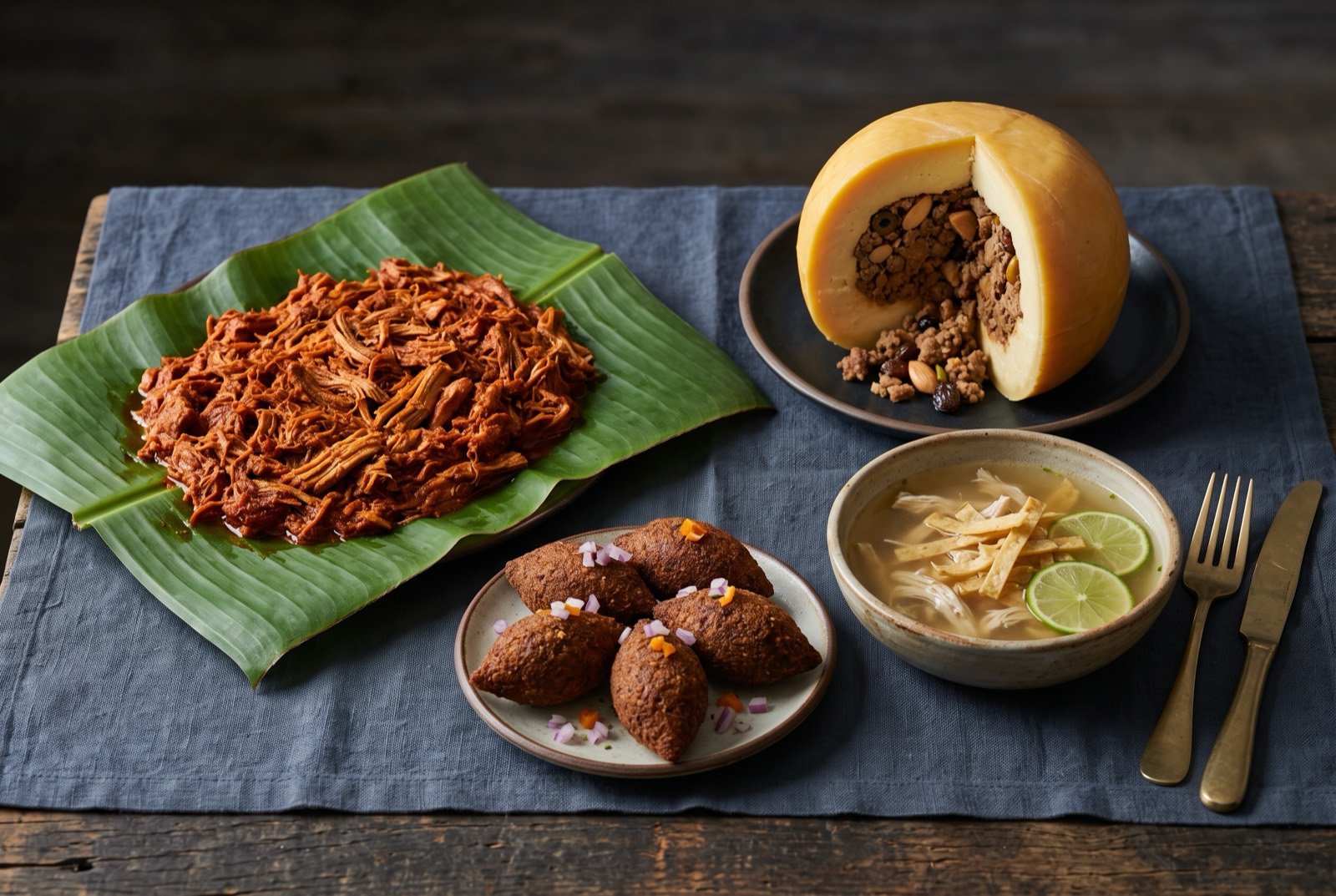
A limestone shelf with no rivers, three states, one Maya language and two migrations layered onto the same kitchen: the deep one, older than the Spanish, built on achiote, sour orange and an oven dug into the ground, and a second, much more recent one, Lebanese families arriving through the port of Progreso from the 1870s onward, who did not add a garnish to Yucatecan food so much as sit down permanently at its table. Not a footnote about kibbeh at the end of a chapter on Maya cooking, but two histories, given their own weight, and joined honestly where they actually meet. Every dish as tradition built it, then what a modern chef would change.
Sources and review · What this chapter does not assert · How we research · Spotted something wrong?
A Sense of Place
The Yucatán Peninsula is not a jungle with beach resorts stapled to one edge. It is a flat limestone shelf with no surface rivers at all, and that single geological fact, more than climate, more than empire, is the reason the cooking looks the way it does.
A shelf with no rivers, and the milpa it produces
The peninsula's bedrock is porous karst limestone: thin, stony, nutrient-poor soil sitting over rock so permeable that rain disappears underground within hours rather than forming streams. Water is reached through cenotes, natural sinkholes into the water table, and through hand-dug wells, not through the river systems that organise most agricultural civilisations. That absence of surface water is the whole explanation for the milpa system underneath everything else in this chapter: maize, beans and squash as the core planted triad, supplemented by lima beans, grown by slash-and-burn, roza-tumba-quema, because thin karst soil needs the nutrient return that periodic burning provides rather than sustaining continuous intensive farming. The UN's FAO recognises the Yucatecan Maya milpa, under the name "Ich Kool," as a Globally Important Agricultural Heritage System, and its own documentation gives real numbers worth carrying into the kitchen: a hundred and sixty species grown or harvested across the system, native maize used by eighty six per cent of producers in over ten varieties, and home gardens, solares, carrying even greater plant diversity than the milpa plots themselves. At any one time only around a tenth of the designated core zone is active milpa; the rest is forest at various stages of regrowth, because long fallow, not continuous cultivation, is the actual logic of farming thin limestone soil. That fallow period has shortened from roughly twenty years to under seven in living memory, a live pressure on the system rather than historical colour, and ritual runs through all of it: permission asked of the land before clearing, thanks given after harvest, local classification systems naming at least sixteen kinds of rain and cloud and nearly twenty soil types.
Yucatec Maya, specifically, not Maya in general
The peninsula's indigenous population speaks Yucatec Maya, one of four languages in the Yucatecan branch of the wider Mayan family, alongside Itzá, Mopán and Lacandón. Proto-Yucatecan and Proto-Cholan speakers split from the main Mayan group and migrated north to the peninsula around 1600 BCE, a deep-time separation that is the actual reason Yucatec Maya cooking sits apart, geographically and linguistically, from the Ch'ol, Tseltal, Tsotsil and other traditions of Chiapas and highland Guatemala. Those are different peoples with their own culinary logic, treated in this atlas's own Chiapas and Guatemalan highland volume, and this chapter does not borrow from them or treat them as interchangeable. Roughly eight hundred thousand people speak Yucatec Maya today, across Yucatán, Campeche, Quintana Roo and northern Belize.
A table of the defining logic
| Element | The Maya lowlands | The Lebanese-Yucatecan layer |
|---|---|---|
| Fat | Pork lard, post-conquest; historically leaner, wild game and turkey fat | Olive oil, alongside the pork lard already standard locally |
| Starch | Maize as tortilla and tamal, nixtamalised | Bulgur wheat, worked in alongside maize rather than replacing it |
| Aromatic base | Recado, achiote-based (rojo), charred-chile-based (negro), or spice-based (blanco); sour orange as the universal souring agent | Garlic, mint, sumac and za'atar where they persist; habanero and sour orange folded directly into Lebanese dishes on arrival |
| Everyday protein | Turkey (domesticated and, separately, the peninsula's own wild ocellated bird), pork, venison historically, coastal fish and shellfish | Lamb in the Lebanese original, substituted with pork by many Yucatecan families, a genuinely telling local adaptation |
| Preservation | The pib pit; escabeche, an Old World technique via Spain; sun-drying for longaniza | The same market and household economy, no separate Lebanese preservation tradition documented as persisting distinctly |
The History in Layers
Deep time, and two turkeys that tell two different stories
The bird at the centre of Yucatecan festive cooking is not the peninsula's own native species. The domesticated turkey, Meleagris gallopavo, Yucatec Maya úulum, was domesticated over a thousand years ago from a wild subspecies native to southern-central Mexico, and was carried into Maya foodways from outside the peninsula entirely. The peninsula's own endemic bird is a different species: the wild ocellated turkey, Meleagris ocellata, Yucatec Maya kuts, smaller than its domesticated cousin, appearing as an alter-ego figure on Classic-period painted vessels and in ritual scenes tied to specific deities in the Postclassic Madrid and Dresden codices. The old Spanish name for the whole peninsula, Uluumil cutz yetel ceh, land of turkeys and deer, names both birds' importance without distinguishing them, and this chapter keeps that distinction the old name blurs: one turkey came from elsewhere and became central; the other was always here, is now listed as near-threatened, and is eaten far less than its ritual weight would suggest.
The Caste War, the rupture this chapter refuses to soften
The single most important nineteenth-century fact about this region is also the one most often left out of food writing about it. The Caste War of Yucatán began on 30 July 1847, when Maya rebels under Cecilio Chi sacked the town of Tepich, direct retaliation for the execution days earlier, on 26 July, of Manuel Antonio Ay, accused of organising an indigenous uprising. What followed ran in three broad phases across more than fifty years: 1847 to 1849 under Ay, Chi and Jacinto Pat; 1850 to 1860 under Crescencio Poot and Dionicio Zapata; and 1861 to 1901, a sustained guerrilla resistance centred on territory that is now Quintana Roo. It cost roughly a quarter of a million lives and reduced the peninsula's population by around half. It effectively erased the white population of much of the region and devastated cities, Valladolid and Izamal among them, that had that century been larger than Mérida itself. It produced a functionally independent Maya state, centred on Noj Kaaj Santa Cruz, that held for close to fifty years before Mexican federal troops finally occupied it in 1901, one of the most sustained near-successful indigenous military resistances anywhere in the Americas. Demographic recovery only began between 1862 and 1870 and was still incomplete at the 1900 census. This chapter treats the Caste War as the central rupture it was, not a footnote before the recipes start: Valladolid and the eastern peninsula in particular were depopulated and reshaped by it, and any claim of unbroken culinary continuity in that specific ground should be read with that in mind.
The Spanish layer: pork, sour orange and an oven that predates both
Pigs are not native to the Americas. They arrived with the Spanish after 1521, which means the technique underneath this chapter's anchor dish is older than the animal cooked in it. The pib, an underground pit oven, stones, banana leaf, buried and sealed, is genuinely pre-Hispanic, used on venison, turkey and peccary long before pork existed anywhere in the hemisphere. Cochinita pibil, the dish, is necessarily post-conquest: Maya cooks took an existing indigenous cooking technology and applied it to a newly imported animal. Several popular Mexican sources call the dish itself "prehispánico" while admitting in the same breath that pigs arrived with the Spanish, an internal contradiction worth naming plainly rather than repeating. In 2021 Mexico's own federal agriculture secretariat published material calling cochinita pibil prehispanic and was publicly corrected for exactly this reason, evidence that this is a live, recognised confusion in Mexican food writing itself, not a pedantic point invented for a British kitchen. Sour orange, Citrus aurantium, arrived by the same route: native to southern China, carried through Persia and the Arab world into the Iberian Peninsula under Muslim rule, brought onward to the Americas by the Spanish, who themselves inherited it from Arab and Persian trade rather than direct contact with China. It naturalised specifically on this peninsula and along the neighbouring Veracruz coast, becoming the cuisine's universal souring agent, standing in for the sweeter orange grown almost everywhere else.
The Lebanese-Yucatecan migration, as its own thread
This is not a garnish on the Maya history above. It is a second, separate migration story with its own dates, its own named families and its own arc, and this chapter gives it that weight deliberately.
The most commonly repeated account names Santiago Sauma, arriving through the port of Progreso in 1879, as the first Lebanese settler in Yucatán, though this is not uniformly agreed: a second, English-language regional source instead names Santiago Jacobo, arriving at Sisal in 1894, and the strongest single academic source on the subject, the historian Luis Alfonso Ramírez Carrillo, places the first Lebanese arrival in Mexico as a whole at the port of Veracruz in 1878, with the broader immigration wave running from Sauma's Yucatán arrival to 1930. This chapter states 1879 and Sauma as the working consensus figure while flagging that it is not settled beyond dispute.
What drove people to leave was real hardship, sharpened twice over. Economic strain under Ottoman rule through the earlier nineteenth century was followed, from around 1860, by intensified conflict between Druze and Maronite communities in Mount Lebanon, an exodus that led the Ottoman Empire and the Western powers to carve out the semi-autonomous Mutassarifat, "Small Lebanon," a settlement that continued to disadvantage the Maronite population it was meant to protect. The First World War then became the sharper, twentieth-century catalyst: the Ottoman Empire's alliance with Germany brought wartime famine to a Mount Lebanon population largely unsympathetic to that alliance. Migrants travelled on Ottoman passports, which is the entire reason Mexicans called them turcos, Turks, despite their being ethnically Lebanese or Syrian and not Turkish at all, a misnomer so thoroughly locally absorbed that Yucatecan businesses of the era branded themselves with it directly: "La Bella Turca" opened in 1913, "El Gran Bazar Turco" in 1907. President Porfirio Díaz's 1886 Law of Foreigners and Naturalisation eased their entry once they arrived.
Why Yucatán specifically, and not simply wherever a ship happened to land, has a real economic answer. Ramírez Carrillo's own scholarship states that Lebanese arrival "coincidió con una coyuntura particular: el inicio de la bonanza henequenera," coincided precisely with the start of the henequen boom, the sisal-fibre export economy that made Yucatán, for a period, one of the wealthiest regions in Mexico. A comparative academic study of Ottoman and Korean immigration confirms Yucatán held the largest population of Ottoman-subject immigrants of any Mexican state in the first decade of the twentieth century, drawn by the same henequen wealth that separately pulled in Korean contract labour in the same years. The distinction worth keeping precise: Lebanese immigrants did not work henequen fields themselves. They arrived as itinerant peddlers, buhoneros, working the cash economy the boom generated, not as agricultural labour. The henequen boom created the market for this migration, not the jobs.
The numbers genuinely diverge and this chapter keeps them separate rather than picking whichever sounds tidiest. Nineteenth century census figures are inconsistent, 371 against 234 for 1895 depending on the source, with no single authority reconciling them. The best-grounded figure is the 1910 official census, 576 people recorded as "Turks," 370 men and 206 women, against community-remembered testimony of over two thousand by the same year, roughly four times the census count, a real historiographical gap this chapter states rather than resolves. What is well corroborated is the present-day figure: approximately nine thousand people of direct Lebanese descent living in Yucatán today, a figure repeated consistently across named local press and attributed to Ricardo Dájer Nahum, the honorary consul of Lebanon in Mérida.
The community built its own institutions early and kept building them. A Maronite benevolent society, the first formal Lebanese institution in the state, was founded in 1897 by Salvador Saidé; the community was, and largely remains, Maronite Christian with some Greek Orthodox, from Mount Lebanon and the Mediterranean coast, not Muslim, a distinction worth stating plainly rather than assuming. The Centro Libanés de Mérida formed from several earlier associations in 1930. In 1977, under the leadership of engineer José Chapur, five members bought three hectares of land and relocated the club to what is now the Colonia México Norte, a neighbourhood so thoroughly marked by this history that within two blocks it carries an Avenida Líbano, a Colegio Libanés Peninsular, an Iglesia Nuestra Señora de Líbano, and a street named for Dr. Fernando Dájer Nahum. The club, now the Club Deportivo Libanés Mexicano, remains civically active: it publicly supported Lebanon during the 2026 crisis there, and in 2021 it staged a fifty-image photographic exhibition, "Líbano, renacer en Mérida," at Mérida's own Museum of the City. Named families worth carrying through the chapter, cross-corroborated across a 1900 census listing and the Ramírez Carrillo scholarship: Sauma, Chami, Faraón, Mena, Rechani, Saidé, Macari, Xacur, Chapur, Rafful, Azar, Charruf.
This is not a marginal or half-hidden history. It is, by every local source consulted for this chapter, a proud and visibly celebrated part of Yucatecan identity, marked by an annual Día Mundial del Emigrante Libanés and by a neighbourhood that wears its name on its streets.
The Flavour Arsenal
Achiote and the three recados
Achiote, Bixa orellana, Yucatec Maya k'uxub, is the seed at the base of the cuisine's defining colour and flavour. "Achiote" itself is a Nahuatl loanword, achiotl, red dye, not a Maya word, one small, tell-tale sign of central Mexican trade reaching the peninsula before the Spanish ever did. Colonial-era chroniclers recorded the Maya colouring and flavouring their cacao drink with it; the seed pulp was equally used as body paint and textile dye. Three distinct pastes are built from it and its cousins, and this chapter is careful not to collapse them into one idea called "Yucatecan seasoning."
Recado rojo is the best known: achiote seed ground with roasted garlic, toasted oregano, cloves, cumin, black pepper, allspice, salt and sour orange juice. What genuinely surprises a British reader used to home-blended spice pastes: in Yucatán, home cooks generally do not make their own recado from scratch. It is bought pre-ground from specialist recado stalls in the popular markets, worked on metates, spice mills and comales by vendors who do this as their trade, closer to a butcher's own house spice mix than to something a home cook grinds fresh each week. No source consulted for this chapter gives one universally agreed ratio, and that variability is itself the honest fact worth stating rather than smoothing over with an invented precise number.
Recado negro, chilmole, Yucatec Maya boox but', "black filling," is built entirely differently: dried chiles, mainly ancho and pasilla types, toasted until nearly burnt, ground with black pepper, cumin, achiote, oregano and garlic. The burning is the technique, not an accident, giving the paste its colour and its smoky bitterness through genuinely different chemistry from recado rojo's fresher grind. Its traditional attribution ties it to funerary ritual, with the pork or meatball element added after the conquest; it appears today at weddings, baptisms and as part of the Hanal Pixán offering.
Recado blanco, despite the name, is not white: garlic, oregano, mixed peppercorns, clove, cumin, salt and coriander seed ground in a molcajete give a pale grey paste, "blanco" naming its place in the trio rather than its actual colour. It underlies pavo en relleno blanco and escabeche oriental.
Sour orange and habanero, the acid and the heat, one settled, one genuinely disputed
Sour orange's own history is covered above. Habanero's is not settled, and this chapter says so rather than picking the tidier story. The popular account has South American origin, arriving in Yucatán via Cuba in the colonial period, which is where the name comes from, of Havana. But Tomás González Estrada, a named researcher at CICY, the Centro de Investigaciones Científicas de Yucatán, a serious regional scientific institution, has identified at least five competing hypotheses, several pointing instead to an African origin, arriving via the transatlantic slave trade through Brazil or through Portuguese introduction in the Caribbean. This is a genuine, named-researcher-level disagreement, not casual noise, and it belongs in the chapter unresolved. What is settled: habanero is naturalised across the whole peninsula, is regarded as the world's hottest naturally developed chile variety rather than one bred for heat, and carries a Denominación de Origen, "Chile habanero de la Península de Yucatán," granted by Mexico's industrial property institute on 4 June 2010 and registered internationally under the Lisbon System in 2011, with CICY's own varietal work directly supporting the application. It runs 150,000 to 325,000 Scoville units, used whole and roasted or raw and crushed, central to xnipec salsa.
Chaya, a leaf that must be cooked, not a stylistic choice
Chaya, tree spinach, is genuinely toxic raw: it contains cyanogenic glucosides that release cyanide-type compounds when its tissue is broken, and must never be eaten raw beyond a token taste. A cited study found roughly twenty minutes' cooking sufficient to break the toxic elements down in leaves, petioles and stems. Traditional practice includes asking the plant's permission before cutting, tied as much to the skin-irritant resin the leaf releases as to any purely ceremonial gesture. It is pre-Hispanic in use, historically worked with corn and pumpkin seed into a tamal-type preparation, a use pattern continuous today in brazo de reina and sopa de chaya, and it is nutritionally dense: fibre, vitamin C, carotene, protein and iron.
Pumpkin seed, xtabentún and a bee older than the Spanish
Pepita, pumpkin seed, is the base of papadzules' sauce and of sikil p'aak. Papadzules' own name, Maya papa, food, and dzul, lord, "food of the lord," names a pre-Hispanic dish that was modified during the conquest era by the addition of egg, while the pumpkin-seed-and-epazote sauce at its centre stayed the dish's true anchor through that change.
Xtabentún, the honey-and-anise liqueur, is popularly described as fermented honey from bees that fed on xtabentún flower nectar, mixed with anise and rum; one speculative account ties it to balché, a genuinely ancient Maya ceremonial drink of honey and tree bark, reworked once Spanish taste rejected balché's own flavour, replacing bark and corn with anise. This chapter holds that lineage as a plausible hypothesis, not an established one. The honey itself, when it is the real thing, comes from xunán kab, "lady bee," Melipona beecheii and related stingless species, kept in hollowed log hives called jobones in a genuinely ancient, pre-Columbian domesticated tradition that predates the European honeybee's arrival in the region entirely, and carried real religious, medicinal and even currency weight in Maya life. This tradition is not a museum piece being romanticised from a safe distance: it is actively endangered, with one recent count naming only eighty seven active meliponiculture producers left in the whole of Yucatán, and this chapter names that decline rather than writing around it.
The Technique Ladder
The argument, from inside
Five techniques, each explained by why it works, not only what it does.
Rung 1. The pib, stones as a thermal battery
A pit roughly the size of the load it will carry is lined with firewood and stones; once the wood has burned to embers, the stones, not the flame, hold and radiate the heat. A leaf layer, banana leaf, stops the food scorching directly on hot stone while converting the food's own moisture into the steam that actually cooks it; a final earth or clay seal traps that steam entirely. Timing scales with load, roughly four hours for a small pot, eight to twelve for a full village-scale Hanal Pixán cook.
Rung 2. Recado grinding, as a trade skill rather than a home one
The reason market-ground recado tastes different from a home approximation is not secrecy, it is throughput and equipment: metate and spice mill grinding at a scale and consistency a domestic kitchen rarely matches, done by vendors whose whole trade is exactly this paste.
Rung 3. Sour orange marinating, acid doing real work
Citrus aurantium's higher acidity than sweet orange breaks down surface protein structure faster and more evenly than a milder citrus would, the mechanical reason it, rather than lime, became the peninsula's standard marinade base for pork and poultry alike.
Rung 4. Chaya's mandatory cook, not a texture preference
Roughly twenty minutes' heat is what breaks down the leaf's cyanogenic glucosides; this is not a chef's choice about doneness, it is the difference between a safe dish and a genuinely toxic one, and the technique exists because the plant demands it.
Rung 5. Kibi's local substitution logic
Soaking bulgur wheat at least eight hours before working it with meat is standard Levantine practice, carried over unchanged; what changed on arrival, pork in place of lamb in many family recipes, habanero and queso de bola folded in, is itself the technique worth naming: an imported method kept intact while its ingredients answered directly to what the Yucatecan pantry actually held.
The Ferment and Preserve Bench
Three preparations, market-made and household technologies rather than modern flourishes.
Recado, in all three colours. Ground fresh by trade rather than at home, in quantities meant to be bought and used across a household's whole week rather than made to order, the market's own version of a preserved pantry staple.
Escabeche. The vinegar-preservation technique itself traces to Arabic sikbâg, carried to the Americas via Spain well before any Lebanese migration to this peninsula, a genuine Old World technique grafted onto a Maya-region spice base long before the nineteenth century's second, separate Levantine arrival. Chicken or turkey, cooked in recado blanco, finished and held in vinegar, a real preservation method as much as a flavour one.
Xtabentún. Honey and anise, fermented and distilled, a way of holding a season's melipona honey and the region's own liana flower through the rest of the year, and, on the balché hypothesis this chapter holds loosely rather than as settled fact, a possible descendant of a genuinely ancient Maya ceremonial ferment.
Sourcing in Britain
Recado rojo. The genuine article, imported rather than reproduced, is buyable and confirmed in stock: MexGrocer.co.uk sells the El Yucateco brand's 100g block for £1.95. Cool Chile Co, the standard UK Mexican specialist, sells its own achiote paste, made to their own recipe in their London factory rather than imported, a real and honest product but a different one from the Mexican-made block; point a serious cook to MexGrocer's imported block first and treat Cool Chile's as the legitimate backup when it runs out.
Habanero. Cool Chile Co's dried whole habanero, £11.75 for 100g, is confirmed and reliable; fresh from a Mexican specialist could not be confirmed, but general UK chilli growers, South Devon Chilli Farm among them, post fresh habanero seasonally, and the fruit grows genuinely well in a UK greenhouse or polytunnel from seed sold by Suttons, Kings Seeds and others, unsuitable outdoors here but reliable under glass.
Sour orange. Real Seville oranges are UK-seasonal and narrow, late December to mid-February only, imported from Spain. Outside that window, the honest workaround, not a real substitute, is two parts fresh orange juice to one part lemon to one part lime, a widely used ratio rather than an authenticated Yucatecan one. Iberia-brand bottled naranja agria is listed on Amazon UK, though its live stock could not be confirmed twice in this research; Goya's more commonly seen US version does not appear to be sold here.
Banana leaves. Frozen and confirmed from multiple UK Asian grocers, including Tuk Tuk Mart and The Asian Cookshop, Southeast Asian-sourced rather than Mexican but entirely serviceable for wrapping cochinita pibil, tamales colados and brazo de reina.
Chaya. Fresh is not obtainable in the UK, and this chapter says so plainly rather than pretending otherwise. Live plants and cuttings are genuinely buyable, from Etsy, eBay and the European specialist Canarius, and will grow in a heated greenhouse or conservatory for a patient reader. For immediate use, spinach or Swiss chard hold a dish together structurally, but neither carries chaya's particular bitterness or its cooked-only safety logic, and no honest substitute changes that.
Pepita. Straightforward: raw hulled green pumpkin seed, suitable for a genuinely smooth papadzules sauce, from Buy Wholefoods Online, iHerb UK, or a standard supermarket own-brand pack, provided it is raw rather than roasted or salted.
Xtabentún. A genuine, uncompromised win: Master of Malt sells the real Casa D'Aristi product, made by the actual Yucatecan producer, for £20.95 a bottle, no substitution required.
Melipona honey. Not obtainable in the UK as the genuine article. A raw, minimally processed UK or European honey, ideally a tangier, less filtered style than standard blossom honey, is the honest recommendation, with the plain caveat that real xunán kab honey's own distinctive low-sweetness acidity will not be reproduced.
Edam for queso relleno. Confirmed straightforward: whole wax-coated Edam balls, the format the dish actually needs for hollowing, from Great British Trading and Pickles of Preston, in preference to a supermarket's pre-sliced wedge, which is the wrong format for this dish however easy it is to find.
Bulgur, sumac and za'atar for kibi. Straightforward from any UK Middle Eastern grocer or supermarket world-food aisle; pan árabe, Lebanese flatbread, is confirmed available from Al'Fez and dedicated Lebanese bakeries.
The single decision that matters most. Recado rojo, and specifically the genuine imported block over a home-blended approximation. It underpins cochinita pibil, poc chuc's finishing salsa and the whole festive relleno family, and it is the one ingredient whose absence would leave every other dish in this chapter tasting approximately, rather than actually, Yucatecan.
Kit. A Big Green Egg or similar kamado is a genuine, reasonable stand-in for the pib's slow, enclosed, moisture-retaining heat, not a literal reproduction of it: the kamado cannot replicate the earth mass or the true steam a buried, leaf-wrapped parcel generates, and this chapter says so rather than overstating the equivalence.
Voices and Sources
Mexican national and regional press, prioritised throughout: Diario de Yucatán, La Jornada Maya, SIPSE, PorEsto, Excélsior, El Universal and Infobae's Mexico desk, for the Caste War timeline, the recado and cochinita pibil material, sopa de lima and poc chuc's restaurant origins, and the Lebanese community's own institutional history.
Mexican academic and government sources: SciELO Mexico and Dialnet-hosted scholarship, Arqueología Mexicana on the pib's contested cosmological meaning and the ocellated turkey, the FAO's own GIAHS documentation of the Ich Kool milpa system, CICY's varietal work on habanero, and the historian Luis Alfonso Ramírez Carrillo's Historia Mexicana article on Lebanese immigration to the southeast, the strongest single academic source behind this chapter's migration history.
Mexican culinary reference: Larousse Cocina México, for recado composition and chaya's toxicity.
On the fine dining and diaspora scene, verified directly rather than assumed: Roberto Solís of Néctar and Huniik, whose recado-negro tempura batter is this chapter's clearest documented example of a traditional condiment translated into restaurant technique; Luis Ronzón of Ixi'im at Hotel Chablé, and Pedro Evia of Kü'uk, both named for the record though this chapter is honest that Kü'uk's current standing could not be confirmed against the 2026 Michelin results that recognised the others; Silvio Campos of Pueblo Pibil, the strongest documented traditional pib technique found anywhere in this research; David Cetina of La Tradición, whose answer to distance, cooking properly in Yucatán and shipping vacuum-sealed rather than remaking the dish elsewhere, this chapter treats as the honest model. In Los Angeles, Gilberto Cetina Jr. of Holbox, the first Yucatecan chef to hold a Michelin star, whose own path from an undocumented childhood to a 2025 US citizenship and a 2026 James Beard nomination is one of the strongest diaspora stories this research found; and Juan Chan of Ek'Balam, whose cochinita pibil is presented and understood by its own chef as ancestral technique rather than fusion.
On the Lebanese-Yucatecan layer specifically: the Lebanese Club of Mérida and its named leadership, Elías Dájer Lixa and Ricardo Dájer Nahum; chef Zazil Torres, who teaches both traditions and has stated plainly that dishes many Yucatecans consider entirely their own are, in fact, Lebanese in origin; and the Chehade family of Biblos and the Abdala family of Patio 57, two of the clearest multi-generational, food-specific family histories this chapter drew on.
Things this chapter has deliberately not asserted
- That habanero's origin is South American via Cuba, the popular story. A named CICY researcher identifies genuine competing hypotheses, including African origin via the transatlantic slave trade, and this chapter leaves the question open rather than picking the tidier account.
- That cochinita pibil, sopa de lima or poc chuc in their present form are ancient or pre-Hispanic dishes. The pib technique is genuinely old; sopa de lima is credibly a 1946 restaurant invention and poc chuc's plated form a 1962 one, and cochinita pibil is necessarily post-conquest since pigs are not native to the Americas.
- That the huevos motuleños origin story, chef Jorge Siqueff, Mérida, 1921, is verified history rather than a widely repeated, consistently detailed, but uncorroborated restaurant legend.
- That the pib's present-day cosmological meaning is unbroken pre-Hispanic continuity. A serious academic source treats how much of that meaning is ancient survival versus modern reconstruction as a genuinely open question.
- That queso relleno's arrival story is settled. Two real, competing accounts exist, a shipwreck and a Belize trade route, and this chapter presents both rather than choosing.
- That Yucatán's own taco árabe descends from, or belongs to the same lineage as, Puebla's taco árabe or taco al pastor. The Puebla dish is credibly Iraqi-founded, not Lebanese; Yucatán's version is a separate, thinly documented local creation with no shared founding story, and this chapter did not force a traditional recipe onto it where none could be verified.
- That za'atar, sumac and seven-spice persist in everyday Yucatecan-Lebanese home cooking, or that a dedicated Lebanese food festival or market district exists in Mérida. Neither could be confirmed.
- Any precise, single ratio for recado rojo, recado negro or recado blanco as the traditional formula. Every credible source treats these as household and market variable, and any single number in this chapter's recipes should be read as one real, sourced example, not a universal standard.
- That this chapter reached genuine Yucatec Maya-language primary sources, or Arabic-language sources specifically discussing the Yucatán emigration wave. Neither could be located despite deliberate search; what stands here is Spanish-language Mexican scholarship and journalism glossing Maya terms, and general Lebanon-to-Mexico material with no Yucatán-specific mention. Both gaps are named here rather than concealed.
The pib, stones as a thermal battery
A pit roughly the size of the load it will carry is lined with firewood and stones; once the wood has burned to embers, the stones, not the flame, hold and...
Recado grinding, as a trade skill rather than a home one
The reason market-ground recado tastes different from a home approximation is not secrecy, it is throughput and equipment: metate and spice mill grinding at a...
Sour orange marinating, acid doing real work
Citrus aurantium's higher acidity than sweet orange breaks down surface protein structure faster and more evenly than a milder citrus would, the mechanical...
Chaya's mandatory cook, not a texture preference
Roughly twenty minutes' heat is what breaks down the leaf's cyanogenic glucosides; this is not a chef's choice about doneness, it is the difference between a...
Kibi's local substitution logic
Soaking bulgur wheat at least eight hours before working it with meat is standard Levantine practice, carried over unchanged; what changed on arrival, pork in...
The dishes
- Cochinita pibil Yucatán, Mexico
- Poc chuc Yucatán, Mexico
- Papadzules Yucatán, Mexico
- Sopa de lima Yucatán, Mexico
- Panuchos Yucatán, Mexico
- Relleno negro Yucatán, Mexico
- Queso relleno Yucatán, Mexico
- Kibi Yucatán, Mexico (Lebanese-Yucatecan)
- Tacos árabes Yucatán, Mexico (Lebanese-Yucatecan)
- Marquesitas Yucatán, Mexico
- Pan de cazón Campeche, Mexico
Sources and review
- Reviewed
- Not yet reviewed from inside the tradition
- Cooked
- Not yet cooked and reported
Where this volume comes from
3 research briefs on file for this volume, researched to the rules on How we research. Published 3 September 2026. Last changed 8 September 2026.
The brief's own account of its sources
Tradition Agent A (Maya cooking): of roughly 60 to 70 distinct sources touched, the large majority, on the order of 85%, are Mexican-published , national and regional press (Excélsior, El Universal, Infobae's Mexico desk, El Financiero, Diario de Yucatán, La Jornada Maya, SIPSE, PorEsto, Heraldo de México Yucatán), Mexican government and institutional sources (INAH, CICY, SADER/gob.