Mesoamerica · Volume 08, Pupusas, Gallo Pinto and the Pacific Volcanic Belt
Gallo pinto
Costa Rica, contested with Nicaragua
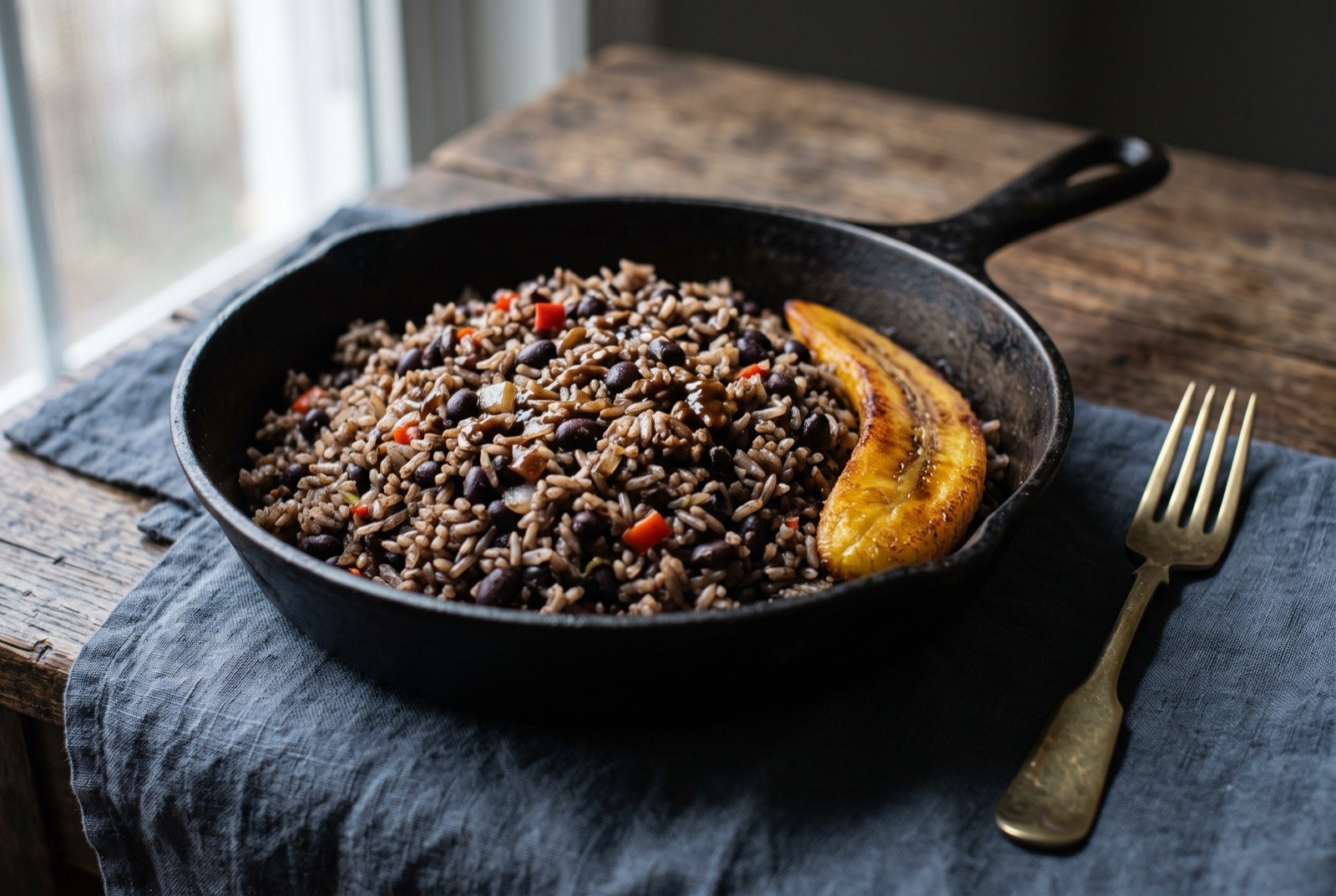
An illustration of the dish, not a photograph of it cooked.
- Time
- 12 minutes
- Reviewed
- Not yet reviewed from inside the tradition
- Cooked
- Not yet cooked and reported
As tradition built it
Gallo pinto
About 9 to 12 minutes.
Ingredients
- 160g cooked black beans
- about 160g cooked rice, roughly a similar volume to the beans, adjustable toward either rice-forward or bean-forward balance
- 1 small, finely chopped onion
- 1 small, finely chopped sweet pepper
- 3 tbsp oil
- 3 tbsp Worcestershire sauce
- as available bean cooking liquid, a portion
- to taste salt, to season
- to taste Salsa Lizano, to finish
- to serve eggs, natilla, fried plantain and tortillas or bread, to serve
Method
- Heat oil over medium-high and sauté onion and sweet pepper 2 to 3 minutes.
- Reduce to medium, add the beans and stir 5 to 6 minutes.
- Add the rice, Worcestershire sauce and a portion of the bean cooking liquid, and stir to coat.
- Season with salt, and cook a further 2 to 3 minutes.
- Finish with Salsa Lizano.
- Serve, most often at breakfast, with eggs, natilla, fried plantain and tortillas or bread.
Notes
A widely repeated story holds that around 1930 a hacendado named Bernabé, whose single roasted bird proved far short of what a large San José feast needed, had his kitchen staff improvise by combining rice and black beans, neighbours joking afterward about "don Bernabé's gallo pinto"; La Nación's own reporting explicitly calls this story "an unproven story and more like urban legend," and this chapter follows that caution rather than repeating the tale as history.
The documented history is different and better sourced: historian Patricia Vega Jiménez concludes gallo pinto is a copy or derivation of the Afro-American rice and beans tradition, carried into the Central Valley by Jamaican and other Afro-Caribbean workers who arrived after 1870 to build the Atlantic railway, verifiably present by 1930, when Carlos Luis Fallas's novel Mamita Yunai describes banana-plantation workers eating exactly this dish for breakfast under exactly this name. Culinary historian Marjorie Ross independently corroborates the Afro-Caribbean account.
Nicaragua disputes the claim of origin too, its own researcher María Esther López Guzmán dating a rudimentary version to the Caribbean coast in the seventeenth or eighteenth century, earlier than Costa Rica's 1930s documentation; this chapter names both national claims without adjudicating between them.
The one concrete, checkable difference between the two countries' versions: Costa Rica uses black beans, Nicaragua red.
What a modern chef changes
Guaranteed dry rice, live-fire finish
Rung 04
Method
- Take the day-old-rice principle further with a dehydrator, spreading cooked rice thin and running it at a low, controlled setting for the final stage of surface-moisture loss, a guaranteed version of what an overnight fridge rest achieves inconsistently.
- Pressure-cook or sous vide the beans separately for even texture before they meet the sofrito, rather than relying on a single simmer to both cook and season them.
- Finish the assembled pinto briefly under a Big Green Egg's direct heat for a light smoky crust along one edge of the pan, the same live-fire instinct Silvestre and BRUTØ apply to humbler ingredients than a tasting menu's centrepiece.